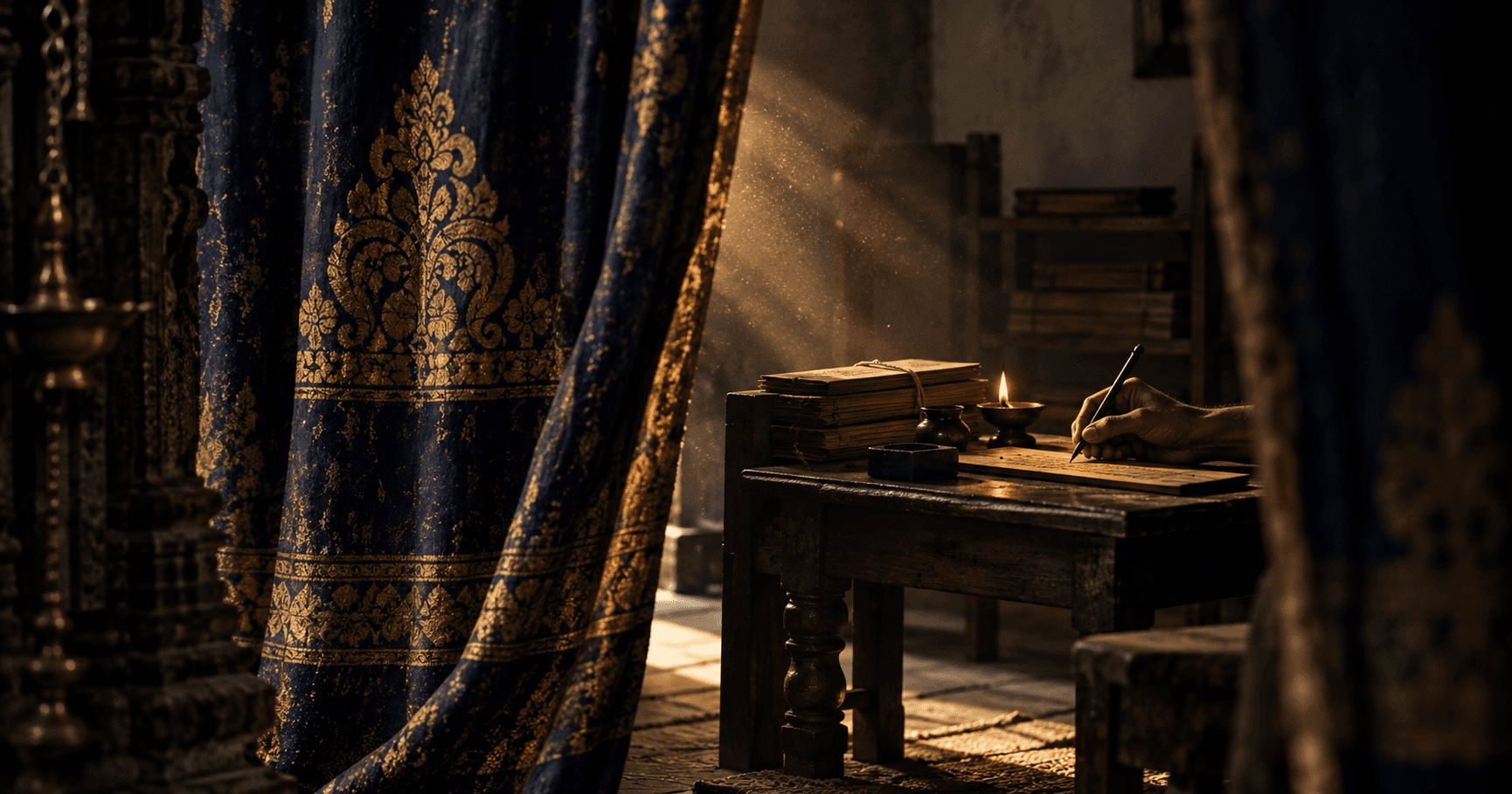
There is a boy in Mhow, in an army cantonment in central India, who is not allowed to touch the water pot at school.
A peon is assigned to pour water into his cupped hands — from a height, so the vessel stays clean. If the peon is absent that day, the boy does not drink. He sits through class with a dry throat and learns something no teacher intended: that his thirst matters less than a clay pot.
He is five or six years old. He does not yet know the word untouchable. But he already knows what it feels like.
That boy — Bhimrao Ramji Ambedkar — will go on to earn a PhD from Columbia University, a DSc from the London School of Economics, a law degree from Gray's Inn. He will draft the constitution of the world's largest democracy. He will write twenty-two volumes of legal analysis, philosophy, and history.
And every word will carry the memory of that water pot.
The Laws That Made Him Untouchable
Before we talk about what Ambedkar wrote, we need to understand what was written against him. Against his people. Against millions of human beings declared unworthy by birth.
Let me be clear about something — and I'll come back to this more than once, because it matters. Ambedkar's fight was never against God. Periyar's fight was never against God. My argument here is not against faith, or devotion, or the quiet comfort people find in prayer.
The fight has always been against human beings who wrote laws in God's name and used them to crush other human beings.
The Manusmriti — the so-called "Laws of Manu" — is the clearest example. This was not a divine revelation. No god descended from the sky and dictated these words. Mortal men wrote them. Men who belonged to the dominant castes. Men who had everything to gain from a system that placed them at the top and locked everyone else below.
And what they wrote is breathtaking in its cruelty.
Manu Chapter 1, Verse 91: The sole duty of a Shudra is to serve the upper three varnas — faithfully, with devotion, and without complaint.
Chapter 4, Verses 78-81: A Shudra is unfit to receive education. Upper castes must never teach a Shudra or give him advice. Those who do will go to hell.
Chapter 8, Verse 270: If a Shudra insults a twice-born man, his tongue shall be cut out.
Verse 271: If he speaks the names and castes of the upper varnas with contempt, a ten-finger-long iron nail, heated red-hot, shall be thrust into his mouth.
Verse 272: If a Shudra "arrogantly teaches Brahmanas their duty," hot oil shall be poured into his mouth and into his ears.
Chapter 8, Verse 417: A Shudra shall not accumulate wealth. A Brahmin may take possession of a Shudra's goods.
Read those again. These are specific, detailed instructions for torture — written by men, enforced for centuries, justified by claiming divine authority. The text does not say "God commands this." But by embedding these laws within a religious framework, the authors made questioning them an act of blasphemy. You could not challenge the law without challenging the faith. That was the design.
And then there are the people outside even this brutal hierarchy — the Avarnas. The outcastes. People so low in the system's estimation that they don't even deserve a varna. Ambedkar was born into this group. The Manusmriti doesn't waste many words on them. They exist to clean, to carry the dead, to do the work that the varna system considers polluting. Their very shadow was considered contamination.
The value of a human life, according to Manu, was graded by caste. Kill a Kshatriya — the penance is one thousand cows. Kill a Vaishya — one hundred cows. Kill a Shudra — ten cows. Kill an outcaste — the text doesn't bother to say. These were the laws that governed India for centuries. Written by men. Enforced by men. Attributed to God.
This is the world Ambedkar was born into. This is what his pen fought against.
The Speech They Cancelled
In 1936, the Jat-Pat Todak Mandal — the Caste-Abolishing Society — invited Ambedkar to deliver the presidential address at their annual conference in Lahore. They were reformists. Good people, mostly. They believed caste could be dismantled through conversation, through slow progress, through gentle nudges from within the Hindu fold.
Ambedkar sent them his speech in advance. Standard practice. They read it.
Then they did what polite society always does when confronted with something it cannot absorb — they asked him to soften it.
He refused. The conference was cancelled. The speech was never delivered.
So Ambedkar published it himself. Annihilation of Caste — the address that was too dangerous for a caste-abolishing society to hear.
Ambedkar's argument was simple, and that's what made it unbearable. He said caste is sanctioned by the Hindu scriptures — the same texts we just read from. The Shastras, the Smritis, the entire religious architecture. As long as these texts are treated as sacred, caste will survive. You cannot prune the branches and leave the roots intact.
"The enemy you must grapple with is not the people who observe Caste," he wrote, "but the Shastras which teach them this religion of Caste."
And then: "You must not only discard the Shastras, you must deny their authority, as did Buddha and Nanak. You must have courage to tell the Hindus that what is wrong with them is their religion — the religion which has produced in them this notion of the sacredness of Caste."
The reformists wanted him to say caste was a social problem. Ambedkar said it was a religious one. That's why they cancelled.
He went further. He prescribed the one cure that makes people uncomfortable ninety years later: intermarriage. The mixing of blood across caste lines. The one thing the entire system was designed to prevent.
"The real remedy for breaking Caste is intermarriage," he wrote. "Fusion of blood can alone create the feeling of being kith and kin."
Now think about 2026. Matrimonial ads still sort by caste. Honor killings still happen because a Dalit boy loved a Thevar girl. Apps let you filter partners by community. Ambedkar named the exact mechanism — endogamy, the closed circuit of marriage — and prescribed the only force that could break it. In 1936. We are still not ready to hear it.
And then he wrote something that lands differently once you understand the Manusmriti:
"Once you clear the minds of the people of this misconception and enable them to realise that what they are told is Religion is not Religion, but that it is really Law, you will be in a position to urge its amendment or abolition."
That is the key. What people call their religion is often law — written by men with power, to keep men without power in their place. Strip the divine coating away, and what you find underneath is legislation. And legislation can be changed.
Gandhi Responds
Gandhi read Annihilation of Caste and published a response in Harijan, his weekly journal. He called the speech "a challenge to Hinduism" but defended varnashrama dharma — the system of four varnas — as a valid social order, distinct from caste. He said Ambedkar had every right to be angry, but was wrong to condemn Hinduism as a whole.
Ambedkar's reply is one of the most extraordinary things I've ever read. Published as an appendix to the second edition, it takes Gandhi's argument apart with the cold patience of someone who has heard every version of this defense before.
"The Mahatma is not honest enough to fight the monster of caste either as a Hindu or as a political leader."
This landed in 1936 India like a grenade in a prayer hall. Gandhi was the most revered figure in the independence movement. But Ambedkar saw the contradiction clearly — you cannot lead a freedom movement while defending the system that keeps sixty million people in chains within your own society. Calling untouchability a sin while calling the varna system divine is like condemning the basement while worshipping the building. They are the same structure.
You cannot fight for a nation's freedom while defending the slavery inside it. Ambedkar saw this. Gandhi didn't — or wouldn't.
The Laws Behind the Gods
Let me return to the point I made earlier, because I think it's the most important thing in this entire article.
Ambedkar's fight — and Periyar's fight, and the fight I'm trying to articulate here — has never been against God. Faith, as a personal relationship between a human being and whatever they believe in, is sacred. Nobody has the right to take that away from anyone.
The fight is against what men do in the name of God.
The men who wrote the Manusmriti did not sign their names. They attributed the laws to divine authority. And by doing so, they made the laws unquestionable. If a Brahmin says "God wants the Shudra to serve," you cannot argue with God. If a priest says "the scriptures forbid the outcaste from learning," you cannot challenge scripture without being called a heretic. The human hand disappears behind the divine curtain.
This is the oldest trick in the history of power. Write the rules. Attribute them to God. Punish anyone who questions them.
| What Manu Prescribed | Who Actually Benefits |
|---|---|
| Shudras must serve upper castes without complaint | Upper castes get free labor |
| Shudras cannot accumulate wealth; Brahmins may take their property | Upper castes control all resources |
| Shudras cannot hear, read, or recite the Vedas — punishment is mutilation | Upper castes monopolize knowledge and spiritual authority |
| A Shudra's life is worth ten cows; a Brahmin's life is beyond price | Upper castes face no consequence for violence against lower castes |
| Women must be under male control at every stage of life | Men control women's bodies, property, and autonomy |
Every single law benefits the people who wrote it. Every single punishment targets the people who might challenge it. And all of it is wrapped in the language of the sacred.
Ambedkar saw this mechanism with devastating clarity. As he wrote in Annihilation of Caste: "Caste is a notion, it is a state of the mind." The physical walls — separate wells, separate streets, separate temples — are maintained by the wall inside people's heads. And that inner wall is built with scripture.
Faith as a personal belief is a fundamental human right. The problem has never been belief itself. The problem is when religion becomes a tool wielded by those in power to crush those without it. Ambedkar, Periyar, and every anti-caste thinker understood this distinction. Their enemy was the priest who used God as a shield for his privilege — never the devotee who prayed in the quiet of her own heart.
The Forensic Demolition
If Annihilation of Caste is fire, Riddles in Hinduism is a scalpel.
Written during Ambedkar's final years and published posthumously, this book terrified the establishment enough that they tried to bury it. The Maharashtra government sat on the manuscript for thirty-one years. It was finally published in 1987 — only after sustained protests and a court order forced their hand.
What was so dangerous? Ambedkar takes the scriptures — the texts treated as divine, as beyond question — and reads them the way a legal scholar reads any document. With cross-references. With an expectation of internal consistency. And he finds what any honest reader would find: contradictions so deep that the entire edifice begins to sway.
The Riddle of Rama. The Riddle of Krishna. The origins of the Brahmins. The invention of the hierarchy. Chapter by chapter, he holds the texts up to the light and asks: if these are divine and perfect, why do they contradict each other? If God wrote them, why do different chapters disagree about who God is?
Think about what this means. A constitutional democracy — the one Ambedkar himself helped build — suppressed a book because it asked questions about religious texts. The book doesn't call for violence. It doesn't incite hatred. It reads scriptures carefully and points out where they don't add up.
That was enough to terrify the people in power. A Dalit man, reading Hindu texts with precision, publishing his findings — and they couldn't let the public see it. Because the whole structure depends on the texts being unquestioned. The moment you question them, the human hands behind the divine curtain become visible.
There is a precision to this work that makes it more dangerous than any polemic. Ambedkar uses the tradition's own terms, its own texts, its own logic. He doesn't shout from outside. He walks inside the fortress, examines every stone, and shows you which ones are hollow.
The Turn Toward Light
On October 13, 1935, at a conference in Yeola, Nashik, Ambedkar made an announcement that shook the country:
"I had the misfortune of being born with the stigma of an Untouchable. However, it is not my fault; but I will not die a Hindu, for this is in my power."
He then spent twenty-one years studying every alternative. Islam. Christianity. Sikhism. Marxism. Buddhism. Twenty-one years of reading, thinking, weighing — because this was Ambedkar. He did nothing without scholarship.
On October 14, 1956, at Deekshabhoomi in Nagpur, he converted to Buddhism. With him came an estimated six lakh followers — the largest mass religious conversion in recorded history.
Why Buddhism?
The answer tells you everything about who Ambedkar was.
He rejected Islam and Christianity because they depend on a creator-god. Ambedkar believed morality should arise from human reason and compassion, not from divine command. If morality comes from God's order, then whoever controls the interpretation of God's word controls morality. He had seen what that looks like. He had Manu's verses burned into his memory.
He rejected Marxism because of its reliance on force and its contempt for spiritual values. He wrote: "The Buddha established Communism so far as the Sangha was concerned without dictatorship. It may be that it was a communism on a very small scale but it was communism without dictatorship — a miracle which Lenin failed to do."
And then the line that reveals the full depth of his thinking: "Humanity does not only want economic values, it also wants spiritual values to be retained."
A man whose people had been denied every economic right for millennia — and he still insisted that the soul matters too. That liberation without dignity, without inner transformation, without compassion, is just another kind of prison.
"According to the Buddha, Dhamma consists of Prajna and Karuna — understanding and compassion. Karuna is love. Because without it, Society can neither live nor grow." This is from The Buddha and His Dhamma, Ambedkar's final book, completed weeks before his death. The man who had every reason to choose rage chose love. But a specific kind of love — the kind that demands justice, not the kind that asks the oppressed to forgive and wait.
His Buddhism was not the Buddhism of temples and rituals. He stripped out the supernatural, centered the ethical core, and rebuilt it as a philosophy of liberation. Religion as morality, not mythology. Faith as compassion in action, not submission to divine authority.
"What the Buddha calls Dhamma differs fundamentally from what is called Religion," he wrote. "Dhamma is social. Dhamma is righteousness, which means right relations between man and man in all spheres of life."
He died on December 6, 1956. The book was published the following year.
When Buddhism Becomes a Weapon Too
And here is where I have to say something uncomfortable.
Ambedkar chose Buddhism because of its core ethical principle — non-violence, compassion, the recognition that all suffering is shared. The Buddha's first precept is ahimsa. The Dhammapada teaches: "Hatred does not cease by hatred, but only by love."
And then the world showed us, twice, what happens when even Buddhism gets swallowed by the same old trick.
Sri Lanka is a Theravada Buddhist nation. Over 70 percent of the population is Sinhalese Buddhist. The country's constitution gives Buddhism the "foremost place" — Article 9, written in black and white.
Between 1983 and 2009, the Sri Lankan state waged a war against the Tamil minority — Hindu and Christian civilians who had lived on that island for centuries. The final months of the civil war, in early 2009, were the worst. The Sri Lankan military herded tens of thousands of Tamil civilians into so-called "no-fire zones" — and then shelled those zones. The UN estimates that between 40,000 and 70,000 Tamil civilians were killed in the last phase alone. Women were raped. Hospitals were bombed. Surrendering fighters were executed on camera. Children starved in internment camps that the government called "welfare villages."
Buddhist monks from organizations like the Jathika Hela Urumaya didn't just stay silent — they actively opposed any peace deal, any ceasefire, any concession to the Tamil population. Monks entered parliament. Monks led rallies demanding military solutions. The Bodu Bala Sena later turned the same nationalist fury against Sri Lanka's Muslim minority.
In May 2009, a Tamil mother and her children walked toward a government checkpoint in Mullivaikkal, waving a white flag. The Sri Lankan military had told civilians to come forward. They would be safe.
Thousands of stories like hers ended the same way. The white flags did not save them. The UN's Panel of Experts later documented systematic shelling of civilian areas, hospitals, and food distribution points. The government denied everything. Fourteen years later, there has been no accountability. No tribunal. No justice.
The Buddha taught that all life is sacred. His followers ran a government that killed tens of thousands of Tamil civilians and called it victory.
Myanmar tells the same story with different names. Eighty-nine percent Theravada Buddhist. In August 2017, the Myanmar military launched "clearance operations" in Rakhine State. Over 400,000 Rohingya — a Muslim minority — fled within weeks. The total displaced: over one million, creating the largest refugee camp in the world in Cox's Bazar, Bangladesh. The UN declared it a genocide.
Buddhist monks provided theological cover there too. Ashin Wirathu — dubbed "the face of Buddhist terror" by Time magazine — spread anti-Muslim propaganda for years. Senior monk Sitagu Sayadaw preached to military officers that violence against Rohingya was permissible because, as Muslims, they were "not fully human."
This is exactly the mechanism Ambedkar spent his life exposing — human beings using religion as a weapon against other human beings. It happened with the Manusmriti in India. It happened with Buddhist nationalism in Sri Lanka against the Tamils. It happened again in Myanmar against the Rohingya. The religion changes. The victims change. The trick stays the same — wrap your cruelty in the language of the sacred, and suddenly genocide becomes national duty.
Ambedkar would have recognized the pattern instantly. The Buddha he followed taught that all suffering is shared, that compassion is the foundation of a just society. Men took the Buddha's name and used it to justify the slaughter of Tamil civilians and the ethnic cleansing of Rohingya families. The problem was never the faith. The problem was always the human hands that weaponize it.
The Right to Write
Here is what makes Ambedkar's writing different from every other intellectual tradition in India.
The Manusmriti — the text he burned at Mahad on December 25, 1927 — prescribed pouring hot oil into a Shudra's ears for daring to teach a Brahmin. Prescribed cutting out tongues. Prescribed mutilation for the crime of learning.
When Ambedkar writes, every sentence defies a prohibition that lasted millennia. A man born outcaste, born into a community the scriptures said should be silent, illiterate, and servile — picking up a pen, publishing a newspaper, writing a philosophical treatise, drafting a constitution.
He understood the weight of this. That's why he founded newspapers before he wrote books. Mook Nayak — Leader of the Voiceless — in 1920, when he was twenty-nine. Bahishkrit Bharat — Outcaste India — in 1927. Prabuddha Bharat — Enlightened India — in his final year. The newspapers reached the Dalit masses in Marathi and confronted the establishment in English. He wrote in both languages because the revolution needed both audiences.
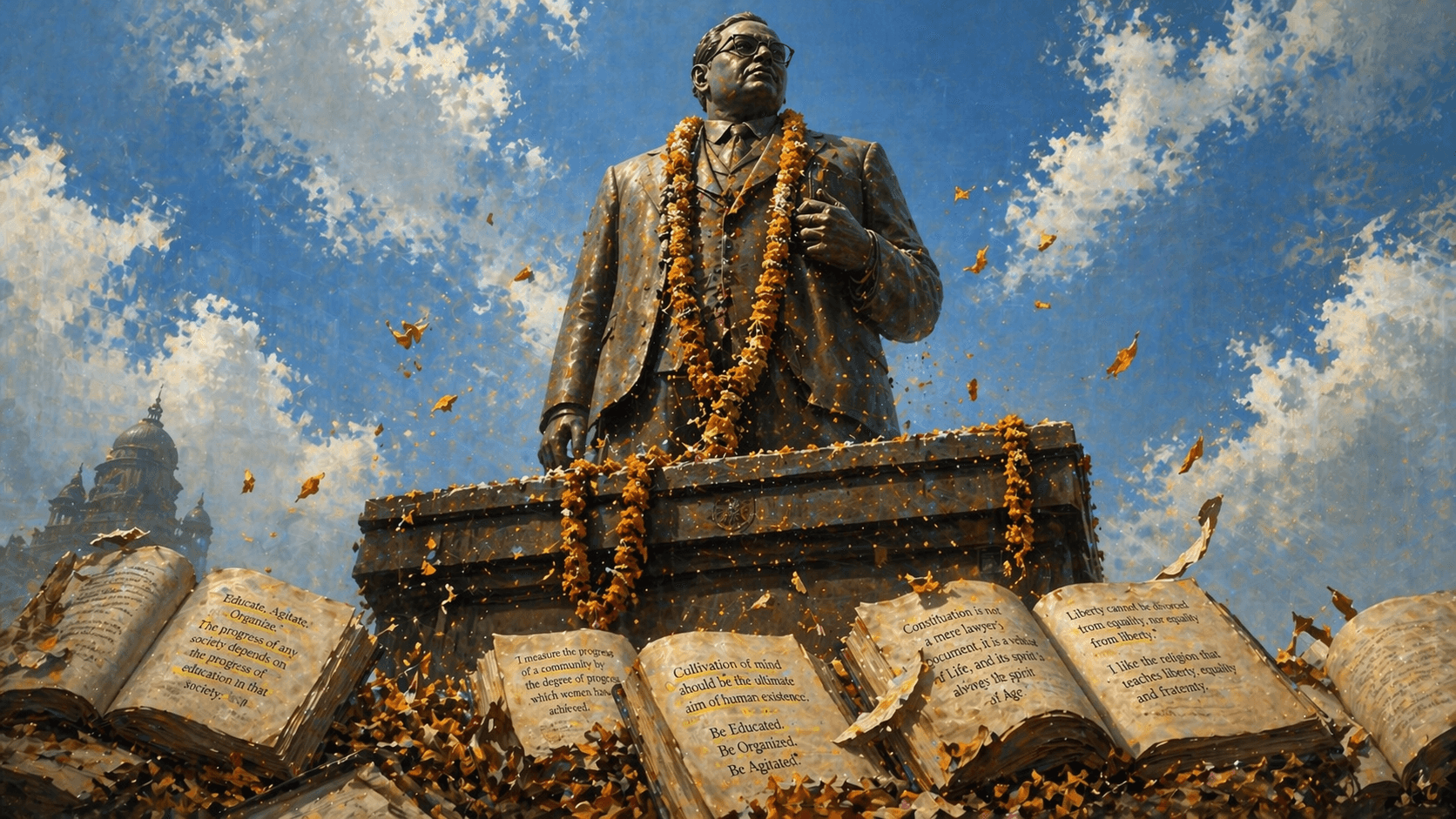
His famous call — Educate, Agitate, Organize — puts education first. Deliberately. Before you fight, you must understand what you're fighting and why. Before you organize, you need the language to articulate what you want. The pen comes before the march.
The Maharaja of Baroda — Sayajirao Gaekwad III — funded Ambedkar's education. One of the few people in power who looked at an untouchable boy and saw brilliance instead of pollution.
Ambedkar went to Columbia. Then London. Then Gray's Inn. He came home with more degrees than almost any Indian alive. PhD. DSc. Bar-at-law.
In a country where the Manusmriti said his people couldn't accumulate wealth, couldn't learn, couldn't even hear sacred words without having hot oil poured into their ears — this man built a library inside his mind that no one could burn.
Every degree was an act of war against the idea that caste determines capacity. And he knew it.
What the Writing Built
There is a temptation to reduce Ambedkar to the Constitution — the legal document he drafted between 1947 and 1949. Article 17 abolishing untouchability. The fundamental rights framework. The reservation provisions that have changed millions of lives.
But the Constitution was a compromise. Ambedkar said so. He wanted stronger land reform provisions. He wanted a uniform civil code. He wanted protections that the Constituent Assembly — dominated by upper-caste men — would not grant. He resigned from Nehru's cabinet in 1951 when the Hindu Code Bill was gutted into something he couldn't recognize.
The writings are where you find the uncompromised Ambedkar. Annihilation of Caste makes no concessions. Riddles in Hinduism doesn't soften its conclusions for anyone's comfort. The Buddha and His Dhamma doesn't hedge on what a just society looks like.
The Constitution tells you what Ambedkar could negotiate past a committee of powerful men. His books tell you what he actually believed. We have honored the compromise and ignored the conviction.
What he believed is still ahead of where India is willing to go. Intermarriage as the dissolution of caste. The destruction of scriptural authority that sanctions hierarchy. A rational, compassionate ethics rooted in human dignity. These weren't moderate positions in 1936 and they aren't moderate now.
| What Ambedkar Wrote | What We Do in 2026 |
|---|---|
| Intermarriage is the only cure for caste | Matrimonial apps filter by community, gotra, sub-caste |
| Discard the Shastras that sanctify hierarchy | Politicians garland his statue and quote the same texts he rejected |
| Caste is a state of the mind — the inner wall must break | "What caste?" is still the first question at weddings, in boardrooms, in newsrooms |
| Education is the first step to liberation | State Board students can't afford NEET coaching; the system filters by wealth |
| Religion should be morality, not mythology | Faith is weaponized for votes, for violence, for exclusion — across the world |
The Unfinished Library
Ambedkar's collected writings and speeches run to twenty-two volumes — published by the Government of Maharashtra over decades, some only after public pressure forced their release. Legal analysis. Philosophy. History. Political commentary. Personal testimony. All of it written by a man who, according to the laws of the land he was born into, should never have learned to read.
Most Indians have never read a single page.
We put his face on currency notes and government buildings. We garland his statues on April 14 and December 6. Every political party claims his legacy while ignoring his prescriptions. The man who said the Hindu scriptures must be discarded is claimed by parties that build mandirs. The man who said intermarriage is the only cure for caste is celebrated by communities that still check gotra before fixing a wedding.
"My philosophy has roots in religion and not in political science," he wrote toward the end of his life. "I have derived them from the teachings of my master, the Buddha."
His master taught compassion. His writings demand justice. Both live in those twenty-two volumes, free, available, most of them online. They don't require the feudal EWS quota to access.
The boy who couldn't touch the water pot grew up and wrote enough to fill a library. The library is open. We just haven't walked in.
This piece is part of the Social Justice series. Previous articles: Social Justice is a Right, Not Charity, Fellow Untouchables, The Women Who Built the Movement, and Merit Is Tyranny.