On the night of September 28, 2015, in Bisahda village near Dadri, Uttar Pradesh, a mob broke into Mohammad Akhlaq's home.
He was fifty-two years old. A blacksmith. A father. That evening, an announcement had been made from the local temple's loudspeaker — someone had slaughtered a cow, and the meat was in Akhlaq's house. The mob came with sticks, bricks, and knives. They dragged Akhlaq out. They beat him until he stopped moving. His twenty-two-year-old son Danish was beaten unconscious and left for dead.
The meat in the refrigerator was later tested by forensic laboratories. The results were inconclusive — some said goat, some said cow, none agreed. It didn't matter. Akhlaq was already dead. A man was murdered over a rumor about what was in his fridge.
An FIR was filed naming ten attackers. A chargesheet eventually named fifteen. The case was sent to a "fast-track" court. A decade later, there have been no convictions. In December 2025, the prosecution moved to withdraw all charges. The court rejected the plea.
Ten years. No justice.
The Pattern
Akhlaq's murder was not an aberration. It was a signal.
Pehlu Khan, 55, dairy farmer from Nuh, Haryana. On April 1, 2017, he was returning from Jaipur with cows and calves he had purchased with legal permits. A group of roughly 200 cow vigilantes stopped his vehicle near Behror on the Jaipur-Delhi highway. They beat him with rods and sticks. The attackers filmed the assault themselves and posted it on social media. Khan gave a dying declaration in the hospital, naming six of his attackers. He died on April 3.
All six were acquitted in August 2019. The court cited "serious shortcomings" in the police investigation. The police had failed to seize the filming device. The video that the attackers posted — of themselves beating a man to death — was not admitted as evidence because it had not been "forensically authenticated."
Junaid Khan, 15, from Ballabhgarh, Haryana. On June 22, 2017, he was traveling on a Mathura-bound train with his brother and friends, shopping for Eid. A group of men boarded, got into an argument over seats, pulled at the boys' beards, called them "beef-eaters," and stabbed Junaid multiple times. He was thrown off the train. Dead on arrival at the hospital. By October 2018, all six accused were out on bail.
Rakbar Khan, dairy farmer, Alwar, Rajasthan. Beaten to death by villagers in July 2018 while transporting cows he had purchased. Four were convicted and sentenced to seven years. Seven years — for murder.
Between May 2015 and December 2018, Human Rights Watch documented at least 44 people killed in cow-related violence across India. Two hundred and eighty people were injured in over a hundred attacks. Thirty-six of the forty-four dead were Muslim.
As per the HRW report, ninety-seven percent of these attacks were reported after May 2014.
In August 2024, cow vigilantes in Haryana shot and killed 19-year-old Aryan Mishra — a Hindu student they mistook for a Muslim cattle smuggler. The bullet doesn't check your Aadhaar card. It follows the logic of the mob.
The Trick With the Cow
Let me be clear about something — and I need to say this early, because it matters. This argument is not against faith. It is not against devotion. It is not against the millions of people who choose vegetarianism as a personal practice — whether for spiritual reasons, health, or simply because they prefer it. That choice is theirs, fully and completely, and it deserves respect.
The argument is against something else entirely. Against human beings who weaponized reverence to build a hierarchy. Against those who use the word "pure" in front of "vegetarian" — and let the implication do its work. Against a system that checks what's on your plate and decides whether you deserve housing, dignity, or your life.
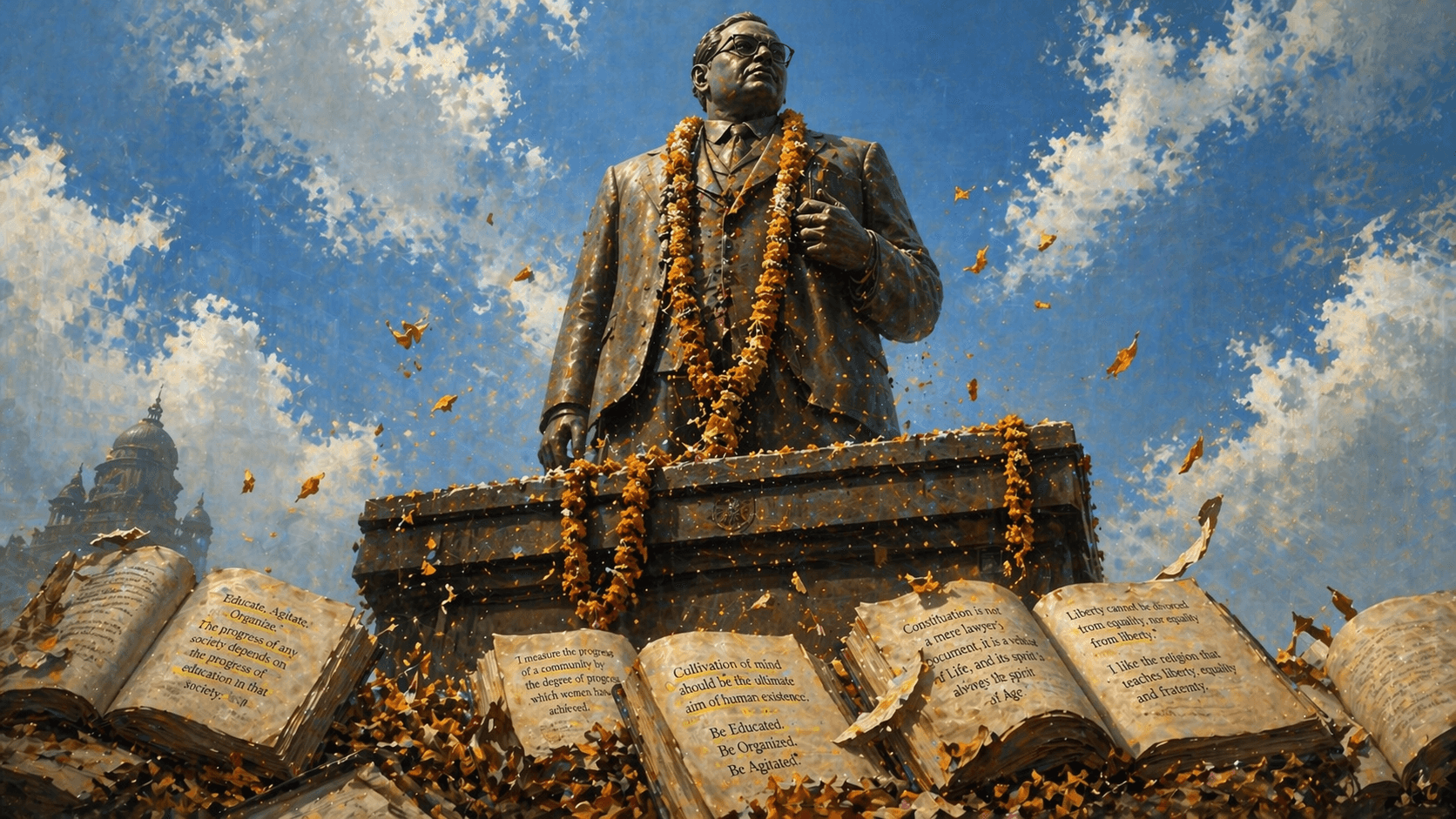
Ambedkar understood this better than anyone. In 1948, he published The Untouchables: Who Were They and Why They Became Untouchables? — and in Part II, across three devastating chapters ("Did the Hindus Never Eat Beef?", "How the Brahmins Became Vegetarians", "The Triumph of the Brahmins"), he made an argument so uncomfortable that most people still haven't reckoned with it.
Brahmins were not just beef-eaters. They were among the most enthusiastic beef-eaters in the subcontinent. Ambedkar put it plainly: "For the Brahmin every day was a beef-steak day."
And he didn't just assert this — he cited their own scriptures against them.
The Taittiriya Brahmana — a Vedic text composed by Brahmins, for Brahmins — prescribes that a cow should be slaughtered when a guest arrives. The Apastamba Dharmasutra says the same. The word "Goghna" in Sanskrit literally means "one for whom a cow is killed." It was a synonym for guest. Think about that for a moment. The people who now lynch men over rumors of beef miss that their entire ancient hospitality was built around serving it.
The Satapatha Brahmana describes elaborate cattle sacrifices. The Rig Veda references the slaughter of cows in ritual contexts. Even Manu — the supposed divine lawgiver of orthodox Hinduism, the man whose code became the blueprint for caste law — permitted the eating of beef at Shraddha ceremonies. Manu specifically lists the flesh of the cow as acceptable.
This was not some fringe practice buried in an obscure text. This was mainstream Brahmanical culture for centuries.
So what changed?
When Buddhism spread across India — preaching non-violence, rejecting ritual sacrifice, winning massive popular support — Brahmins faced a crisis of relevance. The common people were drawn to Buddhism partly because it protected their economic interests. Their cattle were no longer being demanded for Brahmanical sacrifices. Buddhism was winning, and it was winning on moral ground.
Here's what makes Ambedkar's argument razor-sharp. Buddhist monks weren't even fully vegetarian. Under the "three clean" rule, they could eat meat as long as the animal wasn't killed specifically for them. Buddhism opposed ritual slaughter but did not make vegetarianism an absolute requirement.
The Brahmins didn't match Buddhism. They outbid it.
They gave up meat entirely. They elevated the cow from food to sacred symbol. They became more non-violent than the people who invented the principle of non-violence. This wasn't a spiritual awakening — it was a strategic acquisition. If the Buddhists wouldn't kill, the Brahmins would worship what the Buddhists merely spared.
"The clue to the worship of the cow," Ambedkar wrote, "is to be found in the struggle between Buddhism and Brahmanism and the means adopted by Brahmanism to establish its supremacy over Buddhism."
And then came the sorting. The communities that continued eating beef — particularly the "Broken Men," defeated tribal groups who lived on the outskirts of settled villages and followed Buddhist practices — became untouchable. They weren't eating anything new. They were eating what everyone had always eaten. But the rules had changed around them, and their diet became their damnation.
"Untouchability," Ambedkar concluded, "is the result of the breach of the interdiction against the eating of the sacred animal, namely, the cow."
The food rule came after the caste rule. The cow became sacred because making it sacred made certain people impure.
And then, as always happens, the non-Brahmins imitated the Brahmins. Ambedkar noted this too — the spread of vegetarianism among non-Brahmin castes happened through imitation, through the desire to climb the purity ladder by adopting the habits of those at the top. The mechanism is self-replicating. Once you accept the hierarchy, you start enforcing it on the people below you.
This is the pattern that repeats across every religion and every century. Men write rules. Attribute them to divine authority. Make questioning the rules an act of blasphemy. The human hand disappears behind the divine curtain. That's the trick.
The Law and the Hypocrisy
Article 48 of the Indian Constitution reads: "The State shall endeavour to organise agriculture and animal husbandry on modern and scientific lines and shall, in particular, take steps for preserving and improving the breeds and prohibiting the slaughter of cows and calves and other milch and draught cattle."
Two things to note. First, this is a Directive Principle of State Policy — a guiding aspiration, not an enforceable law. The Constituent Assembly deliberately placed it outside Fundamental Rights as a compromise. Second, it mentions cows, calves, and milch and draught cattle. Buffalo are not mentioned.
That second point is important. Because while approximately twenty Indian states have enacted cow slaughter bans — Gujarat punishes it with life imprisonment, in 2025 a Gujarat court actually sentenced three members of a family to life under this law — India is simultaneously one of the world's largest exporters of buffalo meat.
In FY 2024, India exported approximately 1.29 million metric tons of buffalo meat worth $3.74 billion. Major buyers include Vietnam, Egypt, Malaysia, Iraq, and Saudi Arabia. India has been among the top three beef exporters in the world since 2014. Uttar Pradesh — the state where Akhlaq was lynched — is India's largest beef exporter.
Kancha Ilaiah Shepherd, the Dalit-Bahujan scholar, named this contradiction precisely in his book Buffalo Nationalism. The cow — white-skinned, venerated in Sanskrit literature as Kamadhenu and Gomata — receives legal protection, political mobilization, and divine status. The buffalo — black-skinned, producing roughly 45% of India's milk, doing the actual productive work — is slaughtered and exported freely. The cow is Brahminical. The buffalo is Bahujan. The state protects the symbol. The state sells the worker. Ilaiah put it bluntly: the situation of Dalits and Bahujans in India is like that of the black buffalo — giving more, producing more, but pushed to the bottom because of caste. India's Foreign Trade Policy forbids export of cow meat but actively promotes buffalo meat through APEDA, the government's own agricultural export body. The sacred and the profitable were never in conflict. They were always sorted by caste.
Read that again. A country where a man was beaten to death for a rumor about meat in his fridge — exports billions of dollars worth of meat every year. The mobs don't show up at export facilities. The vigilantes don't patrol the ports. The outrage is selective, aimed downward, at the people least able to fight back.
And it gets worse. Watch the same political party operate in different geographies.
In Gujarat, the BJP made cow slaughter punishable by life imprisonment. In Uttar Pradesh, up to ten years of rigorous imprisonment. In Karnataka, three to five years. In Assam, a complete ban on serving beef in any restaurant, hotel, or public place — announced in December 2024.
Now cross over to the Northeast.
In Meghalaya, as reported by Newslaundry, BJP State President Ernest Mawrie publicly confirmed he eats beef and told voters there would be "no restriction on beef eating." According to Outlook India, BJP State Minister Sanbor Shullai — the Minister for Animal Husbandry — encouraged people to "eat more beef." BJP leader Bernard Marak, as quoted in Hindustan Times, promised to make beef cheaper if the party won.
In Nagaland, as reported by Deccan Herald, Deputy CM Y. Patton said "beef is our staple food" and "BJP cannot interfere." According to The Print, the BJP's local unit organized beef parties as part of their election outreach.
In Manipur, as reported by multiple outlets, BJP Chief Minister N. Biren Singh said the party "never demanded beef bans."
In Goa, a powerful Union Minister clarified there were no plans to ban beef in the Christian-majority tourist state.
As the famous meme goes: "In Uttar Pradesh cow is mummy but in the Northeast it's yummy."
The cow is sacred when it wins votes in the Hindi belt. The cow is food when it wins votes everywhere else. A dairy farmer with legal permits gets lynched on a highway. A multi-billion dollar export industry operates without interruption. The cow is sacred when a Muslim man has one in his truck. The cow is a commodity when there's foreign exchange to be earned.
The Myth of a Vegetarian India
There is a story India tells itself — or rather, a story one part of India tells the rest — that this is a vegetarian nation. That meat-eating is an aberration. That the "pure" Indian diet has always been plant-based.
The data tells a different story entirely.
The National Family Health Survey (NFHS-5, 2019-21) — surveying over 700,000 people — found that 77% of Indians eat meat. In Tamil Nadu, 97.6% of the population is non-vegetarian. Kerala: 98-99%. Andhra Pradesh: 98%. Telangana: 95-96%. West Bengal: 99%. Odisha: 97%. In Nagaland, Mizoram, and Meghalaya, it's 99% and above. Even Bihar is at 95%. The only states with a vegetarian majority are Rajasthan (68%), Haryana (62%), Gujarat (55%), and Punjab (55%) — all in the Hindi belt. The "vegetarian India" is a North Indian, upper-caste projection onto a country where nearly four out of five people eat meat.
And here's what makes the projection even more absurd — many Brahmin communities eat meat themselves.
Bengali Brahmins don't just eat fish — fish is central to their identity. Weddings require the groom's family to gift fish to the bride's. Fish is called "jol toori" — "vegetables of the water" — a linguistic sleight of hand that lets you eat what you've always eaten while technically staying within the rules. Brahmins in Bengal were traditionally paid in fish for performing prayers.
Kashmiri Pandits are devoted meat-eaters. Mutton is the centerpiece of their cuisine — Rogan Josh, Yakhni, Kabargah. The Nilamata Purana, a sixth-century text, documents meat and fish as customary in Kashmiri Pandit rituals. Festivals like Gaad-Batt and Khech Mavas involve offering fish and mutton to deities and distributing them as prasad.
Saraswat Brahmins in Goa and the Konkan coast are proudly pesco-vegetarian. They call seafood "vegetable from the sea." Mahapatra Brahmins of Odisha eat fish, chicken, mutton, and eggs. At the Kali temple in Cuttack, fish curry is cooked by priests inside the temple kitchen and served as mid-day prasad.
So when someone in a Bangalore apartment complex puts up a "pure vegetarians only" sign — who exactly are they protecting the purity of? Not the Brahmins of Bengal. Not the Pandits of Kashmir. Not the priests of Cuttack. The word "pure" is doing a very specific job, and it has nothing to do with food.
The Gods Who Eat Meat
The argument that meat is impure doesn't survive a drive through Tamil Nadu.
In Vadakkampatti village near Thirumangalam in Madurai district, the Muniyandi Swami temple has been serving mutton biryani as prasad for nearly ninety years. Every January, during a three-day festival, over 250 goats and 300 roosters are offered to the deity. Over a thousand kilograms of rice and mutton are cooked overnight in fifty-odd vessels on firewood stoves. The biryani is offered to the god at four in the morning and served to over eight thousand devotees by five. Lord Muniyandi, the village guardian, is believed to be a devoted lover of biryani. This tradition gave birth to the Muniyandi Vilas restaurant chain — around 1,500 of them now operate across South India, each contributing from their first daily transaction to fund the annual festival.
Across Tamil Nadu, village deities receive animal offerings as a matter of course. Mariamman temples, Ayyanar temples, Karuppannasamy shrines — goats and roosters are sacrificed at festivals that predate the Brahmanical vegetarian turn by centuries. At the Draupadi Amman temples in Cuddalore, Thanjavur, and Villupuram, the Patukalam festival involves animal sacrifice, and blood-soaked rice is distributed as prasad. This is Hindu worship. This has always been Hindu worship.
And it isn't just Tamil Nadu.
The Khasi tribe in Meghalaya sacrifices roosters and goats at the Ka Pomblang Nongkrem Festival every November — offerings to Goddess Ka Blei Synshar for a good harvest. The Santhal people in Jharkhand sacrifice black chickens and hens to the Bongas — the spirits of nature — during the Sohrai festival. The Gond tribes gather for the Nagoba Jatara in Telangana, a ten-day festival honoring the serpent god. Across Assam, Odisha, Jharkhand, West Bengal, and Tripura, animal sacrifice remains a living practice — goats, chickens, pigeons, male water buffaloes — offered to deities by communities whose faith is no less real for involving blood.
Everyone is free to have their faith. No one has the right to question someone else's.
If a person chooses vegetarianism as a spiritual practice, that is entirely their right. If another person's faith involves offering a goat to a village guardian deity, that is equally their right. If a Tamil Nadu villager offers a goat to Muniyandi and a Bengali Brahmin offers fish to Kali, their devotion is no less sacred than anyone else's. Faith is personal. The moment one group appoints itself the authority on which food is divine and which is polluted, it stops being faith and starts being control.
"Pure Veg" and the Smell of Caste
The violence isn't always a mob with rods on a highway. Sometimes it's quieter. A word in a listing. A separate plate. A complaint about a smell.
At IIT Bombay, posters appeared in canteens: "Vegetarians only are allowed to sit here." The hostel administration officially reserved tables for vegetarian students and barred non-vegetarian students from using circular plates — separate utensils, enforced by institutional policy.
At IIT Madras in 2018, the administration designated separate entrances, separate utensils, and separate wash basins for vegetarian and non-vegetarian students. A "pure vegetarian" food counter was set up.
At IIT Kharagpur in 2025 — a full decade into this pattern — the BR Ambedkar Hall of Residence issued a notice segregating seating arrangements for vegetarian and non-vegetarian students. The notice was revoked after backlash.
Students from Dalit, Bahujan, and Adivasi communities have pointed out what should be obvious: this is caste-based dining discrimination with a modern vocabulary. The word "vegetarian" does the work that "Brahmin" used to do. The separate plate is the new separate well.
And then there's housing. Across Mumbai, Chennai, Bangalore, and Delhi, "vegetarians only" is one of the most common filters in rental listings. Everyone knows what it means. Landlords know. Tenants know. The listing says diet. It means caste and religion. No Muslims. No Dalits. No one whose kitchen smells wrong to the person collecting rent.
And that word — smell — carries centuries of caste violence. The academic paper "Dirty Food: Racism and Casteism in India," published in Ethnic and Racial Studies, specifically documents food odor as "a threat to caste purity." As documented in the study, urban developers in Mumbai knowingly market gated apartments to vegetarian upper-caste communities, aware their clients "would not tolerate the smell of non-vegetarian food in their building." A Vittles Magazine investigation found case after case — a Muslim woman in Mumbai whose landlord "lost it" when he discovered her identity after neighbors complained about chicken bones in the trash; another who was told that previous Muslim tenants' food had "polluted the entire atmosphere." The same investigation documented how migrants from Northeast India face difficulty securing accommodation anywhere in mainland India because their food culture — pork, beef, fermented fish — is treated as an olfactory offense.
Their kitchens stink. Their toilets stink. You've heard it. Everyone who has looked for a flat in an Indian city has heard it. The language of disgust — applied to food, applied to bodies, applied to entire communities — is the oldest tool in the caste system's arsenal. It was there when separate wells were the norm. It is here now, in apartment listings and WhatsApp groups and society meetings where residents vote to ban cooking smells they find offensive.
There is no law against it. The Bombay High Court has stated that housing societies cannot impose food preferences on residents — but enforcement remains nearly nonexistent. The sorting happens in plain sight, and the system looks the other way.
The word "vegetarian" does the work that "Brahmin" used to do. The separate plate is the new separate well.
What It Costs the Body
This isn't only about dignity. It's about survival.
Seventy-three percent of Indians are protein deficient. India's average protein consumption — 47 grams per person per day — is the lowest in Asia. The global average is 68 grams. Sixty percent of the protein Indians do consume comes from cereals like rice and wheat, which are incomplete proteins with poor digestibility. Meanwhile, 36% of India's children are underweight, 38% are stunted, and nearly 59% of children under five are anemic.
For a family living on five or ten thousand rupees a month, vegetarian protein is a luxury they cannot afford. Paneer costs three to four hundred rupees a kilogram. Milk costs fifty to sixty rupees a litre and delivers just three grams of protein per hundred millilitres. Meeting your daily protein requirement through dal alone requires impractically large quantities — and even then, dal is an incomplete protein.
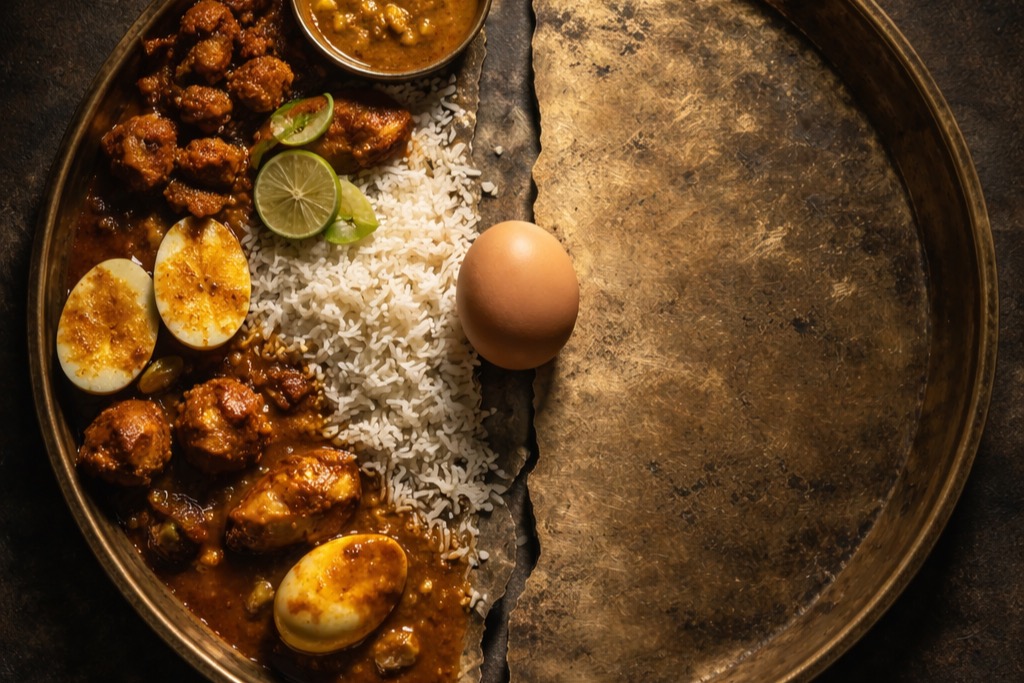
An egg costs six to eight rupees. Three eggs give you nearly twenty grams of complete protein with all essential amino acids — for under twenty-five rupees. A hundred and fifty grams of chicken delivers thirty-one grams of protein for thirty to forty rupees. For a family of five, the monthly difference between vegetarian and non-vegetarian protein sources can be five thousand rupees or more. For India's poorest, forced vegetarianism is economically indistinguishable from forced protein deficiency.
And yet.
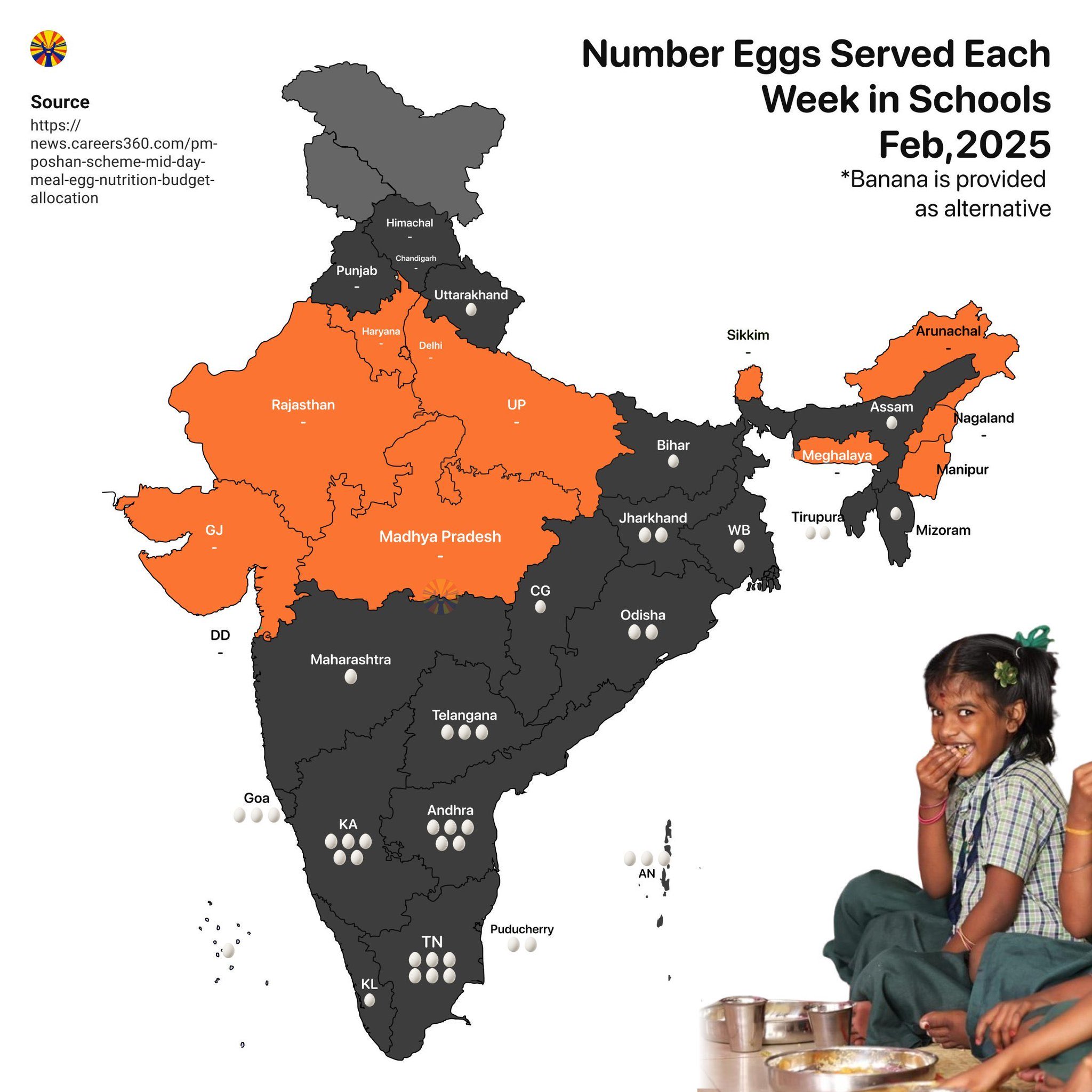
India's midday meal program feeds 120 million children. In sixteen states and union territories — including Tamil Nadu, Kerala, Andhra Pradesh, West Bengal, Odisha, Karnataka, Jharkhand, and Telangana — eggs are part of the meal. Karnataka expanded to one egg six days a week in 2024. Kerala added special funding for weekly eggs and twice-weekly milk in 2025.
In the states that refuse eggs, the reasons are never nutritional.
Maharashtra withdrew egg funding in January 2025 — cutting the fifty crore rupees it had spent annually providing one egg per week to twenty-four lakh students — after religious groups protested. Schools were told to fundraise independently if they wanted to keep serving eggs. Madhya Pradesh removed eggs in 2015 under the BJP, reinstated them under Congress, and removed them again under the BJP. Goa ran a pilot in 2022 and shut it down after "strictly veg" parents and the Jain community objected. The eggs were replaced with millet chikkis and laddus. Rajasthan, Gujarat, Uttar Pradesh, Chhattisgarh — no eggs.
Think about what this means. In states with some of the highest rates of child malnutrition, infant mortality, and maternal mortality in the country, the government actively prevents children from eating an egg — the cheapest, most complete source of protein available — because it offends someone's idea of purity. A child in Tamil Nadu gets an egg six days a week. A child across the border in Karnataka got the same only from 2024. A child in Uttar Pradesh gets nothing — in a state where 40% of children under five are stunted.
The cruelty is quiet. No mobs. No lynchings. Just a policy decision that denies a six-year-old an egg, made by people whose own children have never missed a meal.
The Plant in the Room
There is one more thing worth saying, because the argument for vegetarian purity rests on a premise that science has been quietly dismantling for over a century.
In 1901, at the Royal Society in London, the Bengali physicist Jagadish Chandra Bose connected a plant to his crescograph — an instrument he invented that could magnify plant movements ten thousand times. He dipped the plant's roots in a bromide solution. The audience watched a lighted spot on a screen showing the plant's pulse — a steady to-and-fro, like a pendulum. Within minutes, the spot vibrated violently and came to an abrupt stop. The plant had died. The audience had watched it happen in real time — the death spasm of a living being.
Bose demonstrated that plants show fatigue, excitation, and electrical responses to stimuli — heat, cold, chemicals, electric shocks, even anesthetics — that are analogous to nerve signals in animals. His work impressed Einstein and Lord Kelvin, and unsettled botanists who saw "a dangerous blending of science with spirituality."
A century later, the science has only deepened. In 2023, researchers at Tel Aviv University found that tomato and tobacco plants emit ultrasonic sounds when drought-stressed or when their stems are cut — sounds outside human hearing range, but measurable. Plants communicate underground through mycorrhizal fungal networks — the "Wood Wide Web" — transferring nutrients and stress signals. When one plant is attacked by insects, it sends chemical warnings through these networks, and neighboring plants activate preemptive defenses. Plants generate action potentials similar to those in animal nervous systems.
Plants breathe. Plants respond to damage. Plants communicate. Plants can be killed.
If the moral argument against eating meat is "don't kill living beings" — then every meal involves killing a living being. The line between which killing is acceptable and which is cruel is drawn at the presence of a nervous system. That's a scientific distinction, and a reasonable one. But it's a human-drawn line, not a divine one. And it certainly doesn't support the claim that one person's plate is "pure" and another's is polluted.
The Bodies Behind the Debate
The television debates frame this as a cultural question. Heritage versus modernity. Tradition versus freedom. Pundits argue about dietary preferences as though the stakes are abstract.
They are not abstract. The stakes are Akhlaq's body on the floor of his home. Pehlu Khan's dying declaration that the court threw out. Junaid's blood on a train. Aryan Mishra's family learning that their Hindu son was shot because the vigilantes couldn't tell the difference in the dark. A six-year-old in Madhya Pradesh who didn't get an egg today because someone in power decided her nutrition mattered less than his politics.
The food rule is a caste rule. It always has been. Ambedkar traced it back to its origins — a strategic move by one community to establish supremacy over another, dressed in the language of purity and devotion. The language has changed. The mechanism hasn't.
Twenty states have cow slaughter bans. Zero states have laws against lynching someone over a cow. Gujarat will put you in prison for life for killing a cow. The men who kill humans over cow rumors walk free.
A country that sentences cow slaughter to life imprisonment has no national law against lynching. The Prevention of Lynching Bill, introduced after the Supreme Court's 2018 directive in the Tehseen Poonawalla case, has never been passed by Parliament.
The priorities are written in the law itself. The cow has more legal protection than the people who are killed in its name.
If you choose not to eat meat — for your health, for your faith, for your conscience — that is your right, and no one should question it. If your neighbor chooses to eat beef, or pork, or fish, or an egg — for their health, for their faith, for their survival — that is equally their right, and you have no authority over their plate.
In Kerala and Tamil Nadu, beef and pork are everyday food — sold openly, cooked in homes, served in restaurants. The Dravidian movement has explicitly defended the right to eat what you choose as a matter of personal liberty. Periyar was among the first to frame food choice as a front in the fight against Brahmanical supremacy. What is ordinary life in one state is a death sentence in another.
And every year, the exports continue. The mobs continue. The acquittals continue. The "vegetarians only" signs go up in apartment listings across every major city. Children go without eggs in states where politicians eat mutton behind closed doors.
The plate tells you everything. Who gets to eat. Who gets to live. Who gets to worship their way. And who wrote the rules that decided all three.