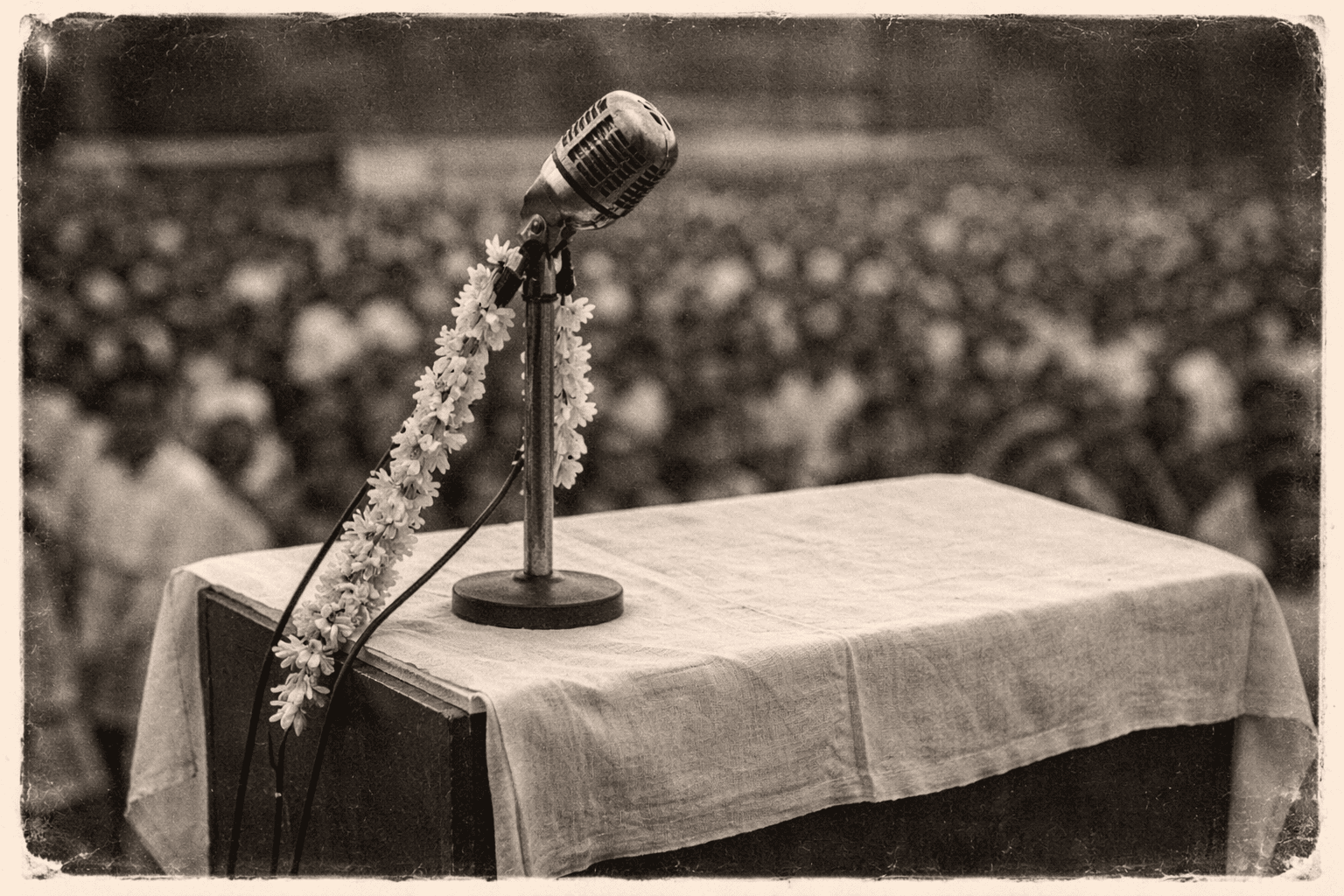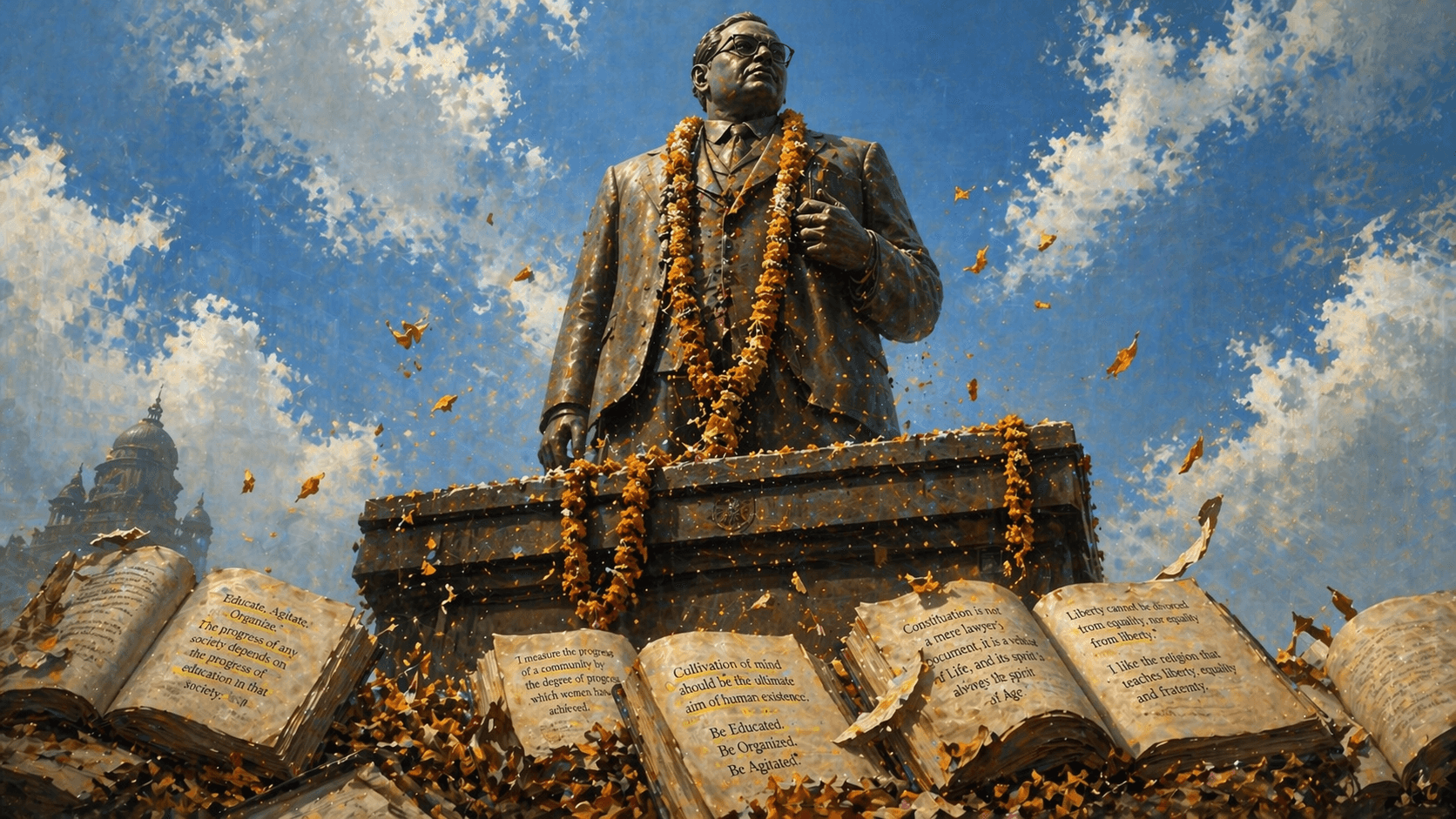
On April 14 every year, every political party in India garlands the same statue.
The BJP garlands it. The Congress garlands it. The BSP garlands it. The CPI(M) garlands it. Regional parties, national parties, parties that agree on nothing else — they all agree that Ambedkar deserves flowers on his birthday. They share the same five quotes on social media. "Be educated, be organized, be agitated." "Life should be great rather than long." "I like the religion that teaches liberty, equality and fraternity."
Safe quotes. Universal quotes. Quotes that could appear on a motivational poster in a government office without making anyone flinch.
Then the garlands wilt. The tweets expire. And the twenty-two volumes of his collected writings and speeches sit exactly where they sat the day before — unread, unclaimed, and deeply inconvenient for everyone who just put flowers around his neck.
Because if you actually open those books, you find a man who had something devastating to say about every institution, every ideology, and every community in India. Including the ones that garland him.
The Five Safe Quotes and the Twenty-Two Dangerous Volumes
Here is what gets shared every April 14 and December 6:
| The Quote | Why It's Safe |
|---|---|
| "Be educated, be organized, be agitated" | Universal enough to mean anything |
| "I measure the progress of a community by the degree of progress which women have achieved" | Nobody argues against this in public |
| "Life should be great rather than long" | Inspirational, no specific target |
| "Unlike a drop of water which loses its identity when it joins the ocean, man does not lose his being in the society in which he lives" | Philosophical, apolitical |
| "I like the religion that teaches liberty, equality and fraternity" | Vague enough to claim for any tradition |
Now here is what he also wrote — the passages that never make it to the posters.
On Hinduism: "To the Untouchables, Hinduism is a veritable chamber of horrors."
On Indian villages: "What is the village but a sink of localism, a den of ignorance, narrow-mindedness and communalism?"
On his own Constitution: "I shall be the first person to burn it out. I do not want it. It does not suit anybody."
On Hindu reformers: "The Mahatma is not honest enough to fight the monster of caste either as a Hindu or as a political leader."
On Indian democracy's future: "In India, Bhakti or what may be called the path of devotion or hero-worship, plays a part in its politics unequalled in magnitude by the part it plays in the politics of any other country in the world. In politics, Bhakti or hero-worship is a sure road to degradation and to eventual dictatorship."
Every single one of these statements targets someone with political power today. That's why they stay in the books.
The Chamber of Horrors
In "The Pen That Burned", I wrote about Ambedkar's major works — Annihilation of Caste, Riddles in Hinduism, The Buddha and His Dhamma — and why the act of writing itself was radical for a man born where he was. What I didn't go into was the depth of his verdict on Hinduism as a system. Because his position was more extreme than what most people — even his admirers — are willing to acknowledge.
Ambedkar did not say Hinduism had some bad practices that needed reform. He said Hinduism was structurally irreformable.
His reasoning was precise, and it distinguishes him from every other social critic in Indian history. Islam has the Quran and the Prophet — if reform is needed, there is a single textual tradition to reinterpret. Christianity has the Bible and the institutional authority of churches and councils that can issue doctrinal changes — the Catholic Church has done so repeatedly over two millennia. Both religions have a center.
Hinduism, Ambedkar argued, has no center. No single book, no single prophet, no ecclesiastical authority, no Pope, no Caliph. The Vedas, the Upanishads, the Smritis, the Puranas, the Itihasas — they contradict each other freely. And because there is no single authority to challenge, there is no mechanism for top-down reform. Any reformer who attacks one text is simply told another text says the opposite. The system absorbs dissent the way a sponge absorbs water — it gets heavier but never changes shape.
Ambedkar examined this across centuries. Every Hindu reformer tried the same approach — accept the Vedas, reject the later corruptions. Ram Mohan Roy in the 1820s said the original Vedas were pure monotheism, and sati and caste were later distortions. Dayananda Saraswati founded the Arya Samaj on the slogan "Back to the Vedas" — purge the superstition, keep the core. Vivekananda preached universal brotherhood and the essential unity of all souls while accepting that varnashrama dharma — the four-fold division of society — was a legitimate social order.
Ambedkar's response was devastating in its simplicity. You cannot reform a house by praising its foundation while removing its walls. The foundation IS the problem. The Vedas and the Smritis sanctify hierarchy. Varnashrama dharma is not a corruption of Hinduism — it is Hinduism's central organizing principle. Every reformer who accepts the Vedas while rejecting caste is performing intellectual surgery with one hand tied behind their back.
"The Hindu Reformers have only played the part of an army of defeated soldiers," he wrote in Annihilation of Caste. "They have not been able to win a single battle in the war they have waged against the Hindu orthodoxy."
Now — and this is important, and I've said it before but it bears repeating — Ambedkar's fight was never against personal faith. A grandmother who prays at her home shrine, a family that finds comfort in a festival, a child who lights a lamp and feels the world get quieter — that is faith, and it is sacred, and nobody has the right to touch it.
Ambedkar's fight was against the architecture built around that faith by men who stood to benefit from it. The priests who wrote the rules, attributed them to God, and punished anyone who questioned them. The mechanism he exposed in Hinduism is the same mechanism I traced in "You Are What They Let You Eat" — human hands behind a divine curtain. His verdict on Hinduism was not about the devotee. It was about the system the devotee was trapped inside.
On the Village
This is where Ambedkar collides head-on with the other great figure of Indian independence — and it has nothing to do with the caste debate.
Gandhi romanticized the Indian village. His vision of Gram Swaraj — village self-rule — was central to his political philosophy. The village was the soul of India. Authentic, communal, self-sustaining. Independent India should be built from the village up, not the city down.
Ambedkar stood in the Constituent Assembly on November 4, 1948, and said this:
"What is the village but a sink of localism, a den of ignorance, narrow-mindedness and communalism? I am glad that the Draft Constitution has discarded the village and adopted the individual as its unit."
This wasn't a throwaway line in a debate. This was a philosophical position rooted in lived experience. Ambedkar knew what the village meant for Dalits — a place where everyone knew your caste, where separate wells and separate streets were enforced by proximity, where escape was physically impossible because every neighbor was a surveillance system. The village was intimate, and for Dalits, intimacy was a prison.
He argued that the city offered something the village never could: anonymity. In the city, a Dalit could find work without their caste following them into every room. They could rent a house without the landlord knowing their grandfather's occupation. They could build a life on what they did, not who they were born as.
Think about that in 2026. The honor killings still happen in villages — Kausalya's husband Shankar was hacked to death in broad daylight in Udumalpet, Tamil Nadu, in 2016, because a Dalit man married a Thevar woman. The village knew everything. The village decided he had to die. Khap panchayats still issue decrees about who can marry whom. Manual scavenging persists in rural areas despite being illegal since 1993. The village Ambedkar described in 1948 has not disappeared. It has only gotten a 4G connection.
Gandhi wrote in Hind Swaraj: "The true India is to be found not in its few cities but in its 700,000 villages."
Ambedkar never sentimentalized his childhood. He wrote in Waiting for a Visa — his autobiographical essays on untouchability — about the village where his family could not draw water from the common well. Where his father, despite being a retired subedar in the army, could not get a barber to cut his children's hair. Where bullock-cart drivers refused to transport Mahar families. Where a schoolteacher forced him to sit outside the classroom on a piece of gunny sack.
Two men, two experiences of the same country. Gandhi saw the village from the veranda. Ambedkar saw it from the well he wasn't allowed to touch.
And if you think the water pot was the worst of it, read Waiting for a Visa.
These are Ambedkar's own stories — autobiographical essays written with the flatness of a man who has been humiliated so many times that the emotion has calcified into record-keeping.
In one essay, he describes arriving at Masur railway station as a boy of nine with his brother and sister. Their father had arranged for someone to pick them up. Nobody came. They asked the station master for help getting a bullock cart. The station master, upon learning they were Mahars, refused. They waited. Eventually a cart driver agreed — but charged three times the normal fare. When the driver discovered their caste mid-journey, he climbed down from his seat and refused to sit near them. The children — the oldest was eleven — had to drive the cart themselves through the night.
In another, Ambedkar describes returning to India after his studies at Columbia and the London School of Economics. PhD in hand. DSc in hand. One of the most educated men in the country. The Maharaja of Baroda had funded his education and appointed him as a military secretary. He arrived in Baroda and could not find a place to live.
Hotels refused him. A Parsi inn took him in — until the other residents discovered he was a Mahar. The innkeeper told him to leave. He found a room by concealing his identity, registering under a false name. When the truth came out, a crowd gathered. He was thrown out again. The most qualified man in the room, sleeping on the street because of who his grandfather was.
He eventually left Baroda. The job the Maharaja had given him became impossible — subordinates refused to hand him files, peons wouldn't bring him water, colleagues treated him as a source of pollution. A PhD from Columbia changed nothing. The village didn't care about degrees. It cared about caste.
This is what Ambedkar meant when he called the village a den of narrow-mindedness. The surveillance wasn't just in the hamlet — it followed you to the city, to the office, to the hotel lobby. But in the village, there was no room to hide. In the city, at least you could try.
This disagreement matters because it's still alive. Every political party in India promises to "develop" villages. Smart Villages, Digital Villages, Gram Panchayat empowerment. The assumption — Gandhi's assumption — is that the village is a good institution that just needs better roads and internet.
Ambedkar's position was more radical. The village, as a social unit, enforces caste. Urbanization and industrialization weaken caste because they break the surveillance network. His prescription — that India should modernize its way out of the village — has been vindicated by every study on Dalit economic mobility. The cities are far from caste-free. But they are where Dalits have found the most room to breathe.
On Women
Here is the political story that most Indians don't know — and it's the reason Ambedkar walked away from power.
In 1941, Ambedkar was appointed to the Viceroy's Executive Council. After independence, Nehru made him India's first Law Minister. His first major act was to draft the Hindu Code Bill — a comprehensive legal reform that would give Hindu women rights they had been denied for millennia.
The bill proposed: women's right to property and inheritance. The right to divorce. Abolition of polygamy. Abolition of caste-based restrictions on marriage and adoption. Equal treatment of daughters and sons in matters of succession.
In 1951, this was revolutionary. Hindu personal law, largely derived from the Dharmashastras, treated women as property — transferred from father to husband, with no independent legal identity. The Mitakshara system of inheritance gave sons a birthright to ancestral property. Daughters got nothing. A woman couldn't divorce her husband regardless of cruelty, abandonment, or abuse. A Hindu man could legally have multiple wives. Ambedkar wanted to dismantle all of this in one stroke.
The opposition was immediate and ferocious.
The first draft of the Hindu Code Bill was introduced in 1947. It went to a Select Committee chaired by Ambedkar himself. The committee debated it for years. Every clause was contested.
When the bill finally reached the floor of Parliament in 1951, the resistance came from everywhere. President Rajendra Prasad — the head of state — privately threatened to use his veto or refer the bill to the Supreme Court. Sardar Vallabhbhai Patel opposed key provisions. Members of Nehru's own Congress party joined the Hindu Mahasabha in denouncing it as an attack on Hindu tradition. Religious leaders organized protests. The Shankaracharyas called it an assault on dharma.
Nehru had the numbers. He had a massive parliamentary majority. He had publicly stated his support for women's rights. And when the moment came, he let the bill die. He allowed Parliament to adjourn without completing the debate, then called fresh elections. The bill lapsed with the dissolution of the first Parliament.
Ambedkar understood what had happened. The government had calculated that Hindu women's rights were not worth the political cost.
Nehru eventually reintroduced the reforms — after Ambedkar had resigned, after the 1952 elections were won, and only by splitting the comprehensive bill into four separate, diluted acts. The Hindu Marriage Act (1955), the Hindu Succession Act (1956), the Hindu Minority and Guardianship Act (1956), and the Hindu Adoptions and Maintenance Act (1956). Weaker than what Ambedkar proposed. Passed after his political death, partially passed after his actual death.
| What Ambedkar Proposed (1948-51) | What Eventually Happened |
|---|---|
| Daughter's equal right to father's property | 1956 Act gave limited rights. Four southern states — AP (1986), TN (1989), Karnataka and Maharashtra (1994) — gave daughters coparcenary rights by birth. Central amendment in 2005. SC didn't fully settle it until Vineeta Sharma v Rakesh Sharma in 2020. Seventy years for what Ambedkar demanded in one bill. |
| Right to divorce on broad grounds | Divorce permitted but with restrictive grounds and lengthy process |
| Complete abolition of polygamy | Polygamy banned for Hindus — but Muslim personal law left untouched |
| Abolition of caste restrictions on marriage | Inter-caste marriage technically permitted |
| Single comprehensive bill — one debate, one vote | Split into four acts to reduce controversy — the opposite of what Ambedkar wanted |
Ambedkar resigned from Nehru's cabinet on October 10, 1951. His resignation speech in Parliament is one of the most painful documents in Indian political history. He spoke for over two hours. He catalogued the government's failures — on foreign policy, on economic policy, on the treatment of Scheduled Castes. But the Hindu Code Bill was the wound that bled most.
"I have only to say that I was not prepared to be a camp follower," he said.
And then, the line that should be studied alongside any course on Indian independence: "To leave inequality between class and class, between sex and sex, which is the soul of Hindu society, untouched and to go on passing legislation relating to economic problems is to make a farce of our Constitution and to build a palace on a dung heap."
He had drafted the Constitution that gave India its legal framework. He had served as the country's first Law Minister. And he walked away — the only cabinet minister in Indian history to resign over women's rights.
The man who wrote the Constitution resigned because the government wouldn't pass a law giving women the right to divorce. That tells you everything about what he valued — and what the government valued.
And in 2026, when people garland his statue and quote him about measuring a community's progress by the progress of its women — they forget that he put his career on the line for that belief, and the system punished him for it.
The central government didn't amend the Hindu Succession Act to give daughters equal coparcenary rights until 2005 — fifty-four years after Ambedkar resigned demanding exactly that. The Supreme Court didn't fully settle the law until Vineeta Sharma v Rakesh Sharma in 2020, ruling that the right was by birth, not contingent on when the father died. Seventy years from demand to settled law.
The only leaders who acted sooner were in the South. Andhra Pradesh under NTR in 1986. Tamil Nadu under Kalaignar Karunanidhi in 1989 — the Hindu Succession (Tamil Nadu Amendment) Act gave daughters equal coparcenary rights by birth, three decades before the rest of India caught up. Karnataka and Maharashtra followed in 1994. Four states. Four Chief Ministers who read Ambedkar and actually did what he asked. The central government needed sixteen more years and a Supreme Court ruling to get to the same place.
On Everyone Else
This is the section that makes the political Left uncomfortable. And it needs to be said, because intellectual honesty was the only currency Ambedkar traded in.
He rejected Islam. He rejected Christianity. He rejected Marxism. Not out of bigotry — out of the same forensic analysis he applied to Hinduism.
On Islam, Ambedkar wrote extensively in Pakistan or the Partition of India (1940, expanded 1945). He analyzed Muslim society with the same scalpel he applied to Hindu society — and found caste there too. The hierarchy of Ashraf (those claiming foreign descent), Ajlaf (converts from Hindu lower castes), and Arzal (converts from Hindu untouchable castes) mirrored the varna system in practice, even if Islam's theology rejected it in principle. He noted that the Muslim community's treatment of the Arzal was "similar to the treatment of untouchables by the Hindus."
On Christianity, his objection was partly colonial — the religion had arrived in India on the back of imperial power, and conversion to Christianity carried the stigma of cultural surrender. But more fundamentally, he rejected any religion that centered on a creator-god whose word could be monopolized by a priestly class. Christianity had its own history of justifying slavery, crusades, and inquisitions through scripture. The mechanism — men writing rules in God's name — was the same.
On Marxism, his critique was both philosophical and practical. The Indian Communist Party treated caste as a "superstructure" — a cultural artifact that would dissolve once the economic base was transformed through class revolution. Ambedkar said this was dangerously wrong. Caste was not a byproduct of class. Caste WAS the structure. A Brahmin factory owner and a Brahmin factory worker had more in common with each other — socially, maritally, in every way that mattered to daily life — than a Brahmin worker and a Dalit worker on the same assembly line. The Left's refusal to see this meant they could never mobilize the people who needed revolution most.
Let me be clear about the faith distinction here — the same one I make every time. Ambedkar's critique of Islam was not the Hindu nationalist's critique of Islam. The BJP quotes his analysis of Muslim society to justify Islamophobia. Ambedkar wrote those words while simultaneously saying Hinduism was worse — because at least Islam and Christianity offered formal equality in principle, even if practice fell short. His position was that all organized religions had been weaponized by men in power. The religion changed. The trick stayed the same.
He chose Buddhism because it met every criterion the others failed. Rational. Ethical. Indian. Egalitarian. No creator-god whose word could be monopolized. No priestly class with exclusive access to the divine. And — crucially — a philosophy he could rebuild on his own terms, stripping out the supernatural and centering social justice. As I wrote in "The Pen That Burned", his Buddhism was a philosophy of liberation, not a religion of submission.
The Indian Left has never fully reckoned with Ambedkar's critique. The Communist Party of India's leadership was overwhelmingly upper-caste Brahmin and Kayastha. E.M.S. Namboodiripad — the CPI(M)'s most prominent leader in Kerala — was a Namboodiri Brahmin. The party that claimed to fight for the working class reproduced the caste hierarchy within its own ranks. Ambedkar saw this clearly: "The Communists have not understood the significance of caste in the social and economic life of the Hindus. They do not seem to realise that the caste system is the greatest enemy of the labour movement."
On the Oppressed Themselves
This is the section that makes everyone uncomfortable. Including the people who need Ambedkar most.
He did not spare the oppressed communities from his analysis. The caste system's most insidious achievement, he argued, was not that it crushed people at the bottom — any system of power does that. Its real achievement was that it made the people at the bottom replicate the same hierarchy among themselves.
Ambedkar observed what any honest observer of Indian society can see: caste discrimination does not flow in a single direction. OBC communities discriminate against Dalits with a viciousness that rivals anything from above. Among Dalits themselves, sub-caste hierarchies persist — Mahars and Chamars and Madigas and Paraiyars have their own internal rankings, their own endogamy rules, their own notions of who is above and who is below.
In Annihilation of Caste, he wrote: "Each caste takes its pride and its consolation in the fact that in the scale of castes it is above some other caste." The Shudra who is oppressed by the Brahmin turns and oppresses the Ati-Shudra. The Ati-Shudra who is denied water by the Shudra denies entry to the tribal. The entire system runs on the principle that suffering is tolerable as long as someone else suffers more.
He saw this with particular sharpness because he lived it. The Mahar community he was born into faced discrimination not only from caste Hindus but from other Dalit communities. The system had penetrated so deep that its primary victims had internalized its logic — measuring their own worth against communities they considered below them.
This is why Ambedkar insisted that caste could not be dismantled piecemeal. You could not simply elevate one community and leave the structure intact. The structure itself — the idea that human beings can be ranked by birth — had to be destroyed. As long as the ladder existed, everyone on it would spend their energy climbing rather than burning it down.
This is the observation that makes Ambedkar's analysis different from simple oppressor-victim narratives. The caste system doesn't just hurt people from the top. It corrupts everyone inside it. The oppressed become oppressors at their own scale. The system is self-replicating, self-sustaining, and designed to prevent solidarity across the groups it divides. That's why it has survived for millennia while other systems of hierarchy have fallen.
Every Dalit political party, every OBC movement, every anti-caste organization that has ever splintered over sub-caste loyalty is living proof that Ambedkar diagnosed this correctly. He called for the annihilation of caste — not the rearrangement of it, not the promotion of one caste over another, not the replacement of Brahmin dominance with Yadav dominance or Jatav dominance. Annihilation. The word is in the title. He meant it.
On His Own Constitution
This is the passage that should be required reading in every school in India, and the reason it never will be.
On November 25, 1949 — the day the Constituent Assembly adopted the Constitution — Ambedkar delivered his final speech. It contained three warnings. All three have come true.
The first warning was about unconstitutional methods.
"If we wish to maintain democracy not merely in form, but also in fact, what must we do? The first thing in my judgement we must do is to hold fast to constitutional methods of achieving our social and economic objectives."
He said this knowing full well that he himself had led marches, satyagrahas, and acts of civil disobedience. But he drew a line: those methods were necessary when there was no constitutional path. Now there was one. Using extra-constitutional methods in a democracy would corrode the very framework built to protect the powerless.
The second warning was about hero-worship.
"In politics, Bhakti or hero-worship is a sure road to degradation and to eventual dictatorship."
Read that sentence in 2026 and tell me he was wrong. The man who wrote it knew exactly what happens when a democracy replaces institutions with individuals — when the leader becomes more important than the law, when loyalty to a person replaces loyalty to a principle. He had watched it happen in Italy, in Germany, in the Soviet Union. And he knew India's cultural instinct for devotion made it uniquely vulnerable.
The third warning was about social democracy. And this is the one that lands hardest.
"On the 26th of January 1950, we are going to enter into a life of contradictions. In politics we will have equality and in social and economic life we will have inequality. In politics we will be recognising the principle of one man one vote and one vote one value. In social and economic life, we shall, by reason of our social and economic structure, continue to deny the principle of one man one value."
Sit with that for a moment. He is standing in the Constituent Assembly, having just spent two years drafting a document that will give every Indian citizen equal political rights. And he is telling the room: this will not be enough. Because the country we are handing this document to has inequality so deep, so structural, so woven into every social interaction, that political equality alone will not survive the weight of it.
Then the line that should be carved into the walls of Parliament:
"How long shall we continue to live this life of contradictions? How long shall we continue to deny equality in our social and economic life? If we continue to deny it for long, we will do so only by putting our political democracy in peril."
He went further. He defined what social democracy meant:
"What does social democracy mean? It means a way of life which recognises liberty, equality and fraternity as the principles of life. These principles are not to be treated as separate items in a trinity. They form a union of trinity in the sense that to divorce one from the other is to defeat the very purpose of democracy."
Liberty without equality is the freedom of the strong to exploit the weak. Equality without fraternity is enforced leveling without human connection. Fraternity without liberty is the solidarity of a prison yard. All three, or none. That was his position.
He warned that a democracy built on social inequality would eventually collapse under the weight of its own contradictions. That warning was delivered in 1949. We are living inside it.
And then there is the other speech — the one from September 2, 1953, in the Rajya Sabha. The quote that gets ripped from context more than any other:
"My friends tell me that I have made the Constitution. But I am quite prepared to say that I shall be the first person to burn it out. I do not want it. It does not suit anybody."
Every party has used this quote for their own purposes. The BJP cites it to argue that even Ambedkar knew the Constitution was flawed — implying it needs to be replaced with something more "Indian" (read: Hindu). The Left cites it to argue the Constitution is a bourgeois document. Critics of reservation cite it to argue Ambedkar himself lost faith in his own creation.
None of them quote what came before and after.
Ambedkar said this in the context of Article 32 — the right to constitutional remedies — being abused. People were filing petitions to block land reform, to prevent the redistribution of zamindari estates, to protect feudal property. The Constitution he wrote to protect the powerless was being used by the powerful to maintain their grip.
His frustration was not with the document. It was with the people who had captured it. He had written the most progressive constitution in Asia — guarantees of equality, abolition of untouchability, reservation for representation, directive principles pointing toward a just society. And within four years, the powerful had figured out how to weaponize it against the very people it was meant to protect.
He wasn't saying the Constitution was bad. He was saying the country had failed the Constitution.
This was grief — the grief of a builder watching his creation turned into its own opposite. The reservation provisions were being ignored. The Directive Principles were treated as suggestions. The Hindu Code Bill had been gutted. The man who built the framework watched it being hollowed out in real time, and he said what anyone who builds something with love says when they see it misused: I'd rather destroy it than watch you turn it into something I don't recognize.
The Uncomfortable Library
Every year in April and December, the flowers come. The tweets come. The banners and the slogans and the cultural programs where a child recites "Be educated, be organized, be agitated" and the audience claps and goes home.
Almost nobody goes home and opens Volume 1.
Because Volume 1 will tell you that Hinduism, as practiced, is a chamber of horrors. Volume 3 will tell you the reformers failed. Volume 7 will tell you the Indian village is a den of communalism. The resignation speech will tell you the government chose patriarchy over justice. Pakistan or the Partition of India will tell you caste exists in every religion. And the final address to the Constituent Assembly will tell you that the democracy you live in is a contradiction that hasn't been resolved — only deferred.
| Who Claims Ambedkar | What He Actually Said About Them |
|---|---|
| BJP | Hinduism is a chamber of horrors; cow worship was a strategic acquisition; hero-worship leads to dictatorship |
| Congress | Hindu Code Bill was betrayed by Nehru's government; the party failed Dalits after independence |
| CPI(M) | Communists don't understand caste; the party's Brahmin leadership reproduces the hierarchy it claims to fight |
| BSP | He rejected the politics of patronage; "Educate" comes before "Agitate" for a reason |
| Religious orthodoxy | Every religion has been weaponized by men; the shastras must be discarded, not reformed |
He didn't write for any of them. He wrote for the people none of them fully serve — the millions who still live inside the system he spent his life anatomizing.
Reading Ambedkar is uncomfortable. It should be. He didn't write to make anyone feel good about themselves. He wrote with the precision of a man who had been told he was less than human and decided to prove, word by documented word, that the people who made those rules were the ones who lacked humanity.
The garlands will come again in December. The quotes will circulate. The statues will get a fresh coat of paint.
The library is still open. We just have to read past page one.
This is part of the Social Justice series. Read the companion piece: The Pen That Burned — on Ambedkar the writer and why writing itself was radical. Also in this series: Merit Is Tyranny, Fellow Untouchables, Social Justice is a Right, Not Charity, The Women Who Built the Movement, The Right to Eat, and You Are What They Let You Eat.