In Part 1, Frodo pushed a boat into the river and rowed toward Mordor. The Ring on his neck. The road ahead darker than anything behind. He had decided to go alone — because the weight was his, and he'd watched it crack open everyone who came close.
But Sam waded into that water anyway. Couldn't swim, didn't care. He'd made a promise.
That's where we left off. A broken fellowship, a boat on a river, and the quiet truth that even the loneliest road has room for someone stubborn enough to follow.
This part is about those people. The ones who walk with you.
The Promise Keeper
Sam is the most important character in The Lord of the Rings. Tolkien said so himself. And if you've ever had someone show up for you when showing up made no sense, you already know why.
There's no flash to Sam. He doesn't wield a legendary sword or deliver speeches that echo through halls of stone. He carries pots and pans into Mordor. He rations lembas bread. He worries about seasoning when the world is ending. His bravery lives in the same part of him that remembers to pack rope and cook rabbits — quiet, domestic, stubborn as soil.
"I made a promise, Mr Frodo. A promise. 'Don't you leave him Samwise Gamgee.' And I don't mean to."
He says it like it's the simplest thing in the world. Like following your friend into the land of shadow is as natural as tending a garden — because to Sam, it is.
You know this person. You've met them. The friend who showed up at your door with food the week after the funeral — not the day of, when everyone shows up, but the week after, when the casseroles stop and the silence starts. The one who drove across town at 11 PM because something in your voice sounded wrong and you said "I'm fine" one too many times. The one who didn't ask what you needed — just sat there, in your kitchen, doing the dishes you hadn't touched in four days.
That's Sam. The person who doesn't need to understand what you're carrying. They just refuse to let you carry it alone.
There's a moment on the stairs leading into Mordor where everything has gone wrong. The food is almost gone. Gollum is poisoning Frodo's mind against Sam. The Ring is heavier than ever, and Frodo can barely stand.
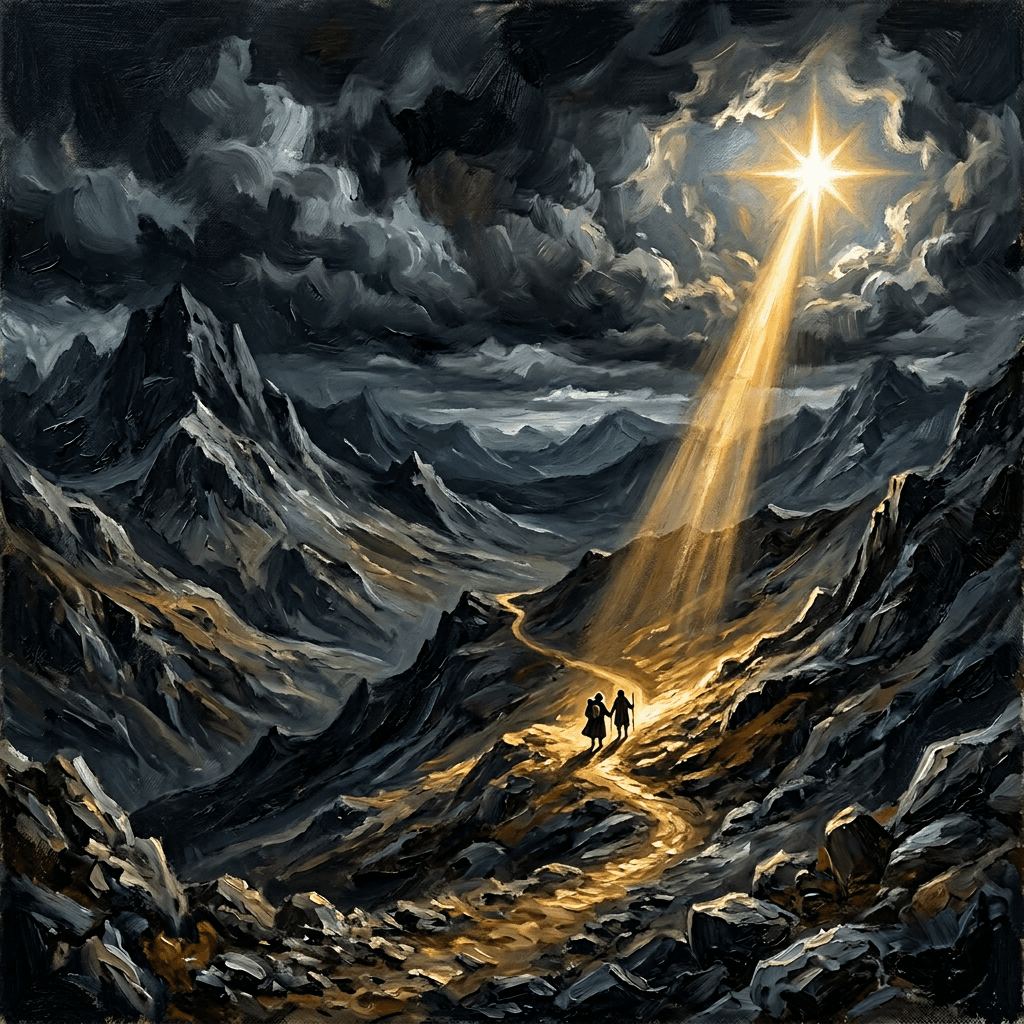
Sam looks up at the sky — at a single star breaking through the clouds above the darkness — and says:
"There, peeping among the cloud-wrack... a white star twinkled for a while. The beauty of it smote his heart, as he looked up out of the forsaken land, and hope returned to him."
In the ugliest place in Middle-earth, Sam looks up and finds something beautiful. He carries hope into places where hope has no business surviving — and that, more than any sword or spell, is what gets them to the end.
Later, when Frodo literally cannot walk another step, Sam says the line that breaks every reader who's ever loved someone through something impossible:
"I can't carry it for you, but I can carry you."
And he does. He puts Frodo on his back and climbs a volcano.
He can't take the Ring. He can't take the pain. But he can put his friend on his back and climb. And sometimes — most times — that's everything.
Think about the people who carried you. Not the ones who fixed your problems — the ones who sat with you inside them. Who held the silence when you couldn't speak. Who showed up with no plan and no answers, just presence. Sam doesn't carry the Ring. He carries the Ring-bearer. And in a story full of kings and wizards and ancient powers, the gardener who packed the cookware is the reason the world survives.
Joy as Resistance
Merry and Pippin start the trilogy stealing vegetables and setting off fireworks. Easy to dismiss. Easy to love.
"What about second breakfast?"
In a story about the end of the world, two hobbits worry about meals. And honestly? They're the sanest ones in the fellowship. Because meals are normal. Meals mean the day still has a rhythm. Meals mean you're alive enough to be hungry, and that's worth protecting — even when everything else is falling apart.
You know the feeling. The friend who cracks a joke at the worst possible moment — in the hospital waiting room, at the funeral lunch, during the 2 AM panic call — and you laugh before you can stop yourself. And the laugh doesn't fix anything. But for three seconds, the weight lifts. Three seconds where you remember you're a person who laughs, not just a person who carries.
That's Merry and Pippin. They carry laughter into the dark like Sam carries hope — stubbornly, instinctively, without ever deciding to be brave.
They get captured by Uruk-hai. Dragged across Rohan. Thrown into a forest of ancient, angry trees. And what do they do? They convince the Ents — beings who haven't gone to war in thousands of years — to march on Isengard. Two halflings who showed up by accident end up turning the tide.
By the end, Merry rides into battle and helps slay the Witch-king. Pippin saves Faramir from his own father's madness. The ones who worried about breakfast ended up saving kings. Growth doesn't always look like growth. Sometimes it looks like two small people, in way over their heads, who simply refused to stay small when it mattered.
The One Who Falls
Boromir is the character everyone gets wrong.
"One does not simply walk into Mordor."
The internet turned it into a meme. But Boromir is the only person at the Council of Elrond speaking plainly about how hard this is going to be. While everyone else talks destiny and strategy, he talks about the actual gates, the actual armies, the actual air that will poison you before you reach the mountain. He's the person in the meeting who says what everyone's thinking and gets punished for it.
He carries Gondor on his back. His father — Denethor, a man being eaten alive by despair — sent him to Rivendell with one instruction: bring me the Ring. Save our city. His people are dying. The enemy is at the gates. And here, in his hands' reach, is a weapon that could end it all.
The Ring doesn't tempt Boromir with power for power's sake. It tempts him with love — love for his city, love for his people, love for the brother fighting a war he can't win. The crack the Ring finds in Boromir is the best thing about him. And it breaks him open.
He grabs for the Ring. He frightens Frodo. And in that moment, the fellowship shatters.
Then the Uruk-hai come. Merry and Pippin — the smallest, the most defenseless — are about to be taken.
And Boromir charges.
One arrow hits him. He keeps fighting.
Two arrows. Still on his feet, still swinging.
Three arrows in his chest, and he's still trying to stand between the hobbits and the enemy. Still trying, with his body failing, to protect the ones he can reach.
Aragorn finds him dying against a tree. Boromir's first words are a confession:
"I tried to take the Ring from Frodo. I am sorry. I have paid."
And then, looking up at the man he'd spent the whole journey questioning:
"I would have followed you, my brother... my captain... my king."
I think about Boromir more than almost anyone in the trilogy. Because good people break. People who love fiercely, who carry too much for too long, who pour themselves into keeping everyone safe — they're the ones the weight finds first. The crack is always in the best part of you. The Ring doesn't corrupt the selfish. It corrupts the ones who care so much they'll do anything.
But Boromir's last act — arrows in his chest, still swinging, spending his final breath on the people he could save — that's the thing worth remembering. We all have moments where the weight wins. Where we reach for something we shouldn't. Where the best parts of us become the thing that breaks us.
What matters is what you do after you break. Boromir spent his last breath on the small and the defenseless. That's the man. Everything else is the Ring talking.
The Unlikely Brotherhood
Legolas and Gimli have no business being friends. Elf and dwarf — their peoples have mistrusted each other for centuries. Legolas's father once threw Gimli's father in a dungeon. The grudge runs deeper than either of them.
They start the journey trading insults. They count kills in battle like it's a competition, because it is. They needle each other the way only people becoming friends bother to — the way you roast someone harder the closer they get.
Gimli sees the Caves of Helm's Deep and swears nothing in Middle-earth compares. Legolas promises to show him Fangorn Forest if Gimli will come. They trade wonders — each one saying the thing I love most, I want you to see. That's not tolerance. That's intimacy. The kind that sneaks up on people who thought they had nothing in common.
When Legolas finally sails to the Undying Lands, he takes Gimli with him. The only dwarf in the history of Middle-earth to make that journey. Because the road dissolved something that centuries of history couldn't.
You don't have to come from the same place. You don't have to see the world the same way. You just have to walk the same road long enough to discover that the person you'd never have chosen is the one you can't imagine the journey without.
The Fellowship Breaks
The company was never meant to last.
Gandalf falls in Moria. Boromir dies on Amon Hen. Frodo and Sam go east. Aragorn, Legolas, and Gimli go west to war. Merry and Pippin are dragged away by the enemy.
Everyone leaves. That's the part that hurts.
Think about your own fellowships. The college friends who were your entire world for four years — where are they now? The colleague who got you through the worst project of your career, who understood everything without explanation — they took a job in another city. The person who sat with you through the worst of it, who you thought would always be there, and then life just... moved.
The fellowship breaks because life breaks everything eventually. People get different jobs, move to different cities, fall in love, fall apart, find roads that lead somewhere you can't follow. And the breaking isn't betrayal. The breaking is just what happens when the road forks and everyone has their own weight to carry.
But here's what stays.
The fellowship gives you something before it breaks — and that something lives in you forever. Enough courage to keep walking when the road splits. Sam's voice in your head saying keep going. Boromir's sacrifice reminding you that broken people can still die protecting someone. Gandalf's words — "All we have to decide is what to do with the time that is given to us" — arriving at 3 AM when you need them most, spoken by someone who isn't there anymore.
Aragorn stands at the river and watches Frodo's boat disappear. His road leads elsewhere — to Helm's Deep, to Gondor, to a crown he's been running from his whole life. He can't follow. But what he says holds:
"I would have gone with you to the end. Into the very fires of Mordor."
He means it. And sometimes meaning it — even when you can't be there — is the most honest thing you can give someone.
The company breaks. The road goes on. And the people who walked with you are still with you — in the way you carry things, in the voice you hear when you're about to quit, in the promise that holds long after the person who made it has gone.
Part 3: The King Who Didn't Claim the Crown — continue reading.