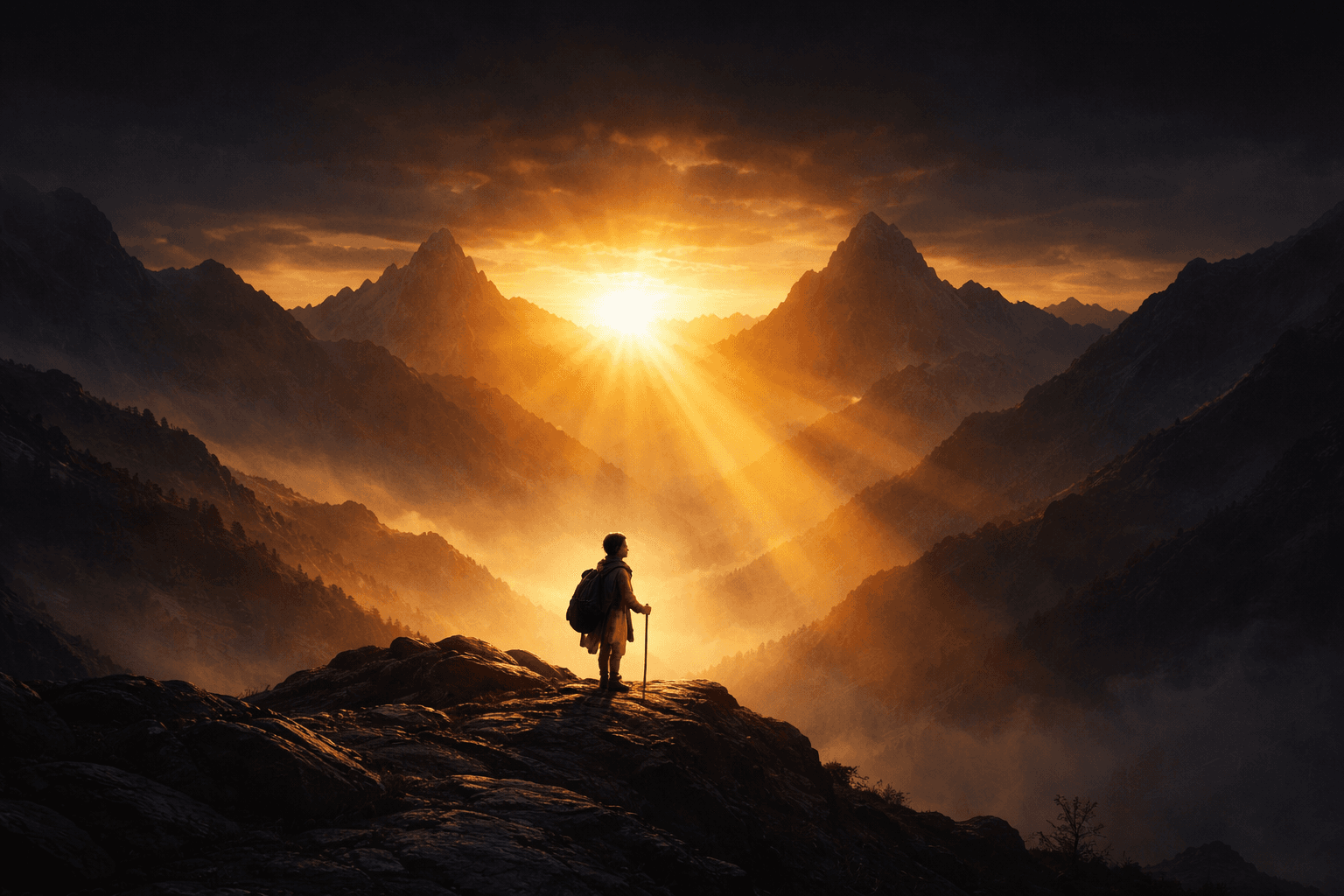
Bilbo Baggins once said something that sounds like advice but lands like prophecy:
"It's a dangerous business, Frodo, going out your door. You step onto the road, and if you don't keep your feet, there's no knowing where you might be swept off to."
He says it casually, the way old people drop wisdom — between meals, half-smiling, already looking at something you can't see. But Frodo will spend the rest of his life learning what that sentence actually means.
We all will.
The Shire
Before anything happens — before rings and wars and the end of the world — there is the Shire.
Green hills. Round doors. Fireworks on birthdays. Ale at the pub. A place so safe that the most dramatic event in recent memory is Bilbo's disappearing act at his own party.
The Shire is where we all start. Not literally — but the feeling. That stretch of life where the world is small and manageable. Where your biggest worry is whether you'll make it to second breakfast. Where danger is something that happens to other people, in other places, in stories you read before bed.
There's a scene early in the journey where Pippin — barely a few miles from home, already concerned about food — turns to Aragorn in genuine alarm.
"What about breakfast?" "You've already had it." "We've had one, yes. What about second breakfast?"
Aragorn walks away without answering. Merry shakes his head. "I don't think he knows about second breakfast, Pip."
It's funny. It's meant to be. But underneath the comedy is something real — the moment where comfort meets the road, and the road doesn't care about your schedule. The world you knew had rules. The road ahead has different ones. And nobody warned you.
Every life has a Shire. And every Shire has a door.
The door doesn't announce itself. It arrives as a phone call at 2 AM. A diagnosis you weren't expecting. A responsibility that falls into your hands because there's no one else to hold it. One day the world is green hills and round doors, and the next day a wizard is sitting in your living room telling you the thing in your pocket could end everything.
You don't leave the Shire because you're brave. You leave because staying is no longer an option.
The Smallest Person in the Room
The Council of Elrond is one of the great scenes in all of fiction — and almost nothing happens.
Elves, dwarves, men, wizards. The most powerful beings in Middle-earth, gathered in one place to decide the fate of the world. Elrond lays it out plainly: "The Ring was made in the fires of Mount Doom. Only there can it be unmade. One of you must do this."
And they argue. They bicker. They point fingers. Boromir wants to use the Ring as a weapon. Gimli tries to destroy it with an axe. Everyone has a plan that conveniently puts them in charge.
And then a hobbit speaks.
"I will take the Ring to Mordor."
Quiet. Almost apologetic. "Though... I do not know the way."
No grand speech. No confidence. Just the smallest person in a room full of giants, saying the thing no one else will say — that someone has to carry this, and since no one else is stepping forward, it might as well be him.
Galadriel will later tell him: "Even the smallest person can change the course of the future."
She's right. But here's what she doesn't say: the smallest person usually changes it precisely because they're small. Because they have no ambition tied to the task. No ego invested in the outcome. They carry the weight because it needs carrying, not because carrying it makes them important.
Purpose rarely arrives with a crown. It arrives with a quiet voice in a crowded room, saying "I'll do it" — while hoping someone else might volunteer first.
That's how it works in life too. The person who ends up carrying the heaviest thing is rarely the strongest person in the room. They're the one who couldn't look away. The one who said yes because silence felt worse than the weight.
The Guide Who Falls
"A wizard is never late, Frodo Baggins. Nor is he early. He arrives precisely when he means to."
Gandalf is the archetype of the mentor — the one who sees further, knows more, and somehow always shows up at the exact right moment. He's the parent who had the answer before you had the question. The teacher who believed in you before you believed in yourself. The boss who saw something in you that you hadn't found yet.
He guides. He protects. He nudges Frodo toward courage without pushing him into it. And when Frodo says he wishes the Ring had never come to him — wishes none of this had happened — Gandalf answers with the sentence that holds the entire trilogy together:
"So do all who live to see such times. But that is not for them to decide. All we have to decide is what to do with the time that is given to us."
Sit with that for a moment. Every human being who has ever faced something they didn't choose has felt exactly what Frodo feels in that mine. The wish to rewind. The longing for the Shire. The quiet rage at the unfairness of being the one holding the weight.
And Gandalf doesn't fix it. He doesn't take the Ring. He doesn't promise it gets easier. He simply says: you didn't choose the burden, but you choose how you carry it.
Then he falls.
The Bridge of Khazad-dum. A Balrog — "A demon of the ancient world. This foe is beyond any of you. Run!" — blocks the path. The Fellowship runs. Gandalf stays.
"You shall not pass!"
He breaks the bridge. The Balrog falls. And Gandalf, caught by the creature's whip, goes with it. His last words to the people he loves:
"Fly, you fools!"
Gone. Just like that. The wisest, most powerful member of the company, swallowed by the dark. The one person who made the road feel survivable, taken from it in a single breath.
Every life has this moment. The parent who was your anchor — gone. The mentor who saw your potential — moved on, or passed on. The person whose voice in the room made you feel like things would be okay, suddenly absent.
And the road doesn't stop. That's the part no one prepares you for. The road keeps going, and now you walk it without the one person who made you believe you could.
Gandalf returns, transformed. But the Fellowship doesn't know that. They grieve. They stumble. They walk through Lothlorien with a hole in the group where certainty used to be. And that walk — the one without the guide — is where they become who they need to be. The guide has to fall. Otherwise you never discover the strength was yours all along.
The Weight Nobody Sees
There's a moment, easy to miss, where Galadriel says something that cuts deeper than any sword in the story:
"To bear a Ring of Power is to be alone."
She's talking about the Ring. But she could be talking about anything we carry that others can't feel.
The grief that sits in your chest while everyone around you goes about their day. The responsibility you can't hand off. The worry that wakes you at 3 AM and sits with you in the dark. The thing that's slowly wearing you down — and you smile through it because what else are you going to do?
The Ring is Tolkien's way of giving that invisible weight a shape. A small gold circle that gets heavier with every step. That whispers to you in moments of weakness. That slowly turns you into someone you don't recognize if you carry it long enough.
Gollum knows. "It came to me, my own, my love... my preciousssss." He carried the Ring for five hundred years. It ate him alive — his body, his mind, his name. Smeagol became Gollum. The burden became the identity. Gandalf understood this when he told Frodo: "Many that live deserve death. Some that die deserve life. Can you give it to them, Frodo? Do not be too eager to deal out death in judgment. Even the very wise cannot see all ends."
Mercy over judgment. That's the instruction. Because the creature crawling in the dark was once a person too — and you don't know how heavy the thing was that broke them.
The Boat
At the end of The Fellowship of the Ring, the company is broken. Gandalf is gone. Boromir has fallen. Merry and Pippin are captured. The grand alliance that was supposed to carry the Ring to Mordor has shattered in every direction.
And Frodo sits alone in a boat on the shore of the river, Ring in hand, ready to go on by himself. He has decided — quietly, without announcement — that the Ring's corruption will take everyone he loves if he lets them stay close. So he pushes off. Alone.
But he's not alone.
Sam — loyal, stubborn, beautiful Sam — wades into the water after him. He can't swim. He doesn't care. He made a promise.
"I made a promise, Mr Frodo. A promise. 'Don't you leave him Samwise Gamgee.' And I don't mean to. I don't mean to."
Frodo pulls him into the boat. And for a moment — just a breath — the weight shifts. Because someone chose to follow you into the dark, knowing exactly what it costs, and came anyway.
"I'm glad you're with me, Sam."
The road goes on. The Ring gets heavier. Mordor is still waiting. But you're not alone. You never were.
And somewhere behind them, Aragorn stands at the river's edge, watching the boat disappear. He couldn't go with Frodo. The road ahead demanded something different from him — a king's burden, waiting. "I would have gone with you to the end," he tells Frodo. "Into the very fires of Mordor."
He means it. But the road splits. Not every companion walks the whole way with you. Some leave. Some fall. Some take a different path because their own weight is calling. And the road they walked with you still matters — even after they're gone.
The company is broken. The guide has fallen. The road ahead is darker than anything behind.
But the smallest person is still walking. And someone is walking with him.
Part 2: The Company You Keep — continue reading.