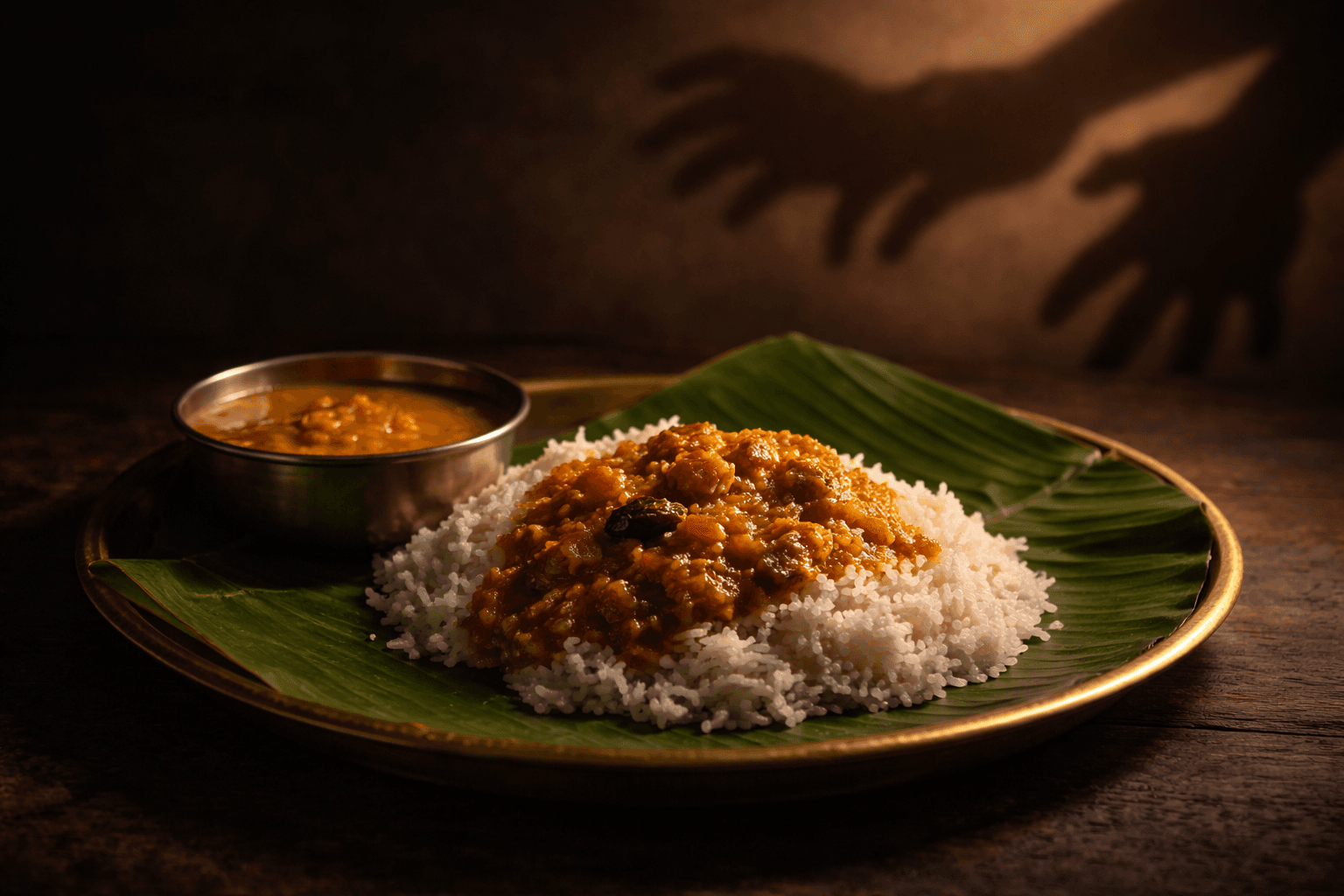
India produces more food than any country on earth except China. It is the world's largest producer of milk and pulses, and the second-largest of rice and wheat. The Food Corporation of India sits on over 80 million tonnes of grain in its warehouses — four times the required buffer stock. That surplus alone could feed every hungry person in India twice over.
194 million Indians are undernourished. The Global Hunger Index ranks India 105th out of 127 countries — in the "serious" category, below Ethiopia, below Bangladesh, below Nepal. 35% of Indian children under five are stunted. 18% are wasted. These are not numbers from a country that cannot grow food. These are numbers from a country that cannot distribute it.
India's hunger is not a scarcity problem. It is a policy failure. And to understand how deeply political that failure is, you need to understand the one state that solved it — and why.
When Food Was a Weapon
Before we talk about ration shops and rice schemes, we need to talk about what food meant in the villages where most Indians lived.
In caste-ordered India, food was never just nutrition. It was hierarchy made visible. Dalits were prohibited from drawing water from the same wells as upper castes — a practice documented in 48% of villages surveyed. They ate from separate plates, drank from separate cups, sat on separate ground. Inter-dining — the simple act of eating together — was prohibited in over 70% of villages. In 40% of schools, untouchability was practiced during mid-day meals — the children of the oppressed eating separately from the children of their oppressors, under the same roof, in a government institution, with government food.
Food was not scarce in these villages. What was scarce was the right to eat with dignity. Landlords controlled the harvest. They controlled the wages — often paid in grain, at rates they set. They controlled the common land where the landless could forage. When a Dalit family refused to work for exploitative wages, the punishment was not violence alone. It was starvation. The denial of food was the quietest, most effective form of caste enforcement — because it left no marks, and the victim's suffering looked like poverty rather than oppression.
On Christmas night, 1968 — eighteen months after the Dravidian movement won power for the first time — the feudal system showed what it thought of Dalits asserting economic agency. In Keezhvenmani village, East Thanjavur, Dalit agricultural labourers had organized to demand a modest wage increase: six measures of paddy for every forty-eight harvested. The Green Revolution had boosted yields. The labourers wanted a share. The landlords, organized under the Paddy Producers' Association, refused.
On December 25, roughly 200 armed men arrived in lorries. They shot at the labourers. Then they surrounded a small hut — eight feet by nine — where women, children, and the elderly had taken refuge. And they set it on fire.
44 people burned alive. 22 children. 18 women. 2 men. 2 elderly. The youngest was an infant.
A district court convicted the landlords in 1970. The Madras High Court acquitted all of them in 1975 — ruling that the arsonists were "unaware" people were inside the hut they set ablaze.
This is the world that Dravidian politics entered. This is what Kalaignar Karunanidhi was governing against when he built the universal food system. Not a welfare programme designed in an air-conditioned office — a direct assault on the feudal order that burned Dalits alive for asking to eat. The landlords controlled the harvest, set the wages, and used starvation as enforcement. Kalaignar's rice scheme didn't just feed people. It broke the landlord's monopoly on food. The state became the provider, bypassing the caste gatekeeper entirely. In 1960s feudal Tamil Nadu, this was not policy. This was revolution.
The Revolution Nobody Talks About
In 1967, C.N. Annadurai — fondly called Anna — won the Tamil Nadu election — the first time the Dravidian movement held power. Among his earliest acts was a promise that now sounds modest but was radical for its time: one padi of rice (roughly 1.5 kg) for one rupee. He launched the scheme in Chennai, then extended it. When Anna died in 1969, Kalaignar Karunanidhi inherited the project and the principle behind it — that no family in Tamil Nadu should go hungry, regardless of who they are or what they earn.
Consider what this man was doing. It was the late 1960s. Feudal landlords still controlled the countryside. Dalits were being burned alive for asking for wages. The caste system's grip on food — who eats, who starves, who decides — was unbroken across most of India. And here was Kalaignar Karunanidhi, a first-generation leader from a movement founded by Periyar — a man who was himself radicalized after being denied food at Brahmin-only choultries — building a system that said: the state will feed everyone, and no landlord, no caste head, no village elder will stand between a family and its next meal.
His first act as Chief Minister in 1969 was legalizing self-respect marriages — dismantling caste control over who you can love. His food policy was the economic parallel — dismantling caste control over whether you can eat. Universalism was not a fiscal convenience. It was the Dravidian ideology of suyamariyathai — self-respect — made material.
What followed over the next five decades was not a single policy but an architecture. Kalaignar Karunanidhi expanded the Tamil Nadu Civil Supplies Corporation (தமிழ்நாடு நுகர்பொருள் வாணிபக் கழகம்), first proposed in 1969 by his food minister, into a statewide network of fair price shops. The Public Distribution System in Tamil Nadu became something no other Indian state built at the same scale: universal.
Universal meant everyone. Not just families below the poverty line. Not just those who could produce a BPL card. Everyone. The rich family and the Dalit family went to the same ration shop, stood in the same line, received the same rice. In a society built on separation, this was not merely an administrative choice. It was a political statement.
By 2008, Kalaignar Karunanidhi launched rice at ₹1 per kilogram — 20 kg per family per month — on Anna's 100th birth anniversary. In 2011, Jayalalithaa went further: free rice. Twenty kilograms per family per month, at zero cost. This continues today.
Tamil Nadu now operates 33,222 fair price shops — 1.3 per revenue village, nearly double the national average of 0.68. 2.22 crore family ration cards cover approximately 7 crore beneficiaries. Rice, wheat, sugar, dal, oil, and kerosene — all at subsidized or zero cost.
The Four Days That Defined a State
In 1997, the Government of India shifted from universal PDS to targeted PDS. The argument was fiscal efficiency: why subsidize food for families that can afford it? Identify the poor with BPL cards, give them subsidized grain, and save the rest.
Tamil Nadu did not implement this. It stood by its people. The right to food had become so deeply embedded in Tamil political identity that no party — DMK, ADMK, or any other — has dared to propose targeting the PDS in Tamil Nadu since.
This is exactly the argument for universalism. When everyone benefits from a system, everyone defends it. When only the poor benefit, the middle class has no stake in its survival — and the system erodes. This is not theory. This is what happened to targeted PDS across India: leaky, corrupt, underfunded, because the people with political power had no reason to fight for it.
A targeted system asks you to prove you are poor. In a country where caste and poverty overlap, the BPL card becomes a new marker of inferiority — a government-issued certificate of deprivation. Universal PDS asks nothing. It treats food as a right, not a concession.
The World That Still Can't Do This
The World Food Programme — the largest humanitarian organization on earth — reached 124.4 million people in 2024, delivering 16.1 billion daily rations across 74 countries. Its budget requirement for 2025 is $16.9 billion. It is chronically underfunded.
343 million people across 74 countries are acutely food insecure. In Sudan, famine was officially confirmed in 2024 — 755,000 people in catastrophic hunger. South Sudan: 7.7 million in crisis. Nigeria: 30.6 million food insecure. Sub-Saharan Africa alone accounts for $8.4 billion of the WFP's needs — half the global total.
These are countries with genuine scarcity — conflict zones, climate disasters, collapsed states. India is none of these things. India is a nuclear power with a space programme and the world's fifth-largest economy. It grows enough food to feed every citizen and has a surplus that rots in government warehouses while children die of malnutrition.
The contrast is not between India and Sudan. The contrast is between Tamil Nadu and the rest of India.
| Metric | Tamil Nadu | Bihar | India Average |
|---|---|---|---|
| Child stunting (under 5) | 25% | 42.9% | 35.5% |
| Multidimensional poverty | 4.89% | 33.76% | 14.96% |
| PDS shops per revenue village | 1.3 | — | 0.68 |
| SDG Goal 1 (No Poverty) score | 78 | 57 | — |
Tamil Nadu is not richer than Bihar because of geography or luck. It is less hungry because sixty years ago, a political movement decided that food is a right — and built the institutions to deliver it.
What the Rest of the World Did
The countries that solved hunger did not do it by growing more food. They did it by deciding to distribute what they had.
Brazil: Lula's Fome Zero programme (2003) combined cash transfers (Bolsa Familia reaching 14 million families), school meals, and food banks. Brazil was removed from the UN Hunger Map by 2014. Hunger dropped from 10.7% to under 2.5% in a decade.
China: Lifted 800 million out of poverty between 1978 and 2020. Undernourishment fell from 23.9% to under 2.5%. State-controlled grain reserves combined with massive rural investment.
Cuba: Despite a US embargo that has lasted six decades, Cuba's universal ration book (the libreta) covers roughly 60% of caloric needs for every citizen. Child stunting is under 7% — comparable to the United States.
Sri Lanka: Had strong food subsidies for decades. In 2022, the Rajapaksa government's organic farming mandate and fiscal austerity collapsed food availability overnight. Inflation hit 70%. Rice prices tripled. A cautionary tale of what happens when a government cuts the system that feeds its people.
The pattern is the same everywhere: hunger ends when a government decides it should end. Not when GDP rises. Not when food production increases. When someone in power says "this is unacceptable" and builds the architecture to make it stop.
In Tamil Nadu, that someone was a succession of Dravidian leaders — Anna, Kalaignar Karunanidhi, Kamaraj, and now Stalin — who understood that the first condition of self-respect is a full stomach.
The Breakfast Revolution
In September 2022, MK Stalin launched something that had never existed in any Indian state: a government-funded breakfast programme for school children.
The Chief Minister's Breakfast Scheme started with 1.14 lakh students. By July 2024, it covered 21.87 lakh students across Tamil Nadu — served hot breakfast every school day before classes begin. Budget: ₹1,138 crore over five years.
The results are not subtle. School attendance increased 30%. Of 92,000 malnourished children identified in urban areas, 62,000 recovered. Hospital admissions among covered students dropped 63%.
And then there is the Thayumanavar scheme — named after the Tamil poet-saint, launched in February 2024 with a budget of ₹27,922 crore. Its target: lift 5 lakh of the most extremely poor families out of poverty within two years. Destitute families, elderly living alone, single parents, orphaned children, persons with disabilities. The scheme works by converging all existing government programmes — housing, education, employment, financial assistance — into a single framework so the poorest families receive everything together rather than navigating ten different bureaucracies. Tamil Nadu's multidimensional poverty is already at 4.89% — among the lowest in India. The goal is zero.
A separate doorstep delivery component launched in August 2025 delivers ration supplies directly to 21.7 lakh elderly and disabled citizens who cannot walk to the ration shop. The state goes to them.
Think about what that means. A child who was going to school hungry — too distracted to learn, too tired to concentrate, too malnourished to grow properly — now eats before the first bell. The cost is ₹520 per child per year. The return is a generation that shows up, pays attention, stays healthy, and finishes school.
India's national Mid-Day Meal Programme — which feeds 120 million children in 1.27 million schools, the largest school feeding programme on earth — was modelled on Tamil Nadu. The concept traces back to 1920, when the Chennai Corporation — then governed by the Justice Party, the predecessor of the Dravidian movement — approved tiffin for students at Thousand Lights school. Kamaraj formalized it in the 1960s. India adopted it nationally in 1995 — thirty-five years after Tamil Nadu proved it worked.
The WFP reports that school feeding programmes in 163 countries reach 418 million children worldwide. Every one of those programmes owes an intellectual debt to a state in southern India that started feeding its schoolchildren a century ago — not because the UN told it to, but because its leaders believed hungry children cannot learn.
The Dignity Arithmetic
There is a utilitarian argument for universal PDS: it reduces malnutrition, it improves school attendance, it increases productivity, it costs less in healthcare downstream. All of this is true and all of it misses the point.
The point is dignity.
When India shifted to targeted PDS, the exclusion errors were catastrophic. An estimated 100 million genuinely poor people were excluded because of errors in BPL identification — wrong surveys, outdated data, bureaucratic indifference, and the structural reality that the poorest people are the least visible to the state. The World Bank and IDS Sussex both confirmed that exclusion errors in targeted systems cause more damage than inclusion errors in universal ones.
But the deeper damage was not statistical. It was human. A targeted system requires you to prove you are poor. You stand in a government office. You show documents. A bureaucrat decides whether your suffering is sufficient to qualify for subsidized rice. In a country where poverty is layered onto caste, this process recreates the very hierarchy that food security was supposed to dismantle. The BPL card becomes a new marker — a government-certified stamp of deprivation that follows you into every interaction with the state.
Universal PDS has none of this. You walk into the ration shop. You show your card. You take your rice. No one asks whether you deserve it. No one decides whether you are poor enough. The system treats you as a citizen, not a supplicant.
In a state where Dalits were once denied the right to draw water, the right to eat from the same plate, the right to sit at the same table — a ration shop where everyone stands in the same line is not just a food programme. It is the quiet, daily undoing of a thousand years of hierarchy.
The Numbers India Should Be Ashamed Of
India wastes approximately 68 million tonnes of food every year. That is enough to feed every undernourished person in sub-Saharan Africa. The FCI warehouse surplus — the grain the government already owns, already stored, already paid for — exceeds 80 million tonnes against a required buffer of 21 million. The excess rots.
Meanwhile, India's per capita food availability is 2,500 kcal per day — adequate on paper. Sub-Saharan Africa's is 2,200 kcal per day. Yet India's malnutrition outcomes are worse than sub-Saharan Africa's on several metrics. These children do not live in a food-deficit country. They live in a food-surplus country that has chosen, through policy and indifference, not to feed them.
The choice is visible. Tamil Nadu chose differently. It chose universal PDS, free rice, school meals, and now breakfast — not because it is richer than Bihar (it wasn't, in 1967) but because its political leadership believed that hunger is a political failure, not an economic inevitability.
India does not have a food problem. India has a distribution problem disguised as a poverty problem, built on a caste system that treated the hunger of the oppressed as natural. Tamil Nadu proved — sixty years ago — that it is not natural. It is a choice. And it can be unchosen.
What This Means for 2026
The DMK's 2026 manifesto promises to expand the breakfast scheme, increase PDS commodities, and maintain universal coverage. These are not revolutionary promises. They are maintenance of a revolution that happened decades ago.
The revolution was not rice at ₹1 per kilogram. The revolution was the idea that food is not charity. That a government's first obligation is to ensure that no citizen goes hungry. That universalism — not targeting, not means-testing, not deserving-poor bureaucracy — is how you build a system that survives political cycles and serves the last person.
Brazil did it with Fome Zero. China did it with state reserves and rural investment. Cuba did it with a ration book under an embargo. Tamil Nadu did it sixty years before any of them — with fair price shops, mid-day meals, and a political movement that understood something the rest of India still hasn't learned:
A full stomach is the first condition of self-respect. Everything else — education, employment, dignity, political participation — begins with the certainty that you will eat today. Tamil Nadu built that certainty into its governance architecture six decades ago. The rest of India — the world's largest food producer, sitting on mountains of rotting grain while 194 million go hungry — has no excuse left.