Two thousand years ago, a Tamil poet asked three questions and answered them with rain.
Who are our mothers to each other? Our fathers — what relation do they share? How do you and I even know each other?
And then, without waiting for logic to catch up:
யாயும் ஞாயும் யாரா கியரோ, எந்தையும் நுந்தையும் எம்முறைக் கேளிர், யானும் நீயும் எவ்வழி யறிதும், செம்புலப் பெயல்நீர் போல, அன்புடை நெஞ்சம் தாங்கலந்தனவே.
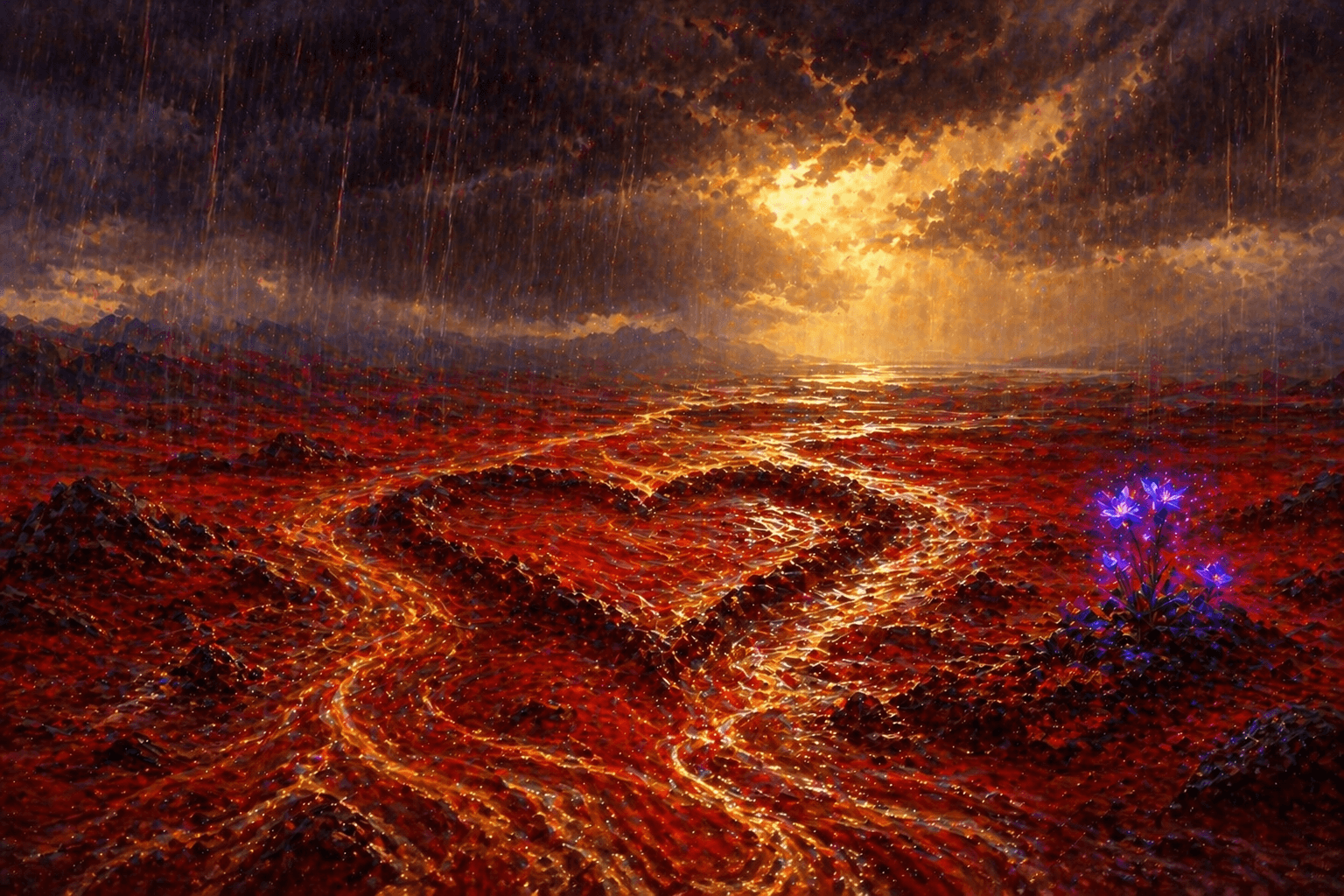
What could my mother be to yours? What kin is my father to yours anyway? And how did you and I meet ever? Like rain on red earth, our loving hearts have merged.
That's Kurunthogai 40. Five lines. No mythology, no gods intervening, no family saga. Just two people who have no business being together — and a monsoon that doesn't care about bloodlines.
The poet's name is Sempulappeyaneeraar. Which, translated, means "he of the rain-water on red earth." We don't know if the poet was named after the poem or the poem after the poet. That ambiguity feels right. When something this honest gets written, authorship almost doesn't matter. The words merge with the world, the way the rain merges with the soil.
In 2018, composer Shabir opened a song in the Tamil film Sagaa with this exact verse. No paraphrasing, no modernizing. Just the original Sangam Tamil, two millennia old, sung by Naresh Iyer and Rita Thyagarajan as if it were written yesterday. The song — Yaayum — crossed 24 million views. A small film, no star power, a debutant composer. And yet, millions of young Tamils heard Sangam poetry for the first time through a love song in their earphones.
That tells you something. The words didn't need updating because the feeling never aged.
Love Has Geography
Here's what the ancient Tamils understood that the rest of the world is still catching up to: love has landscape.
The Sangam poets didn't just write about love. They built an entire geography for it. The Tolkappiyam — the oldest surviving Tamil grammar, older than most things humans have written down — codified five emotional landscapes called tinai. Each one maps a phase of love to a terrain, a flower, a time of day, even a season.
This wasn't decoration. It was taxonomy. A complete emotional atlas, centuries before the French troubadours, millennia before Spotify playlists sorted your feelings into moods.
The Five Tinai — Love's Emotional Atlas
| Tinai | Landscape | Emotion | Flower | Time of Day |
|---|---|---|---|---|
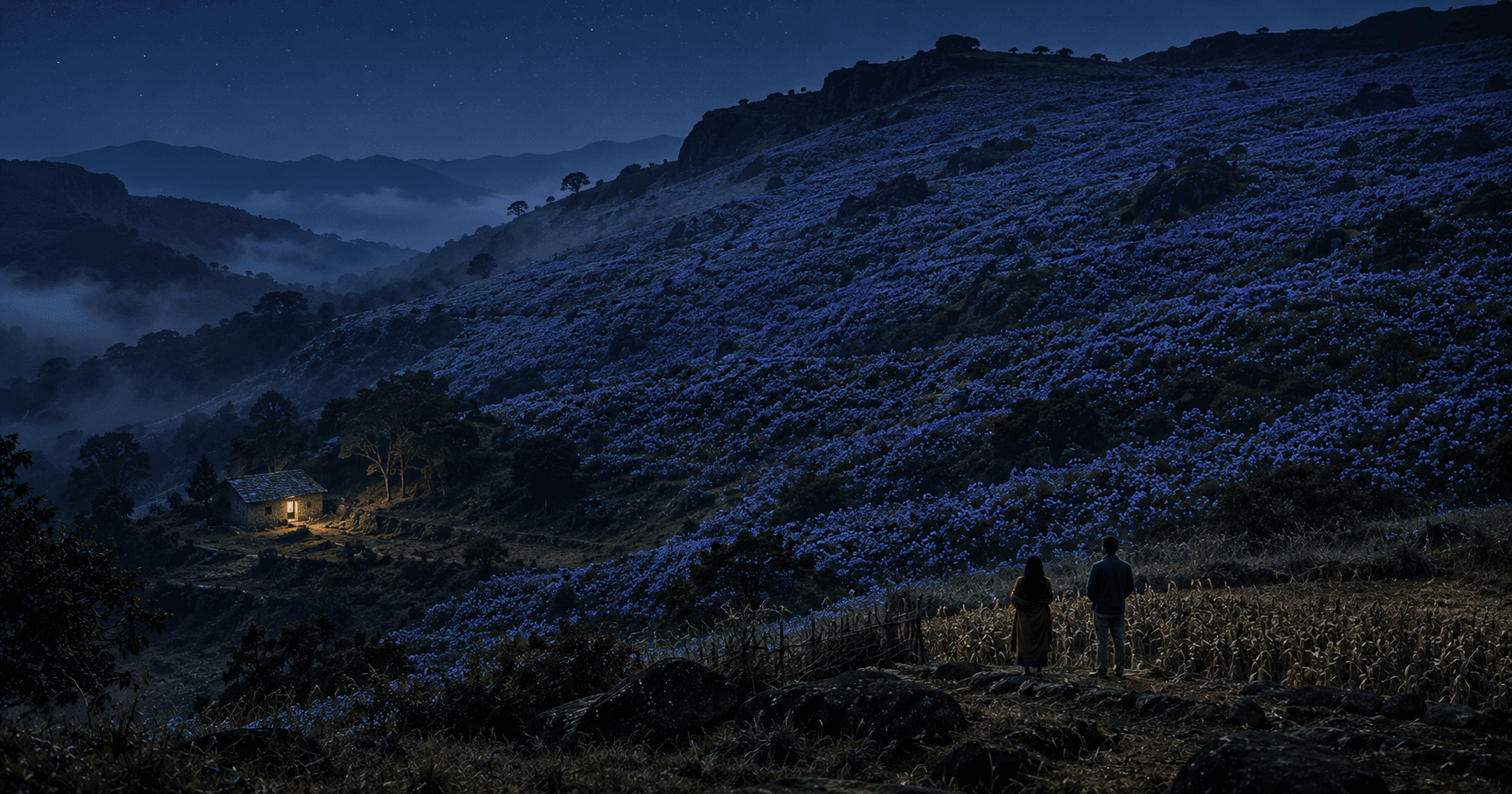
| Kurinji | Mountains | Secret union, first love | Kurinji (blooms once in 12 years) | Midnight |
| Mullai | Forest, pastoral | Patient waiting, faithfulness | Jasmine | Evening |
| Marutham | Farmland, river plains | Lovers' quarrel, jealousy | Queen's Crape Myrtle | Before dawn |
| Neithal | Seashore | Pining, longing | Water lily | Sunset |
| Palai | Desert, wasteland | Separation, hardship | Ivory wood | Noon |
Look at Neithal — love as coastline. The sunset over the sea, the horizon where the lover vanished, the shore that connects and separates at the same time. Every love song about staring out a window? That's Neithal. The Sangam poets just gave it an address.
Or Palai — the desert. The Tolkappiyam makes a devastating observation: Palai is not a naturally occurring landscape. It is what any of the other four becomes when scorched by drought. Separation isn't a place. It's what happens when any love is subjected to unbearable heat.
And then there's Kurinji, where love is secret and the flower that represents it blooms once every twelve years. Think about that. The rarest bloom for the rarest feeling. The ancients didn't believe first love happened every Tuesday.
The Playlist the Sangam Poets Already Wrote
Now here's where it gets interesting. Take any love song you've ever played on repeat at 2 AM, and it maps to a tinai. The Sangam poets already wrote the playlist. The rest of us just keep adding tracks.
George Michael stands at the edge of a dance floor in 1984, saxophone wailing behind him, singing Careless Whisper. He has betrayed someone. The guilt is physical — "guilty feet have got no rhythm." He will never dance the same way again.
That's not longing for someone else. That's longing for who he was before he ruined it. The shore after the ship has sailed and it was his hand on the wheel.
Sinéad O'Connor, six years later, sits in a white room with a shaved head and sings Nothing Compares 2 U. A tear falls, unscripted. She has tried everything — going out, filling time. Nothing works. The person she lost has become the unit of measurement against which all of life falls short.
Adele knocks on her ex-lover's door. He's married now. Settled. Someone Like You is the moment grief begins its slow, unwilling turn toward acceptance. "Never mind, I'll find someone like you" — a lie and a prayer in the same breath.
Three songs. Three decades. All Neithal. All standing at the water's edge, watching someone disappear into the horizon.
Lionel Richie picks up the phone in the opening seconds of Hello and says, "I've been alone with you inside my mind." He has loved this person a thousand times in his imagination. Never once in reality. Mullai is evening — the cows returning home, the jasmine blooming, the lover who hasn't come back yet. Richie is the man standing at the forest's edge, waiting.
Elvis Presley — and this is the beautiful part — sings Can't Help Falling in Love on a melody borrowed from Plaisir d'Amour, a French love song from 1784. "Wise men say only fools rush in." He knows patience would be wiser. He surrenders anyway. Mullai isn't just patience. It's patience that knows it has already lost the argument.
Eric Clapton watches his partner brush her hair in Wonderful Tonight and is simply moved. No drama, no desperation. Just a man in a doorway watching the most ordinary thing in the world and finding it extraordinary. Mullai at its quietest — the evening hour where love isn't tested, just lived.
Ed Sheeran's Perfect — barefoot on grass, dancing in the dark, the whispered certainty of "you look perfect tonight." This is Kurinji. Midnight in the mountains. The secret place where two people find each other and the Kurinji flower blooms, rare and overwhelming.
Elton John, barely twenty-three, sits at a piano and offers Your Song. "If I was a sculptor, but then again, no." He has nothing to give except this melody and the honest admission that no gift will ever be enough. Kurinji's midnight — the vulnerability of first love spoken aloud for the first time.
Now listen to Bryan Adams shout from a castle wall — Everything I Do, I Do It for You. Sixteen weeks at number one. Total, unconditional devotion. That's Marutham energy turned inside out — the fertile plain where love is so abundant it becomes the organizing principle of an entire life. And Whitney Houston's I Will Always Love You — she's leaving, she knows it's right, but her love will outlast the relationship. That's the Marutham harvest: you reap what the land grew, even after you've walked away from the farm.
Across the Sea — The French Knew Too
There's a reason Paris is the city of love, and it isn't just the bridges.
In the 11th century, troubadour poets in southern France invented something they called fin'amor — refined love. Guillaume IX, Duke of Aquitaine, was writing elaborate poetry about the ache of loving someone above his station, declaring that love creates its own hierarchy, indifferent to the one society built. This was radical. A nobleman saying that a peasant's love is as legitimate as a king's desire.
Sound familiar? Yaayum Njayum Yaaraagiyaro — who are our mothers to each other?
The Sangam poets said it a thousand years earlier. But the French ran with it in a different direction. Where Tamil poetry mapped love to nature — red earth, monsoon, jasmine at dusk — French culture mapped love to philosophy.
The French gave us amour fou — mad love. André Breton wrote in 1937 that beauty must be "convulsive or not at all." For the Surrealists, love had to shake you to the foundation. Anything less wasn't real.
The Sangam poets would have understood. They called it iyarkai punarchi — natural, spontaneous union. Love that happens without arrangement, without permission, without social scaffolding. Two things meeting the way rain meets red earth.
Different words. Same monsoon.
Pierre de Ronsard, the prince of French poets, wrote in the 16th century: "Ronsard me célébrait du temps que j'étais belle" — Ronsard celebrated me in the days when I was beautiful. A poem urging his beloved to love now, while time permits. The Kurinji flower blooms once in twelve years. Ronsard and the Sangam poets both understood that love has a clock.
And then there's Jacques Prévert, who in 1945 wrote the most quietly devastating love poem in French:
Mais la vie sépare ceux qui s'aiment, tout doucement, sans faire de bruit. But life separates those who love each other — gently, without making a sound.
That's Palai. The desert. Except Prévert doesn't give you the scorching noon. He gives you the silence. The slow evaporation. Life doesn't rip lovers apart with a dramatic goodbye — it just turns up the heat, degree by degree, until the landscape is unrecognizable.
Édith Piaf sang La Vie en Rose — life in pink — and meant it as defiance. Love doesn't just make you happy; it reconstructs reality. The whole world changes colour because someone whispered the right words. Jacques Brel begged Ne Me Quitte Pas — don't leave me — with a desperation that had no dignity and no interest in finding any. He promised to become the shadow of her shadow, the shadow of her hand, the shadow of her dog. The French refused to separate love from humiliation. They understood that the truest declarations come without armor.
And Serge Gainsbourg whispered Je t'aime... moi non plus — I love you, me neither — and got banned by the BBC and condemned by the Vatican. Because French love refuses to separate the sacred from the physical. The title itself is a contradiction held in suspension. I love you. Actually, no. Actually, yes.
English love songs want to land somewhere. French love songs are comfortable living in the tension.
The Skeptic's Question
And then there's Tina Turner.
- The charts are drowning in declarations — Lionel Richie on the phone, George Michael on the dance floor, everyone falling, surrendering, promising forever. Into this landscape walks a woman who has every reason to distrust the word "love," and she asks:
What's love got to do with it?
Turner called love "a second-hand emotion." Not even a primary feeling — something constructed, assembled from more basic impulses. Physical attraction? Real. The way someone makes your heart race? Real. But love? That's just the label we slap on top to make the biology feel noble.
The song never resolves. Most love songs — even the skeptical ones — eventually surrender. Turner never does.
She had earned that skepticism. Her relationship with Ike Turner had taught her that "love" could be a weapon, a leash, a justification for violence. When she sings "who needs a heart when a heart can be broken," she's not being clever. She's being precise.
And yet — here's what makes the song essential to this essay — Turner doesn't say love doesn't exist. She says the feeling is real but the word might be a con. She's questioning the taxonomy itself. Two thousand years of Sangam poets naming every shade of love, French troubadours building philosophies around it, and Turner stands at the microphone and asks: what if all the naming is the problem?
It's the question every honest love song has to face eventually. Are we describing something real, or are we creating it by describing it?
The Rain Doesn't Answer
Here's what I keep coming back to.
Sempulappeyaneeraar didn't explain love. He didn't classify it, philosophize about it, or question whether it was real. He just pointed at the rain falling on red earth and said — that. That's what happened to us.
The French built cathedrals of thought around love. The English wrote power ballads. The Germans probably have a forty-letter compound word for the specific melancholy of loving someone who is standing right next to you. Tina Turner asked if any of it was real.
But the Sangam poet just pointed at the ground.
Red earth. Rain. Merged beyond parting.
No mothers needed to approve it. No fathers needed to arrange it. No prior acquaintance needed to justify it. Just two things that had no business becoming one thing — and a monsoon that didn't check the guest list.
Every love song ever written is a footnote to a monsoon that fell on Tamil soil two thousand years ago.
The Kurinji flower will bloom again. The jasmine will open at dusk. The shore will hold its shape against the tide. And somewhere, a composer will reach for the oldest words he knows to say the newest thing he feels — and he'll find that a poet who named himself after rain already said it better.
The taxonomy is beautiful. The philosophy is beautiful. The songs are beautiful.
But love doesn't need any of it.
It just needs red earth. And rain.
This is the first in a new series on Love — from Kurunthogai to Kannadasan, from Vaali to Vairamuthu, from George Michael to Édith Piaf. We'll go deeper into the songs and poems we touched here — what makes Careless Whisper the guiltiest sax solo ever recorded, why Brel's Ne Me Quitte Pas is the most undignified and honest thing a man has ever sung, what Prévert's falling leaves have in common with Neithal shores. There is so much more to say. This was just the rain. The floods are coming.