This is Part 7 of the Dravidian Movement series. Read Part 1: The Architects of Dignity on the people who built the movement. Read Part 2: The Numbers Don't Lie on what a century of social justice produced in data. Read Part 3: The Unfinished Revolution on the fight against caste violence. Read Part 4: The Dravidian Model, Tested on five years of MK Stalin's government. Read Part 5: The Reasons Remain on Anna's demand for Dravida Nadu and the grievances that were never resolved. Read Part 6: What They Want to Take on the Delimitation Bill and the covenant broken.
The Paradox
There is one state in India the Bharatiya Janata Party has never governed.
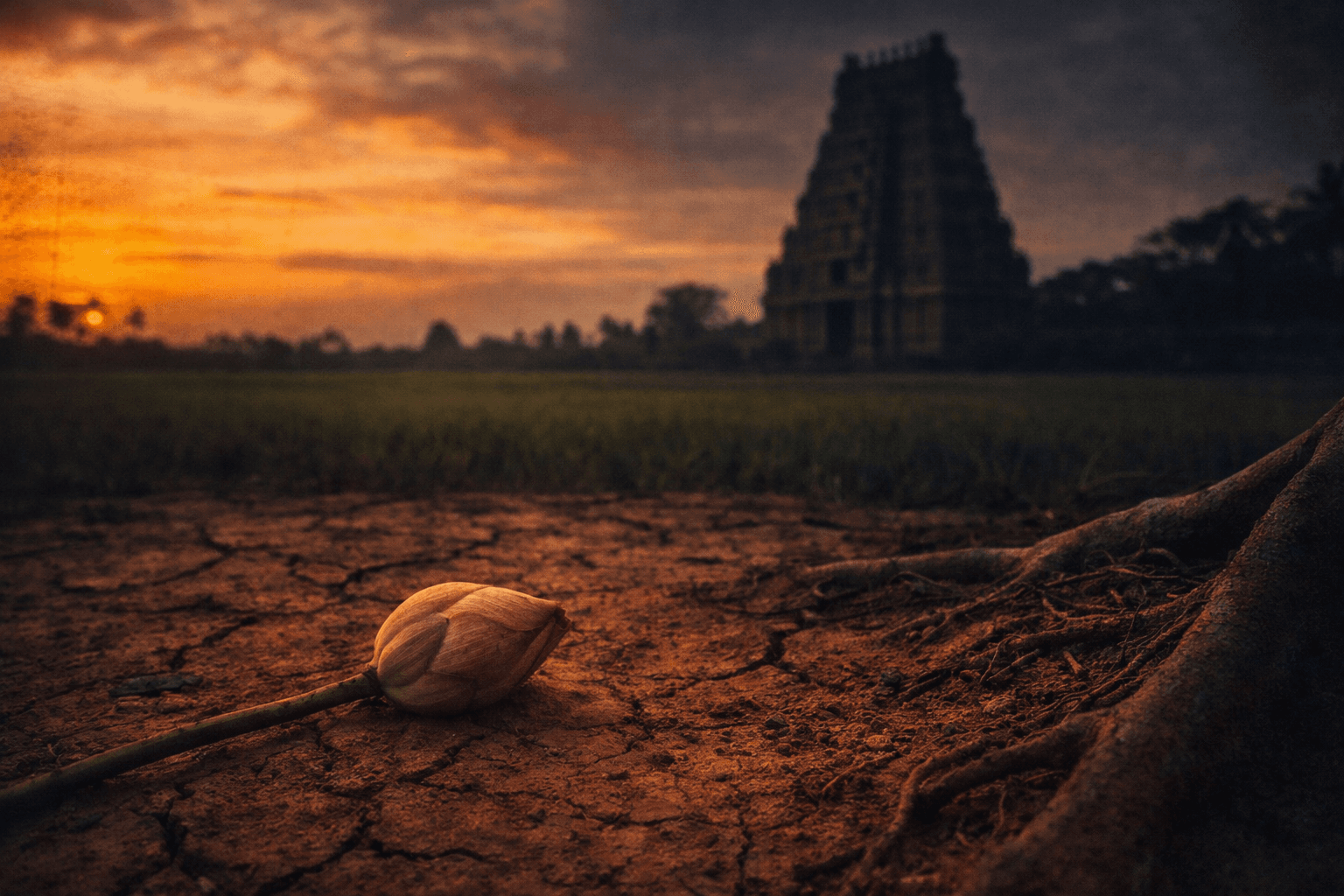
Not in twelve years of unbroken Union government rule. Not in the landslides of 2014 and 2019. Not in 2024, when the party held 240 Lok Sabha seats and a coalition at the Centre. Not as a senior partner, not as a junior partner, not ever. In more than four decades of contesting elections in this state, the BJP has never won an Assembly election or formed a government, and its vote share stayed in low single digits for most of that history — crossing ten percent only in 2024, still nowhere near winning a single Lok Sabha seat from Tamil Nadu in its own right. The lotus, in the party's own chosen metaphor, has never bloomed here.
It has not been for lack of trying.
The party has flooded the state with resources. Central ministers have flown down for rallies. Prime Minister Narendra Modi has campaigned in person, sometimes multiple times in a single election cycle. Amit Shah has drawn alliance maps. K. Annamalai, the former state party chief, rode motorbikes through every district for four years — only to be eased out in April 2025, reportedly as a precondition Edappadi Palaniswami set for resuming AIADMK–BJP alliance talks. His replacement, Nainar Nagendran, was himself a former AIADMK minister. The BJP's most visible Tamil face was sacrificed to rent the Dravidian party it had spent four years attacking. Temples have been consecrated. Rivers have been worshipped. Telugu superstars have been flown in to endorse. Kannada ones too. The playbook that worked in Karnataka, in Maharashtra, in Odisha — in every state where the party broke through a cultural wall — has been opened in Tamil Nadu, page by page. And page by page, it has failed.
Why.
That is the question this article is about. The answer, once you see it, is also the answer to everything the BJP does next in this state — the fiscal penalties, the language war, the Governor's walkouts, the central agency raids, the delimitation bill, the withheld education funds, the rejected metro projects, the suppressed archaeological report that nobody will release. All of it flows from one fact the party has not yet made peace with.
Tamil Nadu has a hundred-year-old political culture that was built, on purpose, to be incompatible with everything Hindutva is selling. The soil rejects the flower. The soil was designed to reject the flower. Tamil has a name for this soil — பெரியார் மண் (Periyar Mann, the soil Periyar tended). And the more the flower tries to force its way in, the more Periyar Mann hardens against it.
The Campaign of Attrition
When a political party cannot win a market, it has two options. Walk away. Or punish the market for not buying.
The BJP chose the second.
What Tamil Nadu has faced over the last decade — especially under the current Stalin government, though the pattern began long before — reads like a coordinated campaign of attrition. Every lever of central power has been deployed. Every line item of cooperative federalism has been weaponized. Every ceremonial and constitutional office has been turned against the state that refuses to vote for the party.
The fiscal penalty. For every rupee Tamil Nadu sends to Delhi, it gets back between 22 and 35 paise. The state contributes 9.4% of India's GDP and receives 4.1% of the divisible pool. Cess and surcharge — revenue that stays outside the sharing pool — has climbed to roughly a quarter of gross central receipts. GST compensation, which was guaranteed for five years to get states to sign on to the new regime, was allowed to expire without extension. In 2024, the state's own finance minister told the Assembly that cuts in devolution since the 14th Finance Commission totalled Rs 2.63 lakh crore — equivalent to 32% of the state's debt. The number is a theft, conducted slowly, over years.
22 to 35 paise back on every rupee sent. 9.4% of India's GDP. 4.1% of the divisible pool. A share halved across three decades of Finance Commissions — from 7.54% to 4.1%. Rs 2.63 lakh crore gone since the 14th Finance Commission alone, equivalent to a third of the state's debt. The arithmetic of a federation that has stopped behaving like one.
The language war. The National Education Policy's three-language formula — a Hindi-imposition mechanism dressed as a pedagogical reform — was rolled out with a funding ultimatum. Sign, or lose Samagra Shiksha money. Tamil Nadu refused to sign. The Centre withheld Rs 2,151 crore. The state filed an Article 131 suit in the Supreme Court. Meanwhile, railway signage across the state was quietly redesigned to place Hindi above English. Protest. Removal. Redesign elsewhere. Kartavya Dwar signage installed at Tiruchi. Protest. Removal. The pattern is industrial.
NEET. Imposed. The state passed two bills to exempt itself. The first was returned. The second was rejected by the President. Stalin called it a "black phase for federalism." The state is now in the Supreme Court. In the meantime, Tamil rural students — who had entered medical colleges through state-board scores in numbers that made Tamil Nadu one of India's largest producers of public-health doctors — have been replaced with students from coaching pipelines concentrated in three northern states.
S. Anitha was seventeen. She had topped her Tamil Nadu state board exams from Kuzhumur village in Ariyalur — the daughter of a daily-wage labourer, a Dalit, the first person in her family in line for a seat at a government medical college. She had not cleared NEET. She had not been inside the coaching classes whose syllabus the exam was built on. Her last interviews asked a question the country has not answered: why was the exam changed in the year I was supposed to write it? On September 1, 2017, she went home, drank pesticide, and died two days later.
The Tamil Nadu Assembly passed its first NEET-exemption bill within weeks. Governor Ravi sat on it. It was returned, re-passed, sent to the President, rejected. Anitha's name is invoked in the preamble of every version. The exam is still in force.
The Governor. Raj Bhavan has become the main opposition in Tamil Nadu — a role the defeated AIADMK cannot play and the BJP does not have the votes to play. Governor R.N. Ravi held bills for years. Twelve bills relating to state universities and vice-chancellor appointments — bills that would have returned control of the Chancellor's office from Raj Bhavan to the elected government — were kept pending for up to three years. The NEET exemption bill described above sat in Raj Bhavan until Ravi returned it, then sat again after the Assembly re-passed it, then was forwarded to the President, who rejected it. The online gambling ban — drafted after a wave of young men in Tamil Nadu took their lives over rummy-app losses — was returned twice, the delay measured in months during which more families kept losing their sons. Fifty-four files on the premature release of prisoners sat on his desk. Appointments to the Tamil Nadu Public Service Commission were left hanging. Files routed to the Governor for a signature that requires no discretion simply stopped moving.
Then came the Supreme Court.
On April 8, 2025, a Division Bench of Justices J.B. Pardiwala and R. Mahadevan handed down one of the sharpest judicial rebukes ever delivered to a sitting Governor in Indian constitutional history. Ravi's conduct was ruled "illegal," "erroneous," and taken "without bona fides." The Court invoked Article 142 — its extraordinary power to do complete justice — to deem ten of the withheld bills as having received assent. No court had ever read deemed-assent into Article 200 before. The Bench then laid down binding timelines the Constitution itself does not spell out: a bill withheld on the advice of the council of ministers must be returned within one month; a bill withheld without that advice, within three months; a bill re-passed after reconsideration, assented to within one month. The Governor's silence is no longer a constitutional weapon.
For the first time in Indian constitutional history, a court invoked Article 142 to grant deemed assent to state bills a Governor had refused to clear. The same bench then wrote timelines into the Governor's office that the Constitution itself had left silent — one month, three months, one month. Ravi's conduct was "illegal," "erroneous," and "without bona fides." The language is unprecedented. So is the remedy.
The theatre has its own rhythm. Tamil Nadu's Assembly protocol is settled and bipartisan, followed for decades — Tamil Thai Vazhthu at the beginning of the Governor's address, the national anthem at the end. The same protocol is observed in the Union Territory of Puducherry, where the BJP is in government. Ravi has repeatedly demanded that the national anthem also be played at the start. The Speaker, citing established practice, has declined. On that manufactured grievance, Ravi has walked out of three consecutive Assembly openings — January 2024, January 2025, January 2026 — skipping the customary speech each time. The national anthem plays at the end of each session, on protocol, with the Governor's chair already empty.
When he does read the speech, he edits it. In January 2023, Ravi omitted three specific passages from the text the Council of Ministers had approved — including the 65th point, which named Thanthai Periyar, Annal Ambedkar, Perunthalaivar Kamarajar, Perarignar Anna, and Muthamizh Arignar Kalaignar as the architects of the Dravidian model, and which described the model itself as "much-acclaimed." He also deleted portions of the 12th point on law and order and the 64th point on governance outcomes. The Chief Minister moved a resolution against the deletions. The Governor walked out while the resolution was being read. In January 2026, when the chair declined to let him deviate from the prepared text again, Raj Bhavan issued a 13-point list explaining why he could not read the speech — calling it, among other things, a document of "unsubstantiated claims." That is now the position of a Governor about the address his own Council of Ministers has prepared for him to deliver. Article 166 of the Constitution does not entertain it.
Outside the Assembly theatre, Ravi has called everyone who opposes the BJP an "extremist." He has unilaterally appointed vice-chancellors to state universities despite state legislation attempting to shift that authority from the Governor to the elected government; the Madras High Court stayed parts of the state law and the matter is now at the Supreme Court, alongside the bills. The office that is supposed to be ceremonial has become a televised, daily sabotage — a Raj Bhavan running a parallel regime from behind the curtain of a constitutional office. The Supreme Court has said so. The Tamil Nadu Assembly has seen it since 2021. And the BJP, through the act of appointing Ravi and defending him at every stage, made explicit what the party otherwise tries to hide — its political project in Tamil Nadu cannot be won at the ballot box, so it must be waged through the last non-elected office in the state.
The agencies. Four sitting DMK ministers have been raided or arrested by the Enforcement Directorate since 2023 — Senthil Balaji, K. Ponmudy, K.N. Nehru, and I. Periyasamy. Every raid has been timed to coincide with opposition coordination events or election preparation. Stalin has said, on record, that the ED has become "our election campaign committee." The joke is grim because it is accurate. Hours after Balaji's June 2023 arrest, Tamil Nadu became the tenth state in India to withdraw general consent to the CBI — a defensive measure that now requires the Union agency to seek case-by-case approval to conduct investigations in the state.
The Supreme Court has begun saying it more plainly. In May 2025, hearing the ED's probe into an alleged Rs 1,000-crore TASMAC scam framed around a state-owned liquor corporation, a bench led by Chief Justice B.R. Gavai used language no Governor or minister had ever used in public about the agency — "Your ED is passing all limits." The probe was stayed. In October 2025, the stay was extended, with the Court pointedly asking whether the ED's raids on a state-owned undertaking were "encroaching on the state's investigative powers." The question was not merely rhetorical — it is the one federalism is built around. A central agency raiding a state-owned corporation, in a state whose ruling party is not the ruling party at the Centre, is a specific kind of constitutional problem. The Supreme Court has now said so, on the record, in open court.
Senthil Balaji spent more than fourteen months in prison on pre-2021 charges dating to his time in the previous AIADMK cabinet. The Supreme Court granted him bail in September 2024, noting the length of his pre-trial detention. He returned to the cabinet. The case against him is ongoing. The conviction is nowhere in sight.
This is the pattern nobody wants to say out loud. Of nearly six thousand PMLA cases the ED has registered since 2015, fewer than twenty have produced a conviction. The Finance Ministry itself told the Rajya Sabha the number — 15 convictions across ten years of investigation. NDTV's analysis of corruption cases specifically placed the conviction rate at 0.1%. Of 132 PMLA cases filed against politicians since 2019, exactly one has ended in conviction. The trial takes years. The corruption narrative takes a news cycle. By the time the case collapses quietly in a courtroom, the election is over and the next round of raids is already being planned. The Supreme Court has told the ED — in the Balaji bail order, in the TASMAC stay, in multiple recent judgments — to "focus on quality prosecution and evidence" rather than on spectacle. The agency has not yet adjusted. It is being used for the political purpose for which it is currently useful. The conviction rate is the giveaway.
15 convictions in ten years. 0.1% conviction rate in corruption cases specifically. 132 PMLA cases filed against politicians since 2019, and exactly one conviction. That is the public record of the agency the Centre uses against state governments it cannot defeat at the ballot box.
The infrastructure. The railway numbers tell the story more cleanly than any speech. Between 2009–14 and the current budget cycle, the Union's overall railway outlay expanded nearly twenty-five times. Tamil Nadu's share grew 7.5 times over the same period — from an average of Rs 879 crore a year to Rs 6,626 crore. DMK Rajya Sabha MP P. Wilson put the comparison on the floor of Parliament. Gujarat's railway funding in the same window went up twenty-seven-fold, well beyond the national multiple. Tamil Nadu rose at less than a third of that rate. The number on paper does not reward the state that runs India's busiest suburban system, feeds its southern freight corridor, and manufactures the coaches that run elsewhere.
Five major railway projects frozen or indefinitely delayed — Tindivanam–Tiruvannamalai, Attipattu–Puttur, Chennai–Cuddalore, Madurai–Thoothukudi, Erode–Palani. The reasons cited shift between "land acquisition delays" and "financial viability." The state has repeatedly countered that the majority of land has already been handed over and that comparable projects elsewhere receive differential funding without the same scrutiny.
AIIMS Madurai was announced in 2015. The foundation stone was laid in 2019. It is still incomplete a decade after announcement. Stalin called it bias. The timeline makes the word unnecessary.
Metro proposals for Madurai and Coimbatore were rejected on the stated grounds of insufficient projected ridership. A downgraded BRTS was suggested in their place. Hold the word — ridership. Over in Uttar Pradesh, the UPMRC — which runs metros in Lucknow, Kanpur, and Agra — booked a loss of Rs 1,700 crore in FY23. Kanpur Metro carries between 8,000 and 10,000 riders a day, a number lower than many Tamil Nadu city buses. Lucknow Metro recorded its best-ever day at 1.3 lakh passengers in January 2024. These are systems the Centre actively funded and continues to expand. Tamil Nadu's request for metros in its second-tier cities — cities with industrial bases, population densities, and surface-traffic indicators that, on any honest read, justify the investment — was turned down on a ridership argument nobody applied to its own northern projects.
The same pattern repeats in aviation. Tamil Nadu's proposal for a greenfield airport at Hosur — an industrial hub anchoring the electronics and EV manufacturing corridor just south of Bengaluru — was rejected on the grounds of a 2004 agreement with Bengaluru Airport that bars any new airport within 150 km until 2033. The 150-km rule, applied rigidly here, does not appear to have been applied elsewhere. Over the same years, UDAN-scheme airports have opened across northern India where no passenger demand justifies them. A February 2026 India Today investigation, using RTI data, found that six of the seven new airports launched in Uttar Pradesh since 2021 — Kushinagar, Azamgarh, Chitrakoot, Shravasti, Moradabad, Aligarh — had halted scheduled commercial flights within months of inauguration. The government itself has now acknowledged that fifteen UDAN airports are temporarily non-operational, citing reasons including "low passenger load factors." Pathankot. Ludhiana. Shimla. Bhavnagar. Rourkela. Kalaburagi. Each of these was a priority for Central funding. Hosur — where industrial demand exists and the ridership math works — was denied before the first foundation could be laid.
The denial is granular and specific — the shape of policy, not the shape of backlog.
Same window, three multipliers. Union railway outlay: up 25×. Tamil Nadu's share: up 7.5×. Gujarat's share: up 27×. Fifteen UDAN airports non-operational across the country, including six of seven new ones in Uttar Pradesh — but Hosur, with a genuine industrial case, was blocked by a 150-km rule that somehow never applies elsewhere.
The relief. Cyclone Michaung, December 2023. Fourteen districts devastated, industrial Chennai under water, an entire monsoon's worth of rain in forty-eight hours. Tamil Nadu sought Rs 7,033 crore as interim relief and Rs 12,659 crore as long-term support. The Centre released Rs 450 crore in the first tranche — roughly six paise on every rupee requested. The Union Finance Minister and state ministers engaged in a public war of words. The MHA eventually sanctioned Rs 285 crore additional from the National Disaster Response Fund. Months later, after Tamil Nadu and Karnataka petitioned the Supreme Court, the finance ministry finally ordered further release — after the court was petitioned, not before.
Cyclone Fengal, November 2024. The state assessed damages at Rs 6,675 crore and asked for Rs 2,000 crore as a single interim disbursement from the NDRF. The Centre approved Rs 944.80 crore — largely the Union share of the SDRF that Tamil Nadu had already co-funded. The Prime Minister offered verbal assurance. The math never caught up to the assurance. In disaster relief — the one thing a federation is supposed to do for its constituent states without politics — Tamil Nadu has been told to wait, to justify, to beg. A state that contributes 9.4% of India's GDP was sent six paise on the rupee in the Michaung first tranche, and had to go to the Supreme Court for the rest — while its people were still bailing water out of their homes.
Michaung (Dec 2023): Rs 7,033 crore asked, Rs 450 crore released in first tranche. Fengal (Nov 2024): Rs 2,000 crore asked, Rs 944.80 crore approved. The further Michaung release came only after Tamil Nadu and Karnataka petitioned the Supreme Court. In disaster relief — where federations are not supposed to do politics — the state has been told to wait, to justify, to beg.
The archaeology. Keezhadi is a village in Sivaganga district, on the banks of the Vaigai, about twelve kilometres southeast of Madurai. Starting in 2014, excavations led by ASI archaeologist K. Amarnath Ramakrishna uncovered the remains of a literate, urban Tamil civilization — brick-built houses with drainage systems, industrial installations, pottery etched with Tamil-Brahmi inscriptions, iron tools, punch-marked coins, ivory and semi-precious stone ornaments. Accelerator Mass Spectrometry radiocarbon dating placed Keezhadi's earliest period at the 8th century BCE, with Phase 4 strata dated to 580 BCE. On that dating, Tamil civilization's urban phase is contemporaneous with Gangetic urbanization, and Tamil-Brahmi literacy pre-dates the Ashokan edicts by centuries. For a political project staked on the primacy of Sanskrit and a single civilizational origin flowing southward from the north, that is unacceptable evidence.
The pushback was administrative. In 2017, after Ramakrishna's second phase produced the most significant finds, the ASI transferred him out of Tamil Nadu; the Tamil Nadu State Department of Archaeology took over the excavation from Phase 3 onwards, and the finds kept coming. In January 2023, Ramakrishna submitted his 982-page final report on the first two phases to the ASI. In May 2025, the ASI formally demanded he rework it — arguing the 8th-century-BCE dating lacked "concrete justification" and suggesting the earliest period should be revised to around 300 BCE. Ramakrishna refused. On June 17, 2025, he was transferred for a third time in nine months, to the National Mission on Monuments and Antiquities office in Greater Noida. In December 2025, the ASI released a 114-page "critical evaluation" calling the 982-page report "ambiguous, incomplete, and underdeveloped." On February 5, 2026, Ramakrishna formally rejected that evaluation as "more mechanical than factual." The ASI subsequently asked a retired archaeologist — one who had previously claimed there were no notable findings — to write a replacement report on the third phase.
The 982-page report sits in limbo. The archaeologist who wrote it continues to decline the demand for revision. The message is unmistakable — this history will not be told if the Centre can help it.
K. Amarnath Ramakrishna sits, these days, in an office at the ASI's National Mission on Monuments and Antiquities campus in Greater Noida — his third posting in nine months. On his desk are the 982 pages he submitted to the ASI in January 2023, documenting what he and his team found under the Vaigai riverbank between 2014 and 2016: brick houses, drainage systems, pottery etched with a script older than the Ashokan edicts, an urban Tamil settlement that Accelerator Mass Spectrometry dating places at the 8th century BCE.
In May 2025, the ASI asked him, formally, to revise those dates downward by five centuries. He declined, formally. His refusal ran longer than some governments' white papers. In December 2025 the ASI released a 114-page counter-evaluation calling his work ambiguous, incomplete, and underdeveloped. On February 5, 2026, he rejected that evaluation as "more mechanical than factual."
The pages are still 982. The dates are still 8th century BCE. The archaeologist, transferred three times, has not blinked.
The Sengol. In May 2023, at the inauguration of the new Parliament building, Prime Minister Modi installed the Sengol — a Tamil royal scepter from the Chola tradition — with Vedic shlokas chanted around it, and framed it as the instrument by which Mountbatten transferred power to Nehru in 1947. Historians, including those consulted by Nehru's own government at the time, disputed the historical claim. A Tamil symbol was stripped of its Tamil context, re-narrated inside a Sanskritic frame, and deployed for Hindutva's national-unity theatre. The state the symbol was taken from was not meaningfully consulted, and the DMK boycotted the ceremony.
The manufactured outrage (Michaelpatti). In January 2022, a seventeen-year-old Class 12 student named Lavanya died by suicide after consuming herbicide. She studied at Sacred Heart Higher Secondary School, a missionary-run institution in Michaelpatti village, Thanjavur district. Within hours, the then-TN BJP president K. Annamalai, the Vishwa Hindu Parishad, and the broader Sangh Parivar were on television and social media alleging a forced-conversion attempt at the school. A state-wide communal agitation followed. The case, on BJP insistence, was transferred to the CBI. In December 2023, the CBI filed its chargesheet before the Chief Judicial Magistrate in Tiruchirappalli. Its conclusion was unambiguous: "Allegation pertaining to the attempt of conversion by the Convent sisters and teachers of Sacred Heart Higher Secondary School, Michaelpatti, could not be established." The Union's own investigative agency — the one the BJP had demanded take over the probe — ruled out the core claim on which the agitation had been built. No public correction or apology has followed from the leaders who built it.
Thiruparankundram. Thiruparankundram is a hill in Madurai sacred to two faiths simultaneously — the Subramaniyaswamy (Murugan) temple at the base, and the Sikandar Auliya dargah at the summit. Cross-community worship has continued for centuries. In 2025, the Sangh Parivar opened a campaign to claim an ancient stone pillar (Deepathoon) near the dargah for a dedicated Karthigai Deepam ritual, bypassing the traditional lighting at the Pillaiyar mandapam. On June 22, 2025, at a Murugan Bakthargal Manaadu convention organised amid the controversy, Annamalai and Hindu Munnani leaders delivered speeches that the Madurai police promptly charged as communal — a criminal case was registered against them on or around July 2, 2025. On December 1, 2025, Madras High Court single judge Justice G.R. Swaminathan, known for his heterodox rulings, ordered that the lamp be lit at the Deepathoon pillar near the dargah, rejecting the dargah's objections. The state government declined to implement the order. Swaminathan launched contempt proceedings against state officials. On March 17, 2026, a Division Bench of Justices N. Sathish Kumar and M. Jothiraman stayed all his contempt orders and held that the single judge could no longer continue hearing the matter once it had reached the Division Bench. A manufactured confrontation over a hill shared peacefully for centuries had been stopped, on the record, by a higher bench of the same court.
Katchatheevu. On March 31, 2024, with the Lok Sabha election nineteen days away, the Prime Minister personally shared on social media an RTI-based report alleging that Indira Gandhi's 1974 government had "ceded" the islet of Katchatheevu to Sri Lanka. The implication was that the Congress had surrendered Tamil territory; the implied remedy was to vote for the party now raising the issue. Rameswaram fishermen — the actual stakeholders, who for a decade had been arrested by the Sri Lankan Navy while the Centre stayed silent — publicly ridiculed the revived outrage as an election ploy. In 2024 alone, 530 Tamil Nadu fishermen were detained by the Sri Lankan Navy, with roughly 360 boats impounded since 2014. Sri Lanka's foreign ministry publicly dismissed the revived claim as having "no ground." Tamil Nadu's elected representatives — including a standing Assembly resolution seeking Katchatheevu's retrieval, passed unanimously — had not been consulted before the tweet. Katchatheevu worked as a campaign prop; the fishermen it was supposedly about continued to be arrested.
The industrial map. In February 2024, the Union approved the India Semiconductor Mission's flagship investments — Tata Electronics' Rs 91,000 crore fab in Dholera, Gujarat, and a Rs 27,000 crore assembly-test facility in Jagiroad, Assam, both with 50% Union capex support (roughly Rs 44,000 crore of public money combined). Tamil Nadu — home to India's largest electronics manufacturing cluster, the auto-parts and EV ecosystem that feeds it, and a mature industrial workforce — was not chosen for either plant. Over the life of the electoral-bonds scheme (2018–2024, before the Supreme Court struck it down), Tata group entities contributed approximately Rs 758 crore to the BJP, per Election Commission disclosures.
The scheme branding. The PM Vishwakarma scheme — launched in September 2023 with a caste-identified target list of 18 trades — was described by Stalin, at the launch of the state's competing Kalaignar Kaivinai Thittam, as "caste-perpetuating." The PM SHRI Schools scheme was tied to NEP compliance; Tamil Nadu refused to sign and lost Rs 2,151 crore in Samagra Shiksha funds. PMJAY / Ayushman Bharat was positioned as a Union overlay on the state's existing Chief Minister's Comprehensive Health Insurance Scheme — a programme that covers 1.58 crore Tamil Nadu families and predated the Union version by several years. The pattern in each case is identical: re-brand a working state scheme, make Union co-funding conditional on the state ceding the branding, refuse the money when the state declines.
The delimitation. Part 6 of this series covered the 131st Constitutional Amendment in detail. Tamil Nadu's parliamentary voice was slated to shrink from 7.4% to 6.1% as a reward for having controlled its population, educated its women, and built the demographic transition the country had asked for. The bill was defeated on April 17, 2026. The architecture behind it remains intact. It will return.
Tamil Nadu 7.4% → 6.1%. The Hindi heartland 33% → 38%. The South 24% → 21%. A population-based redistribution that would have permanently transferred parliamentary weight to states that grew by failing on every national development indicator — defeated in Parliament on April 17, 2026, by a cross-party opposition. The Delimitation Commission architecture remains intact. Another attempt is a matter of timing, not intent.
This is not an exhaustive list. It is a representative one. Every category has its own sub-archive of slights, denials, obstructions, and targeted cruelties. The pattern is consistent. The volume is deafening. And when any single item is raised, Delhi's response follows the same script each time. Assurance. Denial. Counter-accusation. Then the next item on the list begins.
The Architecture TN Was Built Against
The grievance list is a symptom. The disease is older. Tamil Nadu's political culture was shaped, over a century, to reject every load-bearing premise Hindutva rests on. Each premise has a defeat date on the record.
- Hindu unity as a political claim. Periyar named it as a Brahminical frame designed to freeze caste. The Self-Respect Movement (1925) and the Dravidar Kazhagam (1944) built an electorate literate in reading caste hierarchy behind religious vocabulary, decades before the Jana Sangh existed. Tamils know their gods from their politics — Periyar's century did not stop Tamil Nadu from being a deeply religious state; it taught the voters to separate sincere devotion from a political authority dressed up in its vocabulary. That separation is why the food codes, dress codes, and cow-protection politics that took hold across the Hindi belt never found a foothold here.
- Hindi as a unifying medium. The 1965 anti-Hindi agitation — driven by students, championed by C.N. Annadurai and the DMK — stopped Hindi imposition at Union scale. Tamil Nadu has followed a formal two-language policy since 1968. No ruling party has reversed it; no opposition party has run against it.
- Sanskrit as the civilizational base. Kalaignar Karunanidhi built the DMK's cultural apparatus around Tamil as a classical language with its own Sangam past — the Kural, Silappadikaram, Manimekalai — and around the Dravidian claim that South Indian civilization predates and stands independent of the Vedic.
- Caste as manageable through patronage alone. Tamil Nadu has had caste-based reservation since the Justice Party's Communal Government Order of 1921 — the subcontinent's earliest affirmative-action framework. The state today maintains 69% reservation in education and government jobs, the highest in India outside the tribal states, protected through inclusion in the Ninth Schedule. The Supreme Court's Indira Sawhney ceiling of 50% has not been applied here; the 69% has survived every legal challenge to date. Tamil Nadu built a social-justice architecture a century before the national mainstream engaged the question — patronage and rhetoric were not its instruments.
- Centre leads, states follow. Kalaignar Karunanidhi's Rajamannar Committee (1969) was India's first state-level commission on Centre-State relations. Its recommendations were ignored. MK Stalin's Justice Kurian Joseph Committee (2025) is the second; its Part I report called for a "structural reset comparable in ambition to the economic reforms of 1991."
Every Chief Minister of Tamil Nadu, across every party, has defended Tamil Thai Vazhthu. In October 2024, at a DD Tamil golden jubilee event attended by Governor R.N. Ravi, a rendition of the anthem omitted the line "Dravida Nal Thirunaadu." Stalin called the deletion an insult. Sixty years of cross-party consensus hold that the word Dravidam carries a civilizational claim the party's project cannot tolerate.
Which produces the feedback loop the BJP has not yet understood. The party cannot win Tamil Nadu without attacking the Dravidian architecture, and every attack strengthens it. Coercion reads here as confirmation. The delimitation bill was the clearest test. A population-based seat allocation designed to transfer parliamentary weight to the Hindi belt ended instead with seven southern and non-BJP chief ministers forming a Joint Action Committee under Stalin's chairmanship, the 131st Amendment defeated in Parliament on April 17, 2026, and the DMK's 2026 pitch carrying its sharpest weapon yet.
Stalin's formulation is now the clearest on public record: federalism will emerge only when the BJP is out of power at the Centre. He is the next person in a hundred-year lineage whose job is to defend the covenant.
The BJP's failure in Tamil Nadu is architectural, not tactical. The state's political culture was built, on purpose, to reject exactly what the party is offering.
The Soil, Not the Flower
You can see the whole thing, if you step back far enough.
The lotus is a flower that grows in a particular kind of water. The Ganga. The Yamuna. The still waters of the northern plains. In Sanskrit poetry it is a sacred flower because it blooms in mud and rises clean, and that theology has meaning in a specific ecosystem.
Tamil Nadu has lotuses too. Tamil temples have them. Tamil poetry invokes them. But Tamil civilization has never organized its political or cultural self around the flower. It has organized itself around the Kaveri, and the paddy field, and the coconut palm, and the Sangam landscapes — kurinji of the hills, mullai of the forests, marudham of the farmlands, neidhal of the coast, palai of the desert. The geography is different. The metaphors are different. The soil is different.
You cannot force a flower to bloom in soil that was not built for it. You can import the seeds. You can import the fertilizer. You can bring in the gardeners. You can threaten the field itself. The soil has its own chemistry, its own century of cultivation by gardeners who tended it with a different flower in mind. பெரியார் மண் — Periyar Mann. The soil Periyar tended, and Anna tended, and Perunthalaivar K. Kamaraj tended, and Kalaignar Karunanidhi tended. Even Jayalalithaa, from the other side of the Dravidian divide, held the line against the BJP with her full weight until her last breath — because on this one question, the soil did not belong to any one party. This soil has its own Dravidian Model of Governance, rooted in Tamil culture, heritage, and language. What it refuses is a party whose chosen flower blooms in a different ecosystem, and which demands to be addressed in a language Tamil Nadu has spent sixty years refusing to be forced to speak.
The BJP's choice now is an old choice. Keep trying to force the flower, and keep producing the harassment that makes the soil harder. Or acknowledge the obvious — that Tamil Nadu has already made its political choice, has been making it for a century, and will continue making it for as long as the covenant holds. The Dravidian movement chose India. It did not choose the BJP. These are different choices. One is a constitutional commitment. The other is a political preference.
The state kept its promise. The flower keeps failing. பெரியார் மண் does not change.
Appendix: The Record, Category by Category
A flat, scannable index of specific BJP / Union-government actions against Tamil Nadu, grouped by category. Not exhaustive — representative.
Fiscal / Federal
- Tamil Nadu receives 22–35 paise for every rupee sent to Delhi
- Share of divisible pool fell from 7.54% (8th Finance Commission) to 4.1% (16th Finance Commission)
- Rs 2.63 lakh crore cut in devolution since the 14th Finance Commission (~32% of state debt)
- GST compensation allowed to expire after 5 years without extension
- Cess and surcharge raised to ~25% of gross Union receipts, kept outside the divisible pool
- Rs 20,860 crore in pending central dues (TN's 2022 formal demand)
Education & Language
- NEP three-language formula imposed with funding ultimatum
- Rs 2,151 crore Samagra Shiksha funds withheld for refusing to sign NEP
- NEET imposed despite two state exemption bills (one returned, one rejected by the President)
- PM SHRI schools scheme tied to NEP compliance
- CBSE 2026-27 curriculum rolled out with mandatory Hindi as third language
- Railway signage repeatedly redesigned to place Hindi above English
- Kartavya Dwar Hindi signage imposed at Tiruchi station
- State filed Article 131 Supreme Court suit over withheld education funds
Governor R.N. Ravi
- Held 12 state university / VC-appointment bills for up to three years
- Held the NEET exemption bill, returned it, held it again after re-passage, sent it to the President
- Held the online gambling ban bill twice (drafted after youth suicides over rummy-app losses)
- Held 54 files on premature release of prisoners
- Held Tamil Nadu Public Service Commission appointments
- Supreme Court, April 8 2025: conduct ruled illegal, erroneous, without bona fides
- Article 142 invoked for deemed assent — first time in Indian constitutional history
- Court laid down binding 1-month / 3-month / 1-month timelines
- Walked out of three consecutive Assembly openings (Jan 2024, 2025, 2026) over a manufactured anthem grievance
- January 2023: skipped the 65th point of the Council-approved speech (Periyar, Ambedkar, Kamaraj, Anna, Kalaignar as architects of the Dravidian model), and portions of the 12th and 64th points
- January 2026: issued a 13-point list refusing to read the Council-approved speech
- Unilaterally appointed vice-chancellors, bypassing state legislation
- Called every BJP opponent an "extremist"
- October 2024: DD Tamil golden jubilee event — "Dravida Nal Thirunaadu" line omitted from the state anthem, in the Governor's presence
Central Agencies
- Four sitting DMK ministers raided or arrested by the ED since 2023: Senthil Balaji, K. Ponmudy, K.N. Nehru, I. Periyasamy
- Senthil Balaji: 14+ months pre-trial detention; bailed by Supreme Court September 2024
- May 2025 TASMAC probe: CJI B.R. Gavai — "Your ED is passing all limits" — stay granted, extended October 2025
- ED conviction rate in corruption cases since 2015: 0.1% (NDTV)
- 15 total ED convictions in 10 years against nearly 6,000 PMLA cases (Finance Ministry / Rajya Sabha)
- 132 PMLA cases filed against politicians since 2019; 1 conviction (The Wire)
- Tamil Nadu withdrew general consent to the CBI, June 2023 — tenth state to do so
Railways / Infrastructure / Aviation
- TN's railway allocation grew 7.5× vs the national 25× vs Gujarat's 27× over the same window
- Five frozen railway projects: Tindivanam–Tiruvannamalai, Attipattu–Puttur, Chennai–Cuddalore, Madurai–Thoothukudi, Erode–Palani
- AIIMS Madurai: announced 2015, foundation 2019, still incomplete in 2026
- Madurai Metro rejected on "ridership" grounds; Coimbatore Metro rejected; BRTS suggested instead
- Hosur greenfield airport rejected via 150-km Bengaluru rule (in force until 2033)
- Six of seven new UP airports grounded per India Today RTI (Feb 2026): Kushinagar, Azamgarh, Chitrakoot, Shravasti, Moradabad, Aligarh
- 15 UDAN airports "temporarily non-operational" per the Union government's own data: Pathankot, Ludhiana, Shimla, Bhavnagar, Rourkela, Kalaburagi, Datia, Ambikapur, Pakyong, others
- Salem Railway Zone demand pending for decades
Disaster Relief
- Cyclone Michaung (Dec 2023): TN sought Rs 7,033 cr interim / Rs 12,659 cr long-term; Centre released Rs 450 cr first tranche (~six paise on the rupee), Rs 285 cr additional via MHA / NDRF
- Further Michaung release ordered only after TN and Karnataka petitioned the Supreme Court
- 2015 Chennai floods: Rs 8,481 cr damage assessment vs inadequate Union release
- Cyclone Fengal (Nov 2024): Rs 6,675 cr damages / Rs 2,000 cr NDRF ask; Centre approved Rs 944.80 cr
- Inter-Ministerial Central Team reports traditionally delayed beyond the relief window
Culture / Heritage
- Keezhadi excavation report suppressed; archaeologist K. Amarnath Ramakrishna transferred repeatedly after refusing ASI's demand to alter the 982-page report
- Sengol installed in new Parliament (May 2023) with disputed 1947 transfer-of-power claim; DMK boycotted
- Michaelpatti / Lavanya case (Jan 2022): Annamalai, VHP, and Sangh Parivar launched state-wide agitation alleging forced conversion at a Christian school. CBI chargesheet (Dec 2023): conversion allegation "could not be established." No public apology or correction
- Thiruparankundram / Murugan Bakthargal Manaadu (2025–26): Sangh campaign to claim Deepathoon pillar near the dargah for Karthigai Deepam; Annamalai and Hindu Munnani leaders booked by Madurai police (July 2025) for communal remarks at June 22 Manaadu; single-judge Justice G.R. Swaminathan's Dec 1 2025 order favouring the campaign stayed by Division Bench (Justices N. Sathish Kumar and M. Jothiraman) on March 17, 2026
- "Dravida Nal Thirunaadu" line omitted from Tamil Thai Vazhthu at DD Tamil golden jubilee event (Oct 2024)
- Katchatheevu weaponised March 31, 2024, nineteen days before Lok Sabha Phase 1; TN Assembly's unanimous retrieval resolution ignored in framing
- 530 Tamil Nadu fishermen detained by Sri Lankan Navy in 2024 alone; ~360 boats impounded since 2014
- Sri Lanka foreign ministry dismissed the revived Katchatheevu claim as having "no ground"
Industrial / Economic Allocation
- India Semiconductor Mission (Feb 2024): Rs 91,000 cr Tata fab → Dholera, Gujarat; Rs 27,000 cr Tata ATMP plant → Jagiroad, Assam; Rs 44,203 cr combined Union subsidy; Tamil Nadu's electronics/EV cluster skipped for both
- Tata Group's aggregate electoral-bond contributions to the BJP across 2018–2024: approximately Rs 758 crore (ECI disclosure, post-SC verdict)
- Sterlite Copper: Centre argued for reopening as "national asset"; state and Supreme Court rejected
- Kudankulam nuclear expansion: full-scale Russia–India deal advanced without fresh state-level consultation
Political / Electoral
- Delimitation Bill (131st Constitutional Amendment) would have shrunk TN from 7.4% to 6.1% of Parliament — defeated April 17, 2026
- Election Commission Act 2023: CJI removed from selection panel, replaced by Union Cabinet Minister — permanent 2-1 majority for the ruling coalition
- Special Intensive Revision (SIR) of voter rolls initiated pre-2026 TN election — DMK alleges Bihar-style disenfranchisement design
- 2025: AIADMK alliance resumed only after BJP removed K. Annamalai as state chief, reportedly at Edappadi Palaniswami's insistence
Scheme / Branding Wars
- PM Vishwakarma (launched Sept 2023): described by Stalin as "caste-perpetuating"; TN launched Kalaignar Kaivinai Thittam in response
- PMJAY / Ayushman Bharat: layered over TN's existing Chief Minister's Comprehensive Health Insurance Scheme (covers ~1.58 crore families, predates PMJAY)
- PM SHRI: overlay on state school system conditional on NEP sign-on
- "Modi ki Guarantee" branding mandated on centrally sponsored schemes
- Union spends roughly 3.5× more on centrally-branded flagship schemes in state-subject domains than it devolves to states
Representation / Recognition
- Recent central railway examination: only 5 TN candidates qualified; Stalin alleged "systemic discrimination"
- Rajamannar Committee (1969) recommendations: ignored by the Centre for 57 years
- Justice Kurian Joseph Committee (2025, Part I report Feb 2026): awaiting Centre response