This is Part 4 of the Dravidian Movement series. Read Part 1: The Architects of Dignity on the people who built the movement. Read Part 2: The Numbers Don't Lie on what a century of social justice produced in data. Read Part 3: The Unfinished Revolution on the fight against caste violence that governments alone cannot win.
A woman in Virudhunagar district gets ₹1,000 deposited into her bank account on the fifteenth of every month. Kalaignar Magalir Urimai Thogai. She did not apply through a broker or wait in a government office. The money simply arrives.
She rides the government bus to the market for free. Before Vidiyal Payanam, the round trip cost her ₹40. Over a month, that is another ₹1,000 she no longer spends.
Her daughter, the first in the family to attend college, receives ₹1,000 per month under Pudhumai Penn — the scholarship for first-generation government school girls pursuing higher education.
₹3,000 per month. ₹36,000 per year.
In a household earning ₹10,000 a month, that is a 30% increase in what the family has to work with. It is medicine purchased without asking permission. Vegetables for the children without calculating whether the money will last. A daughter who stays in college instead of dropping out to help at home. A bus ride to the hospital that no longer requires a decision about whether the fare is worth it.
This is what governance feels like at the kitchen table.
But the ₹3,000 is just where the story starts. Behind it is an economy that grew 64% in four years. An education system that sent government school children to IITs and universities in Japan. A sports programme that produced the youngest world chess champion in history. An environmental record that won the United Nations' highest honour.
Five years of governance. The data is in.
The Inheritance
On May 7, 2021, MK Stalin took oath as Chief Minister. The state he inherited was in crisis — 35,000 dead from COVID, the second wave still raging, the economy contracted for the first time in decades. And the decade before the pandemic had not been kind.
Jayalalithaa governed Tamil Nadu from 2011 until her death in December 2016. Her Amma brand was powerful: Amma Canteens, Amma Pharmacies, Amma Water. Each scheme bore her name and delivered tangible benefits — despite the political authoritarianism, despite the lack of large-scale new initiatives, she was able to at least sustain growth. But when she died, the system she centralised could not survive without her. The Palaniswami years — 2017 to 2021 — governance was on sick leave. No major policy. No investment push. The state's competitive position eroded while its rivals surged.
The state of play in May 2021: GSDP at ₹19.03 lakh crore. Debt-to-GSDP spiking to nearly 29% from COVID spending. Merchandise exports at $26.15 billion. FDI inflows at ₹5,909 crore. Fiscal deficit at 3.3% of GSDP. 30 government medical colleges. School dropout rate at 16%.
The inheritance was a state with extraordinary fundamentals and atrophied momentum. The engine was sound. It had been idling for a decade.
The Economy
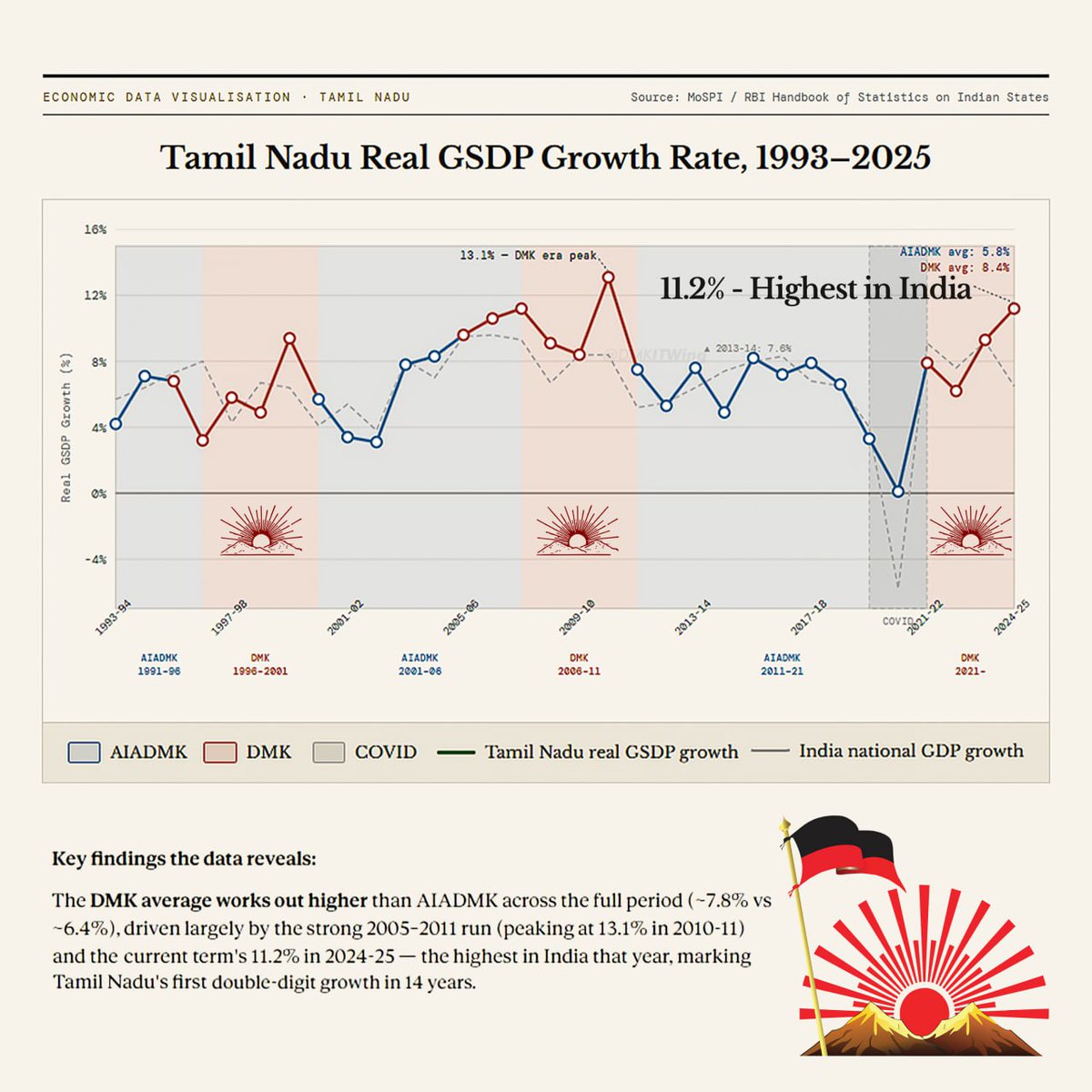
That chart tells the story of three decades. The DMK average across all terms: 8.4% real growth. The AIADMK average: 5.8%. And in 2024-25, Tamil Nadu posted eleven percent real growth — the highest among India's large states, the state's first double-digit growth in fourteen years.
Tamil Nadu's GSDP grew from ₹19.03 lakh crore in 2020-21 to ₹31.15 lakh crore by 2024-25 (Revised Estimate), with the 2025-26 budget projecting ₹35.68 lakh crore. The state is now India's second-largest economy — larger than Pakistan's GDP.
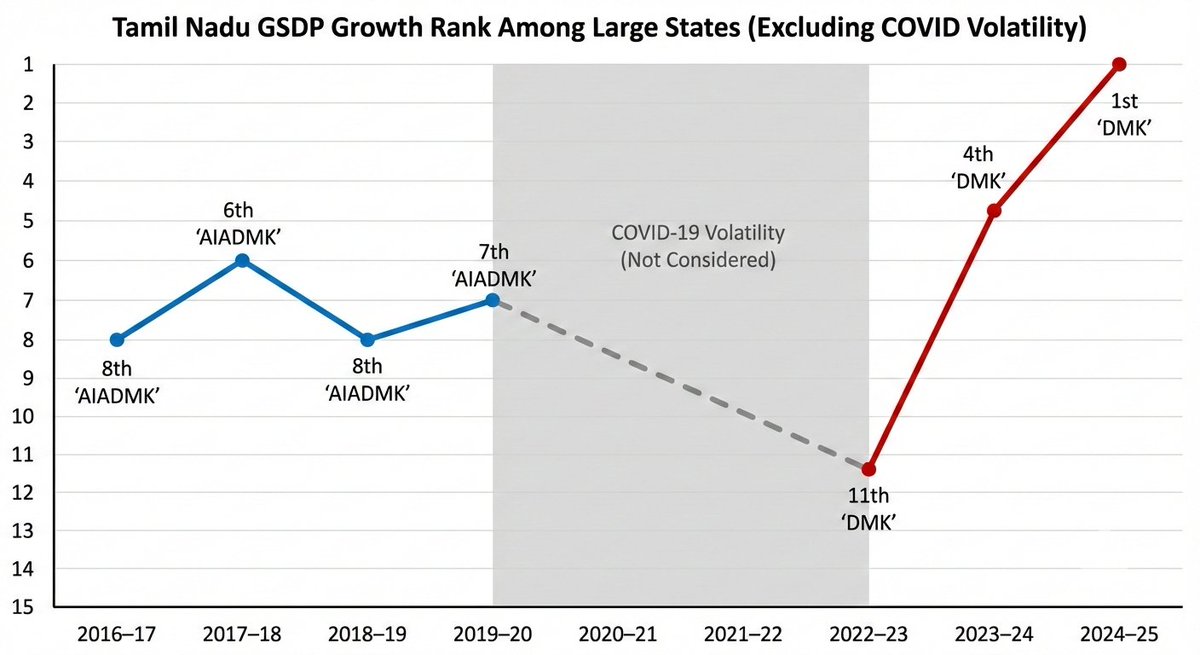
Under the AIADMK, Tamil Nadu ranked 6th to 8th among large states in GSDP growth. Under the DMK: 11th in the post-COVID recovery year, then 4th, then 1st. Per capita income reached ₹3.62 lakh — more than five times Bihar's, more than three times UP's. Exports doubled: $26.15 billion to $52.07 billion. Manufacturing grew at 14.74%, the highest in India. Tamil Nadu now leads the country with 15% of all industrial jobs.
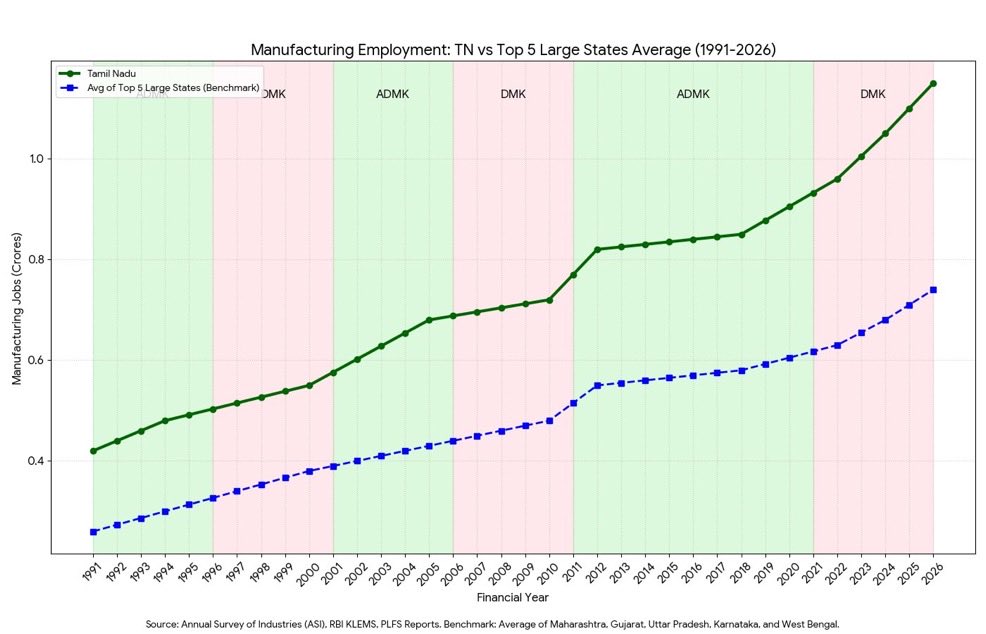
Tamil Nadu generated more manufacturing jobs than the average of the top five large states — Maharashtra, Gujarat, Uttar Pradesh, Karnataka, and West Bengal — and did so at a faster clip. The gap, visible since the 1990s, turned into a chasm in the last five years. From roughly 0.85 crore jobs in 2021 to over 1.1 crore by 2026 — while the top five average barely crossed 0.75 crore. The DMK's industrial policy did not just attract investment. It created employment at a pace no other large state matched.
The fiscal picture is equally strong. Inflation fell from 5.4% to 2.3%. Fiscal deficit narrowed from 3.3% to 3.0% of GSDP. The debt-to-GSDP ratio, which spiked to 29% during COVID, came down to 26.4% — below the FRBM threshold, below the national average. Unemployment declined to 3.5%. Labour force participation rose to 72.1%. Services grew at 11.3%, broad-based across IT, logistics, and hospitality. Capital expenditure over the term: ₹2.54 lakh crore. Social sector spending rose to ₹1,57,864 crore. Every fiscal and employment indicator moved in the right direction.
Tamil Nadu's 11.19% real GSDP growth is the highest among India's large states. Inflation halved. Fiscal deficit narrowed. Debt-to-GSDP improved from 29% to 26.4%. The economy grew faster than the debt — every quarter, every year, for five years.
| Metric | 2020-21 (Inherited) | 2024-25 (Latest) | Change |
|---|---|---|---|
| GSDP | ₹19.03 lakh crore | ₹31.15 lakh crore | +64% |
| GSDP (2025-26 BE) | — | ₹35.68 lakh crore | +87% over 5 years |
| Per capita income | ₹2.10 lakh | ₹3.62 lakh | +72% |
| Merchandise exports | $26.15 billion | $52.07 billion | +99% |
| FDI inflows | ₹5,909 crore | ₹20,157 crore | +241% |
| MSMEs | ~25 lakh | 35.56 lakh (2nd nationally) | +42% |
| Manufacturing growth | — | 14.74% | Highest in India |
| Inflation | 5.4% | 2.3% | -57% |
| Unemployment | — | 3.5% | Declining |
| Labour force participation | — | 72.1% | Rising |
| Services growth | — | 11.3% | Broad-based |
| Capital expenditure | — | ₹2.54 lakh crore | 5-year total |
| Fiscal deficit (% GSDP) | 3.3% | 3.0% | Narrowing |
| Debt-to-GSDP | ~29% | 26.4% | Improving |
The Investment Machine
The Global Investors Meet 2024 signed 631 MoUs worth ₹6.64 lakh crore, with 14.55 lakh direct jobs committed. Across Stalin's tenure, 1,179 MoUs worth ₹12.37 lakh crore have been signed. The conversion rate: 73.53% at advanced stages, with 35% already operational. Over 130 Fortune 500 companies now operate in the state.
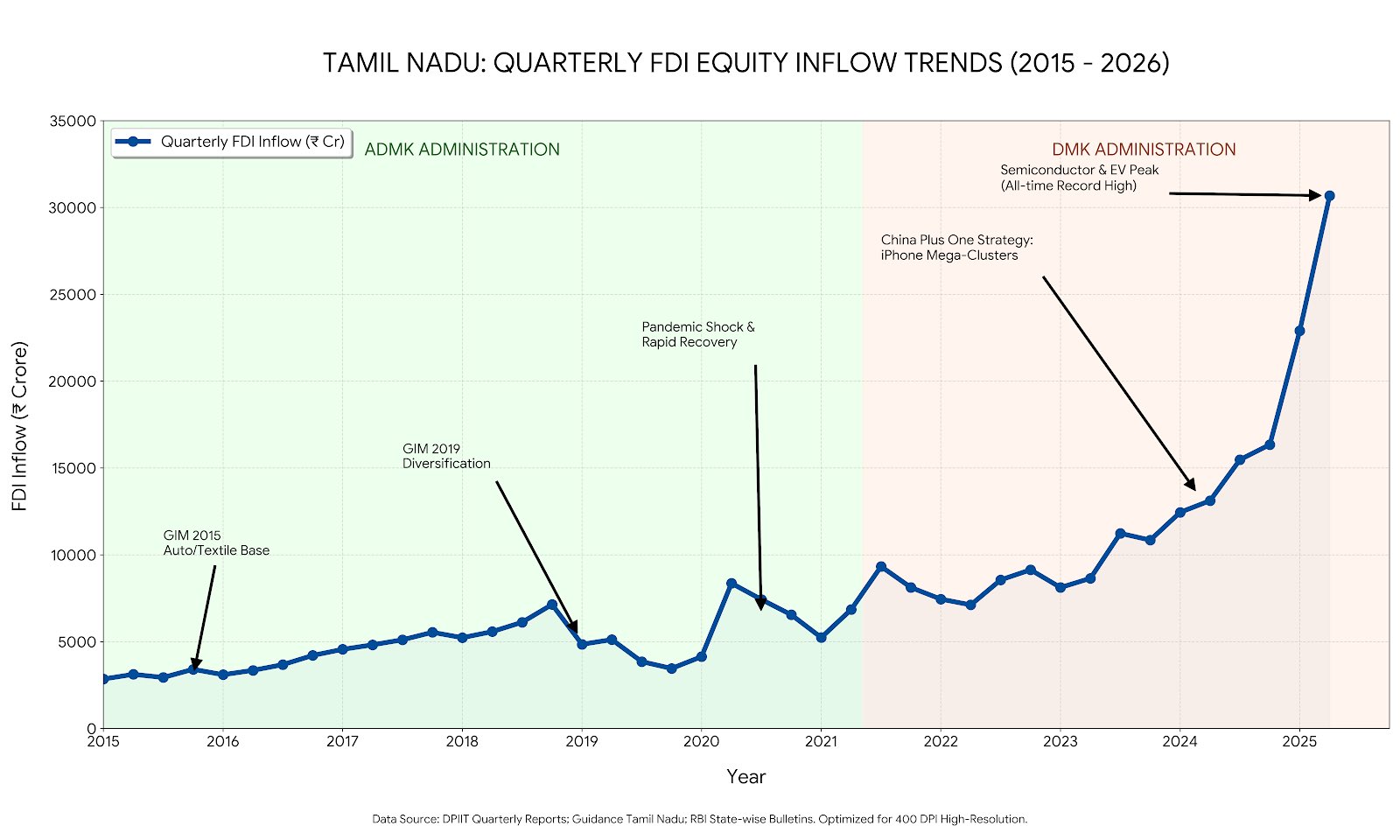
Look at that chart. For the entire ADMK decade — 2011 to 2021 — quarterly FDI hovered between ₹3,000 and ₹8,000 crore. Flat. Ten years of global capital looking elsewhere. Then the DMK took office, and the line bends upward — past ₹10,000, past ₹15,000, past ₹20,000, all the way to an all-time record of over ₹30,000 crore in a single quarter by 2025. Annual FDI inflows: ₹5,909 crore when Stalin took over. ₹20,157 crore by 2024-25. A 241% increase. The semiconductor push, the China+1 wave, the EV corridor, VinFast, Foxconn, Tata Electronics — they did not land in Tamil Nadu by accident. They landed because someone picked up the phone.
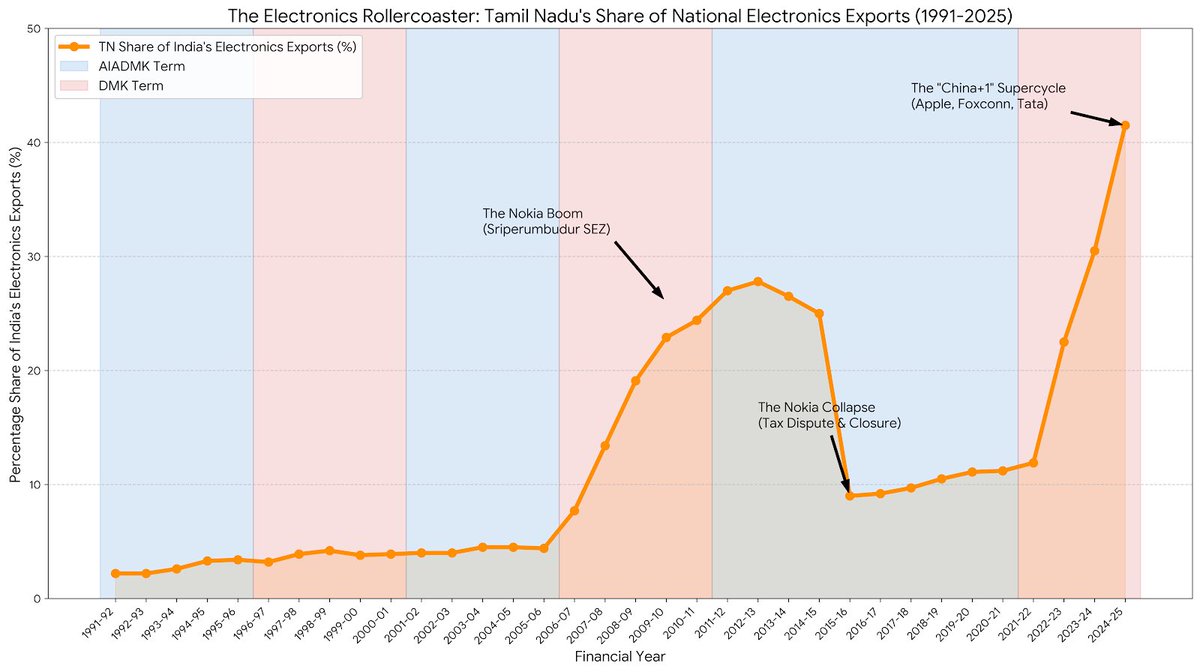
Tamil Nadu's share of India's electronics exports rose to 27% during the Nokia boom — then collapsed after Nokia's tax dispute and closure in 2014. Through the AIADMK decade, it stagnated at 9-11%. Under the DMK, the "China+1" supercycle arrived: Apple, Foxconn, Tata Electronics, Pegatron. The share surged to 41.3%. Electronics exports alone: $14.65 billion in 2024-25, up 53% year-on-year. Tata's iPhone parts plant in Hosur plans to employ 45,000 women.
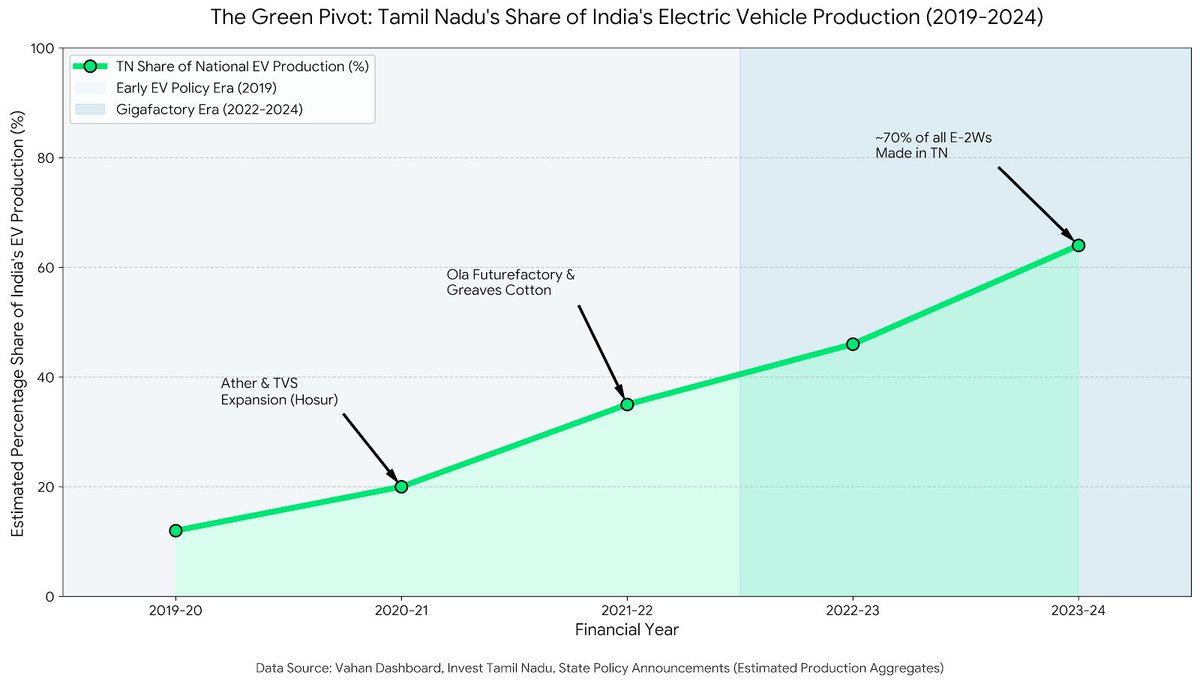
From 12% to 65% of India's electric vehicle production in five years. The EV Policy 2023 backed this with capital subsidies, stamp duty exemptions, and a dedicated EV park. The Electronics Components Manufacturing Scheme — India's first state-level electronics scheme — added depth to the supply chain. The defence corridor from Coimbatore through Salem to Tiruchirappalli, the semiconductor push, VinFast's $2 billion plant in Thoothukudi — these are generational bets. The early signals say they're landing.
Every district in Tamil Nadu is now covered by at least one industrial corridor — the only state in India where this is true. Growth is not confined to Chennai. It reaches every region. The $1 trillion economy target for 2030 is not a slogan. At current trajectory, it is arithmetic.
What the People Got
The economy is the scoreboard. Welfare is the scorecard. Every Dravidian government has understood this: the people who vote for you don't read GSDP figures. They know whether their children ate breakfast, whether the bus ride was free, whether a nurse came to their door.
Stalin's government launched nine major welfare initiatives — and the way they stack is what matters.
| Scheme | Launched | Reach | Key Metric |
|---|---|---|---|
| CM's Breakfast Scheme | Sep 2022 | 21.87 lakh students | Attendance +30%, hospital admissions -63% |
| Magalir Urimai Thogai | Sep 2023 | 1.31 crore women/month | ₹23,879 cr disbursed total |
| Free bus for women | May 2021 | 57 lakh daily | 881 crore total rides |
| Makkalai Thedi Maruthuvam | Aug 2021 | 2.5 crore people screened | Peer-reviewed health outcomes |
| Pudhumai Penn | Sep 2022 | 6.95 lakh students | ₹420 cr budgeted (2025-26) |
| Tamil Pudhalvan | Aug 2024 | 4.25 lakh boys | Higher ed for govt school boys |
| Illam Thedi Kalvi | Oct 2021 | 95.97 lakh students | After-school learning support |
| Naan Mudhalvan | Mar 2022 | 41 lakh trained | 3.28 lakh job placements |
That table is nine schemes. Each one is a story.
In Ramanathapuram district, a government primary school teacher reported that before the scheme, nearly a third of her students arrived listless and unable to concentrate until the mid-day meal at noon. Many came from families where the morning meal was tea and leftover rice, if anything. After the breakfast scheme launched, attendance rose from 78% to 94%. "The difference between a fed child and a hungry child," she said, "is the difference between a student and a body sitting in a chair."
Twenty-one lakh children now eat breakfast before class — up from the initial 1.14 lakh when the scheme launched in 1,545 schools. It has since expanded to every government primary school and 3,995 aided schools. Attendance jumped 30%. Hospital admissions among students dropped 63%. New government school enrolments surged: 2.5 lakh in the first year, 3.7 lakh in 2025-26. Parents who had been paying for private schools chose the government system.
The breakfast scheme feeds 21.87 lakh children daily at roughly ₹600 crore per year — less than 0.2% of Tamil Nadu's GSDP for an intervention that lifted attendance by 30%, cut hospital admissions by 63%, and brought 3.7 lakh new students into government schools.
Kalaignar Magalir Urimai Thogai reaches 1.31 crore women every month — the largest direct cash transfer to women in any Indian state. Total disbursed over five years: ₹33,395 crore — the largest direct cash transfer to women by any state government in Indian history. In early 2026, the government deposited a one-time ₹5,000 lump sum into the accounts of 1.31 crore beneficiaries — three months' advance plus a summer grant. Free bus travel — the first executive order Stalin signed — has logged 881 crore rides, with 57 lakh women riding daily. Women's share of total bus ridership surged from 40% to 61% — a structural shift in who moves through the state. The economics are counterintuitive: when transport is free, women who stayed home now access jobs, markets, hospitals. The mobility multiplier exceeds the cost.
Behind the cash and the bus rides is a deeper infrastructure of women's economic power. Magalir Udhavi Kuzhu — women's self-help groups — now number 6.23 lakh across the state, with ₹1.41 lakh crore in total loans disbursed. Thalikku Thangam provided 27.41 lakh women with gold for marriage — no income ceiling for eligibility. Combined with Pudhumai Penn, Tamil Pudhalvan, Thozhi Viduthi, and Vidiyal Payanam, the architecture is deliberate: money, mobility, education, safe housing, and economic organization. Each piece reinforces the others.
Doorstep healthcare. Makkalai Thedi Maruthuvam sent health workers to screen for diabetes, hypertension, and cancer at the household level. 2.5 crore people reached. Hypertension control rates improved from 3% to 17%. Peer-reviewed studies confirmed the outcomes. Eighty percent of the population screened for diabetes and hypertension — not in hospitals, but in their homes.
The healthcare architecture extends far beyond screening. The Chief Minister's Comprehensive Health Insurance Scheme — cashless treatment across 1,500+ procedures at empanelled hospitals — covered 88.44 lakh beneficiaries at ₹6,768 crore. Dr. Muthulakshmi Reddy Maternity Assistance reached 34.54 lakh women with ₹2,309 crore in direct financial support for pregnancies. Innuyir Kappom — the road accident emergency response programme — reached 4.90 lakh victims at ₹467 crore. Nalam Kakkum Stalin screened 18.52 lakh people. Idhayam Kappom provided cardiac care to 22,793 patients. Six healthcare schemes. Combined spend exceeding ₹10,000 crore. Over 4.5 crore beneficiaries. The system does not wait for people to come to the hospital. It goes to them, funds them, treats them, and follows up.
Illam Thedi Kalvi — "Education at your doorstep" — reaches 95.97 lakh students with after-school volunteer tutoring. Nearly one crore children getting supplementary learning support in their neighbourhoods. Ennum Ezhuthum covers 25 lakh students in foundational literacy. Vasippu Iyakkam reaches 66 lakh in reading skills. The education pipeline does not begin at school. It begins at the doorstep.
Building the Next Generation
The numbers that matter most are the ones that take a generation to show up.
School dropout rate: 16% in 2021. Below 5% by 2024.
Government school students admitted to premier institutions — IITs, NLUs, NIFT: 75 in 2021-22. Then 274. Then 447. Then 910 in 2024-25, across 93 institutions and 50 disciplines. Forty-one government school students are currently pursuing studies at IITs. In JEE Mains 2026 (Session 1), 448 government school students qualified — the top three scoring 99.53, 99.50, and 99.42 percentile.
Jayashee Perumal grew up in Pannandur village, Krishnagiri district. She studied in a Tamil-medium government school. In 2023, through the Naan Mudhalvan scheme's international education pipeline, she won a fully funded scholarship to study Mechanical Engineering at Kun Shan University in Taiwan. The Tamil Nadu government bears all higher education expenses and initial travel costs. Seventeen government school students are currently studying in universities in Japan, Taiwan, and Malaysia — entirely on state support. Seven decades of the Dravidian education pipeline, and it now reaches across oceans.
The education budget grew from ₹32,599 crore to ₹55,261 crore — a 70% increase in five years. Six new government medical colleges (30 to 36, the most in any Indian state). Forty-two new government arts and science colleges. Tamil Nadu now has more institutions in the NIRF top 100 than any other state. Anaithu Palli modernised the physical infrastructure of government schools statewide — smart classrooms, science labs, libraries, digital facilities. The pipeline that sends children to IITs begins with a functioning school building.
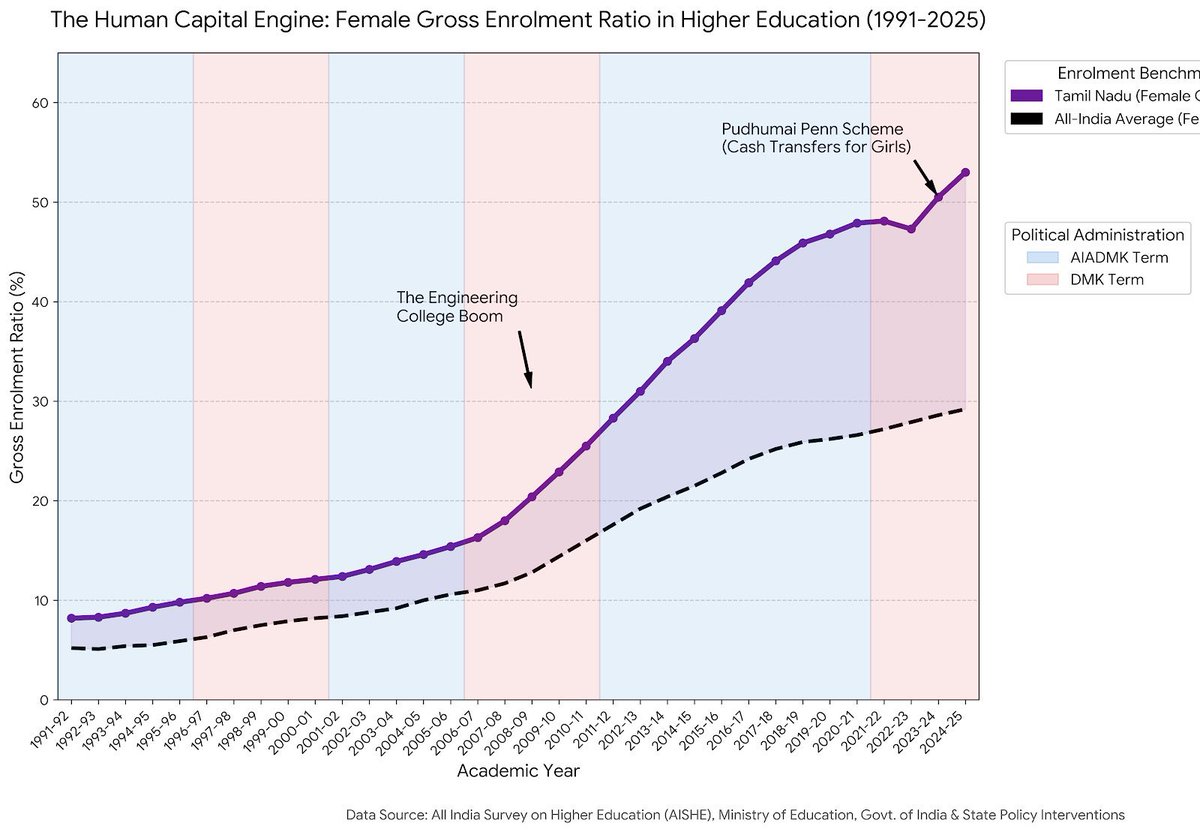
The steep rise in female enrolment after Pudhumai Penn is visible in the data. The scheme's full name tells the story: the Moovalur Ramamirtham Ammaiyar Higher Education Assurance Scheme. Kalaignar originally introduced a marriage assistance scheme — cash and gold for families with daughters. The logic was specific to its time: in a state where female feticide still occurred, where dowry made girl children a financial burden, the scheme sent a message that the government would stand behind families who raised daughters. The precondition was that the girl had to complete Plus Two. It kept girls alive and in school. Stalin's government took that same budget line and moved it to the next stage. The money no longer goes toward marriage. It goes toward completing a degree. From women's rights to women's empowerment — the evolution of the Dravidian commitment across generations. 6.95 lakh young women now enrolled. Female higher education enrolment increased 34%. Tamil Pudhalvan — the counterpart for boys who studied in government and government-aided schools in Tamil medium from classes 6 through 12 — launched in 2024, reaching 4.25 lakh. It evolved from the Moovalur Ramamirtham Ammaiyar Marriage Assistance Scheme, redirecting the same budget line toward higher education. Combined, over 12.36 lakh students now receive ₹1,000 per month to stay in education.
Naan Mudhalvan deserves its own paragraph — or several. Forty-one lakh students trained. 3.28 lakh placed in jobs, with salaries ranging from ₹3 lakh to ₹40 lakh per year. Top recruiters: Amazon, Morgan Stanley, Qualcomm, PayPal, Zoho, TCS. Forty-plus company partners — Microsoft, Google, IBM, Infosys, Oracle, ServiceNow, Salesforce. The programme is integrated as a mandatory 2-credit university course — no other state has embedded industry skill training this deeply into the academic framework.
Under Naan Mudhalvan's UPSC coaching sub-programme, Tamil Nadu secured 57 selections in the 2024-25 Civil Services Examination — the best in five years. Fifty of those 57 came from the Naan Mudhalvan partnership with Shankar IAS Academy. Free coaching, a monthly stipend of ₹7,500, and incentives for clearing each stage. Government school kids preparing for the IAS.
The Overseas Manpower Corporation runs free German language training for nursing professionals — eight months, B1/B2 level, placement in German hospitals at approximately ₹2 lakh per month. Microsoft's TEALS programme — the first in India — teaches AI, Python, and C++ in 100 government schools. The state now offers scholarships of up to ₹36 lakh for SC/ST students pursuing postgraduate studies abroad, and launched a new overseas scholarship for Muslim students in 2025.
In 2025, Tamil Nadu formulated its own State Education Policy — one of the few states to chart an independent course from the Centre's NEP 2020 — and scrapped the Class 11 board examination, cutting a high-stakes public exam from the school pipeline. In 2026, Ulagam Ungal Kaiyil put free laptops in the hands of college students — digital empowerment extended from school-level schemes into higher education. From 2021 to 2026, at least two major education initiatives were launched or expanded every single year. The education push was not a single announcement — it was a system being assembled, one layer at a time.
The startup ecosystem grew from 2,000 registered startups to over 12,000 — a sixfold increase. Tamil Nadu launched India's first state-level deep-tech startup policy in January 2026, targeting AI, semiconductors, biotechnology, and space tech. The ecosystem is now valued at $28 billion.
What Tamil Nadu Became
The economy and welfare are what headlines cover. What follows is everything else — or rather, a fraction of everything else. Five years of governance across dozens of departments, hundreds of schemes, thousands of projects. It is impossible to capture even most of it in a single article. These are highlights.
D. Gukesh was eighteen years old when he became the undisputed World Chess Champion in 2024. What most accounts miss: the Tamil Nadu government organized the Chennai Grand Masters 2023 specifically to give Gukesh a pathway to earn FIDE circuit points. He won that tournament. He qualified for the Candidates. He won the Candidates. He won the world championship. The SDAT categorised him as an elite sportsperson and provided financial support throughout. CM Stalin awarded him ₹5 crore. Tamil Nadu is home to 24 of India's 73 chess Grandmasters. The 44th FIDE Chess Olympiad, hosted in Mahabalipuram in 2022, was the first Chess Olympiad ever held in India — 187 countries, 1,737 participants, ₹75 crore from the state government.
R. Karthika, a seventeen-year-old from Kannagi Nagar — a resettlement colony in Chennai that most of the city pretends does not exist — captained India's Under-18 girls' kabaddi team to gold at the 2025 Asian Youth Games, defeating Iran 75-21. After the victory, she said publicly: "We don't have enough facilities in Kannagi Nagar. People here are talented, they just need support and a chance." Deputy CM Udhayanidhi Stalin visited Kannagi Nagar personally. Four months later, an indoor kabaddi stadium — ₹75 lakhs, international-standard synthetic surfaces, gymnasium, training rooms — was built and inaugurated. Karthika herself opened it.
Tamil Nadu won the FICCI "Best State Promoting Sports" Award in 2025 and Sportstar Aces "Best State Promoting Sports" in 2024. Three hundred and one athletes represented Tamil Nadu in international competitions. Thirteen competed at the Paris Olympics — the third-highest state contingent after Haryana and Punjab. India won its maiden Squash World Cup in 2025 — hosted in Chennai. Chennai hosted the WTA 250 tennis tournament. The Khelo India Youth Games 2024, hosted across four Tamil Nadu cities, saw the state finish second with its best-ever medal haul. Over five years, the state hosted seven international and over forty national-level sporting events.
The sports budget: ₹348 crore across the entire AIADMK decade. ₹548 crore in the DMK's first four years alone. CM Mini Stadia planned for all 234 Assembly constituencies. A ₹261-crore Global Sports City on 42 acres in Chennai. ₹85.99 crore in sports kits distributed to 12,831 village panchayats. ₹172.80 crore in cash incentives to over 5,400 medalists, including para-athletes supported on par with able-bodied athletes for the first time.
The UN's highest environmental honour
In December 2025, the United Nations Environment Programme awarded its Champions of the Earth prize — the UN's highest environmental recognition — to Tamil Nadu's Additional Chief Secretary for Environment, Supriya Sahu. The citation: 108 million trees planted. Mangrove cover doubled from 4,500 to 9,039 hectares. Ramsar wetland sites increased from 1 to 20 — the highest of any Indian state. Seven new wildlife and conservation areas established.
Tamil Nadu created India's first subnational climate institution — the Tamil Nadu Green Climate Company — with a 22-member governing council that includes Montek Singh Ahluwalia and Nandan Nilekani. The state declared heat waves as a state-specific disaster — one of the first in India to do so. Project Nilgiri Tahr, launched in 2022, saw the state animal's population rise 21% in two years. India's first Dugong Conservation Reserve was established in Palk Bay. India's first dedicated Slender Loris sanctuary was notified in Dindigul. A hundred new Reserve Forests were gazetted across ten districts.
The net-zero target: carbon neutrality before India's 2070 deadline.
Infrastructure at scale
1,046 bridges and 3,800 minor bridges built. The GD Naidu Elevated Expressway in Coimbatore — 10.1 kilometres, the longest flyover in Tamil Nadu — reducing travel time from 45 minutes to 10 minutes. The Chennai Peripheral Ring Road: 132.87 kilometres, the state's first ten-lane road. 3,778 new buses inducted into state transport, with 625 electric buses in the first phase and 120 already on Chennai's roads.
Kalaignar Kanavu Illam — the "hut-free Tamil Nadu" housing programme — has completed 81,811 houses with ₹3.5 lakh per beneficiary, approaching its 1 lakh target. Neo TIDEL Parks brought IT to Tier-2 and Tier-3 cities — Villupuram, Thanjavur, Salem, Vellore, Karaikudi, Thoothukudi, Tiruppur, Ooty. The Perur Desalination Plant, foundation laid in 2023, will be Southeast Asia's largest at 400 million litres per day. Patient visits to government hospitals more than doubled since 2021. Tamil Nadu's first separate Agriculture Budget in history was presented — a DMK manifesto pledge.
North Chennai — Tondiarpet, Royapuram, Tiruvottiyur, Manali — has been the city's blind spot for generations. Industrial waste, poor drainage, neglected roads, schools that looked like warehouses. The Stalin government announced the North Chennai Development Plan: ₹6,309 crore across 252 projects. Storm water drains, flyovers, parks, upgraded schools, new hospitals, sewage treatment. A dedicated budget for a part of the city that had been systematically overlooked. Whether the full 252 projects land on time is a question. That the money was allocated at all — specifically, publicly, with project-level tracking — is the break from decades of neglect.
Then there are the mega libraries. The Kalaignar Centenary Library in Madurai — ₹194 crore, 3.3 lakh books, a children's section, digital labs, auditoriums, spread across 2.73 lakh square feet. It opened in 2024 and draws thousands daily. The Periyar Arivulagam in Coimbatore — ₹301 crore, about to open — will be one of the largest public libraries in South Asia. The Kamarajar Library in Tiruchirappalli: ₹290 crore. Salem: ₹74 crore. Tirunelveli: ₹69 crore. Cuddalore: ₹80 crore. Over ₹1,000 crore committed to six mega libraries — in a country where most state governments have not built a single new public library in decades. The message: access to knowledge is infrastructure.
Thozhi Viduthi — working women's hostels — nineteen built, fourteen more under construction, in district headquarters and industrial clusters across the state. Rent ranges from ₹2,000 to ₹10,620 per month depending on the city, with furnished rooms, security, and mess facilities. 1,824 women housed so far, with 90% occupancy. The logic connects directly to the free bus rides and Magalir Urimai Thogai: a woman who has money, transport, and now a safe place to stay can take a job in a city she could not have reached two years ago.
Mudhalvar Padaippagam — government-run coworking spaces at ₹50 per day. Probably the first of its kind in the country: air-conditioned workspaces with high-speed internet, meeting rooms, and printing facilities, placed in strategic locations for people who do not have a dedicated workspace at home. 40,646 student users so far. Thirty planned across all municipal corporations. For a freelancer, a remote worker, a student preparing for competitive exams — a functional workspace that costs less than a cup of coffee at a chain café.
The safest large state
Murder numbers in 2024: 1,540 — the lowest in twelve years. Murder rate down 6.8%. Revenge murders down 42%. Rowdy-related crimes down 21%.
What Nobody Talks About
Nine flagship schemes get the headlines. The DMK government ran fifty-five schemes across fifteen sectors — many of them reaching people who will never trend on social media, whose struggles no news channel covers, whose lives improved without anyone writing a think-piece about it.
Start with the people who fall through every crack.
Differently-abled citizens — 2.59 lakh of them — receive maintenance allowances totalling ₹2,706 crore. Another 1.77 lakh received assistive devices worth ₹469 crore. Micro-enterprise grants helped 17,688 people with disabilities start businesses. Education scholarships reached 95,482 students. Total spend on the differently-abled across five schemes: over ₹3,270 crore. For a population that most Indian states treat as a line item in a budget footnote, Tamil Nadu built an architecture of support — income, equipment, enterprise, education.
SC/ST welfare ran at a different scale entirely. Post-metric scholarships reached 35.49 lakh students at ₹2,537 crore. Pre-matric scholarships: 18.58 lakh students, ₹381 crore. The girl child education incentive covered 22.88 lakh beneficiaries at ₹219 crore. TAHDCO — the Tamil Nadu Adi Dravidar Housing and Development Corporation — funded 18,939 entrepreneurs with ₹885 crore. CM ARISE supported 8,639 more with ₹461 crore. The Annai Ambedkar overseas education scholarship sent 385 Dalit and Adivasi students abroad at ₹130 crore. The Tholkudi tribal programme reached 23 districts. Total SC/ST welfare spend across these schemes alone: over ₹4,684 crore. A Special Act was enacted in May 2024 specifically to monitor SC/ST sub-plan fund allocation — legislation to ensure the money actually reaches the people it is meant for.
Then the sectors that never make election-night graphics.
Tamil Nadu's 7.37 lakh fishing families received ₹1,858 crore across four schemes — fishing ban season relief, lean season support, and savings-and-relief programmes for both fishermen and fisherwomen separately. The handloom sector — 1.64 lakh powerloom workers — got free electricity up to 1,000 units, worth ₹2,201 crore. Another 69,830 handloom weavers received 300 free units. Handloom support schemes covered 1.26 lakh weavers. Total handloom spend: ₹2,273 crore. For a sector that employs families who have woven cloth for generations, whose livelihoods are being crushed by industrial textiles, this is not charity. It is recognition that their work matters.
Unorganized workers — construction labourers, domestic workers, street vendors, the invisible backbone of every Indian city — 37.75 lakh of them received welfare benefits worth ₹3,317 crore. One scheme. One sector. More than three thousand crore rupees for people who have no union, no lobby, no voice in any policy debate.
48.27 lakh free bus rides for transgender persons under Thirunangaigal Vidiyal Payanam. And 7.18 crore free rides for persons with disabilities. In absolute numbers, modest. But in a country where trans persons are routinely denied dignity, denied mobility, denied the simple right to sit in a bus without being stared at or harassed — and where a wheelchair user calculates whether the fare is worth the indignity of boarding — free transport carries a message that no amount of money can buy. It says: you belong here. You are a citizen of this state. You ride the same bus.
Minorities received TAMCO loans — 41,007 beneficiaries, ₹279 crore — along with scholarships for Muslim women students (90,723 beneficiaries), incentives for rural minority girl students (1.02 lakh), and Hajj travel subsidies for 17,121 pilgrims. Backward classes received free bicycles for 19.04 lakh students at ₹918 crore and post-metric scholarships for 20.89 lakh at ₹965 crore.
Agriculture — the sector that feeds everything else. Free electricity connections for 1.97 lakh farmers at ₹2,455 crore. Micro-irrigation systems for 5.02 lakh farmers at ₹1,636 crore. Kalaignar's integrated village agricultural development programme covering 61.75 lakh farmers at ₹693 crore. The Kuruvu special package for 19.51 lakh farmers. Soil health programmes covering 27.61 lakh farmers. Seven agricultural schemes. Combined spend: over ₹5,800 crore. Tamil Nadu presented India's first-ever separate Agriculture Budget — a manifesto promise, delivered in governance.
And one more number that deserves its own paragraph. The HR&CE department recovered 10,296 hectares of encroached temple land — worth an estimated ₹7,680 crore. 3,956 temple consecrations were completed across the state. For a government that its critics relentlessly call anti-Hindu, the numbers tell a different story entirely: more temples restored, more land recovered, more consecrations performed than in any previous term.
Fifty-five schemes. Fifteen sectors. Fishers, weavers, construction workers, Dalit students, differently-abled entrepreneurs, tribal communities, transgender citizens, minority women, agricultural labourers. ₹33,395 crore for women's income. ₹4,684 crore for SC/ST welfare. ₹3,317 crore for unorganized workers. ₹3,270 crore for the differently-abled. ₹2,273 crore for handloom. ₹1,858 crore for fishing families. ₹5,800 crore for agriculture. ₹7,680 crore in temple land recovered. The Dravidian model does not govern for the average citizen. It governs for every last one.
29 Paise Per Rupee
Everything documented in this article — every breakfast served, every bus ride given, every scholarship funded, every factory attracted, every wetland restored — was achieved while Tamil Nadu received back just 29 to 35 paise for every rupee it sent to Delhi.
Tamil Nadu's share of central tax devolution has nearly halved — from 7.54% under the 8th Finance Commission to 4.1% under the 16th. The state contributes 9.4% of India's GDP but gets back 4.1% of the divisible pool. Bihar gets back ₹7.06 for every rupee it contributes. Tamil Nadu gets 30 paise. A twenty-fold gap in return on contribution.
| What the numbers say | Tamil Nadu | Bihar |
|---|---|---|
| Share of India's GDP | 9.4% | ~4.5% |
| Share of central tax devolution | 4.1% | ~10% |
| Return per rupee sent to Delhi | 29-35 paise | ₹7.06 |
| Revenue self-sufficiency | 76% self-raised | Heavily dependent |
The 14th Finance Commission raised states' share of central taxes from 32% to 42% — on paper, a historic jump. In the same period, the Centre tripled its collection of cesses and surcharges — taxes that sit outside the divisible pool and are never shared with states. Cess and surcharge collections surged from ₹2 lakh crore in FY16 to an estimated ₹6.3 lakh crore by FY27. The effective devolution crept from 28.73% of gross tax revenue to roughly 32%. The ten-point "increase" was a four-point sleight of hand.
Southern states — Andhra Pradesh, Telangana, Tamil Nadu, Karnataka, Kerala — contribute 30-35% of India's GDP. They receive 15% of central tax devolution. Their combined share fell from 18.62% to 15.8% in a single decade. States that controlled population growth — exactly as the Centre asked them to — are now penalised for succeeding, as the Finance Commission shifted from the 1971 Census to the 2011 Census for population weightage. Tamil Nadu's decadal population growth between 1971 and 2011 was among the lowest in India. Its reward: a shrinking share of the pie it helped bake.
Tamil Nadu raises 76% of its revenue on its own. State's own tax revenue in 2024-25: ₹1,95,173 crore. Total central transfers: ₹73,109 crore. Only 24% comes from Delhi. Tamil Nadu does not depend on the Centre. It performs despite the Centre.
This is the context that the national debate routinely ignores. When critics call Tamil Nadu's welfare spending "freebies," they forget that the state funds the vast majority from its own pocket. When they ask who pays for the free bus rides, the answer is straightforward: Tamil Nadu does — with money that Delhi takes disproportionately and does not fairly return. The ₹3,000 per month that reaches a woman in Virudhunagar is not Central largesse. It is Tamil Nadu's own earnings, administered by Tamil Nadu's own government, reaching Tamil Nadu's own people. The real freebie is Bihar's ₹7.06 per rupee.
The Full Scorecard
| Indicator | Baseline (2021) | Latest | National Context |
|---|---|---|---|
| GSDP | ₹19.03L cr | ₹31.15L cr (2024-25 RE) | 2nd largest state economy |
| Real GSDP growth | — | 11.19% | Highest among large states |
| Per capita income | ₹2.10 lakh | ₹3.62 lakh | 3× UP, 5× Bihar |
| Exports | $26.15B | $52.07B | Doubled in 4 years |
| SDG Index Score | 74 | 78 | Third nationally |
| MMR (per 100K live births) | — | 35 | Below UN SDG 2030 target of 70 |
| IMR (per 1,000 live births) | — | 12 | Half national average (25) |
| Life expectancy | — | 74.8 years | +3 years vs national average |
| Higher education GER | ~49% | 51.3% | India avg: 28.3% |
| School dropout rate | 16% | Below 5% | — |
| Vaccination coverage | — | 89% | India avg: 76% |
| Poverty headcount | — | ~4.8% | India avg: ~11.3% |
| Startups | ~2,000 | 12,000+ | $28B ecosystem |
| Unemployment | — | 3.5% | Declining |
| Labour force participation | — | 72.1% | Rising |
| Capital expenditure | — | ₹2.54 lakh crore | 5-year investment |
| Industrial jobs | — | 15% of national total | #1 in India |
| Ramsar wetland sites | 1 | 20 | Highest in India |
| Welfare schemes | — | 55 across 15 sectors | — |
| Women's cash transfer (Magalir Urimai) | — | ₹33,395 crore to 1.31 cr women | Largest state-level DBT in India |
| Health insurance beneficiaries | — | 88.44 lakh | ₹6,768 crore disbursed |
| SC/ST welfare spend | — | ₹4,684 crore | 35.49L post-metric scholars |
| Differently-abled welfare | — | ₹3,270 crore | 2.59L maintenance beneficiaries |
| Unorganized workers welfare | — | ₹3,317 crore | 37.75 lakh beneficiaries |
| Temple land recovered | — | 10,296 hectares | ₹7,680 crore value |
| Agriculture schemes spend | — | ₹5,800+ crore | 7 schemes, 61.75L farmers |
| Central tax share (Finance Commission) | 7.54% (8th FC) | 4.1% (16th FC) | Nearly halved |
| Revenue self-sufficiency | — | 76% self-raised | Only 24% from Centre |
Tamil Nadu is classified as a "Front Runner" in 13 of 17 UN Sustainable Development Goals and topped the country on Goal 1: No Poverty. The state's Maternal Mortality Rate at 35 per 100,000 is already below the UN's 2030 target of 70 — which the rest of India is still working toward.
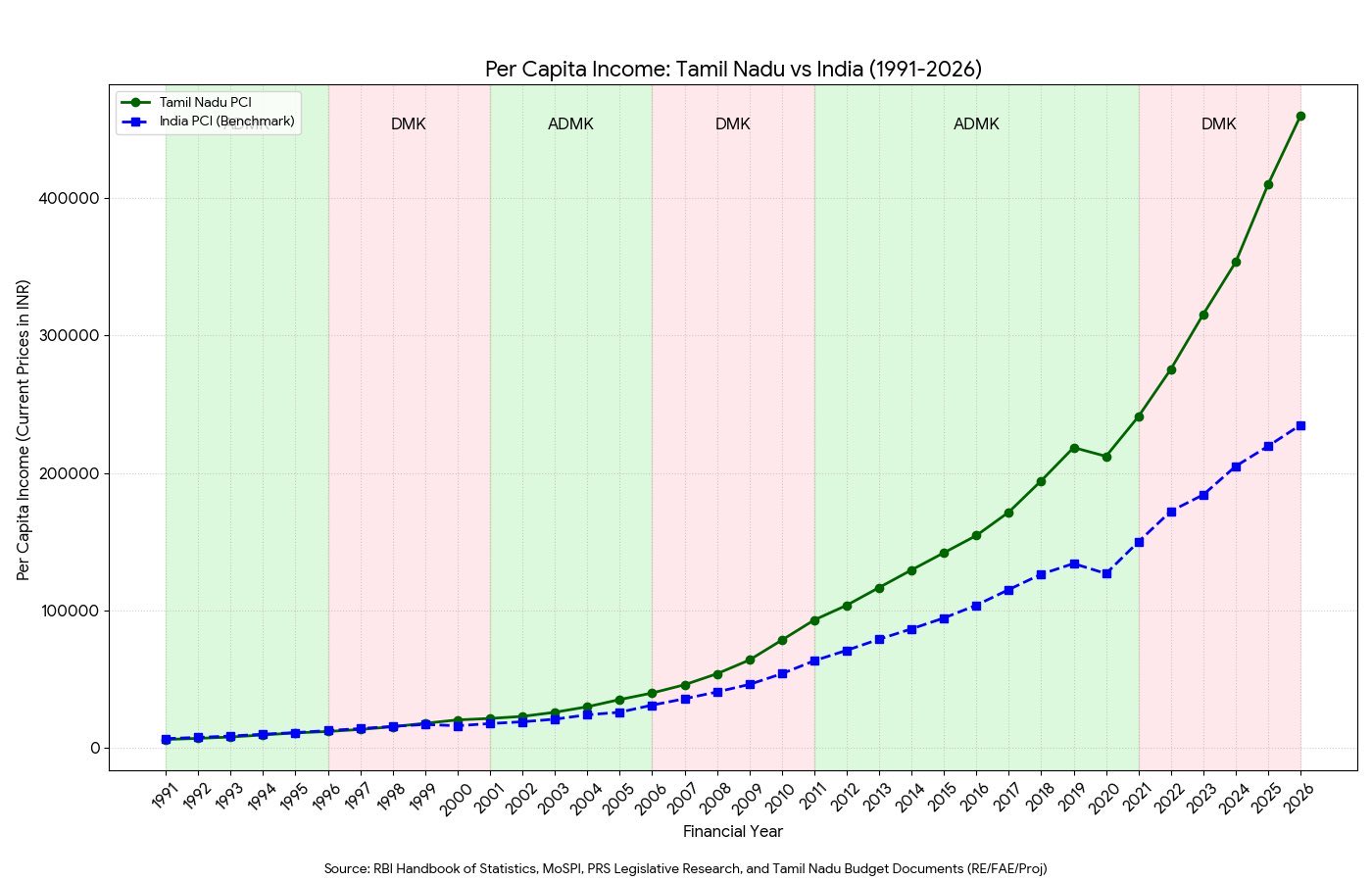
Today, the median Tamil person is richer than the median Indian by the widest margin since independence. That gap has grown exponentially in the last five years. In 1991, Tamil Nadu's per capita income was modestly above the national average. By 2026, it is nearly double — past ₹4.5 lakh against India's ₹2.36 lakh. The green and blue lines ran roughly parallel through the ADMK years. Under the DMK, they diverge like a rocket leaving the atmosphere.
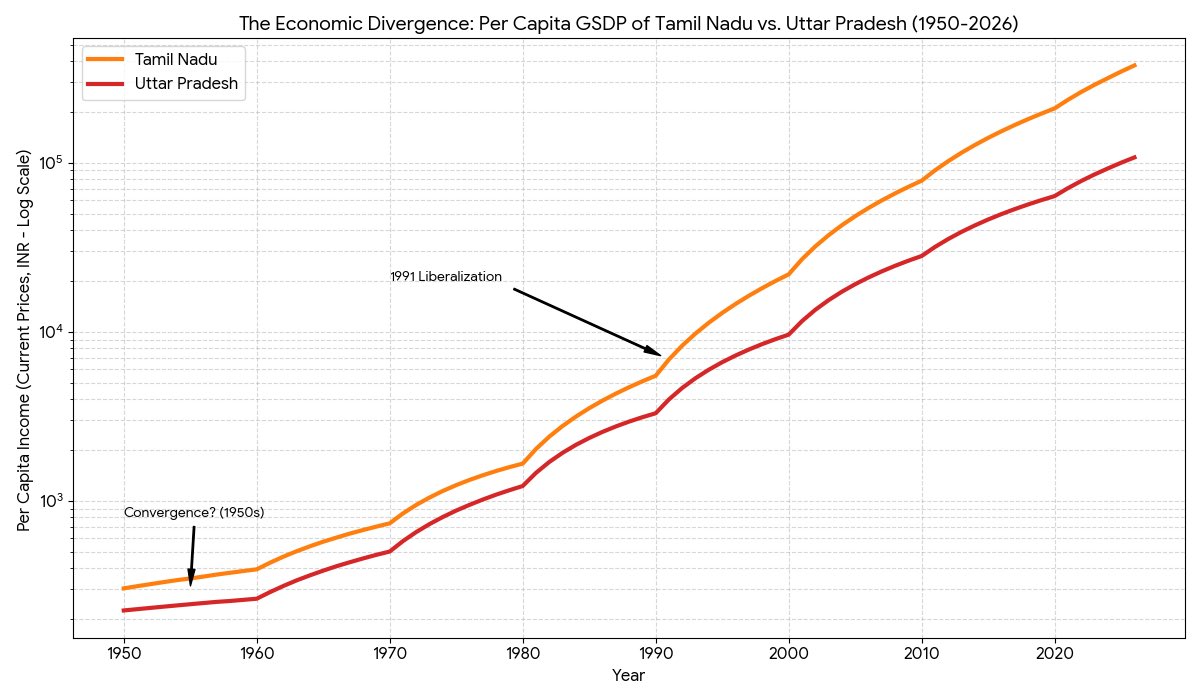
That divergence is what seven decades of Dravidian governance built. Tamil Nadu and Uttar Pradesh started from comparable baselines in 1950. By 2026, the gap is more than threefold. It was built policy by policy, school by school, factory by factory — and the latest five years added more distance than any previous term.
The Contrast
| Metric | 2016 (AIADMK) | 2021 (Handover) | 2025-26 (DMK) |
|---|---|---|---|
| GSDP | ~₹13L cr | ₹19.03L cr | ₹35.68L cr (BE) |
| Per capita income | ~₹1.57L | ~₹2.10L | ~₹3.62L |
| Exports | ~$23B | $26.15B | $52.07B |
| Medical colleges | ~25 | 30 | 36 |
| SDG Index | — | 74 | 78 |
| Debt-to-GSDP | ~19% | ~29% | 26.4% |
| GSDP growth rank | 8th | — | 1st |
| Electronics export share | ~11% | ~11% | 41.3% |
| EV production share | — | 12% | 65% |
| School dropout rate | — | 16% | Below 5% |
| Ramsar sites | 1 | 1 | 20 |
| Sports budget (per year) | ~₹35 cr | ~₹35 cr | ~₹137 cr |
Exports grew $3 billion in the AIADMK decade. They grew $26 billion in the DMK's five years. Electronics export share was flat at ~11% for a decade, then surged to 41.3%. The GSDP growth rank went from 8th to 1st. School dropout rate went from 16% to below 5%. Ramsar sites went from 1 to 20. The AIADMK decade was a holding pattern. The DMK's five years were an acceleration.
Jayalalithaa's Amma schemes were effective — simple, direct, visible. A canteen where a meal costs ₹5 is legible to every voter. The DMK combined similar direct welfare (breakfast scheme, Magalir Urimai Thogai) with long-horizon infrastructure, industrial policy, environmental conservation, and a sports programme that turned Tamil Nadu into India's sporting hub. The combination is more ambitious. The data says it delivered.
A government's character shows in what it builds. Some states build monuments. Some build only hatred. Tamil Nadu built breakfasts, bus rides, medical colleges, metro rail, Ramsar wetlands, sports academies, a chess championship, an electronics corridor, and a pipeline that sends government school children to universities in Japan.
And There Is More
The nine flagship schemes and the fifty-five-scheme count above are what this article had room to document. But the full list of programmes launched or expanded between 2021 and 2026 runs deeper — scheme after scheme, sector after sector, many of them never making a single headline. One line each. Every one of them is real, funded, and reaching people.
Education and skills:
- Sigaram Thodu — free 240-hour industry-led skill training for final-year engineering and science students, focused on emerging technologies and placement
- Uyarvukku Padi — Collector-led drive to re-enrol Class 12 passouts and dropouts into college or skill courses
- Vetri Nischayam — free skill training in 165 courses across 38 sectors for school and college dropouts aged 18–35; Phase-1 target: 75,000 youth, ₹100 crore allocated
- Kalloori Kanavu — career guidance camps for Class 12 students, focused on first-generation college-goers
- CM Research Fellowship — ₹25,000/month for meritorious low-income PhD students in state universities; intake expanded from 120 to 180 per year
- 3% sports reservation — state government job vacancies reserved for national and international-level athletes, age relaxed to 50 for para-athletes
Welfare and social protection:
- Anbu Karangal — ₹2,000/month to children who have lost both parents, plus laptops for those entering college; 6,082 children covered
- Anbucholai — 25 day-care centres for elderly citizens in 10 municipal corporations, offering yoga, physiotherapy, health check-ups, and indoor recreation
- Thayumanavar Thittam — doorstep delivery of PDS ration to 21.7 lakh elderly (70+) and disabled citizens every second Saturday, operating across 34,809 fair price shops statewide
- Samuga Neethi Viduthigal — all 2,739 state-run school and college hostels renamed under one inclusive brand to erase caste labels; 1.79 lakh students covered
- Oottachathai Urudhi Sei — programme to eliminate severe child malnutrition through Anganwadi systems; 77% of severely malnourished children reported returning to normal health
- Innuyir Kappom – Nammai Kappom 48 — free emergency treatment for road accident victims at 721 hospitals within the first 48 hours; coverage at ₹2 lakh; 3.22 lakh beneficiaries; rescuers get ₹5,000 reward
- Thozhilalargalai Thedi Maruthuvam — doorstep health screening for factory and unorganised workers; 3.05 lakh screened, target 32 lakh
Women and gender:
- 40% women's reservation — Tamil Nadu increased women's reservation in state government jobs from 30% to 40% in September 2021
Artisans and livelihoods:
- Kalaignar Kaivinai Thittam — state alternative to PM Vishwakarma; covers 25 trades (vs Centre's 18), loans up to ₹3 lakh with 25% subsidy, open to all castes
- Annai Ambedkar Thozhil Munnodigal — 35% capital subsidy (up to ₹1.5 crore) plus 6% interest subvention for SC/ST entrepreneurs; 2,386 benefited
- Millet festivals and competitions — statewide promotion of millets through district-level food festivals and competitions, aligning with Tamil Nadu's traditional grain heritage
Sports:
- CM's Mini Stadiums — ₹3 crore mini stadiums with multi-sport facilities in all 234 Assembly constituencies; 75 under construction
- Olympic Academies — four zonal academies announced; Sports Science Centre at Chennai's Jawaharlal Nehru Stadium inaugurated April 2025
- Namma Ooru Vilaiyattu Thidal — village-level sports grounds in every panchayat
- Kalaignar International Boxing Centre — world-class boxing training facility
Governance and outreach:
- Ungaludan Stalin — 10,000 doorstep government service camps covering 46 services across 15 departments; 83% of 14.5 lakh petitions resolved within 45 days
- Mudhalvarin Mugavari — integrated public grievance system merging four mechanisms, accessible via phone, web, app, email, and social media
- Neengal Nalama — CM and senior officials directly call scheme beneficiaries to collect feedback and fix delivery gaps
- Differently-abled representation in local bodies — Tamil Nadu became the first state in India to guarantee statutory representation for persons with disabilities in all local bodies. Two Bills amending the Panchayats Act and Urban Local Bodies Act created 13,988 nominated positions — 12,913 in village panchayats, 388 in panchayat unions, 37 in district panchayats, and 650 in urban local bodies. Before this, only 35 differently-abled persons held positions across all urban local bodies in the entire state
- Namma Arasu WhatsApp chatbot — launched January 2026 in partnership with Meta, bringing 51 government services — certificate downloads, bill payments, property registration, ration card services, grievance filing — into a single WhatsApp conversation in Tamil and English; built by TNeGA with intent-based conversational AI that understands context, not just keywords; 50 more services planned within three months
Culture, language, and heritage:
- Vergalai Thedi — free cultural heritage tours for Tamil diaspora youth (18–30) from 15 countries; 292 participants since 2023
- Muthamizh Arignar Translation Scheme — funds translation of major world literary and scholarly works into Tamil, grants of ₹9–12 lakh per project
- Maaperum Tamizh Kanavu — campus programme to sensitise students to Tamil history, civilisation, and culture
Infrastructure and water:
- Athikadavu-Avinashi — ₹1,916 crore scheme to divert surplus Bhavani River water into 1,045 water bodies across Coimbatore, Tiruppur, and Erode districts; a 67-year pending project, commissioned August 2024
- Namakku Naame — community matching scheme where local bodies and residents co-fund infrastructure; ₹150 crore approved for rural areas in 2025-26
- Knowledge City (Arivusaar Nagaram) — 1,703-acre knowledge and innovation hub planned in Tiruvallur district
Urban and municipal governance:
- AMRUT 2.0 — ₹6,656 crore for 446 drinking water and sewage projects across urban local bodies; 379 completed
- Seer Migu Nagar Thittam (Smart Cities) — ₹9,652 crore for 681 projects across 10 cities, covering roads, stormwater drains, parks, and digital infrastructure
- Urban sanitation — ₹7,657 crore invested in urban sanitation infrastructure; 43,226 individual household latrines constructed across municipalities
- LED street lighting — 45.41 lakh LED lights installed across municipalities (98% coverage), saving ₹577 crore in energy costs
- Urban Primary Health Centres — ₹348 crore for 200 new urban health centres and 30 primary health centres, bringing healthcare into municipal wards
- Blue Flag Beach certification — Marina Beach and four other beaches certified to international environmental and safety standards
- NNT (Namakku Naame Towns) — ₹475 crore for 2,720 co-funded projects across 10 municipal corporations
Rural development:
- Anaithu Grama Anna Marumalarchchi Thittam-II — comprehensive village renovation programme covering roads, drainage, community halls, and basic infrastructure on a five-year rolling cycle
- SCPAR (SC Habitation Roads) — ₹580 crore for road and building infrastructure in oppressed caste habitations across 119 constituencies
- Village panchayat digitisation — VPTAX Portal for property tax, UPS systems in 12,525 panchayats, and digital service delivery through Namma Ooru Namma Arasu camps
- Jal Jeevan Mission execution — 50:50 Centre-State funded scheme for rural tap water; Tamil Nadu emerged as one of the top-performing states in coverage, with the state matching every central rupee and delivering the execution — surveying, laying pipelines, last-mile delivery — that turned allocation into actual water reaching homes
Tourism:
- Tourism Destination Development Scheme — master plans for 300 locations; heritage circuits across Ariyalur, Sivagangai, Tiruchirappalli, and Thiruvannamalai
- Eco parks — ₹11.46 crore for hill tourism in Jawvadhu, Kolli Hills, and other biodiversity zones
- TTDC digitisation — online bookings via ttdconline.com, OTA partnerships with MakeMyTrip and Cleartrip, virtual tours for 44 sites in 12 languages
- Tourism revenue — grew from ₹84 crore (2021–22) to ₹238 crore (2024–25), nearly tripling in four years
- Tamil Nadu Wilderness Experiences Corporation — new entity established to develop eco-tourism and adventure tourism across the state
Food security and civil supplies:
- PDS modernisation — IRIS-based biometric authentication at ration shops; 20.57 lakh new ration cards issued; One Nation One Ration Card at 99% digital verification
- Rice procurement — ₹10,917 crore for 83,266 metric tons of paddy and parboiled rice, directly from farmers
- New godowns — ₹826 crore for 383 new storage facilities across 54 districts, eliminating food grain wastage
- Kalaignar Noorandu food outlets — ₹467 crore for state-of-the-art retail outlets selling essentials below MRP
Women and social protection:
- SHG loan waiver — ₹2,756 crore in self-help group loans waived, clearing debt for lakhs of women and freeing working capital for the next cycle
- Maternity leave — extended to 12 months for state government employees, the most generous in the country
Transport modernisation:
- Kilambakkam Bus Terminus — ₹394 crore integrated terminus replacing the congested Koyambedu facility, with capacity for 2,000+ buses daily
- Chennai Metro Phase 2 — 118.9 km expansion across three corridors, connecting the airport, port, and outer suburbs; the largest urban rail expansion in the state's history
- Chennai One Mobility App — integrated transport system with real-time tracking; won Urban Infra Award 2022
- Mini Perundu — new mini bus scheme for last-mile rural connectivity covering 36,893 km of routes; 25,708 km operational
- Hop-On Hop-Off Chennai — vintage-style tourist bus service launched January 2026
- NCMC tap-and-travel — integrated metro card system from January 2025; 1,663 buses enabled for contactless payment
- Fleet renewal — 12,087 new buses introduced (7,417 operational); 1,500 older buses refurbished
- Vidiyal Payanam — ₹866 crore spent on free bus travel for women, the flagship scheme that redefined public transport access
- Nirbhaya Safe City — 2,330 CCTV cameras installed on MTC buses in Chennai for women's safety
Energy and power:
- TANGEDCO expansion — 9,032 MW total installed capacity; 7,769 MW solar capacity added; 74 new substations and 492 distribution transformers
- Free electricity connections — 1.95 lakh new connections through Minnagam centres for below-poverty-line households
- TEDA renewables — Tamil Nadu Energy Development Agency driving renewable adoption via RESCO model since 2021; Solar R&D Lab established September 2023
- EV infrastructure — charging stations and solar-powered EV infrastructure under development in Chennai
Environment and conservation:
- Mangrove restoration — 3,600 hectares of mangrove cover restored along Tamil Nadu's coastline as bioshields against cyclones and erosion
- Wetlands mission — conservation and restoration of Ramsar-designated and state-priority wetlands across districts
Industry and investment:
- 15+ sector-specific policies — the state published standalone industrial policies covering electric vehicles, semiconductors, aerospace, shipbuilding, logistics, textiles, and space — each with its own incentive framework
- ₹10.43 lakh crore committed investment — 1,130 MoUs signed since 2021 across investor conclaves and international roadshows, translating into an active project pipeline of factories, campuses, and export hubs
- TIDEL expansion — IT park footprint expanded from 3 to 24, pushing the sector beyond Chennai into district headquarters
- 122 TANSIDCO industrial estates — small and medium enterprise infrastructure distributed across districts, with dedicated support tracks for women entrepreneurs and first-generation business owners
Archaeology and heritage:
- 14 district site museums — Keeladi's museum operational, with Noyyal, Navai, and Poompuhar museums turning excavation sites into public history
- Kudamuzhukku — 4,180 temple consecrations completed across the state, alongside recovery of 10,296 hectares of encroached temple land
This list is still not exhaustive. It does not include every irrigation modernisation project, every village road, every school building upgrade, every food processing zone. Five years of governance at this density cannot fit in a single article. What it can do is make one thing unmistakably clear: this was not a government that launched three schemes and coasted. This was a government that governed — relentlessly, across every sector, reaching every community, every month, for five years.
What Five Years Proved
The Dravidian model's core insight — that social investment drives economic growth, that feeding a child breakfast and giving her mother ₹1,000 and building a medical college in her district are economic policies — held up under pressure. The data from this five-year term confirms what Part 2 documented across a century: the virtuous cycle works.
But what this term proved goes beyond the model. It proved something about the range and moral ambition of governance itself.
Fifty-five schemes across fifteen sectors. From the woman who gets ₹1,000 a month to the transgender person who rides a bus for free. From the Dalit student on a post-metric scholarship to the powerloom weaver whose electricity bill disappeared. From the fisherman who receives lean-season relief to the differently-abled entrepreneur who got a grant to start a business. From the tribal community preserving ecological knowledge in the Kalvarayan hills to the government school girl in Krishnagiri who is now studying engineering in Taiwan.
Name a developed country — any OECD nation, any Scandinavian welfare state — and ask: does your government run a dedicated scheme for handloom weavers? Does it give free bus rides to transgender citizens? Does it fund micro-enterprises specifically for people with disabilities? Does it send its most oppressed citizens abroad on full scholarships? Does it recover ten thousand hectares of temple land from encroachers while simultaneously consecrating four thousand temples?
The answer, in most cases, is no. Not because those countries lack the money — but because they lack the political imagination, or the electoral compulsion, to govern at this granularity. The Dravidian model does not stop at headline schemes. It reaches the last person, the last need, the one who sits at the furthest edge and expects nothing from government because government has never given them anything.
எல்லாருக்கும் எல்லாம். Everything for everyone. That is not welfarism. That is civilisational ambition.
And it did not come at the cost of growth. Tamil Nadu posted 16% GSDP growth — the highest in India — pushing the state economy to a projected ₹35.7 lakh crore by 2025-26, second only to Maharashtra. Exports hit $52 billion — 12% of India's total — with Tamil Nadu ranking first in motor vehicles, leather, and textiles. The higher education Gross Enrolment Ratio reached 47%, the highest among large states. The Social Progress Index: 63.33, top rank nationally. Over 1,130 MoUs signed since 2021, representing ₹10.43 lakh crore in committed investment. Fifteen sector-specific industrial policies — EVs, semiconductors, aerospace, space, shipbuilding. The TIDEL IT park footprint expanded from 3 locations to 24, pushing the knowledge economy into district towns. This is the only large state in India that leads simultaneously in human capital and industrial capital.
All of this while spending ₹33,395 crore on women's income. While spending ₹4,684 crore on SC/ST welfare. While spending ₹3,317 crore on unorganized workers. While getting back 29 paise for every rupee it sent to Delhi. The economy did not grow despite the welfare. The welfare is why it grew. A woman with ₹1,000 in her pocket takes a bus to the market and spends it. A fed child stays in school and becomes an engineer. A scholarship student clears the UPSC. A weaver with free electricity keeps his loom running. Every rupee spent on the people comes back — in consumption, in productivity, in human capital, in dignity that translates into economic participation.
These fifty-five schemes are not the cost of building Tamil Nadu. They are the blueprint. A ₹35.7 lakh crore economy built not on extraction or exclusion — but on the radical, proven, century-old Dravidian conviction that prosperity must reach every last citizen, or it is not prosperity at all.
Part 1 told the story of the architects. Part 2 showed the receipts. Part 3 demanded more. Part 4 shows that when the Dravidian model runs at full capacity — economy roaring, welfare reaching, institutions building, all while being shortchanged by the Centre — it produces something that very few governments on earth, in any era, have managed: growth and justice, simultaneously, at scale, for everyone.
The model was tested. Tamil Nadu answered.
This is Part 4 of the Dravidian Movement series.
Read Part 1 — The Architects of Dignity: The people, the politics, and the hundred-year-old movement that rewired an entire state.
Read Part 2 — The Numbers Don't Lie: Education, economy, health — what a century of social justice actually looks like in data.
Read Part 3 — The Unfinished Revolution: Caste still kills in Tamil Nadu. And no government can fix it alone.
Charts and data visualisations: Nilakantan RS (@puram_politics), author of South vs North: India's Great Divide.