This is Part 5 of the Dravidian Movement series. Read Part 1: The Architects of Dignity on the people who built the movement. Read Part 2: The Numbers Don't Lie on what a century of social justice produced in data. Read Part 3: The Unfinished Revolution on the fight against caste violence. Read Part 4: The Dravidian Model, Tested on five years of MK Stalin's government.
The Speech They Want You to Forget
On a spring day in 1962, C.N. Annadurai rose in the Rajya Sabha and made a demand that no elected Indian legislator could make today.
He asked for a separate nation.
"I am pleading for separation of Dravida Nadu not because of any antagonism but because, if it is separated, it will become a small nation, compact, homogenous and united, wherein sections of people in the whole area can have a community of sentiment. Then we can make economic regeneration more effective and social regeneration more fruitful."
He wasn't being theatrical. He was being precise. Anna understood — with the clarity of a man who had spent three decades watching the Centre strip power from the states — that the Indian Union's promise of federalism was crumbling before the ink on the Constitution had dried. He told the Rajya Sabha that the very phrase "national integration" exposed the problem:
"The very term 'national integration' is a contradiction in terms. People integrated become a nation and if they become a nation, where is the necessity for integration? Therefore, that term 'national integration' shows the poverty of ideas which has been holding us up all this time."
A year later, the demand was silenced — by law. The 16th Constitutional Amendment, passed in 1963, made advocacy for secession grounds for disqualification from every legislature in the country. The DMK couldn't demand Dravida Nadu and also contest elections. Anna chose elections. He chose to work within the system, to fight for state autonomy instead of statehood.
But he said something else that year. Something that echoes louder in 2026 than it did in 1963:
"But the reasons that instigated me to toil for the creation of a Dravidian state still remain the same."
The demand was shelved. The grievances were not. Anna didn't abandon the diagnosis. He changed the prescription — from separation to federalism, from sovereignty to autonomy. He spent the rest of his political life trying to make the Indian Union work for the states it claimed to serve.
Anna became Chief Minister in 1967, and immediately pushed back against the Centre's creeping control. When the Fifth Finance Commission proposed posting a central official in state finance departments to monitor spending, he opposed it fiercely — calling it an attempt to "debase the self-respect and legitimacy of an elected state government." He told the Rajya Sabha: "Just as a goat does not require a beard, a state too does not really require a governor."
Anna died on February 3, 1969. But the demand for state autonomy didn't die with him. Kalaignar M. Karunanidhi, who succeeded him on February 10, constituted the Rajamannar Committee on September 22, 1969 — headed by former Madras High Court Chief Justice P.V. Rajamannar — India's first state-level commission to formally review Centre-State relations. The committee submitted its report on May 27, 1971, and its findings were devastating: the Constitution appeared federal but functioned as a unitary system. States had been reduced to administrative arms of Delhi. The committee recommended repealing Article 356, abolishing the Planning Commission, transferring subjects from the Concurrent List to the State List, and strengthening the Inter-State Council.
The Centre ignored every recommendation.
Fifty-seven years later, every single one of those recommendations remains relevant. And the fiscal architecture the Dravidian movement warned about has gotten worse — not in the ways they feared, but in ways that would have confirmed everything Anna said in that Rajya Sabha speech.
The Rupee That Never Comes Back
Here is the arithmetic of Indian federalism in 2026.
For every rupee Tamil Nadu sends to the Centre in taxes, it gets back 22 paise. That's just the tax devolution — the share from the divisible pool. Even if you add grants and centrally sponsored schemes, the return climbs to about 29 paise. Udhayanidhi Stalin called Modi "the 28 paisa PM." The number stuck because it's true.
Bihar gets back ₹5.90 per rupee from the divisible pool alone. When you include total central transfers — grants, schemes, all of it — the figure crosses ₹7.
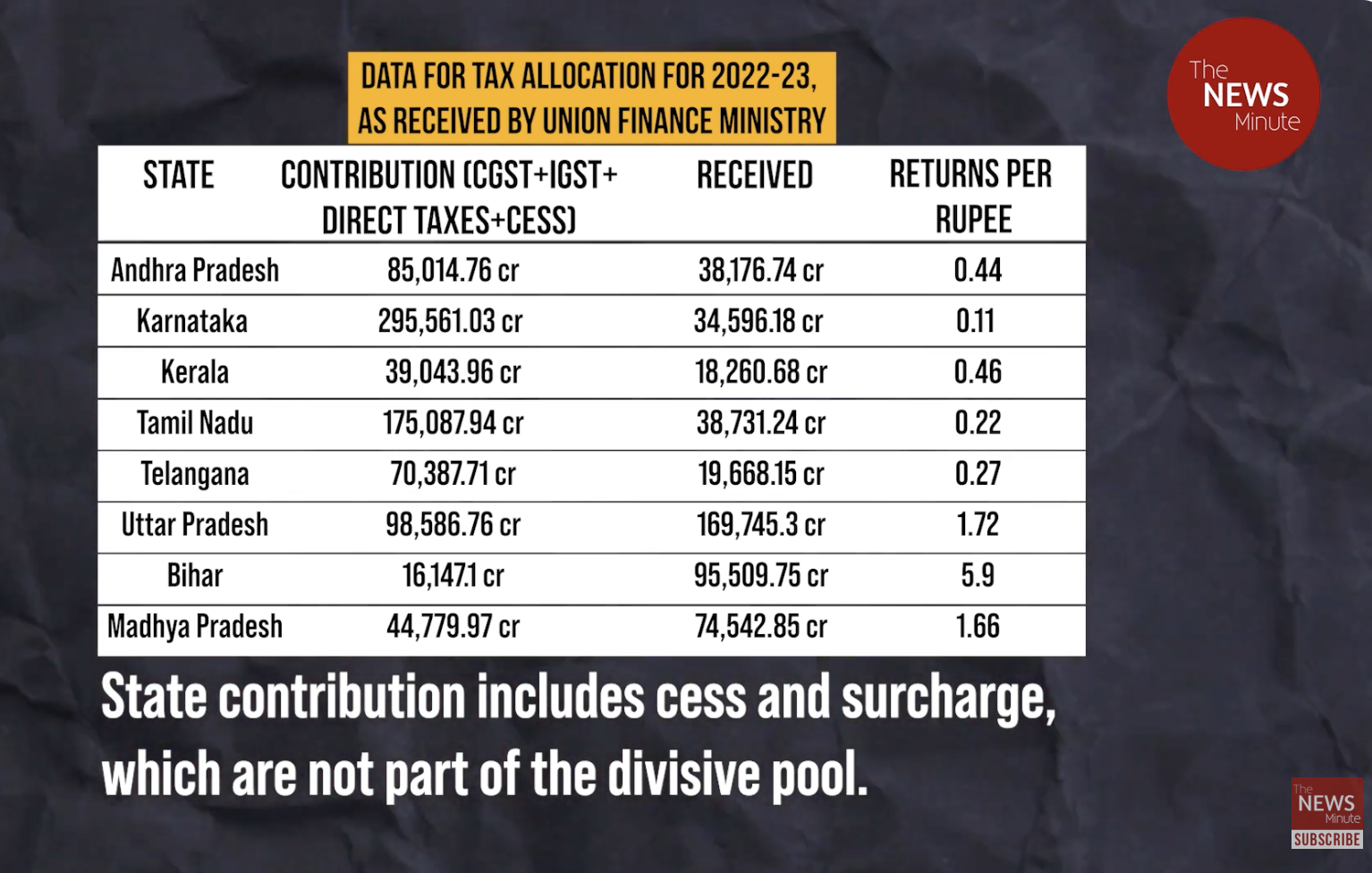
The News Minute's "Paisa Vasool" analysis — using Union Finance Ministry data for 2022-23 — lays it bare. Tamil Nadu contributed ₹1,75,087 crore in CGST, IGST, direct taxes, and cess. It received ₹38,731 crore back. Bihar contributed ₹16,147 crore. It received ₹95,509 crore. Karnataka contributed ₹2,95,561 crore — the second highest in the country — and got back ₹34,596 crore. Eleven paise per rupee.
One state built the second-largest economy in India, the third-highest SDG score, the lowest maternal mortality among large states, 5x the per capita income of Bihar — and receives 22 paise in return. The other state scores last on the SDG index, has the lowest per capita income in India, cannot account for ₹70,877 crore according to the CAG, and receives nearly six rupees for every one it sends.
| State | Share of Tax Devolution (15th FC) | GDP Contribution (~) | Per Capita Income (₹) |
|---|---|---|---|
| Uttar Pradesh | 17.939% | ~8-9% | 1,11,475 |
| Bihar | 10.058% | ~3-4% | 68,624 |
| Madhya Pradesh | 7.850% | ~4-5% | 1,55,289 |
| Rajasthan | 6.026% | ~4-5% | 1,86,610 |
| Tamil Nadu | 4.079% | ~9% | 3,49,248 |
Tamil Nadu generates 9% of India's GDP. It receives 4% of the divisible pool. Uttar Pradesh generates 8-9% of GDP and receives 18%. The allocation formula has nothing to do with contribution and everything to do with population — which means it has everything to do with penalising states that educated their women and controlled their fertility rates, exactly as the Centre asked them to.
The 16th Finance Commission, released in 2026, barely moved the needle. Tamil Nadu's share went from 4.079% to 4.097%. A gain so small it's a rounding error on an insult. And the Commission explicitly stated that the "reward for lower population growth must be phased out in due course from the devolution criteria." The one metric that recognised states for succeeding at development is being eliminated. As Nilakantan RS wrote in The Frontline: "The 16th Finance Commission's serious economists, instead of playing their part as independent umpires, seem to view themselves as the Centre's defence attorneys."
Over three decades, the share of every major southern and western state has been slashed (source: Mint, Finance Commission data):
| State | 10th FC | 15th FC | Change |
|---|---|---|---|
| Tamil Nadu | 6.6% | 4.1% | -2.5% |
| Karnataka | 5.3% | 3.7% | -1.6% |
| Kerala | 3.9% | 1.9% | -2.0% |
| Gujarat | 4.1% | 3.5% | -0.6% |
The cumulative cost to Tamil Nadu alone: an estimated ₹3.17 lakh crore — roughly 33% of the state's current outstanding debt. Tamil Nadu borrowed money to fund programmes that were being paid for — in part — by its own taxes flowing north and never returning.
Anna's words from 1962: "I want that this great State of ours should have self-determination, so that it can contribute its mite to the whole world."
Self-determination. That's what he asked for. What Tamil Nadu got instead is a system where it contributes its might to states that squander it.
The Cess Trick
If the devolution formula is the wound, the cess is the salt.
The Union government collects taxes. Under the Constitution, 41% of the divisible pool is supposed to go to the states. But the Centre has discovered a loophole wide enough to drive a fiscal policy through: cess and surcharges.
Cess and surcharges are collected alongside regular taxes, but they are not part of the divisible pool. They go entirely to the Centre. Here's how the trick works:
- Cess share of gross tax revenue: ~10% in 2011-12 → over 20% by 2020-21
- Divisible pool as share of gross collections: shrunk from ~90% to ~75%
- The real math: 41% of 75% = ~31%. The headline says 42%. The reality is 32%.
- Cess collections: tripled from ₹2 lakh crore (FY16) to an estimated ₹6.3 lakh crore (FY27)
- Accountability: The CAG found ₹2.19 lakh crore of cess collections (2020-2022) parked in the Consolidated Fund instead of being transferred to designated reserve funds
Money collected in the name of education, health, and infrastructure — spent at the Centre's sole discretion. Nobody in the states had a say.
Then came GST.
Before GST, states could set their own indirect tax rates. Tamil Nadu could calibrate its tax policy to fund its mid-day meal programme, its bus subsidies, its health infrastructure. GST centralised all of that. As Tamil Nadu's former Finance Minister P. Thiaga Rajan put it: "If you remove all variables of taxation away from the states and put them under the GST bucket, where are states to determine their revenue policy? You've effectively turned states into municipalities."
Tamil Nadu's manufacturing hubs lose an estimated ₹7,000 crore annually under GST's destination-based model, which penalises producing states in favour of consuming states. The state that builds the factory, trains the workers, maintains the roads, and manages the environmental impact — that state loses revenue to the state where the product is sold.
The structural problem runs deeper than rates. The GST Network — the technical infrastructure that processes every transaction — is managed by the Union government. At The Week's Tamil Nadu Leadership Summit, PTR pointed out that GSTN can effectively override state decisions: "Technology has effectively overridden legislative authority — which is not how a federal system should work." The GST Council is supposed to be the final authority, but decisions are often announced before the Council even meets. Meetings are infrequent. GST has become, in practice, an extension of the Union government.
Anna, 1963: "Protecting the soil is the Centre's duty; protecting the people is the state's duty."
The Centre is protecting neither. It is collecting the money, keeping a growing share of it through cess, shrinking the divisible pool, and then using a population-weighted formula to send the rest primarily to states that have failed on every metric the Centre itself measures.
The promised 41% devolution is a fiction. Cess and surcharges have shrunk the divisible pool so severely that the real share reaching states is closer to 31%. Tamil Nadu gets back 22 paise per rupee. That's the real number.
Where the Money Goes — and What It Buys
Follow the rupee north. See what it purchases.
Bihar received 10.058% of the divisible pool under the 15th Finance Commission. Central transfers constitute 72% of Bihar's entire budget expenditure. Without Delhi's money — most of it generated by states like Tamil Nadu, Maharashtra, Karnataka, and Kerala — Bihar's government would functionally cease to operate.
And what does Bihar do with the money?
The CAG's 2023-24 audit found ₹70,877 crore unaccounted for. Nearly 50,000 utilisation certificates were pending. Of ₹3.26 lakh crore budgeted, only ₹2.60 lakh crore was spent — and of the ₹65,512 crore in savings, only 36% was even formally surrendered. The rest simply sat unused. Bihar, Uttar Pradesh, and Maharashtra together account for 46% of India's rural poor but utilised only 20% of MGNREGA funds.
The money flows. It doesn't work.
| Indicator | Tamil Nadu | Uttar Pradesh | Bihar | Madhya Pradesh |
|---|---|---|---|---|
| SDG Index Score | 78 | ~65 | 57 (last) | ~65 |
| Per Capita Income | ₹3,49,248 | ₹1,11,475 | ₹68,624 | ₹1,55,289 |
| IMR (per 1,000 live births) | 12 | 37 | ~28 | 37 |
| MMR (per 1,00,000 live births) | 35 | 141 | 104 | 142 |
| Literacy Rate | 85.5% | 78.2% | 74.3% | 75.2% |
| Multidimensional Poverty | 2.20% | 22.93% | 33.76% | 20.63% |
| Life Expectancy (years) | 74.8 | 69.8 | 70.0 | 69.8 |
| Exports | $52.07B | $21.98B | Negligible | ~$7.8B |
| FDI (FY25) | $2.4-2.9B | $0.33B | Negligible | Negligible |
The table tells the story. One in three people in Bihar lives in multidimensional poverty. Tamil Nadu's rate is one in forty-five. The state that receives nearly six rupees for every one it sends to Delhi has one-third of its population in poverty. The state that gets 22 paise back has virtually eliminated it.
These are the states that receive the most money. These are the outcomes they produce. And the Finance Commission's response, every five years, is to send them more.
The Experts Know
This isn't a fringe argument made by regional parties with an axe to grind. India's most respected economists, its former central bankers, and its own Planning Commission members have said the same thing.
Raghuram Rajan — former RBI Governor, former IMF Chief Economist — chaired a committee in 2013 that recommended a composite backwardness index for fund allocation. By September 2024, he acknowledged the imbalance openly: "There has to be some transfers from richer states to poorer states. We need to bridge this gap." Even Rajan, who frames redistribution as necessary, conceded the structural tension.
Arvind Subramanian, former Chief Economic Adviser to the Government of India, was blunter: "If better-performing states feel they are being penalised for success, tensions will inevitably grow." He warned that the 2026 delimitation would "increase disaffection" between the south and the Hindi heartland.
Former RBI Governor Y.V. Reddy — the same man who chaired the 14th Finance Commission and raised the states' share from 32% to 42% — likened the entire devolution system to "a game between the Union and the States." Former RBI Governor C. Rangarajan, who led the 12th Finance Commission, urged making devolution mandatory through a constitutional amendment — an implicit admission that the current system allows the Centre to shortchange states at will. He acknowledged the problem directly: "The 14th Finance Commission gave a substantial increase. It left the central government with less money." That's when the Centre started clawing back — through cess, surcharges, and centrally administered schemes.
Nilakantan RS, author of South vs North: India's Great Divide, puts it simply: "The increase that the 14th Finance Commission gave was effectively neutralized."
R. Ramakumar, Professor at the Tata Institute of Social Sciences, studied successive Finance Commissions and found that no government has fully implemented the recommended devolution. During the 13th FC period, actual transfers were 31% against the recommended 32%. For the 14th and 15th FC periods: 40.3% and 38.1% against 41%. "While the Centre has every right constitutionally to levy cess and surcharges," Ramakumar says, "it is ethically wrong and against the spirit of federalism."
Palanivel Thiaga Rajan, Tamil Nadu's IT Minister and former Finance Minister, frames the outcomes question that nobody in Delhi wants to answer: "As it stands today, the devolution process rewards bad outcomes and penalizes good governance." At The Week's Tamil Nadu Leadership Summit in 2026, he went further: "There has never been a government in India's history that has weaponised the distribution of public money as much as the current one. They are quite blatant about it — 'Do what we say, or you won't get anything.' Even if funds are legally sanctioned through Parliament, if you don't comply with extra conditions that are not part of the law, the money is withheld."
R. Srinivasan, Member of the Tamil Nadu State Planning Commission, is equally direct: "Tamil Nadu's total expenses to GSDP ratio is around 11% while that of Bihar and Uttar Pradesh are about 17%. Spendthrift states are given more resources."
Thomas Isaac, Kerala's former Finance Minister: "We are not against redistribution. All we are asking is what is the outcome of decades of redistribution? Hindi-heartland states continue to remain underdeveloped, both socially and economically."
In February 2024, Karnataka Chief Minister Siddaramaiah led a formal protest at Jantar Mantar in Delhi against the fiscal imbalance. The next day, Kerala Chief Minister Pinarayi Vijayan protested at the same venue. DMK MPs held a 'black shirt' demonstration nearby. Four southern states, governed by different parties, standing together on a single demand: give us back what we earn.
The diagnosis is not disputed. The remedy is.
The Population Penalty
The 15th Finance Commission was directed to use the 2011 Census for population weightage, replacing the 1971 Census that earlier commissions had used. This single change reshaped everything.
Tamil Nadu brought its Total Fertility Rate down to 1.8 — below replacement level. Kerala to 1.8. These states invested in women's education, women's healthcare, women's employment. Educated women have fewer children. Fewer children are healthier, better nourished, better educated. The demographic transition is the ultimate proof that social policy works.
Bihar's TFR is still 3.0. Uttar Pradesh's is 2.7.
By switching to the 2011 Census, the Commission rewarded population growth. The states that failed to educate their women, failed to provide healthcare, failed to empower half their population — those states now have larger populations, and larger populations mean larger shares of the tax pool.
As Nilakantan RS, author of South vs North: India's Great Divide, frames it: the system is "punishing south Indian states for sending girls to school." Improvements in health meant less money for health. Improvements in education meant less money for education.
The 16th Finance Commission made it worse. Population weightage was increased from 15% to 17.5%. The demographic performance metric — the only criterion that rewarded states for controlling population — was reduced from 12.5% to 10%. And the Commission recommended phasing it out entirely.
The combined share of the five southern states has declined from 18.62% to 15.8% of devolution. All five southern states together receive less than Uttar Pradesh alone.
The next blow is already visible: delimitation. When parliamentary constituencies are redrawn based on the 2011 Census, Uttar Pradesh could gain seats — potentially up to 143. Tamil Nadu's representation stays flat or shrinks. Economic power concentrating in the south, political power concentrating in the north. By design.
Anna saw this sixty years ago. He didn't need the 16th Finance Commission's report to understand the trajectory. He had watched the Centre take power from the states since independence. He had watched Hindi imposition, fiscal centralisation, and the erosion of federal principles in real time. The 16th Amendment forced him to stop saying "separation." It did not make the reasons for saying it disappear.
What If Tamil Nadu Kept Its Money?
This is the question that every Finance Commission report makes harder to avoid.
Central transfers to Tamil Nadu dropped from 3.41% of GSDP in 2016-17 to 1.96% in 2024-25. The cumulative gap: ₹45,182 crore — accounting for 44% of the state's projected fiscal deficit. Nearly half of Tamil Nadu's fiscal deficit exists because the Centre takes more than it returns.
| Tamil Nadu | Bihar | Uttar Pradesh | |
|---|---|---|---|
| Own tax revenue as % of spending | 75% | ~27% | ~46% |
| Central transfers as % of budget | ~25% | 73% | 54% |
If Tamil Nadu retained a GDP-proportionate share of central taxes — 9% instead of 4% — it would close most or all of its fiscal deficit without borrowing a single additional rupee. The breakfast scheme, the free bus rides, Magalir Urimai Thogai, Pudhumai Penn, the medical colleges, the EV corridor, the semiconductor push — all funded without the debt that critics use to question the state's fiscal health.
The irony is vicious: Tamil Nadu is accused of overspending on welfare by the same people who defend a system that drains its resources to fund states that can't account for how they spend theirs.
Tamil Nadu borrows money to fund breakfasts for children and scholarships for first-generation graduates — because the taxes its people pay are flowing to states that can't account for them, can't feed their children, and score last on every index the Union government measures.
The Intergenerational Theft
The fiscal story has a dimension that most commentary misses — and it's the one that should alarm every young person in Tamil Nadu.
R. Srinivasan, Member of the Tamil Nadu State Planning Commission, has laid out the argument with precision: the current devolution formula prioritises intragenerational equity (redistributing between states in the present) at the direct expense of intergenerational equity (ensuring future generations aren't burdened by today's borrowings).
Here's how it works. A government has two ways to fund public services: taxes or borrowing. If taxes cover current expenditure, the present generation pays for what it receives. If the government borrows, the future generation pays — through higher taxes to service the debt. Borrowing for current expenditure is, by definition, intergenerational inequity.
Now look at what the devolution formula creates:
| High-income states (TN, KL, KA, MH) | Low-income states (BR, UP, MP) | |
|---|---|---|
| Revenue from own taxes | 59.3% | 35.9% |
| Revenue from Union transfers | 27.6% | 57.7% |
| Revenue deficit | 13.1% | 6.4% |
The states that raise their own money and spend carefully end up with double the deficit of states swimming in transfers. The less money Delhi returns, the more these states borrow. According to Mint's analysis of India Ratings data, Kerala's debt-to-GSDP ratio surged from 29% to 40%. Tamil Nadu's climbed from 19% to nearly 29% by 2021-22.
But here's what fiscal discipline looks like under pressure: despite inheriting a pandemic-bloated debt and running the most ambitious welfare slate in India — breakfast schemes, Magalir Urimai Thogai, Pudhumai Penn, free bus rides — the DMK government has brought Tamil Nadu's debt-to-GSDP ratio down from 28.83% (2021-22) to 26.1% (2025-26 BE), with fiscal deficit declining to 3% of GSDP. The state that critics accuse of overspending is the one actually consolidating its books.
Tamil Nadu's children will pay higher taxes tomorrow to service the debt their state incurred today — debt that exists because the Centre redirected their parents' taxes to states that couldn't even spend what they received.
As Srinivasan writes: the Finance Commission should assign larger weight to fiscal indicators and incentivise tax effort and expenditure efficiency through larger transfers. This would automatically ensure intergenerational fiscal equity. Instead, every successive Commission does the opposite — rewarding fiscal dependence and penalising self-reliance.
High-income states finance 59% of their spending from own revenue and still run a 13% deficit — because the Centre redirects their taxes. Low-income states finance only 36% from own revenue, receive massive transfers, and run just a 6.4% deficit. The system forces fiscally responsible states to borrow money that funds fiscally irresponsible ones.
Who Decides How Tamil Nadu's Children Learn?
The fiscal drain is the most measurable wound. But there's a deeper one — the creeping centralisation of subjects that have no business being decided in Delhi.
Education. Healthcare. Agriculture. Social welfare. These are state subjects. They happen on the ground, in districts, in villages, in classrooms where the teacher knows the students and the local health worker knows the families. The Indian Constitution placed them in the State List for a reason: the people closest to the problem are best equipped to solve it.
The Centre has been steadily ignoring this principle.
NEET — the National Eligibility cum Entrance Test — is the clearest example. Tamil Nadu had scrapped its own entrance exam, TNPCEE, because it structurally favoured urban, coaching-class students over rural government school children. Admissions shifted to board exam marks, levelling the field. For over a decade, this worked. Government school students accessed medical education without a gatekeeping exam designed for a different reality.
Then the Centre imposed NEET nationally, overriding the state's policy. The Tamil Nadu Legislative Assembly passed a bill to exempt the state from NEET. The bill sat with the President, unsigned — until the Governor's refusal to forward it became its own constitutional crisis, resolved only when the Supreme Court ruled in 2025 that governors cannot indefinitely withhold assent. The Kurian Joseph Committee went further: dismantle the National Testing Agency entirely. Abolish NEET. Return medical education to state control.
Consider what NEET means in practice. A student in Ramanathapuram — studying in Tamil medium at a government school, eating breakfast under the state scheme, travelling on a free bus — competes against a student from Kota who spent two years in a ₹5 lakh coaching factory. The exam tests the same syllabus. It does not test the same starting line. Tamil Nadu understood this. It designed a system that worked for its students. The Centre replaced it with a system designed for a different country.
And NEET is just one case. The National Education Policy 2020 was drafted without meaningful state consultation. It proposes restructuring that assumes every state shares the same educational challenges — which is absurd. Tamil Nadu's higher education Gross Enrolment Ratio is 51.3%, nearly double the national average of 28.3%. Bihar's GER is a fraction of that. A policy framework that treats both states as if they need the same interventions is a policy framework that understands neither.
Tamil Nadu formulated its own State Education Policy — one of the few states to chart an independent course. It scrapped the Class 11 board exam, reducing exam burden on students. It launched Naan Mudhalvan as a mandatory university credit — no other state has embedded industry skills this deeply into academia. These decisions were possible because the state retained some autonomy. Every centralising move shrinks that space.
Healthcare follows the same pattern. Tamil Nadu's Maternal Mortality Rate is 35 per 100,000 — half the UN's 2030 target. UP's is 141. MP's is 142. Tamil Nadu built a three-tier public health system over decades — Primary Health Centres, district hospitals, teaching hospitals — and then layered Makkalai Thedi Maruthuvam on top, sending healthcare to doorsteps. This system was designed locally, funded locally (with money the Centre was draining away), and delivered outcomes that outperform most middle-income countries.
Why should a centralised health policy designed in Delhi — calibrated for states where the MMR is four times higher and institutional birth rates are half — apply unchanged to Tamil Nadu? One state needs to build primary health infrastructure from scratch. The other needs to maintain what it built and invest in next-generation interventions. A single framework for both is a framework that helps neither.
The same logic applies to agriculture (Tamil Nadu presented India's first separate state Agriculture Budget — a DMK manifesto pledge), to social welfare (the Magalir Urimai Thogai scheme has no central equivalent), and to urban planning (Tamil Nadu is 48% urbanised; Bihar is 11%). The states are at different stages of development. Treating them identically doesn't produce equality. It produces mediocrity for the advanced and irrelevance for the lagging.
Mathiyil Kootachi, Manilathil Suyatchi
True Federal — Federation at the Centre, autonomy in the states.
This phrase — Mathiyil Kootachi, Manilathil Suyatchi — captures the Dravidian movement's federal vision more precisely than any policy paper. Anna conceived it. Kalaignar repeated it across five terms as Chief Minister. Stalin governs by it.
The idea is straightforward: India's diversity requires a Centre that coordinates between sovereign states, not one that commands them. Defence, foreign affairs, currency, inter-state trade — these belong to the Centre. Education, health, agriculture, policing, social welfare, urban planning — these belong to the states. The Centre's role is to hold the federation together. The states' role is to govern their people.
The Rajamannar Committee formalised this vision into constitutional recommendations in 1971. The Centre ignored them. The Sarkaria Commission (1983) said similar things. The Punchhi Commission (2007) said similar things. The Centre ignored those too.
On April 15, 2025, MK Stalin constituted the Justice Kurian Joseph Committee — a three-member panel chaired by retired Supreme Court judge Kurian Joseph, with retired IAS officer K. Ashok Vardhan Shetty and former Tamil Nadu Planning Commission Vice-Chairman Dr. M. Naganathan. The committee submitted Part I of its report — ten chapters — on February 16, 2026. It was tabled in the Tamil Nadu Legislative Assembly three days later. Two more parts are still being prepared.
Its conclusion: "Indian federalism now requires a structural reset comparable in ambition to the economic reforms of 1991."
The report is the most comprehensive critique of Indian centralisation since the Rajamannar Committee. It mapped the pattern of creeping centralisation across decades and proposed specific remedies:
- Governors: Fixed, non-renewable five-year terms. Amend Article 155 so the President appoints from a panel of three names approved by a majority of the State Legislative Assembly. Mandatory timelines for assent to state bills — drawing on the Supreme Court's 2025 ruling in State of Tamil Nadu v. Governor of Tamil Nadu.
- GST: Restructure the GST Council's voting system — reduce the Union government's voting weight, raise quorum thresholds, or adopt "one member, one vote." Allow states to vary SGST rates within a limited band. Create an independent GST Dispute Settlement Authority chaired by a retired Supreme Court judge.
- Delimitation: Extend the freeze on inter-state Lok Sabha seat allocation until 2126 — or until fertility rates converge nationally. Lok Sabha strength to remain at 550. Separate Union and State Delimitation Commissions.
- Rajya Sabha: Equal representation of six seats per state, replacing current population-based allocation. Abolish nominated members. Require members to be residents and registered voters of the state they represent.
- Education: Move education back to the State List. Restore state control over medical education. Dismantle the National Testing Agency and abolish NEET.
- One Nation, One Election: Oppose it — it violates federal balance.
- One Nation, One Language: Reject it. Advocate linguistic equality. Amend Articles 343, 345, and 346.
- State boundaries: Require affected state consent by special majority before Parliament can alter state boundaries under Article 3 — a direct response to the dismantling of Jammu and Kashmir into Union Territories in 2019.
The report drew on Constituent Assembly debates, scholarship across disciplines, and the findings of the Rajamannar, Sarkaria, and Punchhi Commissions. Its verdict: centralisation is increasing, and it is dangerous. Federalised governance isn't just preferable for a country of India's size and diversity — it is essential.
Three committees. Three generations. The same diagnosis. The same prescriptions. The same silence from Delhi.
The Kurian Joseph Committee (2026), constituted by MK Stalin, concluded that Indian federalism needs "a structural reset comparable in ambition to the economic reforms of 1991." It explicitly called for abolishing NEET, moving education back to the State List, restructuring GST, fixing gubernatorial overreach, and freezing inter-state delimitation until 2126. It is the second Tamil Nadu-constituted commission — after Rajamannar (1969) — to formally document the systematic erosion of federal democracy. The Centre has responded to neither.
The Centrally Sponsored Schemes illustrate the problem in microcosm. The Centre partially funds a scheme, the state commits matching resources, Delhi designs the policy, the states implement with tied funds they cannot redirect, and the Centre gets the political credit.
Consider the origin story. When M.G. Ramachandran went to Delhi in 1985 seeking additional funds for the noon meal scheme he had relaunched in Tamil Nadu in 1982, a member of the Planning Commission asked him if his government was running schools or restaurants. That member was Manmohan Singh. Post-independent India's most successful policy experiment — which would go on to transform nutrition, school enrolment, and child development across the country — was dismissed as a freebie by an unelected bureaucrat in New Delhi. As Nilakantan RS notes in The Frontline: "That story, of unelected bureaucrats in New Delhi determining the structure of government that subsumes policymaking in the far corners of the country, continues to this day."
PTR questioned the constitutional basis of this entire mechanism at The Week's Tamil Nadu Leadership Summit: "If something is a state subject, why should the Union government design schemes and then decide how much money each state gets? That goes against the very idea of federalism and the Finance Commission." He described the "double engine" dynamic — where states aligned with the Centre receive more funding but surrender independent decision-making. "You are not expected to think independently. You are expected to follow the Centre's line." These are, in his words, "tied funds and states do not have the freedom to spend as they want. Most of the time, they are poorly designed and one-size-fit-all schemes that are ineffective." Representatives from other states, he said, have privately admitted they cannot speak in their own state's interest because of this dynamic.
By 2023-24, Central Sector Schemes alone reached ₹14.68 lakh crore — over 700 schemes, fully funded and directly implemented by the Union government. Of this, only ₹60,942 crore was devolved to states. As Nilakantan RS observes: "The central government argues it needs more resources for defence, internal security, and foreign affairs — but it actually spends a lot on education, agriculture, health, and social welfare that fall under state subjects through centrally sponsored schemes."
And when the Centre does spend directly, the bias is measurable:
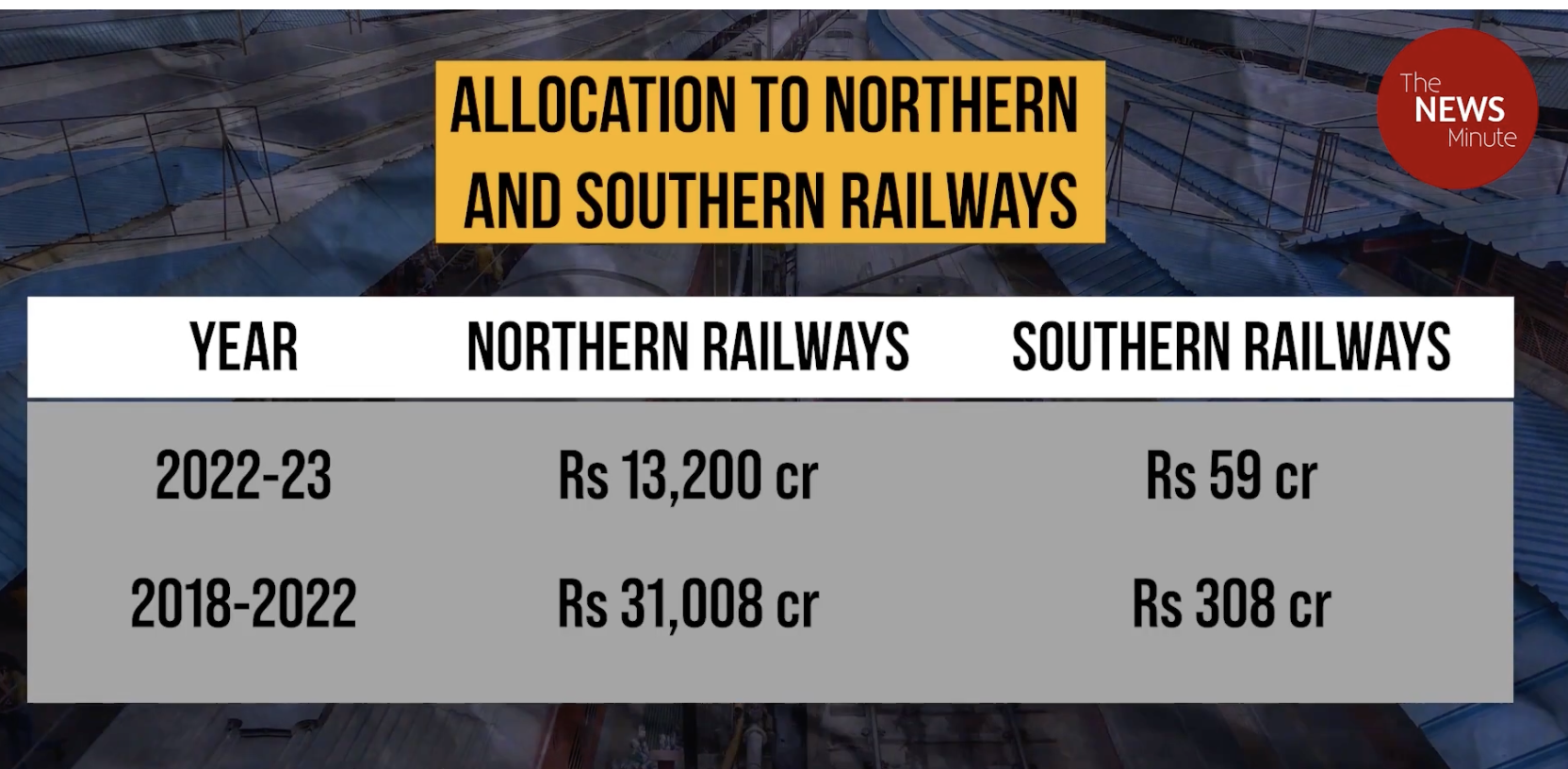
₹13,200 crore for Northern Railways. ₹59 crore for Southern Railways. In a single year. Between 2018-2022: ₹31,008 crore for the north, ₹308 crore for the south — funded by taxes from states like Tamil Nadu and Karnataka, directed overwhelmingly to constituencies that matter electorally for the ruling party at the Centre.
The Dravidian answer has always been the same: Mathiyil Kootachi, Manilathil Suyatchi. Work together at the Centre, govern independently in the states. Let Tamil Nadu decide what its children learn, how its hospitals operate, what its women receive, how its factories are regulated. Let Bihar and UP decide theirs. Judge both by outcomes, not by obedience to Delhi.
Self-respect. It started with Periyar asking why a human being needed a priest to speak to god. Anna extended it to asking why an elected state government needed Delhi to approve its spending. Today, it's the question of why a state that has already achieved the UN's 2030 health targets needs to follow a healthcare policy designed for states that haven't.
The Question That Won't Go Away
There is no accountability. There is no conditionality. There is no mechanism that says: you received ₹31,962 crore this month — show us what it bought. The money flows from south to north like a tax on competence, and every five years the Finance Commission adjusts the formula to make the flow larger.
Anna dropped the demand for Dravida Nadu because the 16th Amendment made it illegal to ask. He did not drop it because the reasons disappeared. He said so himself, in plain words, in a public forum, in 1963.
Sixty-three years later, the reasons haven't just remained. They've compounded. The share has halved. The cess has grown. The divisible pool has shrunk. The population penalty has deepened. GST has stripped fiscal autonomy. Delimitation threatens to strip political representation.
The Dravidian movement's response has been consistent since Anna: work within the system. Demand autonomy, not separation. Build despite the drain. Fund the breakfast scheme even when the Centre takes the money that should have paid for it. Send government school children to IITs on state funds while the Centre rewards states that can't keep their children in school.
But the question Anna asked in 1962 — can this great state have self-determination? — grows louder with every Finance Commission report. It grows louder every time Bihar's CAG audit reveals another ₹70,000 crore unaccounted for. It grows louder every time the cess share climbs and the divisible pool shrinks. It grows louder every time a formula is adjusted to reward demographic failure and punish developmental success.
The demand is shelved. The reasons remain.
They always have.
This is Part 5 of the Dravidian Movement series.
Read Part 1 — The Architects of Dignity: The people, the politics, and the hundred-year-old movement that rewired an entire state.
Read Part 2 — The Numbers Don't Lie: Education, economy, health — what a century of social justice actually looks like in data.
Read Part 3 — The Unfinished Revolution: Caste still kills in Tamil Nadu. And no government can fix it alone.
Read Part 4 — The Dravidian Model, Tested: Five years of MK Stalin's government — what the numbers say, what the people got, and what it cost.