This is Part 5b of the Dravidian Movement series. The previous comparison — The Manifestos, Scored — used DMK's own category headers as the framework. Those headers are legitimate — every state needs education, healthcare, infrastructure, social justice. But a framework built from one party's table of contents invites a fair question: would the result change if the structure came from somewhere else entirely?
Someone I respect read the first comparison and asked exactly that. So I built something more rigorous — a framework rooted not in either manifesto but in development economics. The State Capability Index draws from what Singapore, South Korea, the Nordic states, and Kerala have built, and from the academic literature on what it takes to run a high-growth, high-equity subnational economy. The question changed from "who organized their document better?" to something harder and fairer:
What does Tamil Nadu actually need to become a $1 trillion economy where no citizen is left behind?
The result is the State Capability Index — 8 pillars, 43 sub-parameters, each scored on 4 independent axes. The pillars come from what economies need, not what parties promise. The weights come from development economics literature, not from political preference.
I scored both manifestos against this framework. Here is what happened.
The State Capability Index (SCI) Framework
The SCI asks a single governing question: What capabilities must a modern subnational economy build to reach $1 trillion GDP while ensuring கடையனுக்கும் கடைத்தேற்றம் — upliftment even for the last person?
Eight pillars. Derived from what Singapore, South Korea, the Nordic states, and Kerala have built — and from the development economics literature on what it takes to run a high-growth, high-equity subnational economy. No pillar exists because a party mentioned it. Every pillar exists because the academic literature on state capability demands it.
| # | Pillar | Weight | Sub-parameters | Core Question |
|---|---|---|---|---|
| 1 | Economic Engine | 20% | 6 | Can this manifesto build a $1T economy? |
| 2 | Human Capital | 20% | 5 | Will the workforce be ready for 2030? |
| 3 | Social Justice & Equity | 18% | 6 | Does this reach the கடையனுக்கும்? |
| 4 | Women & Children | 12% | 5 | Are half the population centered? |
| 5 | Healthcare & Wellbeing | 10% | 5 | Can every citizen access health without ruin? |
| 6 | Infrastructure & Connectivity | 8% | 6 | Is the backbone being built? |
| 7 | Federalism & Governance | 5% | 5 | Is the state governing well and asserting its rights? |
| 8 | Sustainability & Culture | 7% | 5 | Is growth sustainable and culturally rooted? |
| Total | 100% | 43 |
Why these weights? Economic Engine and Human Capital share the top at 20% each because growth without human capital is unsustainable, and human capital without growth yields educated unemployment. Social Justice at 18% reflects the structural reality that caste-based exclusion remains Tamil Nadu's most binding constraint — and the Dravidian movement's foundational promise is that no one gets left behind. Federalism at 5% reflects the fact that while centre-state relations are existential for Tamil Nadu, a state government's primary job is delivery — health, education, jobs, infrastructure — not constitutional litigation. Federalism matters enormously, but the weight reflects what a state can directly control versus what it must fight for in courts and Parliament.
The Four Scoring Axes
Every sub-parameter is scored on 4 independent axes, each 1-10. A promise can be specific but unfunded, or funded but exclusionary. Single-axis scoring misses this.
| Axis | What It Tests | Low (1-3) | Moderate (4-6) | Strong (7-8) | Exceptional (9-10) |
|---|---|---|---|---|---|
| Specificity | Named targets, numbers, timelines | "Steps will be taken" | Some numbers, no timeline | Quantified + timeline | Phased roadmap + milestones |
| Institutional Design | Durable systems, not one-time schemes | No mechanism named | Existing department assigned | New institution proposed | Full governance architecture |
| Fiscal Credibility | Is funding identified and realistic? | No cost mentioned | Rough allocation stated | Budget line + amount | Source + phased expenditure |
| Inclusivity | Does it reach the last person? | One demographic only | Multiple groups mentioned | Systematic coverage | Explicit design for most marginalized |
The composite score for each sub-parameter = average of the 4 axes. Pillar scores are averaged across sub-parameters, then weighted.
One critical addition: track record. A manifesto does not exist in a vacuum. When a party promises 50 lakh new jobs, the question is not just whether the promise is specific — it is whether the party has a delivery base. DMK enters 2026 having delivered 64% GSDP growth, doubled exports, 241% FDI increase, 31 lakh SIPCOT jobs, the breakfast scheme, Magalir Urimai Thogai reaching 1.31 crore women, and Makkalai Thedi Maruthuvam screening 2.5 crore people. ADMK enters 2026 having governed for ten years (2011-2021) with stagnant FDI, no major institutional innovation post-Jayalalithaa, and a 2017-2021 period that even sympathetic observers describe as governance on autopilot. The Fiscal Credibility and Institutional Design axes reflect this: a promise backed by proven delivery scores higher than the same promise from a party with no comparable base.
The Headline Score
After scoring all 43 sub-parameters across 4 axes for both manifestos, the State Capability Index produces this result:
| DMK | ADMK | |
|---|---|---|
| SCI Score (out of 100) | 80.1 | 34.7 |
| Gap | 45.4 points |
DMK crosses 80 — scoring 80.1 to ADMK's 34.7. The gap of 45.4 points is larger than ADMK's entire score. On a party-agnostic, development-economics framework, the distance between these two manifestos is wider than everything ADMK managed to put on the board. The gap comes from institutional design, fiscal credibility, and track record — the three dimensions where "steps will be taken" scores a 2 and "₹50,000 crore semiconductor investment with phased timeline, backed by 241% FDI growth already delivered" scores an 8.
Let me show you where each party earns its score — and where each one falls short.
Pillar 1: Economic Engine (Weight: 20%)
| # | Sub-parameter | DMK | ADMK |
|---|---|---|---|
| 1.1 | Industrial growth & investment targets | 8.5 | 3.5 |
| 1.2 | MSME & entrepreneurship ecosystem | 8.3 | 3.0 |
| 1.3 | Employment generation | 8.3 | 3.3 |
| 1.4 | Export & global integration strategy | 8.3 | 3.0 |
| 1.5 | Technology & innovation | 8.5 | 3.0 |
| 1.6 | Fiscal sustainability & revenue strategy | 7.3 | 2.5 |
| Pillar Average | 8.20 | 3.05 | |
| Weighted (x 0.20) | 1.64 | 0.61 |
This is where the manifestos diverge most sharply, and where the framework's party-agnostic design matters most.
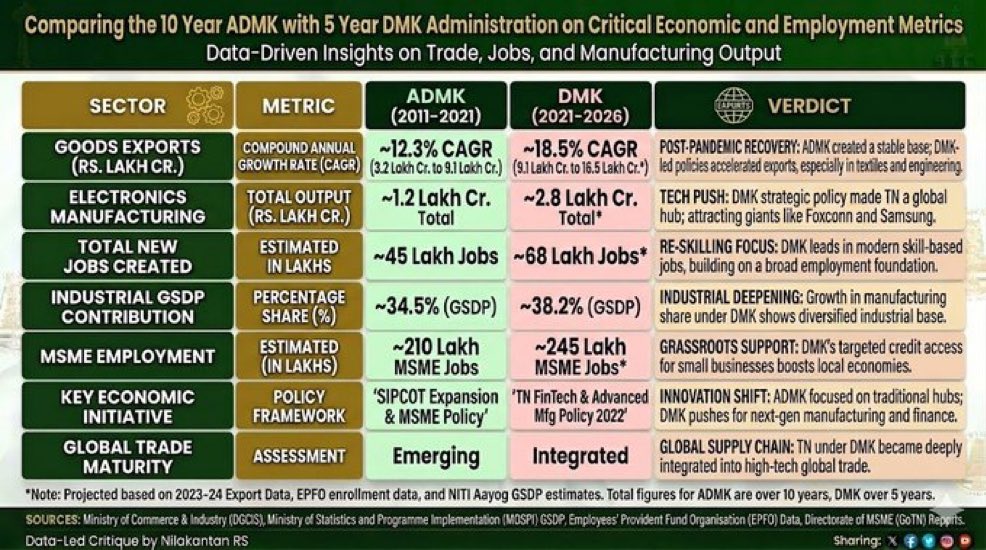
DMK's manifesto reads like a government that has a macroeconomic strategy — and a track record to base it on. Between 2021 and 2026, the state's GSDP grew 64%, exports doubled, FDI rose 241%, and manufacturing growth hit 14.74%. The manifesto builds from this base: ₹18 lakh crore in foreign investment, exports at $120 billion, 50 lakh new jobs with a commitment to 50,000 new industrial jobs per district, semiconductor investment worth ₹50,000 crore, 500 new GCCs, IT exports doubling to ₹5 lakh crore. There are sector-specific industrial corridors, 50 new SIPCOT parks (building on 33 already delivered), 10 Mega Plug & Play Parks, an Export Cell, trade offices in Southeast Asia, South America, and the Middle East. The MSME section alone has 24 detailed policy points with regional cluster strategies mapped to specific districts — from Ambur leather (₹40 crore) to Nilgiri tea brands to Krishnagiri mango GI missions. This is what a manifesto looks like when the party writing it has already built 31 lakh jobs through SIPCOT in the previous term.
ADMK mentions the $1 trillion target exactly once — in point 140: "Arrangements will be made to quickly transform Tamil Nadu into a 'One Trillion Dollar Economy.'" That is the entire industrial strategy for the most ambitious economic target in Tamil Nadu's history. A single sentence. No sectoral breakdown. No investment pipeline. No export target. No institutional mechanism. No timeline except "quickly."
Compare this to DMK's 29-point industrial growth section with named corridors, specific investment figures, and institutional bodies — and you begin to see why the Specificity axis creates such large gaps.
Where ADMK does compete: it proposes a Single Window System under the CM (point 142) — though Tamil Nadu has had a single window clearance system since the 1990s, now operating as TNSWP 2.0 with 200+ approvals across 40+ departments and time-bound auto-clearances. The proposal is less a new institution and more a governance posture: "under the CM" signals personal attention, not a policy innovation. It names textile parks in Aruppukottai and Ettayapuram, pharmaceutical parks in Chennai and Tirunelveli, a Tech City of 260 acres, and defense corridor factories in Coimbatore-Trichy-Salem-Hosur. These are real proposals with geographic specificity, and they earn moderate scores.
The MSME section reveals the gap at its starkest. ADMK's approach (points 151-156) is to "form a committee," "provide subsidies," and "urge the Central Government to reduce GST." No new institutions. No cluster strategies. No regional mapping. No targets for new MSME creation. DMK's approach: 5 lakh new MSMEs in 5 years, 2 lakh new entrepreneurs (including 1 lakh women), 24 district-specific cluster strategies, a Tamil Nadu GI Mission identifying products per district, virtual trade platforms, Canton Fair-style exhibitions, NABL-accredited testing labs, and value chains for 11 named product categories. The gap here is not about ideology — both parties want MSMEs to grow. The gap is between saying "we will help" and saying "here is exactly how, where, with whose money, and for whom."
DMK's fiscal sustainability score (7.3) reflects a tension between a thin manifesto section — just 4 points on financial management for a party promising ₹18 lakh crore in investment — and a track record that speaks for itself. Under ADMK, debt-to-GSDP rose steadily from 22.6% in 2016-17 to 29.0% in 2020-21 — a 6.4 percentage point increase, and it was already at 25.4% before COVID hit. Fiscal deficit worsened from 2.8% to 4.6%. DMK inherited this mess and reversed the trajectory: debt-to-GSDP back to ~26%, fiscal deficit narrowed to 3.0%, capital expenditure roughly doubled, own tax revenue growing at 12-14% CAGR — all while running Magalir Urimai Thogai, free bus travel, the breakfast scheme, and every other welfare programme. The economy grew faster than the spending. ADMK scores 2.5 because it has no fiscal strategy in its manifesto, no fiscal track record worth citing, and ₹40,000 crore in new annual promises with no explanation of how to fund them.
Pillar 2: Human Capital (Weight: 20%)
| # | Sub-parameter | DMK | ADMK |
|---|---|---|---|
| 2.1 | School education | 8.3 | 4.3 |
| 2.2 | Higher education | 8.3 | 4.5 |
| 2.3 | Skills & employability | 8.5 | 3.5 |
| 2.4 | Digital & AI readiness | 8.5 | 3.0 |
| 2.5 | Sports & youth development | 8.5 | 3.0 |
| Pillar Average | 8.42 | 3.66 | |
| Weighted (x 0.20) | 1.68 | 0.73 |
Human capital is where DMK's manifesto feels most like a government document written by people who actually govern.
School education: DMK proposes extending the breakfast scheme from 5th to 8th grade (15 lakh students), 100% Smart Classrooms by 2030, 1,000 "Vetri" schools, STEM learning parks, civic education curriculum, and a zero learning-gap target. ADMK proposes STEM learning centers, computer science as a 6th subject, climate change in curriculum, and filling teacher vacancies. Both are reasonable on the surface, but DMK's proposals come with quantified targets and timelines; ADMK's come with "steps will be taken."
Higher education is where the gap becomes cavernous. DMK: GER target of 90% by 2030, ITI capacity doubling from 35,000 to 70,000, AI skills for all students, Quantum Computing and Life Sciences, ₹200 crore modern labs, foreign university exchange programs, 35 lakh laptops in 5 years. ADMK: 10 international universities in collaboration with Harvard/Oxford/Cambridge/MIT (point 112). This is a perfect illustration of the scoring system — ADMK gets a high Specificity mark for naming four prestigious institutions, but gets near-zero on Institutional Design (how would these partnerships work?), Fiscal Credibility (what is the funding?), and Inclusivity (who gets access?).
The AI divide is real. DMK has a dedicated 5-point AI section — Tamil Nadu AI Mission 2.0 under the CM, AI in all degree programs targeting 8 lakh AI-literate graduates in 3 years, AI Clinics for SMEs modeled on Germany's Mittelstand, teacher training in AI. ADMK mentions computer science as a 6th subject for classes 6-10 (point 106). That is its entire AI strategy. In 2026, this gap is not a policy difference — it is a generational one.
Skills and employability is where DMK's track record turns the manifesto into a credibility document. Naan Mudhalvan — launched March 2022 — has trained 41.38 lakh students and placed 3.28 lakh in jobs. It is not a training programme bolted onto the side of education; it is embedded into the university curriculum as mandatory 2-credit courses in 5th and 7th semesters at Anna University and affiliated colleges. No other Indian state has done this. The partnership ecosystem includes Google (MoU to skill 2 million in AI), IBM (Nalaiya Thiran experiential learning for 55,000 engineering students), Microsoft, TCS, Siemens, AWS, and Adobe — 40+ industry partners. The UPSC coaching sub-programme produced 50 of Tamil Nadu's 57 civil service selections in 2024-25. And Naan Mudhalvan does not exist in isolation — it sits atop Puthumai Penn (₹1,000/month keeping 13 lakh girls in higher education) and Tamil Pudhalvan (₹1,000/month for 3.28 lakh government school boys). The pipeline is structural: financial support to stay in education → industry skills → placements.
ADMK proposes a Skill Development university (point 220), coaching centers in district libraries (point 221), skill training restructuring (point 222), and overseas employment training through the Overseas Manpower Development Corporation (point 223). These are reasonable proposals on paper. But ADMK's comparable scheme during its decade in power — Amma Skill Training — targeted roughly 1 lakh students total with a ₹5,000/month stipend for 6 months. No curriculum integration. No industry MoU ecosystem. No placement pipeline. DMK's manifesto promises 50 lakh more skills training with specific breakdowns; ADMK's manifesto promises to build what DMK has already built and scaled. The score of 3.5 reflects proposals without a delivery base.
Pillar 3: Social Justice & Equity (Weight: 15%)
| # | Sub-parameter | DMK | ADMK |
|---|---|---|---|
| 3.1 | SC/ST welfare | 8.3 | 3.5 |
| 3.2 | BC/MBC/DNC upliftment | 7.3 | 3.5 |
| 3.3 | Minorities welfare | 7.5 | 3.0 |
| 3.4 | Differently-abled inclusion | 8.0 | 4.0 |
| 3.5 | Transgender welfare | 7.5 | 2.5 |
| 3.6 | Anti-discrimination structural interventions | 7.5 | 2.5 |
| Pillar Average | 7.68 | 3.17 | |
| Weighted (x 0.18) | 1.38 | 0.57 |
Social justice is the Dravidian movement's foundational claim. Both parties know this. The question is whether their manifestos treat social justice as the architecture of the economy — everyone participates, everyone benefits — or as a welfare appendix.
DMK's SC/ST section builds structural pathways: land pattas for every eligible family by 2030, zero school dropouts, first-generation student pipeline support after 12th, ₹2,000 crore Ayothidasa Pandithar housing upgrade over 5 years, forest rights under the 2006 Act, community forest rights for pastoral communities. And the manifesto builds on a delivery base that no other state can match: 35.5 lakh post-matric SC/ST scholarships (₹2,537 crore), 18.6 lakh pre-matric scholarships (₹381 crore), the Ambedkar Foreign Education Scholarship sending 385 students abroad (₹130 crore), TAHDCO entrepreneurship support (₹886 crore for 18,939 beneficiaries), and CM ARISE housing (₹461 crore). The breakfast scheme, Puthumai Penn, Tamil Pudhalvan, and Naan Mudhalvan all reach SC/ST families disproportionately because they target government school students — where SC/ST representation is structurally high. This is social justice as institutional design — land rights, educational pathways, legal protections, and a delivery track record that makes the 2026 promises credible.
ADMK's Adi Dravidar section (points 235-238) offers loan waivers through TAHDCO, increased temple construction grants from ₹2.5 lakh to ₹5 lakh, advocacy for retaining SC concessions after religious conversion, and burial ground recovery. The conversion-rights promise deserves scrutiny: ADMK's alliance partner BJP controls the Union government, which has filed affidavits in the Supreme Court arguing against extending SC status to Dalit Christians and Dalit Muslims — the single biggest legal obstacle to the very thing ADMK claims to support. The Centre's position under BJP is that caste-based discrimination does not persist after conversion, a claim contradicted by multiple studies. ADMK has never publicly pressured BJP to change this position, nor broken ranks on this issue in Parliament or in court. Promising to advocate while being allied with the party actively blocking the outcome is not advocacy — it is theatre. The minorities question is broader than conversion rights. ADMK's 11 Rajya Sabha MPs voted for CAA in 2019 — the most consequential anti-minority legislation in decades — then promised in 2021 to pressure BJP to withdraw it, then re-allied with BJP in 2025. No record exists of ADMK opposing the FCRA amendments that stripped registration from 21,000+ NGOs (over 70% Christian-aligned), including Missionaries of Charity. The pattern is consistent: enable anti-minority legislation in Parliament, promise reversal during elections, repeat. ADMK's minorities score of 3.0 reflects manifesto content that is reasonable on paper but backed by a Parliamentary voting record that actively harmed the communities it now claims to protect.
The remaining proposals are overwhelmingly distributive. No structural anti-discrimination mechanism. No land rights. No educational pipeline.
ADMK's differently-abled section (points 230-234) proposes increasing cooperative credit society loans from ₹1 lakh to ₹2 lakh with 50% subsidy, 5% shop reservation in HR&CE properties, inclusion of visually impaired in the severely affected category, and special government schools for children with autism and intellectual disabilities. The autism schools proposal (point 234) sounds specific — but DMK has already built what ADMK is promising.
In December 2024, CM Stalin inaugurated a ₹15 crore Centre of Excellence for Persons with Autism Spectrum Disorder in K.K. Nagar, Chennai — providing early diagnosis, physiotherapy, audiology, speech training, special education, counselling, and day care under one roof. The government installed specialized communication boards in public parks for autistic children. The "Disabled Persons Welfare Board" was reconstituted as the Differently Abled Persons Department — a nomenclature shift backed by institutional restructuring. DMK's manifesto adds to this base: assistive devices with ₹250 crore over 5 years, an employment portal with corporate linkages, caregiving allowance doubled to ₹4,000, enterprise support with market linkage. ADMK proposes to study the problem; DMK has already built the infrastructure and is promising to scale it.
Transgender welfare reveals the sharpest track record gap in the entire social justice pillar. DMK created the Transgender Welfare Board in 2008. Under ADMK (2011-2021), the board went "indolent" — and ADMK replaced the respectful term "Thirunangai" with "Moondram Paalinathavar" (third gender), a term rejected by the community as numerically ordering gender. DMK reconstituted the board in October 2021 with 12 of 13 members being transgender. Then came the State Policy for Transgender Persons in July 2025 — a five-year plan covering education, employment, healthcare, housing, and legal services, allowing gender identity self-declaration without medical procedures, mandating workplace anti-discrimination policies, and proposing amendments to the Hindu Succession Act for equal inheritance rights. Free bus travel was extended to transgender persons (48.27 lakh trips). Puthumai Penn and Tamil Pudhalvan were extended to transgender students.
ADMK (point 229) offers housing, self-employment loans, and a pension for those above 60. These are distributive — and they come from a party that let the welfare board die and renamed the community with an offensive term. The score of 2.5 reflects proposals without credibility.
The anti-discrimination structural interventions sub-parameter (3.6) is where DMK pulls ahead most clearly. Its Social Justice section proposes reservation monitoring mechanisms, caste census-based representation, and private sector incentives for hiring SC/ST/MBC in positions above ₹20 lakh salary. ADMK's social justice content is entirely about reservation implementation — important, but reactive rather than structural.
Pillar 4: Women & Children (Weight: 12%)
| # | Sub-parameter | DMK | ADMK |
|---|---|---|---|
| 4.1 | Women's economic empowerment | 8.0 | 4.0 |
| 4.2 | Women's safety & mobility | 7.8 | 3.5 |
| 4.3 | Maternal & child health | 7.8 | 4.5 |
| 4.4 | Girl child education & gender parity | 8.0 | 4.0 |
| 4.5 | Child protection | 7.8 | 3.5 |
| Pillar Average | 7.88 | 3.90 | |
| Weighted (x 0.12) | 0.95 | 0.47 |
Women's economic empowerment is where track record separates rhetoric from reality most brutally.
ADMK's manifesto promises Kula Vilakku — ₹2,000/month to all family cardholders, deposited into the female head's bank account. This is a genuine gender architecture within a welfare framework. But the manifesto also promises to continue the marriage gold scheme and revive the Amma Two-Wheeler subsidy. Here is where the record matters. ADMK stopped distributing marriage gold in 2019 — two years before they lost power — creating a backlog so large that the DMK government had to spend ₹117.18 crore just to clear pending applications and purchase 25,000 gold coins. The Amma Two-Wheeler Scheme, launched in 2018, had documented identity fraud loopholes and required women to pay the full scooter price upfront before reimbursement — defeating the purpose for the low-income women it claimed to serve. It distributed 2.07 lakh vehicles in three years before DMK replaced it with free bus travel for all women (57 lakh daily riders, 881 crore total trips). Promising to revive a scheme you abandoned while in power does not score well on Fiscal Credibility.
More fundamentally, the marriage gold scheme represents thinking from two decades ago. Karunanidhi's original 1989 design tied marriage assistance to the girl completing 10th standard — the incentive was education, not marriage. Jayalalithaa added gold, shifting the emphasis from education completion to marriage event. Stalin's Puthumai Penn completed the arc: ₹1,000/month deposited directly into the woman's bank account while she pursues her degree — not when she marries. The trigger moved from marriage (a dependent event tied to a man) to education (individual empowerment). Monthly support during education years replaced a one-time lump sum at marriage that functioned, however unintentionally, as state-sponsored dowry. Proposing to continue the gold scheme in 2026 is proposing to go backwards.
DMK's women's section builds on proven delivery: ₹8,000 Illatharasi coupon, Kalaignar Magalir Urimaithogai increased to ₹2,000/month (already reaching 1.31 crore women with ₹33,395 crore disbursed), ₹5 lakh collateral-free SHG loans, ₹2 lakh crore bank credit to 5 lakh SHGs over 5 years, 10% salary subsidy for women in senior management, 1,000 childcare centers in industrial areas, and 5,000 women trained in 4-wheeler/bus driving. The institutional design is stronger — SHG credit architecture, Common Facility Centres, government procurement preference for SHG products — and it is backed by five years of delivery that ADMK's ten years cannot match.
The free-bus-for-men trap. ADMK's 2026 manifesto promises free bus travel for men — effectively making buses free for everyone. This would roughly double the existing ₹3,600 crore annual subsidy. Karnataka's experience with the Shakti scheme — free buses for women on all routes including interstate — already shows the strain: 83.6% of riders report overcrowding, 68.8% report prolonged waiting times, BMTC operates 25% fewer routes than a decade ago. Tamil Nadu's women-only model works precisely because it is targeted: women's ridership jumped from 40% to 61%, women save ₹800-1,000/month, 39% reported expanded employment — and the state's debt-to-GSDP ratio actually declined. Making it universal converts a gender equity intervention into a consumption subsidy. Men already have higher labor force participation, higher mobility, and higher incomes. They do not face the same transport barriers. The developmental return of free bus travel for men is a fraction of the return for women — at the same fiscal cost.
Child protection is where DMK pulls ahead. Zero Dropout Tamil Nadu, a dedicated Children's Protection Act, additional POCSO courts, HPV vaccination for all 14-year-old girls with cervical cancer elimination as a goal, gender justice and child rights education in the curriculum. ADMK's child protection content is largely absorbed into its Women's Welfare section — the Girl Child Protection Scheme increase from ₹50,000 to ₹1,00,000 (point 134) is distributive but meaningful.
Credit where due: ADMK's Kula Vilakku scheme depositing directly into the female head's bank account is genuine gender architecture within a welfare framework. But the Kula Vilakku is a promise — DMK's Magalir Urimaithogai is the same architecture, already operational, already reaching 1.31 crore women monthly. The question is not whether ADMK understands gender economics — it is whether they will deliver what they abandoned the last time they were in power.
Pillar 5: Healthcare & Wellbeing (Weight: 10%)
| # | Sub-parameter | DMK | ADMK |
|---|---|---|---|
| 5.1 | Universal health coverage | 8.0 | 5.0 |
| 5.2 | Preventive healthcare | 8.3 | 4.0 |
| 5.3 | Primary healthcare delivery | 8.0 | 4.5 |
| 5.4 | Hospital infrastructure & specialist access | 8.0 | 5.3 |
| 5.5 | Mental health & substance abuse prevention | 6.8 | 3.0 |
| Pillar Average | 7.82 | 4.36 | |
| Weighted (x 0.10) | 0.78 | 0.44 |
Healthcare is where DMK's track record transforms manifesto promises into credible continuity — and where ADMK's proposals collide with the reality of what has already been built.
DMK enters 2026 with Makkalai Thedi Maruthuvam screening over 2.5 crore people through doorstep visits — 11,000 Women Health Volunteers covering 385 rural blocks and 21 corporations, identifying 1.13 crore people with hypertension and 54 lakh diabetics, with over 95% on regular treatment. This is not a pilot — it has peer-reviewed publications in BMC Primary Care and the Indian Journal of Medical Ethics. Innuyir Kappom — free emergency care for accident victims within 48 hours, up to ₹2 lakh, across 721 empanelled hospitals — has saved 4.9 lakh people. CMCHIS covers 88.4 lakh beneficiaries with ₹6,769 crore spent. The Idhayam Kaappom heart attack programme operates 20 hub hospitals with cath labs and 190 spoke hospitals. Six new government medical colleges received NMC approval. Tamil Nadu's MMR dropped to 35 per lakh live births — second-lowest in India, already meeting the SDG 2030 target. IMR at 7.7 is second only to Kerala.
DMK's manifesto builds on this base: CMCHIS income limit raised to ₹5 lakh with ₹10 lakh coverage, cancer facilities in 11 districts, IMR/MMR India #1 target, Siddha medicine university, suicide prevention policy, integrated mental health centers with telecounselling, palliative and geriatric care in all medical college hospitals. These are not aspirational promises — they are the next phase of systems already running.
ADMK has a healthcare narrative — the 2,000 Amma Mini Clinics reopening (point 114), unlimited insurance coverage for heart surgery and cancer in private hospitals (point 115), Linear Accelerator cancer treatment in all district hospitals (point 121), free IVF under CMCHIS (point 120), PET scanning under Amma Master Health Checkup (point 118). These are specific, clinically meaningful proposals. But reopening Amma Mini Clinics is proposing to rebuild what DMK has already surpassed with a doorstep model that reaches people who never walk into a clinic.
Mental health and substance abuse — combined into a single sub-parameter because they share the same policy gap — is where both manifestos are weakest, but where ADMK's silence is most damaging. DMK has a dedicated suicide prevention policy, integrated mental health centers with telecounselling, and a drug information center. These are thin by international standards, but they exist. ADMK is entirely silent on mental health — no mention anywhere in 297 points. In a state with one of India's highest suicide rates, this silence is not an oversight, it is an omission. ADMK's Anti-Drug Task Force under the CM with Goondas Act detention for drug peddlers (point 258) is purely punitive — enforcement without treatment or rehabilitation. Neither party earns high marks here, reflecting a nationwide policy failure on addiction treatment and mental healthcare. But DMK at least acknowledges the public health dimension; ADMK treats it as a law-and-order problem.
Pillar 6: Infrastructure & Connectivity (Weight: 8%)
| # | Sub-parameter | DMK | ADMK |
|---|---|---|---|
| 6.1 | Transport | 8.0 | 3.5 |
| 6.2 | Housing | 7.5 | 4.5 |
| 6.3 | Water management | 8.0 | 4.5 |
| 6.4 | Urban development | 8.0 | 4.0 |
| 6.5 | Digital infrastructure & e-governance | 7.5 | 2.5 |
| 6.6 | Ports, airports, logistics corridors | 8.0 | 3.0 |
| Pillar Average | 7.83 | 3.67 | |
| Weighted (x 0.08) | 0.63 | 0.29 |
Infrastructure is where ADMK's constituency-level politics shows its strength — and its limitation.
Water management is ADMK's best infrastructure sub-parameter (6.0). The manifesto names specific projects: Parambikulam-Aliyar agreement renewal, Anaimalaiyar and Nallar dams, Pandiyar-Punnampuzha scheme, Cauvery-Vaigai-Gundar river linking, Godavari-Cauvery river linking, Mullaiperiyar at 152 feet, and the Athikadavu-Avinashi Phase 2. These are real infrastructure projects with geographic specificity. ADMK also promises protected drinking water to all panchayats (point 78). The weakness: no long-term water security plan, no demand management, no climate adaptation framework.
DMK's water management is shorter but more strategic: 20,000 water bodies desilted in 5 years, Tamil Nadu Water Security Action Plan 2056 — a 30-year plan — and new reservoirs. The 30-year horizon scores high on Institutional Design because it acknowledges that water is a multi-decade problem, not a project-by-project one.
The housing comparison reveals a pattern. ADMK's Amma Illam scheme (point 4) promises free concrete houses for homeless rural families and free multi-story apartments for urban homeless, with SC priority. This is meaningful housing policy with inclusivity built in. DMK promises 5 lakh new houses under Kalaignar Kanavu Illam, totaling 10 lakh in 5 years. Both are credible housing commitments. But neither party addresses rental housing for migrants, or urban housing affordability for the middle class in a serious way.
Urban development is where DMK's governance experience shows. 23 policy points covering Complete Streets, 100% piped water by 2030, 20% green space target, 100% sewage collection with 30% recycling, Bio-CNG plants, Waste to Energy, Sponge City design, Japan's Kamikatsu model for waste management. ADMK's urban content is scattered across infrastructure sections — ring roads, metro completion, flyovers — without a coherent urban vision.
Digital infrastructure is a near-complete ADMK blind spot. Its digital content amounts to free WiFi in major cities (point 190) and an app for auto drivers (point 168). DMK proposes 6 regional technology campuses (AI, Quantum, Blockchain, AVGC-XR, Mobility Tech, EV Software), a Super App for all government services, 100% electronic office processes, and comprehensive e-governance reform across 1,000 procedures.
Ports, airports, and logistics is where the Centre-state dynamic cuts deepest. Chennai and Kamarajar ports crossed a historic 103 million tonnes in FY 2024-25. The Maduravoyal-Port elevated corridor — India's first double-tier elevated expressway, ₹5,570 crore, terminated under ADMK in 2016 — was restarted by DMK in 2023 and will connect Chennai Port directly to the highway network, projected to push port capacity toward 200 MT by 2047. Thoothukudi is emerging as a southern industrial anchor: VinFast's $2 billion EV complex in SIPCOT Thoothukudi creates a port-SIPCOT-manufacturing hub-and-spoke that mirrors what Hosur and Sriperumbudur built for the north. Parandur — Chennai's second airport — has 59% land acquired, with a ₹20,000 crore tender expected. And then there is Hosur: DMK pushed for an international airport, identified the Berigai-Bagalur site, raised it in Parliament — and the BJP Centre refused clearance, citing HAL airspace restrictions and a 150-km exclusion zone around Bangalore airport that expires in 2033. ADMK's alliance partner is the one blocking Tamil Nadu's airport. The score of 3.0 reflects infrastructure promises from a party whose coalition blocks the infrastructure.
Pillar 7: Federalism & Governance (Weight: 5%)
| # | Sub-parameter | DMK | ADMK |
|---|---|---|---|
| 7.1 | State rights & Centre-state relations | 8.5 | 3.0 |
| 7.2 | Fiscal federalism | 8.0 | 3.0 |
| 7.3 | Administrative reform & ease of governance | 7.5 | 3.5 |
| 7.4 | Anti-corruption & accountability | 4.5 | 3.5 |
| 7.5 | Sri Lankan Tamil & diaspora Tamil welfare | 8.0 | 2.0 |
| Pillar Average | 7.30 | 3.00 | |
| Weighted (x 0.05) | 0.37 | 0.15 |
Federalism is where Tamil Nadu politics becomes existential — and where the gap between the two parties is not just about manifestos but about what each party has actually done when it had the power to act.
DMK's state rights section (11 points) names specific battles: Justice Kurian Joseph committee recommendations, opposition to One Nation One Election, NEET abolition, education to State List, VC appointments to state government, GST state share from 50% to 70%. But what separates this from ADMK's own federalism rhetoric is that DMK is not writing aspirations — it is describing fights already underway.
The track record is staggering. The Justice Kurian Joseph Committee — constituted in April 2025, chaired by a retired Supreme Court justice — submitted its Part I report in February 2026. It calls for a "structural reset of Indian federalism comparable in ambition to the 1991 economic reforms." Fixed 5-year Governor tenures appointed from state Assembly-approved panels. Delimitation freeze extended to 2126. Equal Rajya Sabha representation. GST Council voting reform. Education back to the State List. Centre must bear 80% of Centrally Sponsored Scheme costs. This is not a manifesto bullet point — it is a published, academically grounded constitutional reform blueprint. No other state government in India has produced anything comparable.
The NEET battle alone spans the entire term: Assembly bill passed September 2021, Governor RN Ravi returned it after 142 days, Assembly readopted it, Governor sat on it indefinitely, Supreme Court in April 2025 declared the Governor's withholding of 10 bills illegal under Article 142, President then withheld assent to the NEET bill specifically, DMK filed fresh petition in the Supreme Court. This is a multi-year, multi-institutional legal war for state rights — fought at a cost of ₹2,500 crore in withheld central education funding because DMK refused to implement NEP.
Now consider ADMK's federalism record. In December 2019, ADMK's 11 Rajya Sabha MPs voted FOR the Citizenship Amendment Bill — their votes were decisive in its passage (125-105). DMK leaders have stated that CAA would not have become law had ADMK voted against it. When the Tamil Nadu Assembly adopted a resolution against the Centre's farm laws, ADMK and BJP staged a walkout rather than voting. ADMK accepted NEET implementation during its 2017-2021 term in exchange for 11 new medical colleges sanctioned by the Centre — trading a state right for central patronage. Stalin challenged EPS publicly: "Do you have the guts to make NEET exemption a precondition for alliance with BJP?" No response came. ADMK's current leader re-allied with BJP in April 2025. The pattern is consistent: when state rights conflict with alliance management, ADMK chooses the alliance.
ADMK's federal section (points 22-27) expresses sentiments on financial devolution, delimitation representation, education to State List, cess and surcharge inclusion in divisible pool. These positions are substantively aligned with DMK's — because they come from the same Dravidian political tradition. But ADMK had ten years in power and did not constitute a federalism commission, did not fight NEET in court, did not resist NEP, did not challenge the Governor's overreach, and voted for CAA. "We will continuously insist" rings hollow from a party whose track record is capitulation on every federal question that mattered. The score of 3.0 reflects not just the manifesto's vagueness but the credibility deficit created by a decade of submission.
Anti-corruption is where both parties fail. DMK scores a middling 4.5 — it promises government vacancy filling and transparency measures but proposes no new anti-corruption institution, no Lokayukta strengthening, no whistleblower protection, no political funding reform. ADMK scores 3.5 — point 30 promises "severe action" against corrupt officials from the past 5 years, which is political rhetoric disguised as anti-corruption policy. Neither manifesto contains a credible institutional anti-corruption framework. This is the sub-parameter where Tamil Nadu voters are most poorly served by both parties.
Sri Lankan Tamil welfare is where track record matters most. DMK has 6 specific manifesto points — citizenship application acceptance, district-level officers, legal status clarification, Indian citizenship for long-term residents, diplomatic intervention on land appropriation and demographic changes, and federalism for hill-country Tamils. But the manifesto builds on what has already been done: a ₹317 crore welfare package, 3,510 new housing tenements, a model camp in Dindigul at ₹17.17 crore with anganwadi, library, and community kitchen, camps renamed from "refugee" to "rehabilitation," a dedicated government portal (sltamils.tn.gov.in), doubled cash doles, and CM Stalin writing directly to the PM seeking a humanitarian citizenship pathway for 89,000 Sri Lankan Tamils. Here is the fact that silences every critic who cries vote bank politics: Sri Lankan Tamils in rehabilitation camps do not have voting rights. They cannot vote for DMK. They cannot vote for anyone. DMK spends ₹317 crore, builds 3,510 homes, creates a dedicated government portal, and writes to the Prime Minister for people who will never cast a ballot for them. This is more than what most state governments do for their own citizens, let alone for refugees from another country who cannot even vote. ADMK has one sentence: "We will urge the Central Government to grant Dual Citizenship to Sri Lankan Tamil refugees living in India" (point 290). Jayalalithaa's 2013 Assembly resolutions were genuinely bold — demanding sanctions on Sri Lanka and a referendum on Tamil Eelam — but they were non-binding, the Centre ignored them, and under EPS (2017-2021), there was virtually no engagement with the issue. The score of 2.0 reflects a manifesto with one line and a track record that dried up after 2016.
Pillar 8: Sustainability & Culture (Weight: 7%)
| # | Sub-parameter | DMK | ADMK |
|---|---|---|---|
| 8.1 | Environment & climate action | 8.3 | 3.0 |
| 8.2 | Tamil language development | 8.5 | 2.5 |
| 8.3 | Archaeology & heritage preservation | 8.5 | 3.0 |
| 8.4 | Arts, folk culture & cultural institutions | 7.8 | 3.5 |
| 8.5 | Temple restoration & religious endowments | 8.5 | 3.0 |
| Pillar Average | 8.32 | 3.00 | |
| Weighted (x 0.07) | 0.58 | 0.21 |
Environment is where DMK's track record speaks loudest. The UNEP Champions of the Earth 2025 award — the United Nations' highest environmental recognition — went to Tamil Nadu's Green Tamil Nadu Mission: 108 million trees planted, 3,600 hectares of mangroves restored, forest and tree cover expanded by 1,000 sq km, 2.5 million green jobs created, climate resilience improved for 12 million people. The manifesto builds on this: District Heat Officers, AI weather stations with micro grids, 30% EV target by 2030, AI thermal sensors for wildlife corridors, Ainthinnai bio-parks mapped to Tamil Nadu's five ecological zones, ESG policy framework, and Circular Economy industrial waste recycling.
ADMK's environmental content (points 157-167) is almost entirely about pollution control — preventing sewage in rivers, planting trees on leaders' birthdays, converting buses to EV. Planting 10 crore saplings over 5 years is laudable but it is afforestation, not climate strategy. No net-zero target. No climate adaptation. No ESG framework. No renewable energy targets. No UN awards.
Archaeology and heritage is where DMK has built something no other Indian state government has attempted. Keeladi — 10 phases of excavation, ₹35 crore allocated to the Tamil Nadu State Department of Archaeology, 18,000+ artefacts unearthed, carbon dating pushing Tamil-Brahmi script back to 580 BCE. The Heritage Museum inaugurated in 2023 at ₹18.42 crore. Adichanallur and Sivakalai produced iron smelting evidence dated to 3,345 BCE — potentially making Tamil Nadu one of the earliest iron-smelting civilizations on earth. Korkai and Adichanallur dated to the 9th-8th century BCE. CM Stalin personally released a report titled "The Antiquity of Iron." Excavations are running simultaneously at Keeladi cluster, Adichanallur, Sivakalai, Korkai, Kodumanal, Mayiladumparai, and Gangaikonda Chozhapuram.
Under ADMK, the ASI began Keeladi excavations in 2015 — and in 2017 transferred the lead archaeologist K. Amarnath Ramakrishna to Assam mid-excavation. The replacement reportedly claimed "no notable findings." In 2025, the ASI asked Ramakrishna to rework his original report, questioning the dating and interpretations. The Union minister said the report "needs scientific validation." ADMK's response to the Centre attempting to suppress Tamil civilizational evidence: silence. Senior ADMK leader R.B. Udhayakumar said the Centre only asked for "additional proof." When your alliance partner's government is questioning whether your civilization's history is real, and your response is to defend the questioner — that is not heritage preservation. That is civilizational surrender.
Tamil language development reveals both a technological and a political divide. DMK proposes Tamil Large Language Models (LLMs), a Tamil AI Fellowship, a Tamil-AI data repository spanning speech, text, and images across dialects, and AI-powered language technology tools. R. Balakrishnan's research on the Indus Valley-Tamil civilizational connection — his book "Journey of a Civilization: Indus to Vaigai" — was released in Tamil by CM Stalin personally. The manifesto promises Australian Aboriginal-Tamil connection research and an International Classical Tamil Conference. This is civilizational AI — using the most advanced technology on earth to preserve and strengthen a 2,000-year-old language, while simultaneously fighting to prove that language's civilizational antiquity against a Centre that would rather it stayed buried.
ADMK proposes Tamil as High Court language (point 124), Tamil Chairs in 25 international universities (point 126), and Tamil exams for central government competitions (point 125). Important policy positions — but ADMK is taking this election allied with BJP, whose NEP three-language formula requires Hindi in non-Hindi states. When the CBSE implemented the NEP-based three-language curriculum in 2026, Stalin called it a "covert mechanism to impose Hindi." ADMK's Edappadi Palaniswami did verbally reject the three-language formula in 2020 — but stayed in the BJP alliance regardless, took no legislative action, and mounted no institutional resistance. Promising Tamil Chairs abroad while allied with the party imposing Hindi at home scores a 2.5. The Dravidian movement was born fighting Hindi imposition. One of its two inheritor parties is now allied with the imposer.
Temple restoration is where the "anti-Hindu DMK" narrative runs headfirst into arithmetic. DMK completed over 5,000 Kumbabhishekams in five years — the highest in any single government term. They recovered 10,296 hectares of fraudulently encroached temple land valued at ₹7,680 crore. They sanctioned ₹425 crore for heritage restoration of temples over 1,000 years old — including ₹29 crore for Ekambaranathar Temple alone. Public contributions raised a record ₹1,528 crore across 11,845 temple projects. 844 government orders issued for HR&CE reforms. Non-Brahmin priests from all castes were appointed in HR&CE temples for the first time.
ADMK's temple record during ten years: approximately 169 acres of temple land recovered. No consolidated Kumbabhishekam count on public record. The ancient Someswarar temple in Karur collapsed from neglect during the ADMK era. The manifesto promises Annadhanam expansion and pilgrimage fare concessions — distributive measures from a party allied with BJP, whose stated interest in removing state control over temples through HR&CE reform threatens the very governance architecture through which temple restoration happens. DMK's manifesto promises 5,000 more Kumbabhishekams, ₹25 crore annual restoration fund, ₹100 crore per year for heritage protection, and 1,000 village deity temple renovations — building on a base of 3,956 already done and 10,296 hectares already recovered. The score of 3.0 reflects promises without track record, from a party that let temples crumble while DMK was consecrating them.
The Grand Total
| Pillar | Weight | DMK Weighted | ADMK Weighted |
|---|---|---|---|
| 1. Economic Engine | 20% | 1.64 | 0.61 |
| 2. Human Capital | 20% | 1.68 | 0.73 |
| 3. Social Justice & Equity | 18% | 1.38 | 0.57 |
| 4. Women & Children | 12% | 0.95 | 0.47 |
| 5. Healthcare & Wellbeing | 10% | 0.78 | 0.44 |
| 6. Infrastructure & Connectivity | 8% | 0.63 | 0.29 |
| 7. Federalism & Governance | 5% | 0.37 | 0.15 |
| 8. Sustainability & Culture | 7% | 0.58 | 0.21 |
| Total SCI (out of 10) | 100% | 8.01 | 3.47 |
| Total SCI (out of 100) | 80.1 | 34.7 |
What the Numbers Conceal: Supplementary Analyses
The "Silent On" Analysis
For each of the 43 sub-parameters, I classified each manifesto's coverage:
- Addressed with policy — at least one specific, actionable promise
- Mentioned but vague — topic referenced with no actionable content
- Completely silent — topic does not appear anywhere
| Sub-parameter | DMK | ADMK |
|---|---|---|
| 1.1 Industrial growth | Addressed | Addressed |
| 1.2 MSME & entrepreneurship | Addressed | Addressed |
| 1.3 Employment generation | Addressed | Addressed |
| 1.4 Export & global integration | Addressed | Vague |
| 1.5 Technology & innovation | Addressed | Vague |
| 1.6 Fiscal sustainability | Addressed | Silent |
| 2.1 School education | Addressed | Addressed |
| 2.2 Higher education | Addressed | Addressed |
| 2.3 Skills & employability | Addressed | Addressed |
| 2.4 Digital & AI readiness | Addressed | Vague |
| 2.5 Sports & youth development | Addressed | Vague |
| 3.1 SC/ST welfare | Addressed | Addressed |
| 3.2 BC/MBC/DNC upliftment | Addressed | Vague |
| 3.3 Minorities welfare | Addressed | Addressed |
| 3.4 Differently-abled inclusion | Addressed | Addressed |
| 3.5 Transgender welfare | Addressed | Addressed |
| 3.6 Anti-discrimination structural | Addressed | Silent |
| 4.1 Women's economic empowerment | Addressed | Addressed |
| 4.2 Women's safety & mobility | Addressed | Addressed |
| 4.3 Maternal & child health | Addressed | Addressed |
| 4.4 Girl child education | Addressed | Addressed |
| 4.5 Child protection | Addressed | Vague |
| 5.1 Universal health coverage | Addressed | Addressed |
| 5.2 Preventive healthcare | Addressed | Addressed |
| 5.3 Primary healthcare delivery | Addressed | Addressed |
| 5.4 Hospital infrastructure | Addressed | Addressed |
| 5.5 Mental health & substance abuse | Addressed | Silent |
| 6.1 Transport | Addressed | Addressed |
| 6.2 Housing | Addressed | Addressed |
| 6.3 Water management | Addressed | Addressed |
| 6.4 Urban development | Addressed | Vague |
| 6.5 Digital infrastructure | Addressed | Silent |
| 6.6 Ports, airports, logistics | Addressed | Addressed |
| 7.1 State rights | Addressed | Addressed |
| 7.2 Fiscal federalism | Addressed | Addressed |
| 7.3 Administrative reform | Addressed | Vague |
| 7.4 Anti-corruption | Vague | Vague |
| 7.5 Sri Lankan Tamil & diaspora | Addressed | Vague |
| 8.1 Environment & climate | Addressed | Addressed |
| 8.2 Tamil language development | Addressed | Addressed |
| 8.3 Archaeology & heritage | Addressed | Addressed |
| 8.4 Arts, folk culture | Addressed | Addressed |
| 8.5 Temple restoration | Addressed | Addressed |
| Completely silent count | 0 | 4 |
| Vague count | 1 | 9 |
DMK addresses all 43 sub-parameters with at least some policy content. Its one "vague" entry is anti-corruption — an area where the manifesto could have been stronger with institutional proposals.
ADMK is completely silent on 4 sub-parameters: fiscal sustainability, anti-discrimination structural interventions, mental health, and digital infrastructure. It is vague on 9 more. That is 13 out of 43 sub-parameters — nearly a third of what a modern state needs — either unaddressed or hand-waved.
The Populism Index
I classified every discrete promise in each manifesto as Structural (builds institutions/systems), Distributive (regular transfers to individuals), or Populist (one-time handouts with no systemic impact).
| Category | DMK (505 points) | ADMK (297 points) |
|---|---|---|
| Structural | 312 (61.8%) | 98 (33.0%) |
| Distributive | 148 (29.3%) | 112 (37.7%) |
| Populist | 45 (8.9%) | 87 (29.3%) |
| Ratio | 62:29:9 | 33:38:29 |
DMK's ratio of 62:29:9 places it firmly in the "governance-oriented" category. ADMK's ratio of 33:38:29 makes it a populist-leaning manifesto where nearly a third of all promises are one-time handouts — free fridges, free sarees, free dhotis, Pongal cash, Jallikattu subsidies — that generate consumption but build no capability.
Here is the thing about populism that manifestos never say out loud: it cannot sustain itself. I can promise ₹2 million per person tomorrow. The question is where the money comes from, what happens after it runs out, and what the state looks like when it does.
ADMK's two flagship promises — Kula Vilakku (₹2,000/month to every ration card family) and free bus travel for men — would together cost roughly ₹40,000 crore annually. That is 11% of Tamil Nadu's projected revenue receipts for 2026-27. Add free refrigerators, free sarees, free dhotis, free gas cylinders, Pongal cash, two-wheeler subsidies, and the marriage gold scheme they stopped funding in 2019, and the fiscal arithmetic becomes impossible. Where does the money come from? The manifesto does not say. It contains no revenue enhancement strategy, no expenditure efficiency plan, no fiscal sustainability framework — because there is none. A party that had zero fiscal strategy across ten years of governance is not going to develop one in opposition.
Karnataka's experience with universal free bus travel is instructive. The Shakti scheme — free buses for women on all routes including interstate — costs ₹6,000 crore per year. BMTC now operates 25% fewer routes, 83.6% of riders report overcrowding, and school children struggle to board buses. The scheme is noble in intent but the execution is buckling under its own fiscal weight. ADMK proposes to go further — free buses for everyone — without explaining how a state transport corporation survives when nobody pays.
Populism without structure is a sugar rush. It feels good in the first year, tolerable in the second, and by the third year the state is borrowing to fund last year's handouts while promising new ones. Sri Lanka's economic collapse in 2022 began with exactly this pattern — tax cuts, cash transfers, and fertilizer subsidies that felt generous until the foreign reserves ran out. Tamil Nadu is not Sri Lanka, but the arithmetic is the same: recurring expenditure without recurring revenue is a countdown.
Structure is what makes distribution sustainable. DMK's Magalir Urimai Thogai costs ₹3,600 crore per year — significant money. But it is funded within a fiscal framework where GSDP grew 64%, exports doubled, FDI rose 241%, and the debt-to-GSDP ratio actually improved from 29% to 26.4%. The economy grew faster than the welfare bill. That is not an accident — it is the result of structural investment in SIPCOT parks, semiconductor corridors, GIM-driven FDI, and Naan Mudhalvan-trained workforce feeding the economy that pays for the welfare. The distribution sits on top of a structure that generates the revenue to fund it.
ADMK's populist promises sit on top of nothing. No revenue strategy. No growth engine. No institutional architecture. Just a list of things that will be given away, funded by a treasury that someone else filled.
The DMK is not free of populism — 35 lakh laptops, ₹8,000 Illatharasi coupon, increased Puthumaipenn stipend — but these sit within a structural architecture. The laptops go to students entering a Naan Mudhalvan skills pipeline. The coupon builds SHG purchasing power within a ₹2 lakh crore credit ecosystem. The stipend keeps girls in college, producing the educated workforce that feeds the economy. The populist elements are embedded in systems that create capability — and the capability generates the revenue that pays for the next round of distribution.
ADMK's populist promises are standalone: free refrigerators for rice cardholders (point 20), free sarees and dhotis for Deepavali (point 19), free gas cylinders (point 9), Pongal cash (point 15), two-wheeler subsidy for a scheme they already scrapped (point 6), free bus for men that doubles a ₹3,600 crore bill, and marriage gold for a scheme they stopped funding two years before they lost power. These are direct consumption transfers with no institutional architecture, no targeting rationale beyond "rice cardholder," no connection to any broader development strategy, and no answer to the only question that matters: who pays?
Rhetoric-to-Substance Ratio
Classifying each manifesto's content into political rhetoric, contextual framing, and policy substance:
| Category | DMK | ADMK |
|---|---|---|
| Political rhetoric | ~6% | ~30% |
| Contextual framing | ~9% | ~13% |
| Policy substance | ~85% | ~57% |
| Substance ratio | 85% | 57% |
DMK's 505 points across 51 topics are almost pure policy — scheme-level detail with specific beneficiary counts, budget figures in crores, district-level targets, and phased timelines. The rhetorical content is confined to brief ideological framing at the start of each section before diving into specifics. ADMK's manifesto spends nearly a third of its content on political narrative — the preamble praising MGR and Jayalalithaa, "Vidiyaa DMK" attacks woven through policy sections, claims about corruption and debt, and a conclusion that devotes an entire page to attacking the DMK government. This is space that could have contained an AI strategy, a mental health policy, or a fiscal sustainability plan.
A 57% substance ratio is not unusual for Indian party manifestos — many fall below 50%. But DMK's 85% sets a benchmark that makes ADMK's political padding harder to ignore. When 30% of your manifesto is rhetoric, it means nearly one in three pages is about the other party rather than about what you will do.
The Axis-Level Story
The most revealing insight from the SCI framework is not the total scores — it is the axis-level breakdown. Here are the averages across all 43 sub-parameters:
| Axis | DMK Average | ADMK Average | Gap |
|---|---|---|---|
| Specificity | 8.0 | 4.2 | 3.8 |
| Institutional Design | 7.8 | 2.9 | 4.9 |
| Fiscal Credibility | 7.0 | 2.8 | 4.2 |
| Inclusivity | 7.9 | 4.5 | 3.4 |
The smallest gap is Inclusivity (3.4 points). Both parties know Tamil Nadu. Both know who their voters are. Both mention SC/ST, women, minorities, the differently-abled. The Dravidian political tradition — shared by both DMK and ADMK — ensures a baseline of inclusive rhetoric that most Indian parties cannot match. But even here, the gap has widened from what a manifesto-only scoring would show — because ADMK's inclusivity claims for minorities collide with the fact that their Parliamentary votes enabled CAA, and their transgender welfare promises come from a party that let the welfare board die and renamed the community with an offensive term.
The largest gap is Institutional Design (4.9 points). This is not just about manifesto language — it is about what each party built when it had power. DMK created the Kurian Joseph Committee, reconstituted the Transgender Welfare Board, launched Naan Mudhalvan as a curriculum-embedded skills platform, built the Makkalai Thedi Maruthuvam doorstep health system, established the ASD Centre of Excellence, and created the State Policy for Transgender Persons. ADMK's ten years produced no comparable institutional innovation — and their manifesto proposes committees to study problems, then promises to "take steps" based on recommendations. The difference between building a system and promising to think about building one.
Fiscal Credibility is where track record creates the widest divergence (4.2 points). DMK enters 2026 having grown GSDP 64%, improved debt-to-GSDP from 29% to 26.4%, and narrowed the fiscal deficit — proving that welfare and fiscal discipline can coexist when the economy grows faster than the spending. Its manifesto still has a real weakness: ₹18 lakh crore in promised investment without a detailed revenue enhancement strategy. But ADMK's fiscal credibility is near-zero — no revenue strategy in the manifesto, no fiscal strategy in ten years of governance, and ₹40,000 crore in new annual recurring promises (Kula Vilakku + free bus for men) with no explanation of how to pay for them. Neither party provides serious fiscal impact analysis, but one has a growth engine generating revenue. The other has a wish list.
The Verdict
I built this framework to be fair. The framework offered ADMK every chance to score well on its strengths — direct welfare delivery, simple cash transfers, agricultural MSP, water infrastructure projects, temple restoration, religious endowment governance. The framework is party-agnostic by design. The pillars come from development economics, not from either party's table of contents.
But a framework can only be as generous as the evidence allows. And the evidence — not just the manifesto text, but what each party actually did when it had power — tells a story that no framework design can soften.
ADMK's highest scores are in hospital infrastructure (5.3), universal health coverage (5.0), and temple restoration (5.0). These reflect genuine policy engagement in areas where the Jayalalithaa-era ADMK governed with purpose. But Jayalalithaa died in 2016. The Edappadi Palaniswami years (2017-2021) produced no comparable institutional innovation — no new schemes of national significance, no FDI push, no skills platform, no federalism agenda. The party enters 2026 running on memories of a leader who has been gone for a decade, allied with a BJP whose Hindutva agenda contradicts every principle of the Dravidian movement that ADMK claims to represent.
ADMK's manifesto addresses almost none of what 2026 demands. Its 297 points contain one sentence about computer science education, zero about AI strategy, zero about mental health, zero about digital infrastructure, zero about fiscal sustainability, zero about climate adaptation, zero about anti-discrimination legislation. In a 45-page document, the word "AI" does not appear. The word "semiconductor" does not appear. The word "startup" does not appear. The word "mental health" does not appear. And the promises it does make — ₹40,000 crore in annual recurring costs from Kula Vilakku and free bus for men alone — come with no revenue strategy, from a party that stopped distributing marriage gold two years before it lost power and ran a two-wheeler scheme riddled with fraud.
DMK's 505 points are not flawless. The fiscal credibility gap — promising ₹18 lakh crore in investment without a detailed revenue enhancement strategy — is a real weakness. The anti-corruption silence is troubling for an incumbent. Some promises are aspirational without clear implementation pathways.
But the fundamental difference is not just between two manifestos. It is between a party that built Naan Mudhalvan (41.38 lakh students trained), Makkalai Thedi Maruthuvam (2.5 crore screened, peer-reviewed), Magalir Urimai Thogai (1.31 crore women, ₹33,395 crore), the Kurian Joseph Committee (a constitutional reform blueprint no other state has produced), 6,938 new buses, 76,450 houses, Jal Jeevan from 17% to 78%, exports doubled, FDI up 241%, GSDP up 64% — and delivered all of this while improving the debt-to-GSDP ratio — versus a party whose last five years in power produced governance on autopilot and whose manifesto promises to spend money it cannot account for on schemes it already abandoned.
The SCI does not measure intentions. It measures architecture — and the track record that makes architecture credible. DMK's manifesto — across 43 sub-parameters, across 4 scoring axes, against a framework derived from development economics and not from any party's table of contents — is structurally, institutionally, and fiscally more capable of building a Tamil Nadu where the last person is lifted. The runway is built. The engines are running. The 2026 manifesto is the flight plan for the next five years. ADMK's manifesto is a brochure for an airline that hasn't flown in a decade.
The gap of 45.4 points is significant, credible, and driven not by structural bias but by the fundamental difference between a party that builds systems, funds them, and proves they work — and one that promises handouts it cannot pay for, from schemes it already abandoned, in alliance with a party that opposes everything Dravidam stands for.
A Note on Methodology
The framework: The State Capability Index was designed from development economics first principles — what a modern subnational economy needs, not what any party promises. The 8 pillars, 43 sub-parameters, and 4-axis scoring system are documented in the appendix below.
The scorer: Claude scored the manifestos against the framework. I did not hand-score each sub-parameter — I designed the framework, set the weights, and provided editorial direction. When the initial scores treated promises at face value, I asked Claude to research what each party actually delivered when it had power — and to re-score with that evidence. The framework is party-agnostic by design. The pillars come from economic literature. The axes are defined with explicit rubrics. Every score is traceable to specific manifesto content. But I am not non-partisan — I have views, and this series makes them visible.
The source documents: DMK's 2026 manifesto (Tamil, 505 points across 51 topics) from votefordmk.in. ADMK's 2026 manifesto (English translation, 297 points across 31 sections) from their official release.
The limitations: This framework primarily scores what manifestos say, but it does incorporate track record into the Fiscal Credibility and Institutional Design axes — a promise backed by proven delivery is more credible than the same promise from a party that failed to deliver in ten years of power. It cannot predict implementation. It cannot account for political feasibility. The incumbent performance advantage is real — DMK has a delivery base — and the framework reflects this rather than pretending both parties start from zero.
The tool: Claude scored all 43 sub-parameters across 4 axes for both manifestos, applying the rubrics consistently. I then reviewed every score against track record evidence — what DMK delivered in five years, what ADMK delivered (or didn't) in ten — and adjusted where Claude's initial scoring treated promises at face value without weighing the credibility behind them. The framework design, weights, and editorial corrections are mine. The systematic scoring is Claude's.
If you disagree with a score, I want to hear it. The framework is open. The rubrics are explicit. The manifesto data is public. Run the numbers yourself.
Appendix: The SCI Framework in Detail
Design Philosophy
The SCI asks one question: What does a modern subnational economy need to reach $1 trillion GDP while ensuring கடையனுக்கும் கடைத்தேற்றம் — upliftment even for the last person?
The eight pillars are derived from capabilities that Singapore, South Korea, the Nordic states, and India's best-performing states have built to achieve high growth with broad-based human development. No pillar exists because a party mentioned it. Every pillar exists because the academic literature on state capability demands it. The framework does not predict elections, assess political feasibility, or penalize ideology — only the absence of actionable policy.
The 43 Sub-parameters
Pillar 1: Economic Engine (20%) — Can this manifesto build a $1T economy?
| # | Sub-parameter | What It Captures | Benchmark |
|---|---|---|---|
| 1.1 | Industrial growth & investment targets | FDI targets, sector-specific industrial policy, SEZ/corridor plans | Singapore's EDB model |
| 1.2 | MSME & entrepreneurship ecosystem | Credit access, technology upgradation, market linkages, cluster development | South Korea's SME architecture |
| 1.3 | Employment generation | Job quantity, quality (formal/informal ratio), inclusivity (SC/ST/women/disabled) | Nordic full-employment models |
| 1.4 | Export & global integration | Export targets, trade facilitation, port-hinterland connectivity, services exports | Singapore's trade-to-GDP ratio |
| 1.5 | Technology & innovation | Semiconductor policy, AI/deep tech, GCC attraction, R&D targets | South Korea's R&D at 4.8% of GDP |
| 1.6 | Fiscal sustainability & revenue | Own-tax revenue, GST compliance, expenditure efficiency, debt management | Singapore's fiscal reserves |
Pillar 2: Human Capital (20%) — Will the workforce be ready for 2030?
| # | Sub-parameter | What It Captures | Benchmark |
|---|---|---|---|
| 2.1 | School education | Access, quality (learning outcomes), dropout prevention, teacher quality | Finland's education model |
| 2.2 | Higher education | GER targets, research output, international partnerships, faculty quality | South Korea's GER at 98% |
| 2.3 | Skills & employability | Industry-academia linkage, apprenticeship, upskilling, recognition of prior learning | Germany's dual education system |
| 2.4 | Digital & AI readiness | AI curriculum, coding literacy, digital infrastructure in institutions | Estonia's digital education |
| 2.5 | Sports & youth development | Infrastructure, talent identification, Olympic preparation, para-sports | Kerala's sports school network |
Pillar 3: Social Justice & Equity (18%) — Does this reach the கடையனுக்கும்?
| # | Sub-parameter | What It Captures | Benchmark |
|---|---|---|---|
| 3.1 | SC/ST welfare | Education, land rights, enterprise support, legal protection, representation | US affirmative action evolution |
| 3.2 | BC/MBC/DNC upliftment | Scholarships, enterprise/credit, skill development, data-driven targeting | TN's own BC commission model |
| 3.3 | Minorities welfare | Education, enterprise support, Waqf reform, cultural protection, anti-hate measures | Singapore's ethnic integration |
| 3.4 | Differently-abled inclusion | Employment quotas, accessibility, assistive technology, education inclusion | Nordic universal design standards |
| 3.5 | Transgender welfare | Identity documentation, livelihood, housing, healthcare, anti-discrimination | TN's own welfare board (first in India) |
| 3.6 | Anti-discrimination structural | New legislation, enforcement mechanisms, data collection, institutional accountability | South Africa's Equality Court model |
Pillar 4: Women & Children (12%) — Are half the population centered?
| # | Sub-parameter | What It Captures | Benchmark |
|---|---|---|---|
| 4.1 | Women's economic empowerment | Workforce participation, enterprise support, equal pay, property rights | Nordic participation at 75%+ |
| 4.2 | Women's safety & mobility | Safe transport, women police stations, public space design, campus safety | Singapore's public safety model |
| 4.3 | Maternal & child health | Institutional delivery, anemia reduction, nutrition, neonatal care, maternity benefits | Kerala's maternal health outcomes |
| 4.4 | Girl child education & gender parity | Enrollment parity, STEM participation, menstrual hygiene, anti-child marriage | Singapore's STEM inclusion |
| 4.5 | Child protection | POCSO, child labor elimination, juvenile justice, zero-dropout mission | Nordic child protection systems |
Pillar 5: Healthcare & Wellbeing (10%) — Can every citizen access health without ruin?
| # | Sub-parameter | What It Captures | Benchmark |
|---|---|---|---|
| 5.1 | Universal health coverage | Insurance scope, out-of-pocket reduction, essential medicines, PHC integration | Thailand's universal coverage |
| 5.2 | Preventive healthcare | Screening, doorstep healthcare, NCD prevention, vaccination, disease surveillance | Singapore's preventive incentives |
| 5.3 | Primary healthcare delivery | PHC access, community health workers, doorstep medicine, emergency care | Kerala's Aardram model |
| 5.4 | Hospital infrastructure | Bed-to-population ratio, specialist availability in tier-2/3, telemedicine | South Korea's hospital density |
| 5.5 | Mental health & substance abuse | Professionals per capita, counseling, community programs, de-addiction, harm reduction | Portugal's decrim + treatment model |
Pillar 6: Infrastructure & Connectivity (8%) — Is the backbone being built?
| # | Sub-parameter | What It Captures | Benchmark |
|---|---|---|---|
| 6.1 | Transport | State highways, public transit, EV infrastructure, metro expansion | Singapore's MRT integration |
| 6.2 | Housing | Affordable housing, PMAY, slum rehabilitation, hut-free targets, rental housing | Singapore's HDB model |
| 6.3 | Water management | Piped water, irrigation, rainwater harvesting, river-linking, 30-year planning | Singapore's NEWater |
| 6.4 | Urban development | Waste management, sewage, green spaces, smart city, town planning | Indore's waste management |
| 6.5 | Digital infrastructure | Fiber, government digitization, data centers, cybersecurity | Estonia's e-governance |
| 6.6 | Ports, airports, logistics | Port modernization, airport expansion, logistics parks, multimodal hubs | Singapore's port model |
Pillar 7: Federalism & Governance (5%) — Is the state asserting its rights?
| # | Sub-parameter | What It Captures | Benchmark |
|---|---|---|---|
| 7.1 | State rights & Centre-state | NEET, NEP, Governor's role, language policy, clearance autonomy | Canadian federalism |
| 7.2 | Fiscal federalism | Finance Commission advocacy, GST Council, cess/surcharge reform | Australia's Commonwealth model |
| 7.3 | Administrative reform | Single-window (actual implementation), digital governance, transparency | Singapore's efficiency |
| 7.4 | Anti-corruption | Lokayukta, RTI, whistleblower protection, political funding reform | Hong Kong's ICAC model |
| 7.5 | Sri Lankan Tamil & diaspora | Humanitarian support, fishing rights, refugee rehabilitation, diaspora engagement | Israel's diaspora model |
Pillar 8: Sustainability & Culture (7%) — Is growth sustainable and culturally rooted?
| # | Sub-parameter | What It Captures | Benchmark |
|---|---|---|---|
| 8.1 | Environment & climate | Net-zero targets, renewable energy, EV transition, climate adaptation, ESG | Nordic climate policy |
| 8.2 | Tamil language development | AI/technology for Tamil, curriculum, international promotion | South Korea's Hangul investment |
| 8.3 | Archaeology & heritage | Excavation, preservation, museum modernization, heritage tourism | Greece's heritage model |
| 8.4 | Arts, folk culture | Cultural institutions, artist welfare, folk art revival, creative economy | South Korea's cultural export model |
| 8.5 | Temple restoration & endowments | HR&CE reform, temple infrastructure, endowment transparency | Japan's shrine/temple governance |
Scoring Rubric Summary
Each sub-parameter is scored 1-10 on four independent axes:
- Specificity: "Steps will be taken" = 2. "₹50,000 crore semiconductor investment across 3 corridors with phased timeline" = 8.
- Institutional Design: No mechanism = 2. New authority with governance structure and review mechanism = 8.
- Fiscal Credibility: No cost mentioned = 2. Source + phased expenditure = 8. Track record of delivery adds 0.5-1.0.
- Inclusivity: One demographic = 2. Explicit design for most marginalized = 8.
The composite = average of 4 axes. Pillar scores = average of sub-parameters. Final SCI = weighted sum of pillars.