This is Part 5 of the Dravidian Movement series. Read Part 4: The Dravidian Model, Tested on five years of MK Stalin's government in numbers.
Election manifestos are promises. Everyone knows that. But the gap between a promise and a plan is where governance lives.
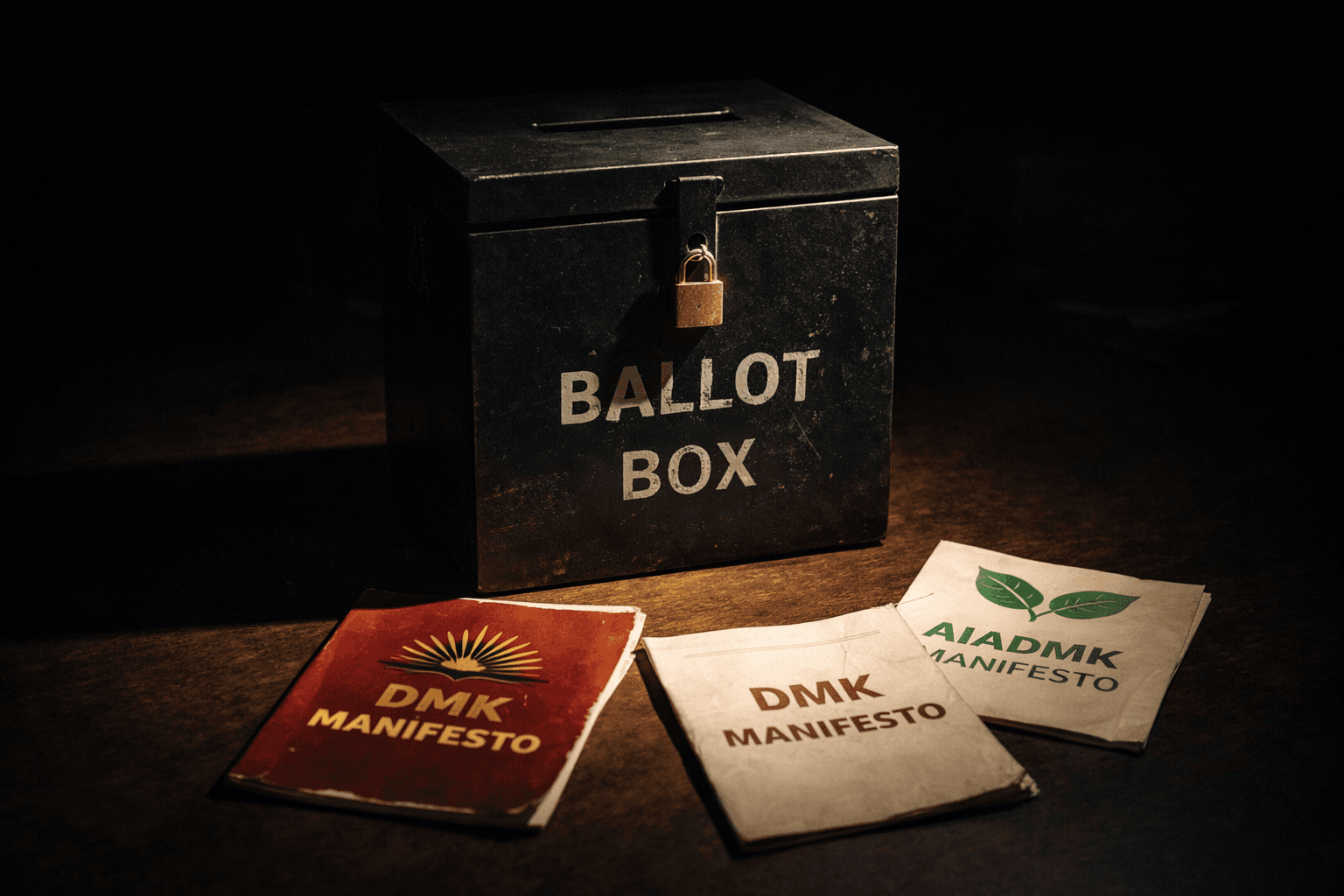
When the DMK released its 2026 manifesto — "Dravidam Model 2.0" — and ADMK followed with "Let Us Save the People," I wanted to see what each document actually said. Not the headlines. Not the rally slogans. The actual policy architecture underneath.
So I ran both manifestos through a structured analysis. Fifty categories. Each scored out of ten. The scoring penalises "steps will be taken" language with no roadmap and rewards concrete timelines, quantified targets, institutional mechanisms, and identifiable funding sources.
The result: DMK 423, ADMK 255, out of 500.
DMK leads in all fifty categories. The closest contests are Police Department (7 vs 6) and Fisheries (8 vs 6). The widest gaps are in AI (9 vs 3), Startups (9 vs 3), and Financial Management (8 vs 3).
The Scorecard
What the Numbers Reveal
Three patterns stand out.
ADMK's manifesto is a welfare catalogue, not a governance document. Where it competes — women's development, labour welfare, agriculture — the proposals are direct cash transfers or goods deliveries. ₹10,000 family relief. Free refrigerators. Three LPG cylinders a year. These score 5–6 because execution is simple: announce, disburse, done. But wherever the question demands vision — AI policy, startup ecosystems, financial management, state rights reform — the document collapses into "steps will be taken."
DMK's manifesto reads like a government that has been governing. The $1 trillion economy target comes with sector-specific industrial corridors, semiconductor policy worth ₹50,000 crore, a Tamil AI Mission with language models, and a GCC target of 500 companies. The women's empowerment section doesn't just promise money — it builds institutional architecture around it. The education section doesn't just add laptops — it maps pathways from government schools to IITs and international universities.
The "steps will be taken" gap is real. ADMK's dominant rhetorical mode is aspirational. DMK's is operational. One document answers "what will you do?" The other answers "what will you do, how will you do it, with whose money, by when, and who is accountable if it doesn't happen?"
A Note on Methodology
This is a user-generated analysis. I used Claude as the analytical tool to compare both manifestos — the DMK's Tamil-language document and ADMK's English manifesto. The scoring framework rewards specificity, measurable targets, institutional mechanisms, and implementation pathways. A score of 7–8 requires concrete timelines and quantified targets. A score of 5–6 means a vague promise with some specificity but no institutional pathway. A score of 3–4 means a headline pledge with no roadmap.
These scores are not official, partisan, or verified by either party. They reflect the analytical framework described above — nothing more.
The full interactive scorecard above lets you explore all 50 categories, see the score breakdowns, and read the notes on each dimension.
168 points is a wide gap. But the real gap isn't in the numbers. It's in what each document reveals about how each party thinks about governance itself — as a set of promises to announce, or as a system to build.