The first enterprise demo I ever sat through, I watched a product manager spend forty minutes showing a Fortune 500 CIO a beautifully designed dashboard. Smooth animations. Color-coded charts. The kind of UI that wins design awards. The CIO listened politely, then asked three questions: "Does it integrate with our Okta setup? What's your SOC 2 compliance status? And how long until full rollout across five thousand users?"
The room went quiet. The PM had no answers. The deal died in that silence.
I've spent most of my career in enterprise software — healthcare platforms, claims systems, multi-tenant SaaS products serving thousands of users across dozens of organizations. And the single biggest lesson from all of it is that enterprise product management operates under a completely different gravity than consumer product management. The skills transfer, but the instincts don't. The things that make you successful in B2C — viral loops, delightful micro-interactions, rapid A/B testing on millions of users — become almost irrelevant when your buyer has a procurement process, your user was told to use the product by their manager, and your "churn" means losing a seven-figure contract.
The transition shock is real. And most people who make the leap underestimate it.
Three People, One Product
In consumer products, the person who discovers your product, evaluates it, pays for it, and uses it is the same person. That simplicity is a luxury you don't appreciate until it's gone.
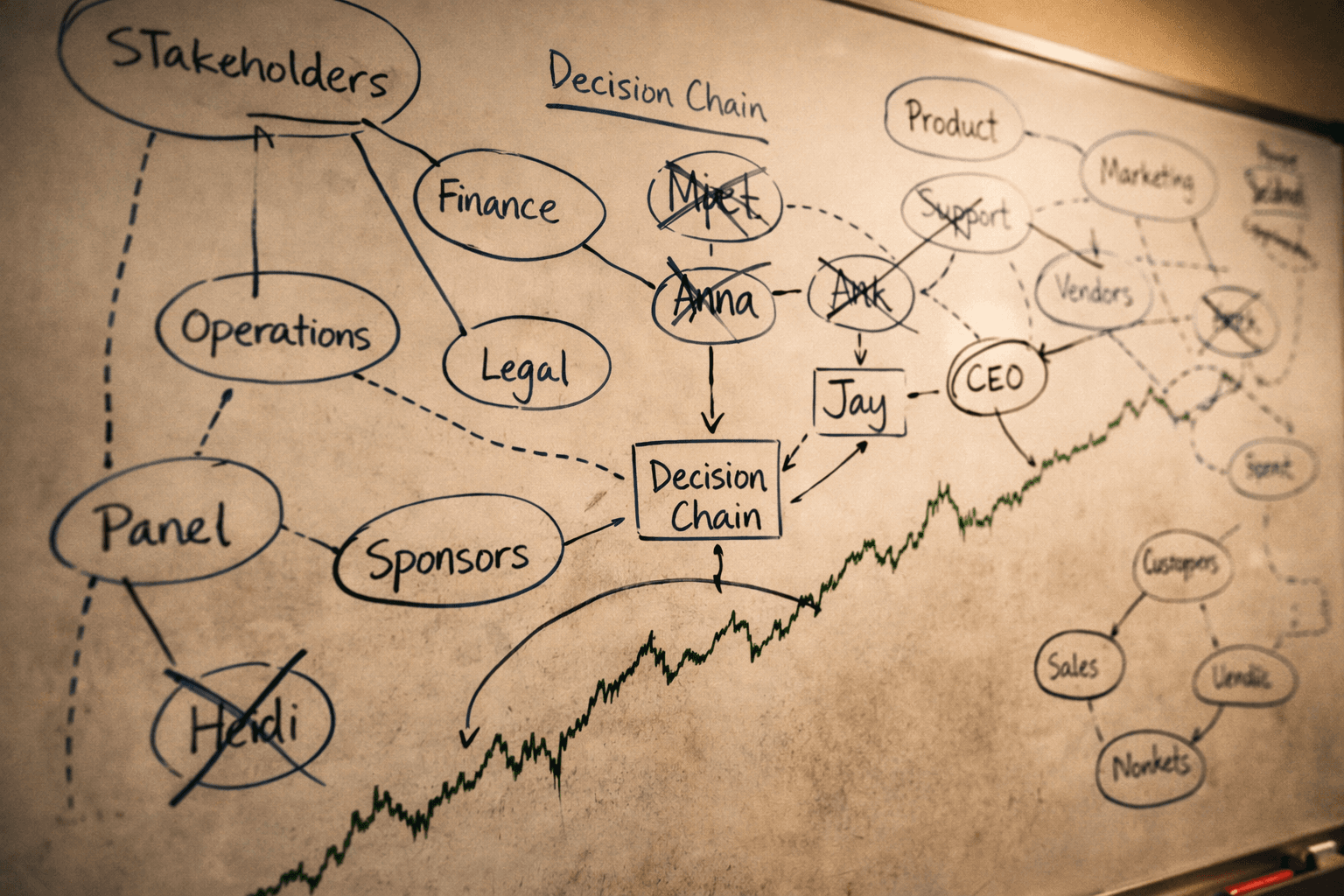
Enterprise splits that single person into at least three:
Every enterprise feature should answer three questions: Does it justify budget (buyer)? Does it save time (user)? Does it build advocacy (champion)? A feature that only satisfies one of the three is a feature that creates problems.
| Consumer | Enterprise | |
|---|---|---|
| Who decides | The user | A committee the user may not be on |
| Who pays | The user | A VP or C-suite exec who never logs in |
| What they evaluate on | The experience | A spreadsheet: ROI, risk, compliance |
| Who uses it daily | The person who chose it | Someone who was told to use it |
| Who champions it | Word-of-mouth users | A mid-level manager spending political capital |
| What closes the deal | Delight | Trust, integration, vendor stability |
| What drives retention | Habit | Switching cost + ongoing value |
| Sales cycle | Minutes | Months to years |
I once watched a CRM rollout collapse at a healthcare organization because the product wowed the CIO with analytics dashboards but completely ignored what the care coordinators needed — fast data entry on mobile devices between patient visits. The champion, a clinical operations director who had spent months pushing for the product internally, got buried in complaints from her team. She stopped advocating. The product became shelfware. At renewal, the contract wasn't even discussed — it was just gone.
The CIO who signed the deal had moved on to the next initiative. The care coordinators went back to their spreadsheets. The only person who lost was the champion, who had spent her political capital on a product that didn't understand who it was actually for.
Salesforce understood this triad from the beginning. Executives get ROI dashboards and forecasting. Managers get workflow automation and pipeline views. Reps get keyboard shortcuts and mobile access. The roadmap explicitly maps features to each persona. That discipline — building for three audiences simultaneously — is what separates enterprise products that stick from enterprise products that get replaced at the next contract cycle.
Trust Beats Beauty
Consumer PMs live in a world where A/B testing button colors moves revenue. Enterprise PMs live in a world where a missing SOC 2 certification eliminates you from a deal before anyone sees your UI.
This isn't because enterprise buyers don't care about design. They do — increasingly so. But trust is the prerequisite. A beautiful product that can't pass a security review is a beautiful product that never gets deployed. And in regulated industries like healthcare and finance, the stakes aren't abstract. A data breach means lawsuits, fines, congressional hearings. The buyer evaluating your product carries that weight, and your gradient buttons don't lighten it.
The trust stack in enterprise looks like this:
- Security fundamentals — Role-based access control, encryption at rest and in transit, audit trails for every action. These aren't features to highlight in a demo. They're table stakes that disqualify you if they're missing.
- Compliance checkpoints — SOC 2, GDPR, HIPAA, FedRAMP. Each one is a gate, and missing any gate means your product doesn't exist for that buyer.
- Observability for admins — Not your users' dashboard. The IT admin's dashboard. Who logged in, what they accessed, what changed. Enterprise buyers need to answer "what happened?" at 2 AM when something goes wrong.
Good enterprise UX isn't flashy UX. It's predictable, scalable, and auditable UX. Workday isn't beautiful — but it's unbreakable. That's the design philosophy that wins enterprise contracts and, more importantly, renewals.
The best enterprise products treat trust as a design principle, not a compliance checkbox. Embed security from day zero. Build audit trails into the architecture, not bolted on after the first security review. Frame role-based access as "empowering teams safely" in the product experience, not as a configuration screen buried in settings.
The Sale Is Just the Opening Act
In B2C, the moment of purchase is the victory. In enterprise, signing the contract is where the real work begins.
Implementation. Migration. Configuration. Training. Change management. Phased rollouts across departments that have different workflows, different data, and different levels of enthusiasm about the new tool someone just decided they'd be using. Gartner estimates that roughly 70% of enterprise deals stumble during implementation — not because the product is bad, but because the post-sale experience wasn't designed with the same care as the pre-sale demo.
When I was building an electronic health records platform, every new clinic onboarding was an overnight ordeal. Someone sat there running SQL scripts to provision the system — seeding databases, configuring specialties, mapping procedure codes to the right billing categories. It worked, but it was fragile, slow, and dependent on one person knowing which scripts to run in which order.
I built a simple Windows Forms application — one screen, pick the new clinic, choose which existing clinic to copy configuration from, click a button. The overnight shift became a two-hour process. That tool wasn't on any roadmap. No PM asked for it. But it was the difference between onboarding three clinics a month and onboarding twelve.
The product was the EHR. But the thing that let the company grow was the unsexy provisioning tool that nobody outside the operations team ever saw.
This is where product thinking meets customer success, and enterprise PMs who ignore the post-sale journey build products that churn. The best enterprise products treat onboarding as a core product surface — in-app guides, usage analytics, automated nudges, health scores that flag accounts going quiet before anyone submits a cancellation request.
Measure success not by sign-ups, but by active users at month three. If your product is still being used — really used, not just logged into for compliance — ninety days after deployment, you've built something that sticks.
The Metrics That Actually Matter
Most product teams track metrics that feel good but mean nothing. Downloads. Page views. Daily active users. In enterprise, these are especially dangerous because they can hide the truth: DAUs might reflect mandatory logins, not meaningful work. Page views could spike because your navigation is confusing, not because users are engaged. Email open rates on reports rarely correlate with anyone actually acting on the data.
The gap between vanity metrics and real signals is where enterprise products get lost.
| Vanity Metric | What It Hides | Better Alternative |
|---|---|---|
| Daily active users | Mandatory logins vs. real engagement | Workflow completion rate |
| Page views | Poor navigation vs. genuine interest | Time to first value |
| Features shipped | Output without outcomes | User behavior change |
| NPS score | Survey fatigue, selection bias | Renewal rate, expansion revenue |
The frameworks that actually work in enterprise look different from their B2C versions:
North Star Metric — The single metric that captures core value delivery. Slack measures messages sent per organization per week. Datadog measures time to first dashboard. For a healthcare claims platform, it might be percentage of claims processed without manual intervention. The North Star isn't a vanity metric dressed up — it's the behavior that, if it increases, means your product is genuinely working.
AARRR adapted for enterprise — The pirate metrics framework translates, but every stage changes meaning. Acquisition becomes sales-assisted onboarding. Activation becomes time to first successful workflow. Retention becomes renewal rate and power user growth. Referral becomes internal expansion to new departments. Revenue becomes expansion revenue or documented cost reduction.
If your quarterly review has forty KPIs and none of them drive a specific decision, you're performing metric theater. You don't need more dashboards. You need better questions. Start with: "What decision does this metric unlock?"
The real job of metrics in enterprise is closing the gap between intention and impact. Your product strategy is working if it changes user behavior in the right direction, that behavior aligns with value delivery, and you can explain not just what happened but why — and what you'll do next.
The Red Ocean of Enterprise AI
Walk through any enterprise software conference in 2026 and the booths blur together. AI copilot. AI assistant. AI-powered insights. AI-driven automation. Every vendor has bolted a language model onto their existing product and called it innovation.
This is a Red Ocean — the term from Kim and Mauborgne's Blue Ocean Strategy for markets where competitors fight over the same customers with the same features until margins collapse. And enterprise AI is already there. Dozens of customer support bots, indistinguishable. Endless productivity copilots from Google, Microsoft, and startups alike. Copycat generative AI tools multiplying weekly.
The result is commoditization before most companies have even found product-market fit for their AI features.
Three forces keep enterprise companies trapped in the Red Ocean:
- Feature parity pressure — "Our competitor launched an AI copilot. We need one by Q3."
- Analyst scorecards — Vendors build to tick Gartner boxes, not to solve problems.
- Investor FOMO — Capital chases what's trending, not what's valuable.
The way out isn't more AI features. It's a different ocean entirely.
The danger for enterprise products in 2026 isn't being out-featured. It's being out-imagined — building the same AI copilot as everyone else while someone else reframes the entire category.
Blue Ocean Strategy offers a practical framework — the ERAC grid — that applies directly to enterprise AI product decisions:
| Action | Question | Enterprise AI Example |
|---|---|---|
| Eliminate | What should we remove entirely? | Dashboards nobody reads. Reports nobody acts on. |
| Reduce | What should we scale below industry norms? | Manual configuration. Admin overhead. |
| Raise | What should we elevate far above the norm? | Time to first value. Explainability. Trust. |
| Create | What new value has the industry never offered? | Autonomous action, not just recommendations. |
The companies finding Blue Oceans in enterprise AI aren't adding chatbots. They're reframing categories:
- Stripe embedded fraud detection invisibly into payment APIs. Developers don't configure it, don't think about it, don't manage it. The AI is the product, invisible and indispensable.
- Octopus Energy uses AI to balance renewable energy supply and demand across millions of homes in real time. They didn't build a better energy dashboard. They made the dashboard unnecessary by having the system act autonomously.
- PathAI accelerates pathology to detect cancer earlier. They didn't digitize existing lab workflows. They reframed diagnostics from reactive to predictive.
The pattern is the same every time: don't fight harder in crowded water. Change the water.
What's changed in just the last few months is that the gap between "AI demo" and "AI in production" is finally closing. AI coding tools like Claude Code and Cursor have compressed build cycles from weeks to days — teams are shipping features at a pace that would have been absurd eighteen months ago. Product discovery is accelerating too: AI-powered synthesis of user interviews, automated analysis of support tickets to surface unmet needs, rapid prototyping that lets you test three approaches in the time it used to take to spec one. And the most significant shift — enterprise AI features are moving from recommendation engines that suggest actions to autonomous agents that take them. Approving routine claims. Resolving tier-one support tickets. Triaging security alerts. The products gaining ground aren't the ones adding another AI insights tab. They're the ones quietly removing entire workflows by letting AI handle what used to require a human in the loop.
And the biggest untapped Blue Ocean in enterprise AI? The noncustomers — the people actively avoiding AI tools. Lawyers who distrust AI contract review. Clinicians who fear black-box diagnostics. Finance teams who won't trust automated reconciliation. Their resistance reveals exactly where the opportunity lives: build AI with explainable reasoning for lawyers, transparent evidence chains for clinicians, auditable decision trails for finance. Avoidance is white space.
Integration Is the Moat
In consumer products, standalone brilliance can win. A killer feature goes viral. Enterprise is the opposite — isolation is death. Buyers want ecosystems, not islands. They need your product to plug into their existing stack without friction, because they've spent millions on that stack and they're not ripping it out for your tool.
The integration hierarchy in enterprise:
- Core integrations — SSO (Okta, Azure AD), ERP (SAP, Oracle), CRM (Salesforce, HubSpot), data platforms (Snowflake, Databricks). Missing any of these for your target market means you don't exist.
- API-first architecture — Expose endpoints early. Let customers build what you haven't thought of yet. The best enterprise products become platforms precisely because they made integration a first-class citizen.
- Open standards — Webhooks, OAuth, low-code connectors. Proprietary lock-in strategies that worked in 2010 are liabilities in 2026.
Slack's early growth came almost entirely from integrations — GitHub for developers, Jira for PMs, Zoom for meetings, Salesforce for sales. It became the connective tissue between everything else, which made it indispensable. Microsoft Teams eventually competed by bundling similar integrations, but Slack's lesson stands: in enterprise, your product's value is often proportional to how well it connects to everything around it.
A practical rule of thumb: dedicate at least 30% of your roadmap capacity to integration work. Track "integration debt" as a metric — how many of your target customers' critical tools do you support natively? Start with the top five requests and build from there.
Innovation in enterprise often shines through integration, not despite it. AI features that pull context from a customer's existing data feel magical. An AI assistant that understands your Salesforce pipeline, your Jira backlog, and your Slack conversations simultaneously — that's a product experience no standalone tool can match.
I wrote in Product Thinking for Engineers about the difference between engineers who implement specs and engineers who understand the job to be done. Enterprise integration is the same principle at the product level. The job isn't "connect to Salesforce." The job is "eliminate the tab-switching and copy-pasting that costs your team four hours a day." The integration is how you solve it. The time savings is why anyone cares.
The Enterprise Chessboard
Consumer product management is a fast game. Ship, measure, iterate, ship again. The feedback loops are tight, the experiments are cheap, and a single viral moment can change everything.
Enterprise product management is chess. Every move takes longer. Every decision affects more people. The consequences of getting it wrong are measured in lost contracts and damaged relationships, not in slightly lower conversion rates. But the rewards compound differently too — a single enterprise customer can represent more revenue than a million consumer users, and a well-designed enterprise product creates switching costs that keep customers for decades.
The PMs who thrive in enterprise are the ones who internalize that the game changed, not just the scale. The triad of buyer, user, and champion. Trust over beauty. Post-sale as the real product. Metrics that measure behavior change, not activity. Blue Ocean thinking instead of feature parity. Integration as strategy, not afterthought.
Twenty-two years in enterprise software, and the products I've seen survive the longest weren't the prettiest or the most feature-rich. They were the ones that understood the organization — not just the user — and built for the whole chessboard.
The next time you're in an enterprise deal and someone asks about your Okta integration before they ask about your UI, don't be surprised. They're telling you exactly what sport you're playing.