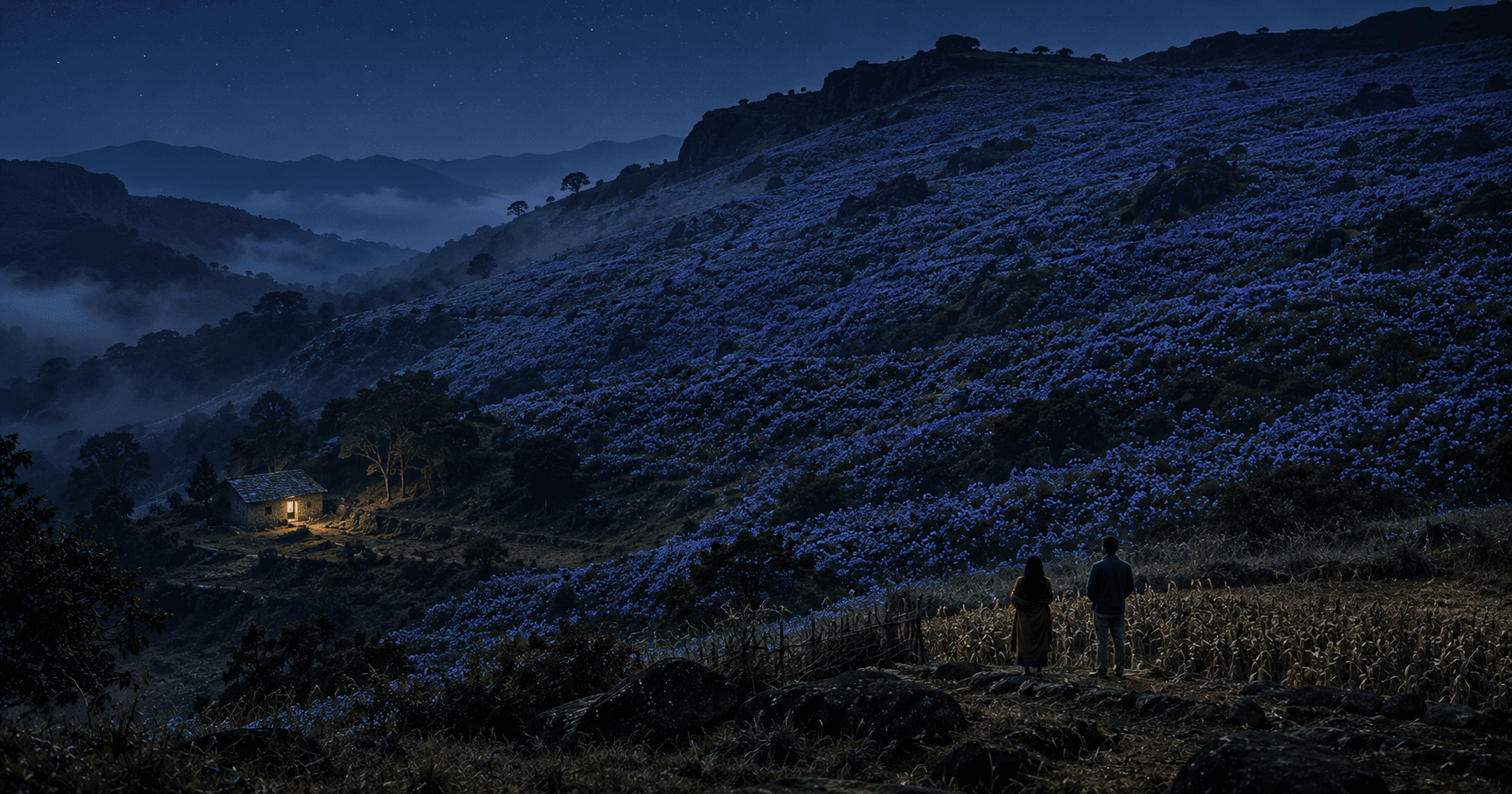
There is a ridge above Munnar called Chokramudi, and it has been turning blue since July.
It happened without much announcement. The bloom everybody remembers is the 2018 one, inside Eravikulam, where the slopes went over all at once and the district ran extra buses and the photographs were unavoidable for a month. This is a different hillside on a different clock, and it started quietly, the way most of them do. By now it has spread toward Edalimedu and Sevenmala and the higher stretches of Meesapulimala, and it will hold through October, and then it will be finished.
If you want to see it, go now. If you miss it, the same hillside is next due in 2038.
குறிஞ்சி
Kurinji. A flower. Also a mountain. Also, for two thousand years, the name Tamil gave to the first time.
I have written about this flower before and I got something wrong about it. That is most of what this essay is for.
The Clock Is Not One Clock
Strobilanthes kunthiana grows in the shola country of the Western Ghats, between roughly 1,300 and 2,400 metres, and it flowers about once every twelve years. The botanical record of those flowerings runs back to 1838, which means we have been watching this plant keep time for nearly two centuries.
What gets lost in the headlines is that there is no single appointment. The hills hold separate populations and each one runs its own twelve.
| Population | Flowerings on record | Blooming now | Next due |
|---|---|---|---|
| Mattupetty–Kannimala | 1990, 2002, 2014 | yes | 2038 |
| Chokramudi–Kodaikanal–Poondi | 2014 | yes | 2038 |
| Eravikulam | 2018 | no | 2030 |
So the blue you can drive to this month belongs to a different stretch of hill, one that last did this when a different set of people were young. The 2018 slopes have another four years to wait.
The flower gave its name to the mountains themselves. Neela and kurinji — blue, and the hill flower. The Nilgiris carry the same arithmetic in their name, nil and giri, the blue mountains, named after a colour they are almost never wearing. Someone decided a whole range should be called after an event that occupies a few weeks in twelve years, and nobody has argued since.
The Only Tinai Named After an Absence
Red Earth and Rain laid out the five landscapes and walked all of them in one essay. The Shore of Longing stopped in one and stayed. This is the other one that deserves a whole piece to itself, and the reason is sitting in the table below.
Each tinai comes fully specified. The Tolkappiyar set down far more than a mood and a hillside: the landscape arrives with its hour, its season, its god, its working people, its food, its water, and exactly one condition of love.
| Element | Kurinji |
|---|---|
| Land | Mountain, the shola slopes |
| Hour | Midnight |
| Season | The cold, dewy months |
| God | Seyon — Murugan |
| People | Kanavar, Vedar, Kuravar — hunters and hill folk |
| Work | Hunting, honey-gathering, millet |
| Food | Millet, wild honey |
| Water | Waterfalls |
| Flower | Kurinji |
| The love | புணர்தல் — punarthal, union |
Read down that column and the film almost assembles itself: a hill at midnight in the cold season, millet standing in a clearing, a waterfall somewhere behind, honey in the rocks, and two people who have arranged to be there.
Every other element in that column is permanent, or near enough — the mountain stays a mountain, midnight arrives nightly, the waterfall runs, the millet comes every season. The emblem at the centre of it is the one thing on the hillside that is almost never there.
Tamil had its pick of hill flowers. It chose the one you cannot count on seeing.
Bigger Than the Earth
The third poem in the Kurunthogai is a Kurinji poem, and it is one of the most quoted things in the language. The poet is Thevakulathar.
நிலத்தினும் பெரிதே, வானினும் உயர்ந்தன்று,
நீரினும் ஆரளவின்றே, சாரல்
கருங்கோல் குறிஞ்சிப் பூக் கொண்டு
பெருந்தேன் இழைக்கும் நாடனொடு நட்பே.Greater than the earth, higher than the sky,
deeper than water and past all measuring —
this bond with the man of the hill country,
where on the slopes great honey is wrought
from the flowers of the dark-stemmed kurinji.
Three cosmic measurements in six words, and then the poem does two things that most translations flatten.
The first is the honey. Instead of his face, or anything he said, she gives us his address — the man of that country — and the country is identified by the honey that gets worked out of kurinji flowers on its slopes. The bees are not even named in the Tamil; the poem leaves them to be understood. Which is to say she has picked, out of everything on that mountain, the sweetness that comes from the bloom you get once in twelve years. The whole landscape is available to her as description and she reaches for the rarest thing in it and uses it as an address.
The second is the last word. After earth and sky and ocean, after the biggest comparisons a poem can make, the noun she arrives at is நட்பே — natpu. Bond. Friendship. Not kaadhal, not desire, nothing with heat in it. She runs the universe through a scale and then names the thing she is measuring with the plainest available word, and the plainness is the point. Anybody who has felt this at seventeen recognises the move. The feeling is enormous and the vocabulary you reach for is shy.
Then there is what the commentators do with the three measurements themselves, which I came to late and have not stopped thinking about since.
Read as superlatives they are just the biggest things to hand — earth, sky, sea, in descending order of how much of it you can stand on. Taken one at a time, though, each is good for nothing. Earth with no water grows you nothing. The sky is a thing overhead. The ocean is enormous and undrinkable and on its own it feeds nobody.
What makes any of them worth anything is the circuit between them. The sea gives its water up to the clouds, the clouds carry it into the sky, the sky lets it down over the land, and the earth — at that point and not before — does what earth is for.
So the poem has described a working system rather than three large objects, and dropped her bond into the middle of it. Three things that are nothing apart and everything in combination.
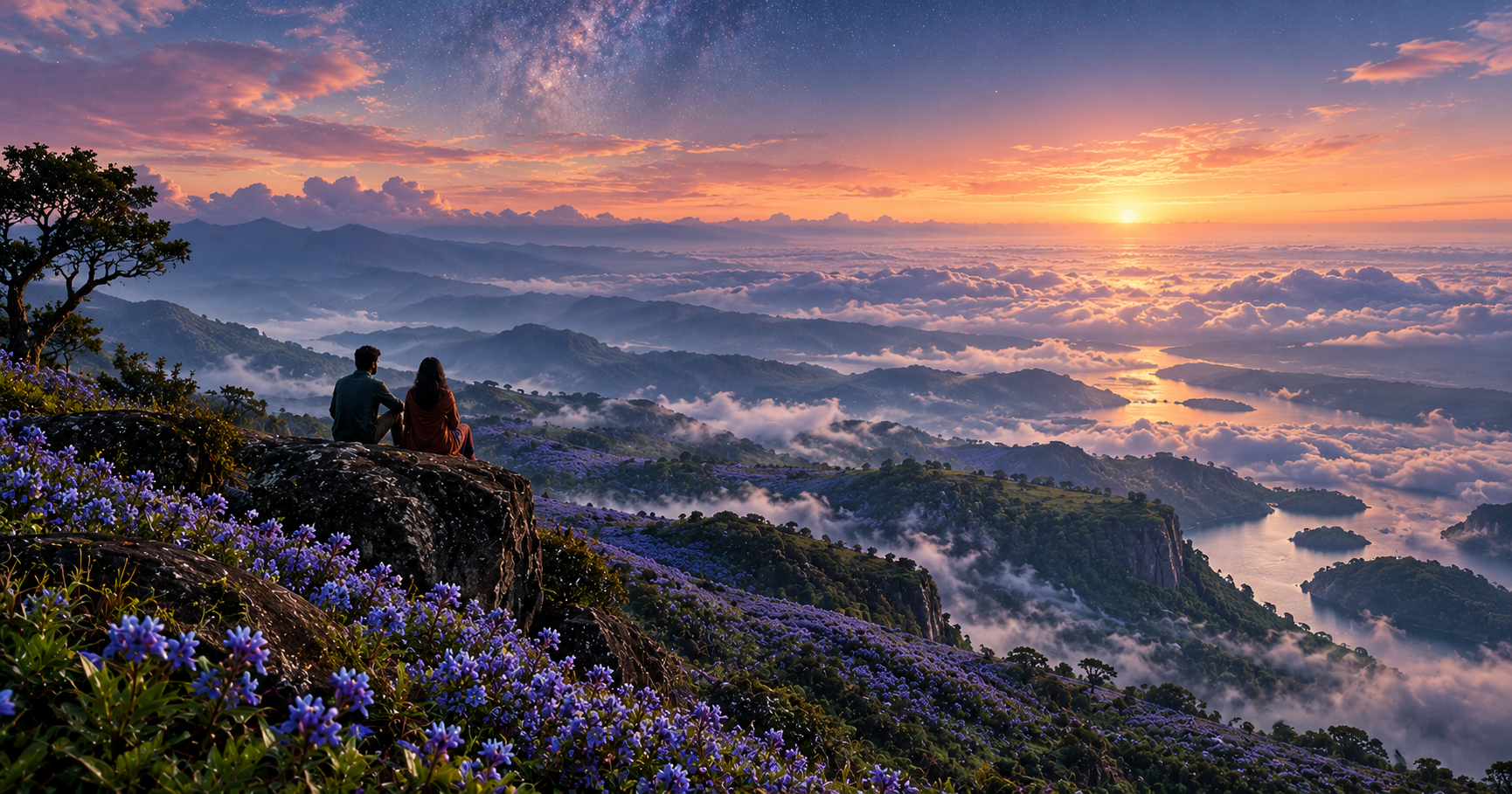
And this is where the series turns out to have been circling one image the entire time. Red Earth and Rain opened on Kurunthogai 40 — rain falling on red earth, two hearts going into each other the way water goes into ground. Eight essays later the poem at this end is running the same weather from the other direction: the ocean, the sky, the land, and the rain that is the only reason the three of them matter.
And there is one more thing about that poem, which the commentators preserved and which changes it completely.
The person she is addressing is her friend.
The friend has been saying the sensible thing — that he has not come, that nothing has been settled, that this is going nowhere. And the heroine replies with earth and sky and ocean.
The man is standing on the other side of the fence, listening.
So the most expansive declaration of love in early Tamil is delivered sideways, to a third party, within earshot of the person it is about, by somebody who could not say it to his face.
The Borrowed I
The same staging turns up at the other end of the world.
Your Song is the most-quoted first-love confession in English, and the first person in it is on loan. Bernie Taupin wrote the words. Elton John wrote the melody and sang them, and sang them as I, on an album recorded in January 1970 and released that April. Taupin has spent decades batting away the legend that the lyric took ten minutes — he has said it might have been fifteen, or half an hour — and the melody went on in roughly twenty.
Half an hour of somebody else's afternoon, and it became the sentence a few million people have used to mean this is how I feel.
The lyric itself is an inventory of inadequacy. If he were a sculptor — but then again, no. If he had money — he does not. The song's entire engine is a young man cataloguing what he cannot give you and offering the catalogue instead, which is the most accurate description of first love anybody has put on a record. Nothing to bring. Shows up anyway. Apologises for the size of the gift while handing over something enormous.
Part 1 of this series put Perfect in this landscape alongside it, and I would adjust that now. Ed Sheeran's song is barefoot on grass and dancing in the dark, and all of that is Kurinji — but it is sung by a man who already has her, looking back from inside the safety. First love remembered from a marriage is a warm and entirely different object from first love in progress. The ache has been taken out and replaced with gratitude.
Kurinji is the one where nothing has been settled yet.
Both traditions arrive at the same staging. The feeling is cosmic, and it goes out sideways — to a friend across a fence, through a lyricist's borrowed I, into a notebook, at a wall. Almost never to the face it belongs to.
What I Got Wrong in Part One
This is the part I owe the series.
Red Earth and Rain ends on a run of reassurances, and one of them is this:
The Kurinji flower will bloom again.
It is a nice line and I believed it when I wrote it, and it is wrong about the plant in a way that turns out to matter.
Strobilanthes kunthiana is monocarpic. It flowers once in its life, sets seed, and dies. Botanists file its particular version of this under plietesial — the whole population builds for years, goes over together, and goes down together. The hillside above Munnar that is blue this month is a hillside in the act of dying, all at once, on schedule, having waited twelve years to do it.
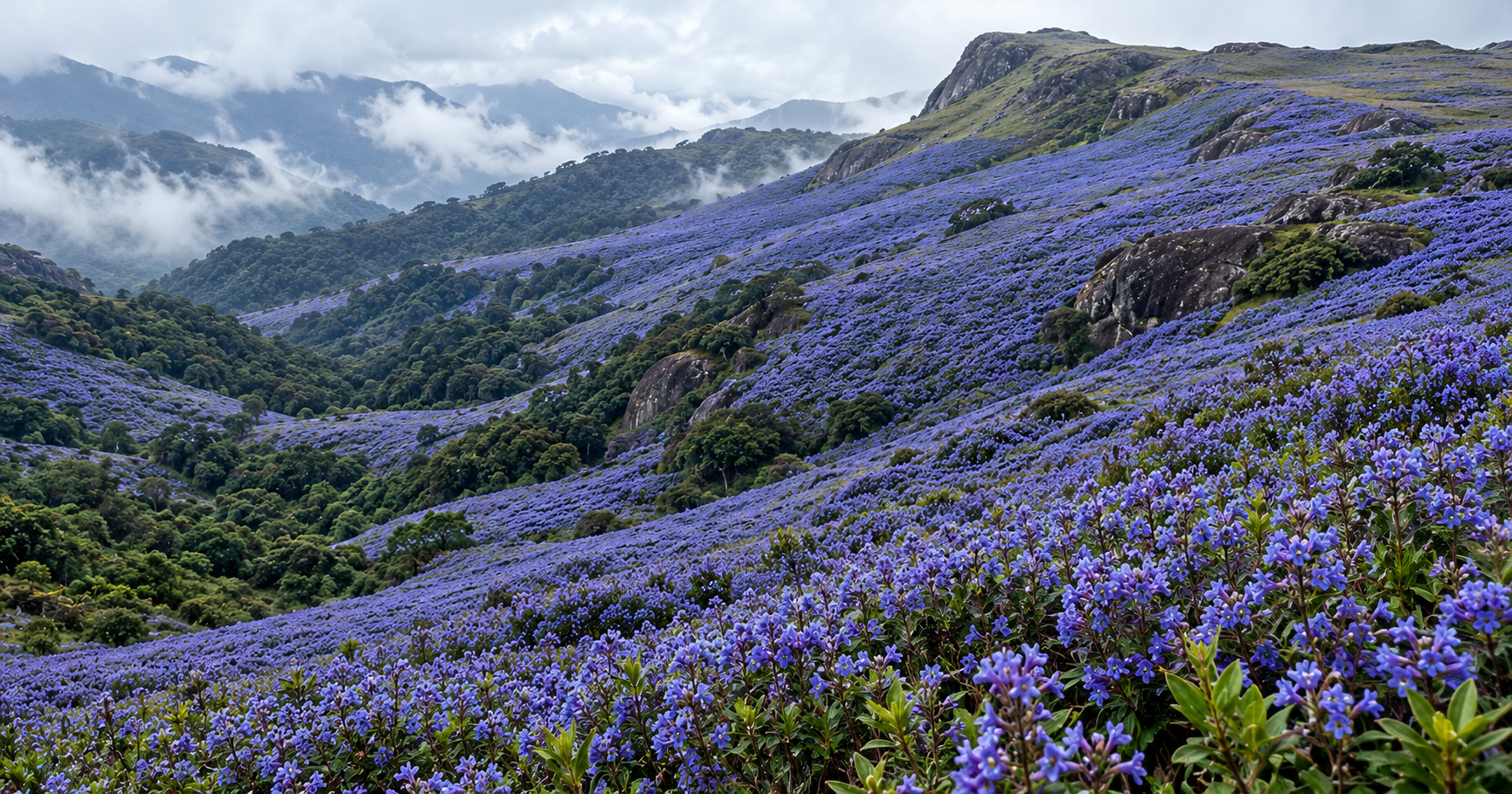
Nothing on that slope is coming back in 2038. The seed is already in the soil, and what arrives twelve years from now is the next generation, flowering for its own one time, on ground held by the remains of this one. From the road it will look identical. It will not be the same plants, and the plants doing it now will not see it.
The real structure of the thing is both harder and better.
First love does not recur; the capacity for it does.
You get later loves, and the honest ones among us will admit the later ones are usually better — steadier, more exactly aimed, able to survive weather this one could not have stood for a week. But the event itself happens once. It belongs to a version of you that flowered and then was finished, and everything after it grows out of that ground without being it.
There is something clean in that. The plant got one flowering and spent everything it had on it.
The grammar, incidentally, seems to have understood the shape of this even without the botany. The commentators did not leave Kurinji's cell holding union by itself. Filed in the same place, as part of the same landscape, are the fear of separation, the need for reassurance, and doubt. Union and the dread of losing it were entered under one heading, by people who had watched enough of it to know the two arrive together.
கள்ளப்பூ
The hill communities have a word for something the tourist calendars do not cover.
Before a real flowering, small clusters sometimes open early — a handful of plants going over out of sequence, a patch of blue in a year with no bloom in it. There were reports of exactly this in 2025, the season before the one happening now. The local name for them is kallappoov: the false bloom.
The word itself carries the verdict. கள்ள — false, stealthy, thieving. பூ — flower. The stolen flower, the flower that is pretending.
Tamil poetics reaches for the same root when it names the love that belongs to this landscape. Kurinji's union is களவு — kalavu. The clandestine phase. The love that happens before anything is declared, before the families are told, before it has a public name. And kalavu is the ordinary Tamil word for theft.
The same root runs through both. The hills named a flower that arrives out of turn and cannot be trusted using the word for stealing, and the grammarians named love that happens in secret using the word for stealing, and the two sit a syllable apart.
Everyone has a kallappoov. The one before the one. It had every quality of the real thing while it was happening — there is no test you can run in the moment, no way to hold a patch of early blue against a hillside that has not flowered yet. You find out what it was afterwards, by what followed it, which is the only instrument available and always arrives late.
How the Paliyan Count
The Paliyan people of Tamil Nadu use the flowering to reckon age.
They use it as arithmetic rather than ornament. The hill goes blue, and that is a mark on the count, and a person's age is the number of marks they have been present for.
The sum is the most quietly devastating thing I came across writing this.
A long life is six or seven blooms. That is the whole allocation. And the first two or three do not count for much, because a four-year-old does not know what they are looking at — so the first bloom you actually own, the one you can place yourself inside and remember the weather of, is somewhere in your teens or early twenties.
That one becomes the origin. Everything after it gets measured as so many blooms since.
Which is precisely what first love does to a life. It installs itself as the unit. People who have been happily married for thirty years will still, if you ask the question properly, date things from something that happened over a few months when they were nineteen — and feel slightly foolish admitting it, and admit it anyway. The grammar had a landscape for it. The Paliyan have a calendar built on it. Both of them are saying the same thing: this is the event you count from.
Nobody tells you at the time that the clock is being set. You are just on a hill, and it is blue, and you assume this is what hills do.
Midnight
The hour the Tolkappiyar assigned to this tinai was midnight, and the practical reason is unromantic. Kalavu meets at midnight because kalavu cannot meet at noon. Before anything is settled, before the families know, the only hour available is the one nobody is watching.
The god of the landscape got the same treatment, which I did not expect.
Murugan — Seyon, the presiding god of Kurinji — has his own Kurinji romance, and it is a hill story down to the last karuporul in the table. Valli is a chieftain's daughter in the mountain country, set to guard a millet field and keep the birds off it. He comes to her there, and he does not come as himself: a hunter who has lost his way, then a tree, then an old man, and at one point an elephant arranged by his brother. She sends him away more than once. They spend time away from her family after the harvest, and her father goes out looking for her because she is not where she should be.
A millet clearing, a hunting people, a courtship in disguise, a girl missing from home and a father searching the hills. Everything in the Kurinji column, with the god of the landscape playing the part.
In Kodaikanal there is a temple called Kurinji Andavar — Murugan as the lord of the kurinji — and the grounds keep Strobilanthes plants growing. A temple to the god of this landscape, gardening the flower that gave the landscape its name, holding on to the one element of the set that will not stay.
Through October
The bloom is on now. Chokramudi, Edalimedu, Sevenmala, up toward Meesapulimala. Kurinjimala Sanctuary, which exists because somebody in 2006 decided thirty-two square kilometres of grassland at Kottakamboor and Vattavada ought to be held for a flower that shows up three or four times in a working life. The district is sorting out visitor slots and buses, the trails are marked, and the standing request is the obvious one: stay on the path, do not pick anything, carry your plastic back down.
The species is listed as Vulnerable. Plantations and settlements have taken most of the ground it used to flower on, which means some of the hillsides that went blue in 1838 have been unavailable for a long time, and no amount of waiting twelve years brings those ones back either.
Go if you can. And if you cannot, the thing worth keeping from it survives the trip just as well.
Tamil looked at the first time two people find each other — unsettled, unannounced, happening at midnight on a slope with nobody watching — and gave it a mountain, a god, a season, an hour, and an emblem that is absent from the hillside for eleven years and some months out of every twelve. Nobody was ever promised a second bloom. The emblem earned its place by being the most accurate object on that mountain — enormous while it lasts, finished when it finishes, leaving behind ground that everything later has to grow in.
And the poem that came out of that landscape, the one that reaches past the earth and the sky and the sea to find a scale big enough, ends up choosing the smallest word it could have used.
நட்பே. This bond.
Said to a friend, with him listening on the other side of the fence, on a hill where the honey comes from a flower that is not there most years.
This essay lives in the Love series. Don't Give Me a Voice is the love that turns up holding a toolbox; She Loved You in Whole Sentences the one who spoke plainly and went unread; The Last Couplet the quarrel of two people who are staying. This one is about the one that happened first, and once.
நிலத்தினும் பெரிதே — Kurunthogai 3, on a feeling that outgrew the earth and settled for the word "bond"