மொழி
Mozhi. Language — the whole system, with no opinion about whether it travels through a throat.
Somewhere in Chennai in the mid-2000s, a film director kept noticing a girl in his own colony. She was deaf. She looked cheerful, she moved around the place easily, and nothing about her asked anybody for sympathy. What stayed with him was a question he had no way of answering from where he was standing.
"I would wonder what 'sound' meant to her."
He could have made a sad film out of that. What Radha Mohan did instead was invent the one man who would make the question unbearable — not a doctor, not a social worker, not a patient saint with a sign-language manual, but a keyboard player. Somebody who pays his rent with organised sound, falling for a woman for whom none of it exists.
That became Mozhi, February 2007. Prakash Raj produced it and then cast himself as the best friend. Prithviraj played Karthik. Jyothika played Archana. Vidyasagar scored it and Vairamuthu wrote the words — two men whose whole craft is melody and language, building a film around a woman who uses neither.
It opened against Paruthiveeran and held Chennai for five straight weeks. Jyothika took the state award and was shortlisted for the National. And nearly twenty years on, the scene people still describe to each other is not the one where he wins her.
It is the one where she gets angry at him for trying.
The Title Was the Thesis
Tamil has a word for speech — பேசுதல், pesuthal. A word for sound — ஒலி, oli. A word for voice — குரல், kural. Radha Mohan reached past all three and took மொழி.
Once you see the title is an argument, the songs stop being songs. Vairamuthu wrote eight of them for a woman who cannot hear one, and look where the titles keep going:
கண்ணால் பேசும் பெண்ணே — Kannal Pesum Penne. The girl who speaks with her eyes.
மௌனமே உன்னிடம் — Mouname Unnidam. Silence, in you.
காற்றின் மொழி — Kaatrin Mozhi. The language of the wind.
Speaking with the eyes. Silence addressed as a second person, as somebody you could talk to. And the wind — pure movement, carrying no words at all, understood by everybody who has ever stood outside in it.
Three titles, three refusals to accept that language needs a throat. S. P. Balasubrahmanyam won a Filmfare for singing the first one, which is its own quiet joke: the most recognisable male voice in Tamil film music, given an award for a song about a girl who does her talking without one.
And there is a cruelty in that soundtrack nobody mentions. Those eight songs are for us. Archana never gets them. We sit in the dark being handed the exact sense the film withholds from her, and we are handed it as pleasure, and the thing the pleasure describes is her — sung in a voice she will never know the sound of, to a crowd who will leave humming it.
Which is more or less how the hearing world always talks about the deaf. Warmly. Admiringly. At volume. In a register the subject cannot audit.
The Body Was Always in the Grammar
And here is the part that makes Mozhi less of an innovation than it looks, in the best possible way.
Tamil worked this out a very long time ago.
தொல்காப்பியம் — the Tholkappiyam, the oldest surviving Tamil grammar, old enough that nobody agrees how old — does not stop at letters and words and metre. It has a chapter called மெய்ப்பாட்டியல். Mey is the body. Padu is the showing of a thing. Meyppadu: the body's showing.
An entire section of a grammar given over to how feeling appears on a person.
The Tholkappiyar lists eight.
| Tamil | Reading | What the body shows |
|---|---|---|
| நகை | nakai | laughter |
| அழுகை | azhukai | weeping |
| இளிவரல் | ilivaral | contempt |
| மருட்கை | marutkai | wonder |
| அச்சம் | achcham | fear |
| பெருமிதம் | perumitham | pride |
| வெகுளி | vekuli | anger |
| உவகை | uvakai | joy |
Eight states, each with its visible signature, each set down with the care of a rule.
Two thousand-odd years ago a Tamil grammarian looked at a human face and decided it belonged inside the study of language. Not beside it, as a kindness for the inarticulate — inside it, with the case endings.
Tamil settled this long ago: meaning travels on the body, and that is grammar, not consolation.
Which changes what you are watching. When Archana signs, she is not operating a substitute system because the real one was withheld from her. She is using the part of the language the Tholkappiyar already indexed, and using it better than most of the hearing people in the building manage with their mouths.
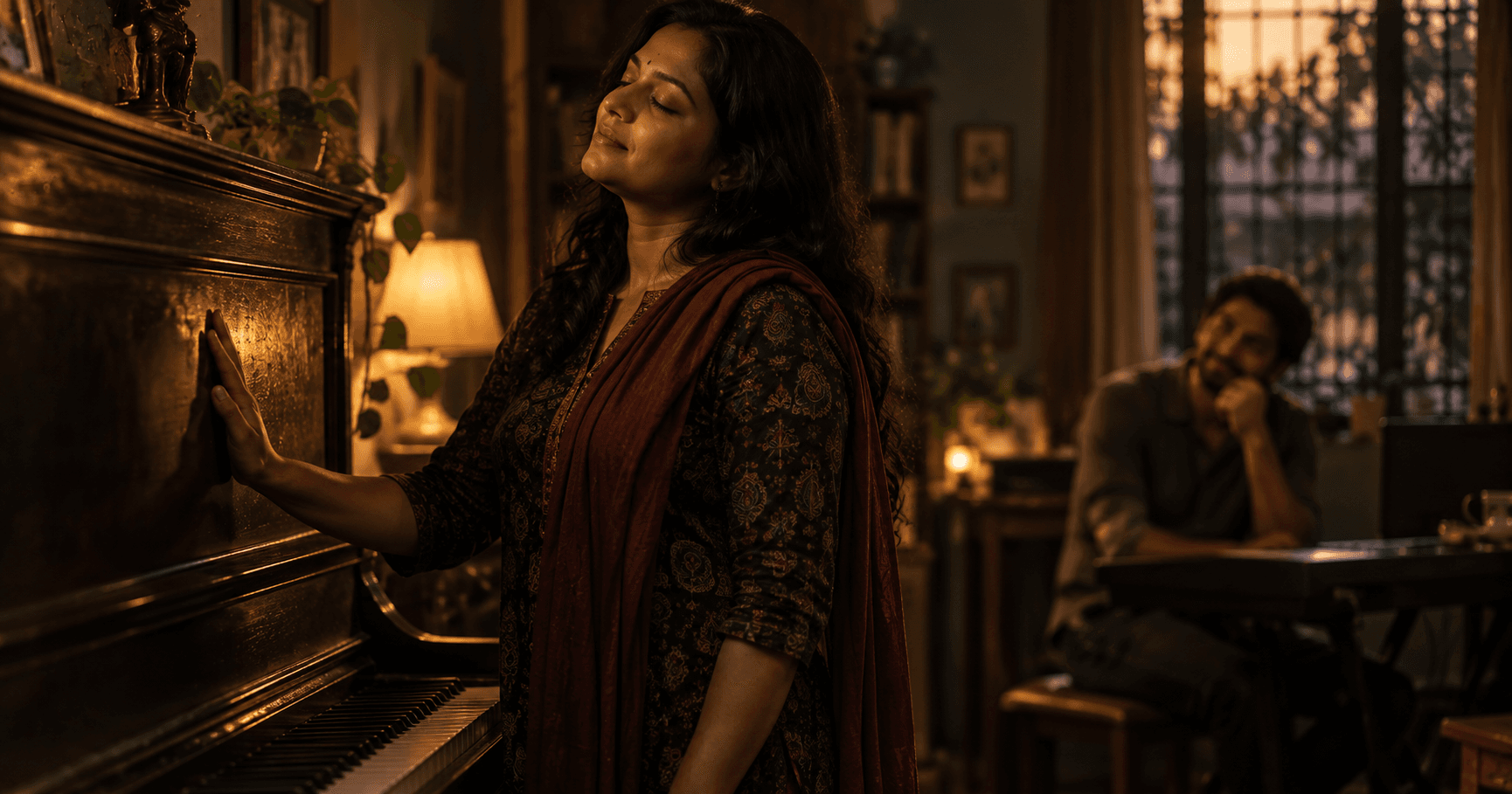
Watch Jyothika with meyppadu in your head and the performance reorganises itself. Nothing in it is playing deprivation. She runs the whole list, nakai to uvakai, through the only channel the character has, with no line reading anywhere to fall back on.
The Scene Everyone Remembers Wrong
Karthik does it all by the book. He notices her. He goes and learns sign language. He builds the friendship first. By the standards of every romance ever written, he has earned the scene where she says yes.
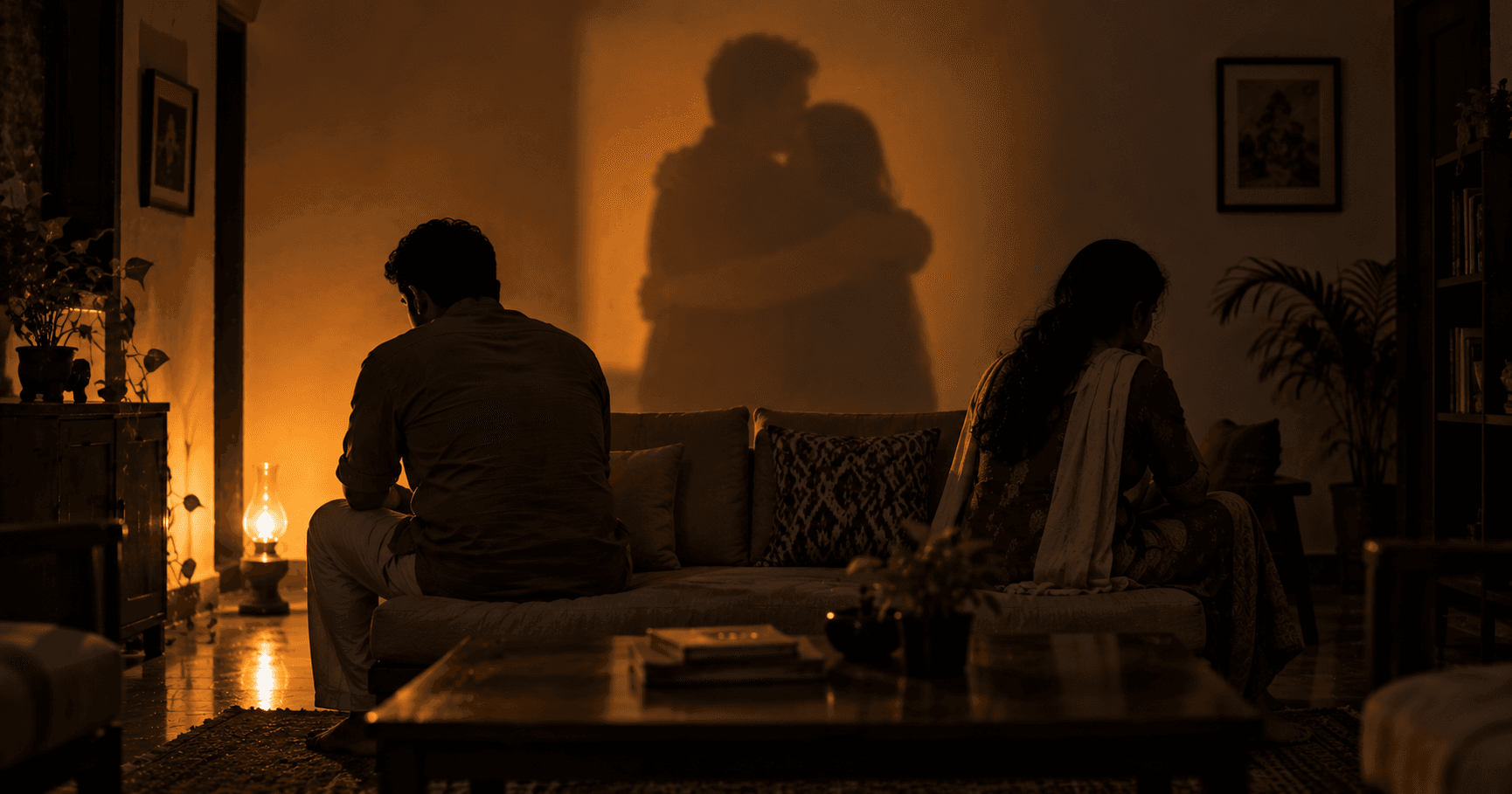
When he finally tells her he loves her, she turns on him.
Part of what she says is arithmetic, and it is brutal in its clarity. If they have children, the children may inherit what she has. And on that day, she tells him, he will leave. She has run the numbers on her own life and concluded she is a bad bet.
Underneath the arithmetic sits the thing that makes the scene famous. Somewhere along the way his love began behaving like a project — an effort to find her a voice, to make her whole in the one grammar he happens to own.
And she noticed. Because the offer of a voice carries a sentence folded inside it that nobody ever says out loud: as you are, there is something missing.
A hundred films have given us a disabled woman and a devoted man, and almost all of them are organised around his patience. We are invited to admire him for staying. Reviewing it at the time, Rediff found the words — the film "does not over-sentimentalise physical handicaps."
What it does instead is let her be furious. Furious at the kindest thing anyone has ever done for her, which takes far more nerve than letting her be furious at a villain.
The Diagnosis Inside the Gift
Everybody who has loved anybody has run this reflex.
Somebody tells you about their day and before the sentence lands you are already solving it. A friend describes something heavy and you arrive with three options and a timeline. A parent watches a child struggle with a thing the child has said, clearly and more than once, that they want to struggle with alone — and the parent cannot keep their hands off it.
It feels like love. Most of the time it genuinely is. It is also the most comfortable thing on the table, because fixing turns a person into a task, and tasks have steps, and steps can be completed and felt good about. Sitting beside somebody inside a difficulty you cannot touch has no steps at all. It asks you to tolerate being useless and present at the same time, and almost nobody is taught how.
So we translate. We take love — open-ended, uncomfortable, with no completion criteria — and render it into the one language we happen to be fluent in. The musician offers sound. The doctor offers a diagnosis. The engineer offers an architecture.
And the person receiving it hears the translation perfectly.
They hear it because a solution always ships with a diagnosis attached, whether or not you meant to include one. You cannot offer somebody a repair without first telling them you have classified them as broken. Most of the time they take the help and say thank you and file the classification somewhere quiet, and it sits there for years, and it surfaces one evening in an argument that appears to be about something else entirely.
There is a clean test and it survives most situations. Help that was asked for is help. Help that was supplied is usually about the supplier — our discomfort, our competence, our need to be the one who made the difference.
Archana never asked for a voice. Karthik needed her to want one, because a world with no sound in it was a world where he had nothing to give.
That is the trap, and it is a kind one. His gift is sincere. His effort is real. He is a decent man doing the most generous thing he can think of, and the generosity itself is the wound, and nobody in the scene is a villain.
Two Doors Apart
The film has a second storyline most summaries drop, and dropping it loses the design.
M. S. Bhaskar plays Professor Gnanaprakasam, an old man in the same building whose mind stopped in 1984, the year his son died. He is still living in it. Radha Mohan coached the walk himself, and Bhaskar carried a state award out of the picture for it.
Look at what has been assembled inside one apartment block.
A young woman with no speech and an enormous quantity of language — working, arguing, teasing, refusing, running her own life, entirely legible to anybody who bothers to learn how to read her.
And an educated man with a complete and functioning voice who cannot say the one sentence that would let him back into the present tense.
One of them lost the channel and kept the language. The other kept the channel and lost the sentence. They live a few doors apart, and the film never once points at it.
A weaker script has somebody deliver a speech here about how we are all disabled in our own way, and the whole thing collapses into a greeting card. Radha Mohan puts them in the same corridor and trusts you to do the arithmetic on your own time.
Her Fear Had Receipts
Here is where it could have gone soft, and declines.
Archana's calculation is easy to wave away. We want to tell her she is catastrophising, that love cannot be run as an actuarial exercise, that she is talking herself out of the best thing available to her. The film holds her position long enough that we have to climb inside it.
From in there, the arithmetic looks reasonable.
People do leave. The fear that somebody will stay while your difference is still novel and go once it has become logistics is not paranoia — it is pattern recognition, assembled over a lifetime out of how the world has actually behaved toward her. Every kindness she has received arrived with a quiet question underneath it about whether the kindness would survive contact with cost. Enough of them did not.
Reassurance does almost nothing against that. Of course I would never leave has no weight behind it, because every person who ever left said it first and meant it sincerely at the time. She has heard the sentence. She has watched what the sentence turns out to be worth.
You cannot argue someone out of a conclusion they assembled from evidence. You can only become new evidence, slowly, in a format they are able to check.
And the specific ache of Karthik's offer is that it answers the wrong fear. She is frightened of being left. He responds by proposing to fix the thing he imagines makes her leavable — which confirms, in the most affectionate way possible, that he agrees with her about what makes her leavable.
The Uncomfortable Bit, Which Is Mine
There is a problem with everything I have just admired, and I built it.
In She Loved You in Whole Sentences I argued that women love in complete, specific, unglamorous detail — that it arrives as did you eat and gets filed as logistics — and that men read the first word and call it the message. I believe every part of that still.
Karthik breaks the pattern. He noticed there was a language, went away, learned it properly, came back fluent. He did the thing I spent four thousand words asking men to do.
And he still got it wrong.
So fluency was never the whole answer, and I should have said so. What he acquired was vocabulary. What he kept doing with it was translating her into his own terms — running her life through his grammar, finding the gap, offering to fill it. You can learn every sign in the dictionary and still use them to tell somebody they are incomplete.
In A Lifetime to Prove It I set a test for the patient man — does her no cost you anything? If you can absorb a refusal endlessly without pain, you were never listening to it.
Karthik passes. Her no costs him everything. He is wrecked by it, and he does not appeal it, does not wait it out, does not quietly append a yet to her sentence. He takes the refusal as information about himself.
He went and learned her language. What he had to learn next was that she had never asked to be translated.
Learn the Language
The resolution arrives at somebody else's wedding, at a church in Puducherry, and it arrives on her terms.
Nobody fixes Archana. Nobody delivers the speech that dissolves twenty years of evidence. She decides, with the fear fully intact, to take the risk anyway. The fear never gets cured. It gets outvoted. Most films about loving a difficult person end with the difficulty dissolving, as though love were a solvent; this one leaves it sitting in the room and lets two people pick it up between them.
But the thing Karthik gets right happens much earlier, and nobody applauds it.
Before the declaration, before the gesture, before any of the trouble — he goes and learns sign language. He does not wait for her to approximate his world. He does not arrange an interpreter and call that effort. He walks into the only language she has and makes himself a beginner inside it, which for a man who is expert at something is the hardest move available to him.
Everything that goes wrong afterwards goes wrong the moment he forgets that and starts trying to hand her his.
And somebody in your life is speaking a language you have quietly decided is a deficiency. The friend who answers in one word. The parent who talks about the weather and the traffic and your cousin's knee for forty minutes and means something else entirely. The partner who says it's fine in a tone doing all the work. The colleague who goes silent in the meeting and writes you four paragraphs at eleven at night, because that is the channel that works for them.
The reflex is to coach them into fluency in yours. To ask them to be clearer, to say what they mean, to use their words — and there is a version of that which is fair, and a far more common version that means translate yourself into something I find convenient.
Nobody is waiting to be completed. They are waiting to be understood in their own grammar, by somebody who went to the trouble of learning it.
The Tholkappiyar knew. He looked at a face doing azhukai and a body doing achcham and put them in the grammar with everything else, because meaning was never the property of the mouth.
Stop handing people voices.
Go and learn the one they already have.
Radha Mohan wrote and directed it; the structural nerve is the achievement, putting a musician opposite a deaf woman and then refusing for two and a half hours to let the obvious scene happen. Prakash Raj produced it, played the friend, and won Best Supporting Actor — an actor financing the film he plays second lead in is probably why this script survived at all; a studio would have asked for the miracle cure in the final reel. Jyothika stepped away from films soon after and stayed away eight years, until 36 Vayadhinile in 2015 — a strange and fitting place to close a chapter, in a film about everything that gets said without sound.
This essay lives in the Love series. She Loved You in Whole Sentences is the woman who spoke plainly and went unread; A Lifetime to Prove It sets the test this film passes — does her no cost you anything; The Last Couplet is the quarrel they all end up living in; The Mountain at Midnight goes back to the first time, and to a flower that only does this once. This one is about the love that turns up holding a toolbox.
"I would wonder what 'sound' meant to her." — Radha Mohan, on where Mozhi came from