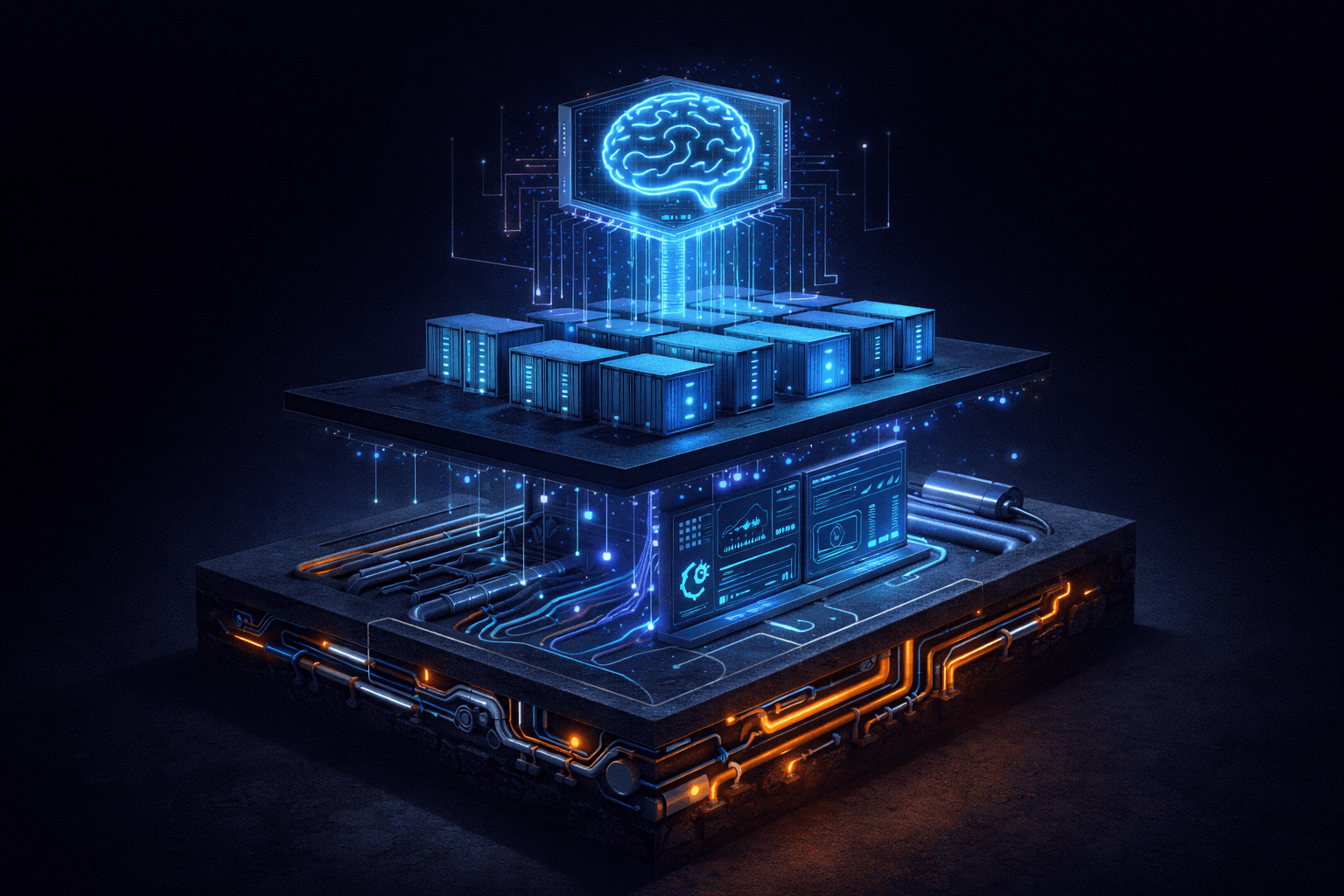
Platform engineering exists because developers were drowning.
"You build it, you run it" was supposed to empower teams. Instead, it buried them. Every developer suddenly needed to understand Kubernetes, Terraform, CI/CD pipelines, observability stacks, networking, security policies, and twelve different YAML dialects — on top of the code they were actually hired to write. The promise was autonomy. The reality was every backend dev turning into a reluctant part-time SRE, mass-producing artisanal YAML at 2 AM on a Tuesday.
Platform engineering is the response: a dedicated team builds an internal developer platform (IDP) that abstracts away infrastructure complexity and gives developers self-service capabilities. Instead of filing a Jira ticket and waiting three days for a database while your PM asks why the feature is behind schedule, you click a button. Instead of hand-writing Helm charts from StackOverflow copypasta, you pick from a golden path that your platform team has already hardened, tested, and blessed with the kind of institutional knowledge that usually lives in one person's head (and that person is always on vacation when you need them).
The promise is simple. Developers focus on building. Platform teams handle the how.
Now AI is changing what that "how" looks like — and honestly, it's changing it faster than most orgs are ready for.
The Cognitive Load Problem
Every platform engineering effort starts with the same realization: developers spend too much time on things that aren't their product.
Studies from Team Topologies and the DORA research program consistently show that cognitive load is the bottleneck. When a developer needs to understand infrastructure deeply just to ship a feature, everything slows down — deployment frequency drops, lead time increases, and engineers burn out maintaining systems they didn't design and don't fully understand. DORA's State of DevOps reports have been screaming this for years: the teams with the highest software delivery performance aren't necessarily the most technically brilliant — they're the ones where developers spend the least mental energy on undifferentiated infrastructure work.
Think about it in computer science terms. Your developers have a finite cognitive thread pool. Every infrastructure concern they hold in working memory is a context switch away from product code. Platform engineering is essentially a scheduler optimization — you're reducing contention on the developer's cognitive resources by offloading infrastructure work to a dedicated execution context.
Platform engineering doesn't remove complexity. It moves complexity to where it belongs — behind an abstraction layer maintained by people whose full-time job is getting it right. It's the same principle that makes a good API great: the contract is simple even when the implementation is gnarly.
The golden path is the key concept. You give developers a paved road — a pre-built, opinionated way to deploy a service, set up a database, configure monitoring. They can step off the path if they need to, but most of the time, the path is faster, safer, and better than whatever they'd build from scratch. Netflix calls these "paved roads." Spotify built Backstage around this idea. Google has been doing this internally since before most of us knew what a container was.
AI makes building and maintaining those paths dramatically easier. And in some cases, it's making the paths build themselves.
Infrastructure as Code
This is where AI delivers the most obvious wins — and it's not even close.
Writing Terraform modules, Kubernetes manifests, and Helm charts is pattern-heavy work. You've seen it before. You know the structure. You just need to type it out, get the syntax right, and remember which version of the provider API changed that one argument name. It's the kind of work that feels like it should be automated because your brain is basically acting as a lookup table with a text editor attached.
AI compresses that. Describe what you want — "a PostgreSQL RDS instance with Multi-AZ, encrypted at rest, in a private subnet with a security group allowing access only from the application subnet" — and get a working Terraform module back. Review it, refine it, ship it. What took 45 minutes of docs-diving and copy-paste-adapt now takes 5 minutes of review. And the 5 minutes of review is the part you should never skip.
The real value shows up in platform teams building reusable modules. Instead of writing fifty variations of the same infrastructure pattern, you generate them, standardize them, and expose them through your IDP. Your platform team becomes a factory for golden paths, and AI is the conveyor belt.
# Generated, reviewed, and refined — not blindly accepted
module "app_database" {
  source         = "./modules/rds-postgres"
  environment    = var.environment
  instance_class = var.db_instance_class
  multi_az       = var.environment == "production"
  subnet_group   = module.networking.private_subnet_group
  allowed_cidrs  = [module.networking.app_subnet_cidr]

  # AI suggested this. The human made sure it was right.
  backup_retention_period = var.environment == "production" ? 35 : 7
  deletion_protection     = var.environment == "production"
}
The same rules from AI-assisted coding apply here — arguably more so. Read every line. Understand the security implications. AI will happily generate a security group with 0.0.0.0/0 ingress if you're not paying attention. It'll disable encryption if the prompt is vague. It'll create an RDS instance that's publicly accessible because you didn't explicitly say "private." Infrastructure mistakes are expensive, often invisible until something breaks, and when they break, they break at scale. The blast radius of terraform apply with a bad module isn't a 500 error — it's a security incident.
One more thing: AI is exceptionally good at the boring-but-critical work of policy validation. Feed it your organization's infrastructure standards — naming conventions, tagging requirements, encryption mandates, network segmentation rules — and use it to audit generated IaC before it ever hits a pull request. Think of it as a pre-flight checklist that actually scales.
CI/CD Pipelines
CI/CD is where platform teams spend a disproportionate amount of time — and where AI can quietly save hours every week. If infrastructure-as-code is the skeleton of your platform, CI/CD is the nervous system. And right now, most organizations' nervous systems have the reflexes of a sloth on melatonin.
Intelligent test selection. Not every code change needs to run every test. This is one of those things that's obvious when you say it out loud but surprisingly hard to implement well. AI models trained on your commit history and test outcomes can predict which tests are likely to fail for a given change and run those first. Launchable, Buildkite, and others have been shipping this for a while. The math is compelling: if you have 10,000 tests and AI can correctly predict that only 800 are relevant to a given change, your feedback loop just went from 40 minutes to 4 minutes. The result: faster feedback loops without sacrificing coverage.
Flaky test detection. Flaky tests are a tax on every engineering team — the kind of tech debt that compounds silently until half your team has learned to just hit "re-run" on CI and check back in 20 minutes. AI can analyze test run histories, identify patterns in flaky failures (this test fails every third Tuesday when the database seed rotates, that test breaks when two specific suites run in parallel), and flag — or quarantine — tests that fail non-deterministically. Some teams report cutting their flaky test investigation time by 60-70%. That's not optimization. That's reclaiming entire engineering days.
Pipeline generation. Describe your deployment strategy and AI generates the pipeline configuration. "I need a GitHub Actions workflow that runs lint, unit tests, and integration tests in parallel, then deploys to staging on merge to main, with a manual approval gate before production, and posts the deployment status to the team's Slack channel." What used to take an hour of YAML wrangling takes five minutes of review.
Dependency intelligence. This one's underrated. AI models can analyze your dependency graph — not just direct dependencies, but the transitive closure — and flag risk. A new CVE dropped? AI can tell you which services are affected, which pipelines to trigger, and what the upgrade path looks like, before you've finished reading the advisory. This turns "we should probably audit our dependencies" from a quarterly chore into a continuous process.
Observability and Incident Response
This is where AI gets genuinely exciting for platform teams. And by "exciting," I mean the kind of exciting where it's 3 AM, everything is on fire, and AI is the one person in the room who actually knows what's happening.
Modern systems generate volumes of telemetry that no human can process in real time. Logs, metrics, traces, events — all flowing through your observability stack at a rate that makes manual correlation impractical during a live incident. A medium-sized microservices deployment might generate hundreds of gigabytes of telemetry data per day. The signal-to-noise ratio during an outage is abysmal. You're looking for one misbehaving service in a haystack of metrics, and the haystack is on fire.
AI-assisted root cause analysis. When an alert fires, AI can correlate signals across your monitoring stack — this service's latency spiked at the same time that service's error rate jumped, right after a deployment to that other service. The kind of connection that takes a human twenty minutes of dashboard-hopping and mental graph traversal, AI surfaces in seconds. Dynatrace's Davis engine, New Relic's AI, and Datadog's Watchdog have all been iterating on this for years. The latest generation, built on LLMs, can actually explain the correlation chain in plain English instead of just showing you a dependency graph and hoping you figure it out.
Runbook generation and summarization. AI can generate draft runbooks from incident post-mortems, past resolution steps, and system documentation. When you're paged at 3 AM, having an AI-generated summary of "the last three times this alert fired, here's what the team did, here's what actually fixed it, and here's what didn't" is worth its weight in uptime. This is one of those applications where AI's ability to synthesize unstructured text is a genuine superpower. Your post-mortems are gold mines. AI is the mining equipment.
Alert tuning. AI analyzing alert history to identify noisy alerts, suggest threshold adjustments, and reduce alert fatigue. This alone justifies the investment for many teams. If your on-call engineers are getting 200 alerts per shift and 180 of them are noise, you don't have an observability stack — you have a noise machine that occasionally produces signal. AI can break that cycle.
Anomaly detection without manual baselines. Traditional monitoring requires you to define "normal" up front. AI flips this — it learns what normal looks like from your data and flags deviations. Seasonal patterns, gradual degradation, subtle correlation shifts — the kinds of things a human might catch after staring at dashboards for six months, AI catches on day one. The caveat: it also catches things that aren't problems, so tuning the sensitivity is a human job.
The best platform teams don't just build infrastructure. They build the feedback loops that tell you when infrastructure is lying to you. AI makes those loops faster, sharper, and — critically — less dependent on tribal knowledge that walks out the door when someone changes jobs.
The Internal Developer Portal
Backstage, Port, Cortex, OpsLevel — the IDP market is crowded and growing. These portals serve as the front door to your platform: service catalogs, documentation, self-service workflows, scorecards. They're the UI layer of platform engineering — the place where all those golden paths, automation pipelines, and observability integrations come together into something a developer can actually use without reading a 47-page Confluence doc.
AI changes the interface layer. Fundamentally.
Instead of navigating a catalog and filling out forms, developers describe what they need in natural language. "Spin up a new Python microservice with a PostgreSQL database, connected to the payments VPC, with standard observability and a 99.9% SLO." The portal translates that into the right templates, the right golden path, the right Terraform modules — and provisions it. It's the difference between a command-line interface and a conversation. The IDP stops being a tool you learn and starts being a tool that learns you.
This sounds futuristic. It's already shipping.
GitHub Copilot for Infrastructure, Pulumi AI, and Firefly's natural language infrastructure generation are production-ready. Platform teams are building internal ChatOps bots that wrap their IDP APIs in conversational interfaces. A developer in Slack types a request, the bot provisions infrastructure, runs the pipeline, and posts the service URL back — all within minutes. No context switching, no tab juggling, no "wait, which Terraform workspace am I in?"
Where this gets really interesting is intent-aware scaffolding. AI doesn't just provision what you ask for — it provisions what you probably also need but forgot to mention. You asked for a microservice? It sets up the health check endpoint, the Prometheus metrics exporter, the structured logging configuration, and the Dockerfile because it knows that's what your golden path includes. It fills the gaps between what you said and what you meant.
The best internal developer portals reduce decisions, not just clicks. AI takes this further by understanding intent and mapping it to your organization's specific golden paths. The developer says what they want. The platform figures out how. And the gap between "I need a thing" and "the thing is running in staging" shrinks from days to minutes.
Security and Compliance — The Quiet Revolution
Nobody talks about this one enough, but AI might deliver its biggest platform engineering ROI in security and compliance.
Platform teams are increasingly responsible for guardrails — ensuring that whatever developers ship meets the organization's security posture without turning every deployment into an audit. Traditionally, this meant policy-as-code tools like OPA/Gatekeeper, Sentinel, or Kyverno. These work, but writing and maintaining policies is tedious, error-prone, and always lagging behind the latest threat landscape.
AI changes the economics here. It can analyze your infrastructure configurations against compliance frameworks (SOC 2, HIPAA, PCI-DSS, CIS benchmarks) and flag violations before they reach production. More importantly, it can explain the violation in context — not just "this S3 bucket is public" but "this S3 bucket is public, it's in the payments service, and your PCI-DSS scope says payment-related storage must be encrypted and private."
It also helps with the supply chain problem. AI models trained on vulnerability databases and dependency graphs can do continuous risk assessment across your entire service fleet. Not just "this library has a CVE" but "this CVE affects three services, two of which are internet-facing, and here's the upgrade path ranked by blast radius."
Security is where the "human in the loop" principle is non-negotiable. AI surfaces risks. Humans decide what to do about them. An AI that auto-remediates a security finding in production without human approval is a liability, not a feature.
What Doesn't Work (Yet)
AI in platform engineering has real limits. Knowing them saves you from expensive disappointments — and from vendors who want to sell you a future that doesn't exist yet.
Fully autonomous operations. AI can suggest, summarize, and accelerate — but letting it make infrastructure decisions without human review is a recipe for outages. The blast radius of an infrastructure change is orders of magnitude larger than a bad line of application code. A wrong terraform destroy doesn't give you a 500 error — it gives you a resume-generating event. Every AI-generated change needs a human in the loop. Period. No exceptions. Not even if the vendor demo looked really convincing.
Context-aware architecture decisions. AI can tell you the tradeoffs between ECS and EKS. It can generate a detailed comparison matrix with cost estimates and migration complexity scores. What it can't tell you is which one fits your team's skill set, your compliance requirements, your migration timeline, and the fact that your best Kubernetes engineer just gave notice. Architecture is context, and context is the one thing AI consistently lacks. It can inform the decision. It can't make the decision.
Replacing platform engineers. AI makes platform engineers more effective, not redundant. Someone still needs to design the abstractions, curate the golden paths, set the standards, and make the judgment calls that define your platform's opinion. AI handles the implementation. Humans handle the intent. This distinction matters, because the companies that try to replace their platform team with AI are going to discover very quickly that AI without curation produces chaos at scale.
Cross-system reasoning. Your platform spans dozens of tools — Terraform, ArgoCD, Datadog, PagerDuty, Backstage, Vault, and whatever new thing your CTO saw at KubeCon last month. AI is excellent within each tool but still weak at reasoning across the full stack. The "glue" between systems — understanding that a Vault policy change affects which services can access which secrets which affects your ArgoCD deployment order which affects your rollback strategy — remains a deeply human problem. MCP (Model Context Protocol) and similar approaches are trying to solve this, but we're early.
Handling drift gracefully. Infrastructure drift — when reality diverges from your declared state — is one of the hardest problems in platform engineering. AI can detect drift. It can even suggest remediations. But understanding why drift happened and whether the drift or the code is the source of truth requires judgment that AI doesn't have. Sometimes the drift is the fix that someone applied at 3 AM during an outage and forgot to backport into Terraform. AI doesn't know that. Your on-call engineer does.
Where This Goes
Platform engineering is heading toward a model where the platform understands your intent and handles execution end-to-end.
You describe a service — its purpose, its dependencies, its SLOs. The platform provisions infrastructure, configures monitoring, sets up the deployment pipeline, generates documentation, wires everything into the service catalog, and creates the initial runbook. You review and approve. The platform handles the rest. It's not a pipe dream — it's an engineering roadmap with most of the pieces already in production somewhere.
We're closer to this than most people think. The pieces exist. IaC generation, intelligent CI/CD, AI-powered observability, natural language portals — they're all production-ready individually. The integration layer is what's still being built. And honestly, the integration layer is where the real magic will happen. Not in any single AI-powered tool, but in the connective tissue between them — the ability for your platform to reason about the full lifecycle of a service from idea to incident.
The platform of the future doesn't ask you to learn its language. It learns yours. And the gap between what you intend and what gets deployed becomes so small that infrastructure starts to feel invisible — which is how it should have felt all along.
For platform teams right now, the practical move is clear: start where the repetition is heaviest. IaC generation. Pipeline templates. Runbook drafts. Alert tuning. Each one is a concrete, measurable win that compounds over time. Don't try to boil the ocean. Pick the thing that eats the most hours on your team's weekly calendar and throw AI at it. Measure the result. Then pick the next thing.
The developer experience you're building isn't just about removing friction today. It's about building a platform that gets smarter the longer your team uses it. Every incident resolved feeds better runbooks. Every deployment pattern refines the golden path. Every developer interaction teaches the platform what "good" looks like for your organization.
That's the real promise. Not AI replacing your platform team, but AI giving your platform team leverage — the kind of leverage where a team of five can build and maintain a platform that would have taken twenty people three years ago.
And it's already happening.