Everyone on Oceanic 815 was running from something.
That's the detail that makes LOST work — before the plane breaks in half, before the smoke monster, before the island pulls them out of the sky like a hand reaching up to grab them, every single person on that flight was carrying something they couldn't put down.
Jack was burying his father. Kate was in handcuffs, escorted by a federal marshal. Sawyer was leaving a con gone wrong. Sayid was searching for a woman he had lost a lifetime ago. Locke had been denied a walkabout he'd crossed the world to attempt. Charlie was strung out in an airplane bathroom. Jin and Sun were strangers to each other in a marriage they no longer recognized. Michael had a son who didn't know him. Hurley had won the lottery and watched his life fall apart anyway.
They didn't know each other. They weren't supposed to know each other. They were three hundred and twenty four strangers on a Tuesday morning flight from Sydney to Los Angeles, each one carrying a private weight, each one convinced that the plane was taking them away from whatever was hunting them.
And then the plane broke.
The Beach
The pilot episode of LOST opens on an eye. Jack's eye, specifically — bloodshot, disoriented, opening into sunlight and bamboo. He stands up. He runs toward the beach. And what he finds there is the most carefully choreographed chaos in television history — burning wreckage, a jet engine still turning, bodies in the sand, screaming, smoke, a pregnant woman going into labor, a man pinned under metal, a wing about to fall.
Jack runs. He starts fixing things. He doesn't ask who anyone is. He doesn't check their story. He pulls a man out from under debris and passes him to the next person. He drags the pregnant woman away from the engine and hands her off. He doesn't know their names. It doesn't matter. The beach has become the only reality, and in this new reality, the résumés they were carrying when the plane went down are gone.
That is the strange grace of a crash.
It strips a person down. It takes the story you were telling yourself — the one about who you are, what you deserve, what you're owed, what you're running from — and it rips it in half and leaves it in the sand. What's left is a much simpler question. Will you help the person next to you, or won't you?
Every life has crashes like this. They don't always arrive as plane wrecks. Sometimes they arrive as a phone call at 3 AM. A diagnosis. A funeral. A layoff. A child in the emergency room. A marriage ending. A decade ending. The slow kind of crash where nothing looks broken from the outside but everything inside has been rearranged. And in that moment, before you've had time to reconstruct the story you were telling yourself, there is always someone on the beach with you. A stranger you would not have chosen. A stranger who may turn out to be the only thing standing between you and dying alone.
Jack's Sermon
A few episodes in, the survivors are arguing. About water, about the caves, about leadership, about whether Jack has any right to tell any of them what to do. Sawyer is snarling. Kate is caught in the middle. The fragile civility of the first week is cracking. And Jack — exhausted, overwhelmed, a surgeon who never asked to be anyone's leader — stands in front of them and says the line that will echo through every season of the show:
"If we can't live together, we're going to die alone."
He is past speeches. What comes out of his mouth is closer to a diagnosis — a doctor who has seen what happens when people stop helping each other, speaking plainly to a group of strangers who are one bad day away from turning on each other.
Sit with that sentence for a moment.
On the surface it reads like survival advice for people stranded on an island. Read it a second time and it becomes something much larger — survival advice for being alive.
If we can't live together, we're going to die alone. The show is about an island. The sentence is about everything.
Every community that has ever held together held together because somebody said something like this out loud. Every family, every friendship, every neighborhood, every team, every marriage — at some point, somebody tired and overwhelmed looked around and said: we have to do this together or we won't do it at all. That sentence is the foundation under every structure human beings have ever built that mattered. And the absence of that sentence is the foundation under every structure that collapsed.
The World That Engineered the Beach Away
Here is the quiet tragedy of our time.
The Losties had to live together. The beach was too big, the jungle too dangerous, the night too dark, the food too scarce, the injuries too serious. No one could survive on their own. The have to was written into every sunrise. They needed each other the way a body needs a heartbeat — constantly, unconsciously, without the luxury of opting out.
We do not have that have to anymore.
Our food arrives at our doors in sealed bags. Our entertainment plays on screens we hold six inches from our face. Our work happens through video calls with people we have never met in person and may never meet. Our relationships are curated through messages we can revise before sending. We can go weeks — months, if we are careful — without needing anything from anyone who lives within walking distance. We have built a world where solitude is the path of least resistance.
We have engineered away the crash. Which means we have engineered away the beach. Which means we have engineered away the only condition under which most of us would ever have met the people who could have become our family.
This is the part nobody wants to say out loud. Loneliness is epidemic in the modern world because comfort has become so complete that the forces that used to push us into each other's lives have quietly disappeared. A century ago, you needed your neighbors to get through winter. Fifty years ago, you needed your co-workers to get through a project. Today, you can arrange your entire life so that you never truly need any single person. And in the process, you will lose the most important thing a life can contain.
The Ones You Would Never Have Chosen
Look at the people who became a family on that beach.
Jack, the Type-A surgeon who needs to fix everything. Sawyer, the conman who was running a long con on the woman he crashed next to. Sayid, the former torturer for the Iraqi Republican Guard. Hurley, the lottery winner who felt cursed by his own good fortune. Jin and Sun, a couple with a failing marriage and a language barrier that extended to most of the people around them. Claire, an eight-months-pregnant Australian woman carrying a baby she had planned to give up. Locke, the wheelchair-bound office worker the universe kept humiliating. Charlie, the former pop star hiding heroin in his sock.
In what world would any of these people have become each other's closest companions?
Not ours.
In our world, Jack would have his surgeon friends. Sawyer would have his marks. Sayid would have his memories. Hurley would have his mansion and his very small circle. Jin and Sun would have their separate lives. Claire would have her support group. Locke would have his empty cubicle. Charlie would have his pills. They would have passed each other on the street a thousand times and looked through each other the way we look through strangers every day of our lives.
The island made them look.
It made them stay. It made them share food, and share names, and share stories, and eventually — without any of them deciding to — share a family. They became close because they had no choice, and they were paying attention. Shared history came later. What they had in common came later still.
That is the lesson hiding inside the premise. The people who will eventually hold your hand when you die are almost never the people you would have picked from a catalog. They are the ones you ended up next to. The ones who showed up when you needed something. The ones who kept showing up even when you were difficult, or scared, or ashamed, or wrong.
The Fire on the Beach
There is a scene, somewhere around the middle of the first season, that you might miss if you're watching for plot.
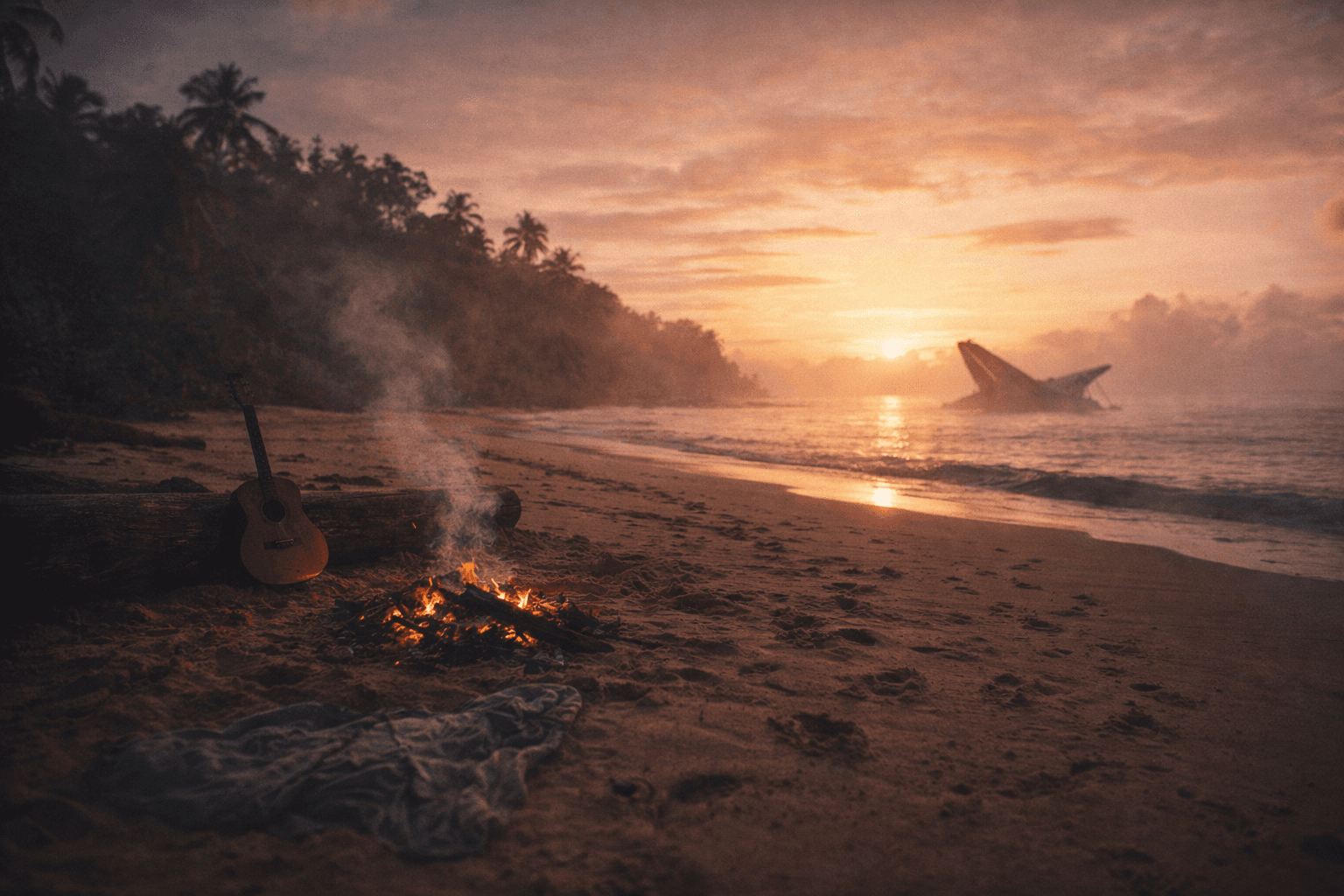
It's night. The survivors have built a fire on the beach. Someone is playing the guitar — Charlie, probably. Hurley is passing around something to eat. Jack is sitting with Kate, not talking much. Sawyer is pretending not to be part of the group and clearly being part of the group. Sayid is watching the ocean. Jin is trying to say something to Michael and failing, and both of them are laughing about it. Claire has her hand on her belly. Locke is off by himself, content.
Nothing happens.
That's the scene.
And it's one of the most devastating things the show ever put on screen, if you're paying attention — because these people have lost everything, and in that moment they have something most of us will never have. They are fully present. No phones. No email. No audience to perform for. They are sitting around a fire at the end of the world, and they are at peace in a way that no algorithm and no amount of comfort has ever produced.
We have everything. They had nothing. And on a long enough timeline, it is worth asking which of the two is the more dangerous condition.
The Question the Show is Asking
If we can't live together, we're going to die alone.
The show repeats the line across six seasons, in different mouths, in different contexts, and each time it means something slightly more than the last. It means: help each other in the caves. It means: forgive each other on the beach. It means: forgive yourself for what you did before the crash. It means: carry the people who can't carry themselves. It means: when the plane goes down, the only thing that matters is who you become on the way down, and who you choose to reach for when you land.
We are all shipwrecked. Different planes, different beaches, different reasons for going down. The work of a life is finding the people on your beach before the tide takes you somewhere else.
Part 2: Man of Science, Man of Faith — coming soon.