Desmond says it first to a stranger.
Jack is running stairs in a stadium at night — the kind of self-punishment that passes for exercise when a man is trying to outrun something he cannot name. A stranger appears on the bleachers. Scottish accent, easy smile, a warmth that has no business being in a parking lot at midnight. They talk for a few minutes about nothing important. And then the stranger leaves with a phrase Jack will not understand for years.
"See you in another life, brother."
It sounds like a goodbye. The kind of thing a traveller says when he knows the road ahead is long and the odds of crossing paths again are thin. Desmond Hume says it like a man tipping his hat — casual, kind, already moving on.
He says it again on the island. And again off the island. It becomes his signature — dropped like a coin into every farewell, as if he knows something about the shape of time that the rest of them have not yet figured out.
It takes six seasons to learn that Desmond was not being poetic. He was being precise.
The Room at the End
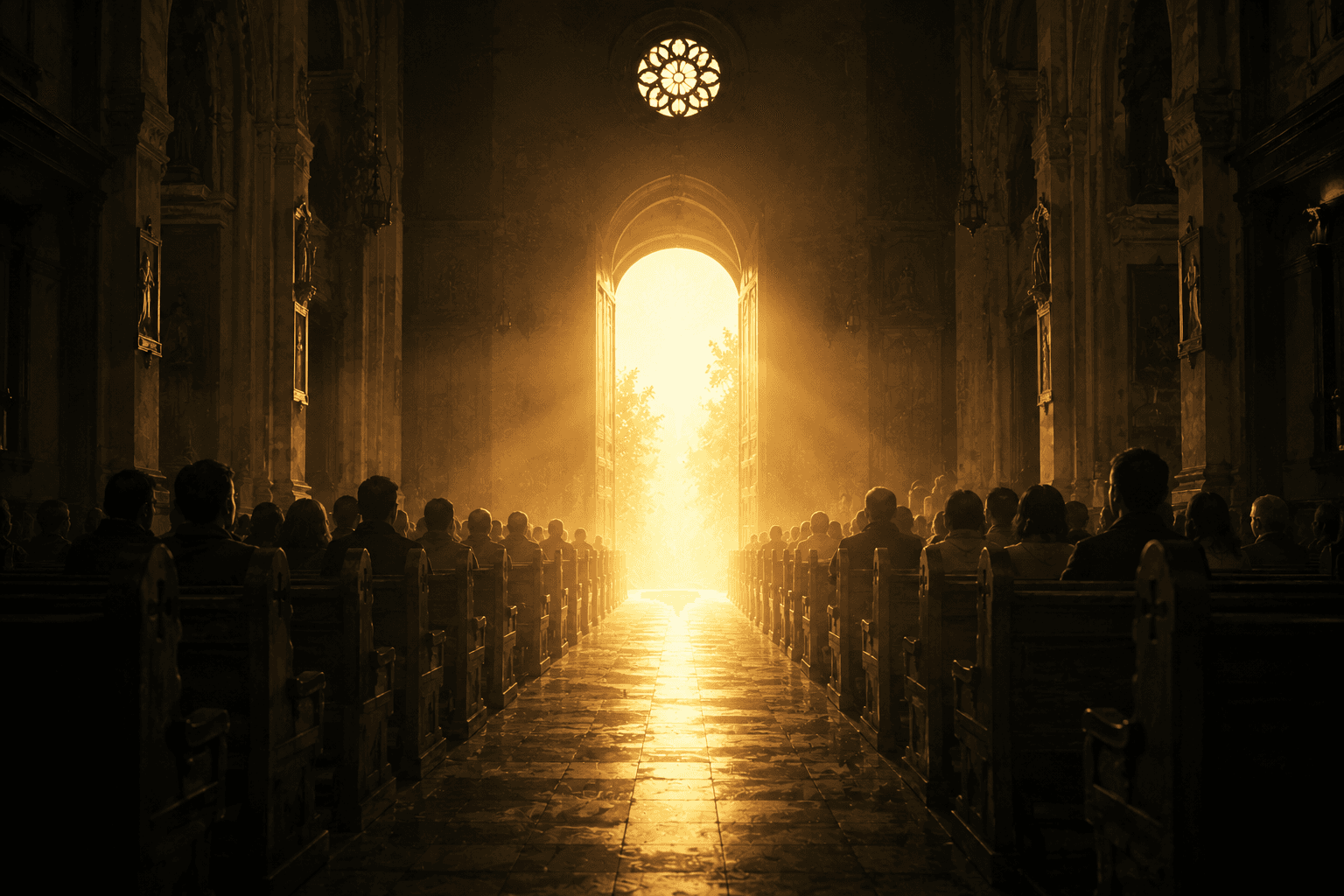
The finale of LOST does not end with a battle or a rescue or an escape. It ends in a church. A small, warm, wooden room filled with light. Every character the show spent six years building — the ones who died on the island and the ones who lived decades after — is sitting in the pews. They have found each other in a place beyond time, a place they built together without knowing they were building it, because the years they spent on that island were the most important years any of them ever lived.
Christian Shephard says it plainly: "The most important part of your life was the time you spent with these people."
The doors open. The light comes in. Nobody walks through alone.
The show could have ended a hundred ways. It could have explained the island. It could have resolved the mythology, answered the numbers, named the light. Instead it ended with the simplest possible image — a room where everyone who mattered is together, and the only thing left to do is go.
That ending made a lot of people angry. They wanted answers. They wanted the plot resolved. And LOST said: the plot was never the point. The people were the point. They were always the only point.
Becoming Permanent
Here is what the show understood about relationships that most stories do not bother to articulate.
There are people in your life who are passing through. They are good people. They matter. They teach you things, share a season with you, make the commute bearable. And then the chapter changes and they drift, and you drift, and within a year the friendship that felt essential has become a name you scroll past without stopping.
And then there are the ones who become permanent.
You know them by the weight they leave. Not the time they spent — some of them were only in your life for a year, maybe two. But when they left, the architecture of your thinking had already changed, and it could not change back.
The friend who showed up during the worst year and did not ask what was wrong — just stayed. Close enough to reach, far enough to give you air. The person who said the thing about you that you had never been able to say about yourself, and once they said it, you could not unhear it. The colleague who saw your work clearly when you couldn't, who said keep going at exactly the moment you were building a case to stop.
These people do not need to be in your life every day to be permanent. Some of them live in other cities now. Some of them are no longer alive. It does not matter. They are woven into how you think. You could no more remove them than remove a load-bearing wall from a house and expect the roof to hold.
The Ways We Find Them Again
Desmond's phrase — see you in another life — sounds mystical. Like a promise about the afterlife. But I think the show is saying something more ordinary and more true.
You find them again all the time. You just have to know what finding looks like when it is not a church full of golden light.
You find them in the decision you make at 2am when no one is watching — the one where you choose the harder, kinder thing, and you know whose voice is in your head when you choose it. A friend from a decade ago. A teacher whose name you half-remember. Someone who would never know they were in the room with you at that moment, but they were.
You find them in your children. Not because your children are them — but because the way you love your children was shaped by someone who loved you that way first. The patience you did not have naturally, that someone modelled for you long enough that it became yours. You pass it forward without attribution. That is how they show up in another life.
You find them in a song that hasn't played in years, and for three minutes you are twenty-two again, sitting on a floor with someone who understood you before you understood yourself. The song ends. You go back to work. But for those three minutes, the room was full.
The church in LOST is not a supernatural event. It is the show's way of making visible what is already true — that the people who shaped you are present in your life long after the chapter that contained them has closed. They live in the grammar of how you move through the world. They show up in the choices you make, the things you refuse to tolerate, the warmth you extend to strangers because someone once extended it to you.
The Church You Are Already Building
You do not have to die to build the church. You are building it now — every time you let someone matter enough to change you. Every time you stay in a room that is difficult because the person in it is worth the difficulty. Every relationship where you are honest enough to be known, and brave enough to know someone back.
The pews fill slowly. Over years, over decades. Most of the people in them do not know they are there. They dropped a sentence into your life in 2009 and kept walking, never knowing that the sentence became a wall you lean against every day. They gave you a year of themselves and then moved on, never knowing they left something structural behind.
That is fine. The church does not require attendance. It only requires that you were changed — that somewhere in the long, ordinary process of being alive, another person walked into your story and the story was different after they left than it was before they arrived.
"Nobody does it alone, Jack. You needed all of them, and they needed you."
Strip away the theology. Strip away the afterlife. Strip away the golden light and the church and the stained glass. What remains is the simplest observation LOST ever made: you are not the person you became by yourself. Every good thing in you — every piece of courage, every reflex of compassion, every moment where you were better than you would have been alone — has a name attached to it. A person who planted it. A relationship that made it possible.
The church is just a room where you finally see that clearly. Where the debt is visible. Where the people who built you are present and accounted for, and you can look at them and know — fully, without the distortion of daily life — what they gave you.
Closing the Series
This is the last essay in a series of seven.
A beach where strangers became family. A debate between a scientist and a believer that was the same hunger in different clothes. A phone call that held a man together across time. A wheelchair and a man who needed to be needed. A parking lot and a man who could not survive the life he fought so hard to reach. A cave and a man who learned to hold something without fixing it.
And now a church. A room where the holding is done, and the only thing left is gratitude.
The people who matter most do not stay because you hold them. They stay because they became part of how you think. You could no more lose them than lose your own voice.
Every essay in this series ended by asking a question aimed at the living. This one asks the last one.
Who is in your church?
Whose voice do you hear when you are deciding something important? Whose patience are you borrowing when you are patient with your children? Whose courage are you spending when you walk into a room that frightens you? Whose kindness did you inherit, without paperwork, without ceremony, without them ever knowing they left it to you?
They are in the pews. They have been there for years. Some of them are still alive — you could call them tonight and they would answer and they would not know why you called and that would be fine. Some of them are gone — gone in the way that people go, where the body is absent but the shape they carved in you remains, permanent, load-bearing, yours.
LOST says the most important thing that ever happened to you is the people. Not the career. Not the island. Not the mythology or the mystery or the answers to the questions you thought you needed answered. The people. The ones who walked into your life carrying nothing but themselves and left behind something you will never be able to return.
See you in another life, brother.
It was never a goodbye. It was a recognition — that the people who become permanent do not end when the chapter ends. They show up again. In your decisions, your instincts, your children, your kindness, your refusal to walk past someone who needs help. They show up in another life because they became part of this one.
The door is open. The room is full. It has been full for longer than you knew.
This is the final essay in the LOST series. Start from the beginning →