Thirteen parts of this series have ended on a number.
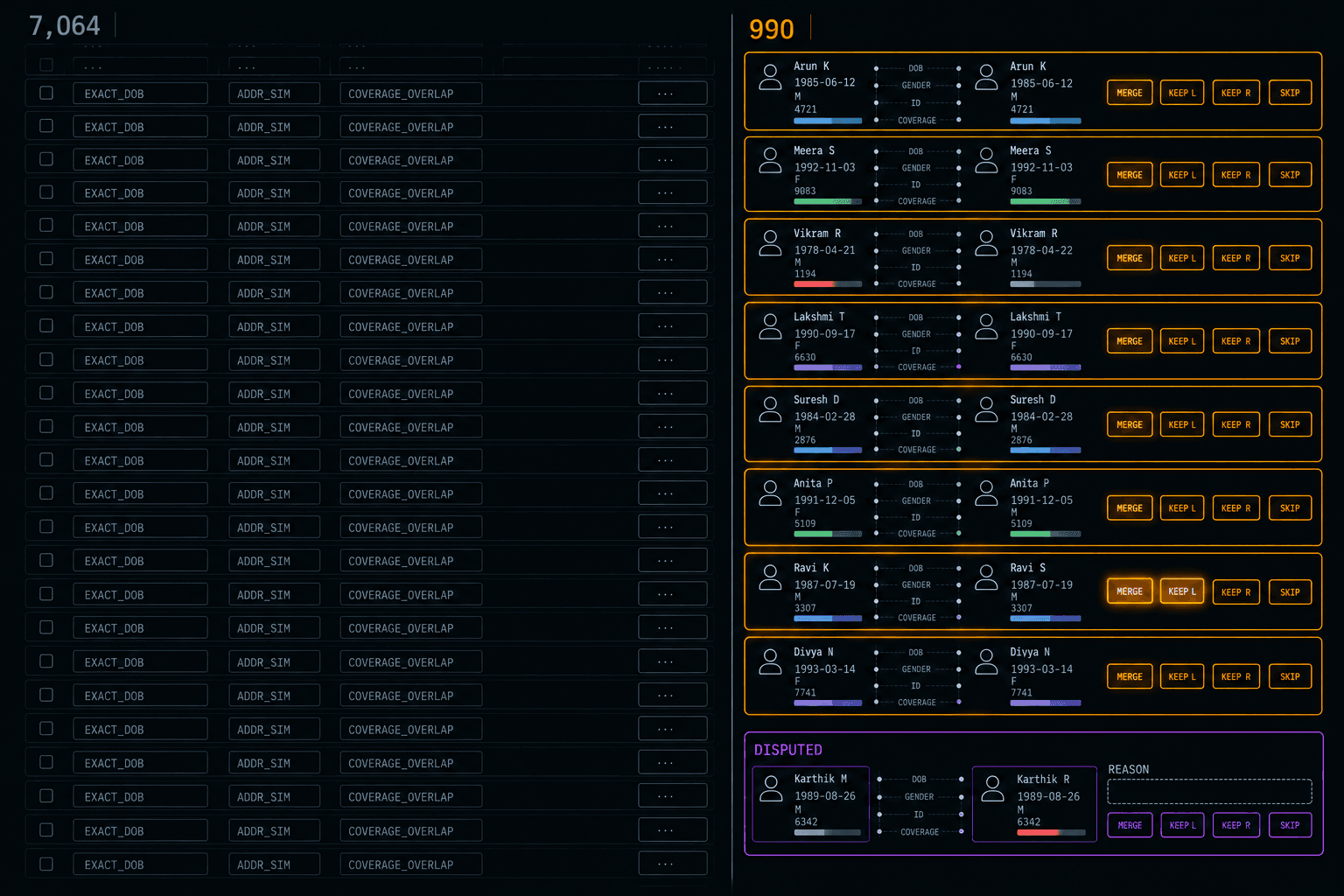
Nine hundred and ninety records out of seven thousand that needed a person. Eight hundred and thirty-nine re-arrivals with no identifier. Nineteen hundred and thirty-four tests. One thousand one hundred and thirty-six questions with known answers, and a hundred and ninety-six wrong. The argument underneath all of it has been the same one, stated in Part 9 and repeated since: a number you have not measured is a number you do not have.
This part was supposed to price one last number. Part 13 closed by promising a retrospective on the cost of eight mechanisms designed, named, published in an article, and never once called — a pattern the series had been tripping over since Part 11, and had got better at finding each time it did.
The eight could not be checked. There was no list.
A Word in a Closed Vocabulary Is a Claim
Most of the platform's meaning lives in small closed sets. An identifier has a type: a subscriber id, a member id, a medical record number. A lineage row has a transformation: this entity was mapped, merged, corrected, reasserted. A coverage has a benefit status. Each set is declared once in Python, pinned in the database by a CHECK constraint that refuses anything outside it, and documented in a comment explaining what each word means.
A word in a set like that is a claim. It says the platform can produce this; a reader who sees it in a column knows what happened; a reviewer who reads the enum learns the vocabulary of the system.
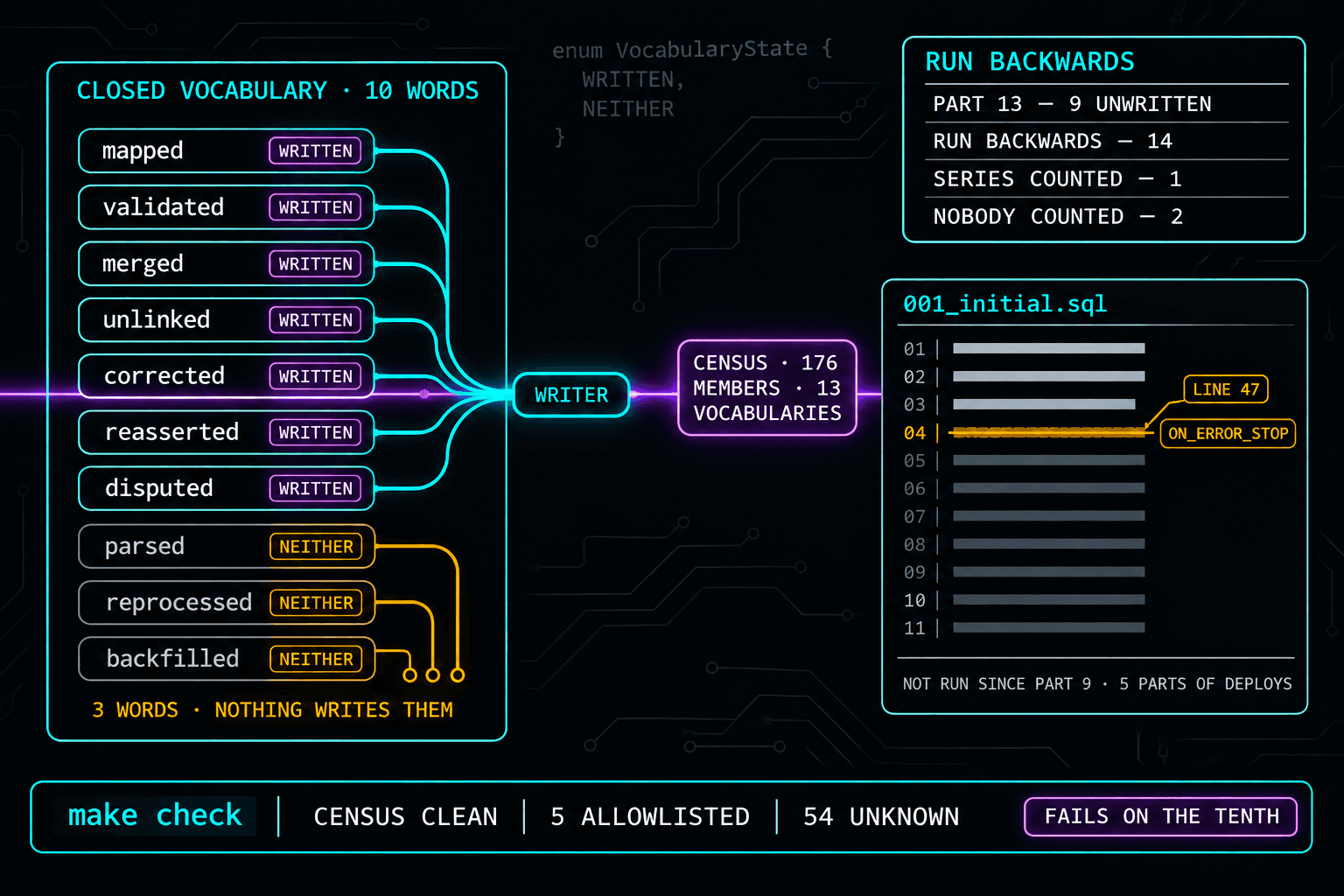
Three of the ten words in the lineage vocabulary had nothing behind them. Nothing in the codebase had ever written parsed, reprocessed or backfilled. The series had counted one of the three.
That was found by reading one file while writing this part's build plan, which is how the previous two had been found, and it is where the plan stopped. So the plan's last step was a tool: walk every closed vocabulary in the repository, find every reference to every word, and report each one as written, read, neither or unknown — with tests counted separately, because the word disputed had sat for nine parts in two comments, a migration test and a CHECK constraint, and in no code path at all.
One hundred and seventy-six words across thirteen vocabularies. At the close of Part 13, nine had nothing writing them, of which the series had counted one.
Then the tool was run backwards, over the last commit of every part.
Fourteen words were unwritten at the end of some part from Part 4 onward. Two of them were quietly written later, by a part that had no idea it was filling a hole: a lineage transformation that went unwritten through Parts 9 and 10, and a gender value through Parts 4 and 5. Nobody in any part ever counted those two, because nobody was counting.
Under its own definition the eight were right. They were mechanisms the series had written about — published, explained to a reader, and then left uncalled. That is a real category and a fair one. What it was not was measured, or written down anywhere as a list: three of the eight carry an ordinal in the repository and the first five had to be reconstructed for this part from Part 11's own text.
The tool counts something broader, and the two numbers answer different questions. Nine against eight is not an error rate, and this is worth being careful about, because the temptation in a retrospective is to find the biggest available number and divide something by it. Four of the eight were never vocabulary words at all — a calibration harness, a weight estimator, a query parameter, an empty route — so no census could have caught them. Three of eight is what the tool would have flagged on the day they were declared. Three is the claim it can carry.
Every number anyone in this series arrived at by reading, including this part's own plan, came in low.
Where This Pays for Itself: A Child Nobody Could Look Up
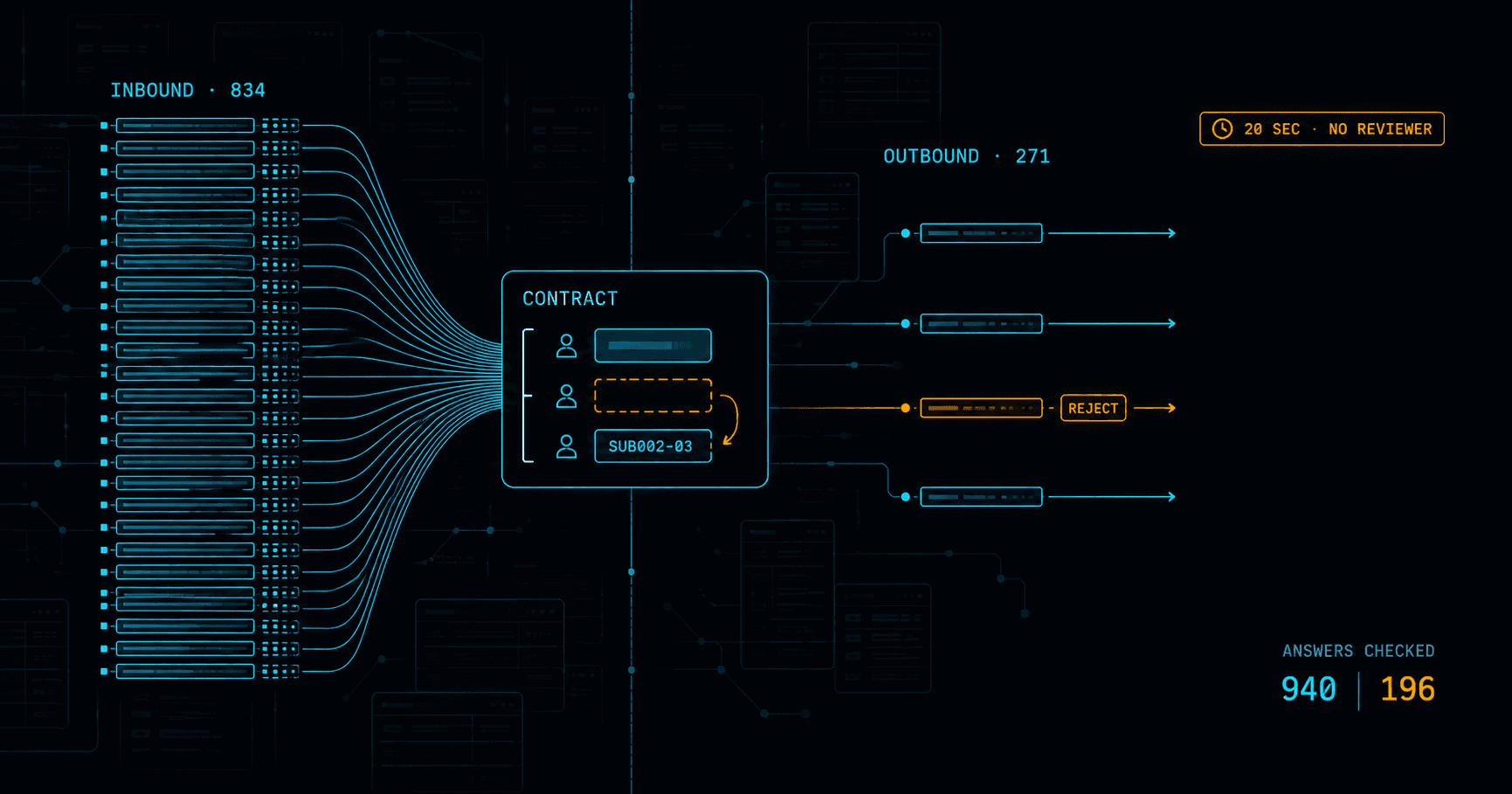
A mother brings her daughter to a clinic. The card in her hand has one number on it, the contract's, and the front desk sends an eligibility inquiry with it.
Until Part 13, this platform answered with the father's coverage.
A dependent held no identifier of her own. The vocabulary had a word for exactly this case — Part 3 declared it with a comment explaining that a person code is how the standard distinguishes dependents on one contract — and nothing ever wrote one. The cheap exact-match tier resolved the card number to the subscriber, who is the father. The probabilistic tier was switched off. The model-driven tier merged fathers and sons at 0.85 to 0.93 confidence, because nothing in their records distinguishes them.
A dependent nobody can look up by the number on her card is a receptionist on hold with the payer, a parent waiting, and a sick child in a plastic chair. It is the most common eligibility inquiry in the business, failing in the way that costs a person twenty minutes rather than a system an error.
The engineering number underneath it had been sitting in plain view for two parts. In Part 11, 839 of 1,847 re-arrivals carried no identifier and sat unlabelled in the weight estimator's negative class, where they were blamed on the sampler. 443 of the 839 were this single cause. The word was declared on 9 August and found on 25 October: ten parts, eleven weeks.
What finding it on the day would have cost is one run of a make target over that commit. The ledger shows it plainly — at the end of Part 3, the person code is already in state neither, and so is disputed, which went on to be found nine parts later by someone reading the code.
Now the honest accounting in the other direction, because the tool is not free and would not have been right from day one. Run against Part 3's commit it flags ninety-eight words, since nothing capable of writing them existed yet; it would have been pure noise. From Part 4 onward it flags between seven and eleven per part, and each one would have demanded a sentence.
Some of those sentences would simply have said "Part 13". That is the point rather than a weakness.
A Deferral and a Defect Had the Same Shape
Several of the unwritten words were the right call, decided deliberately, and written down at the time.
BenefitStatus.SUSPENDED is the clearest. In Part 4 I worked out that no enrollment code actually means suspended — the two that look like it mean the coverage is continuing, for a surviving spouse or under a federal continuation rule — wrote that down in the log, and pinned it with a test asserting the mapper never produces the word. It stayed in the vocabulary because removing it narrows a CHECK constraint on what coverage may express, which is a decision about the canonical model rather than a tidy-up.
So by Part 11 the repository held two words with identical shapes: one the platform had decided not to say, one it had forgotten to write. A member in an enum. A constraint admitting it. Sometimes a test. Ten parts of reading could not tell them apart, and neither could I.
What failed was the vocabulary itself, which had no way to record the difference. The fix is a file that costs one sentence per word: why it is there, and either the work that will write it or a flat statement that nothing will. The build fails on any unexplained word, and on any sentence that has stopped being true.
Writing those sentences sorted the seven unwritten words on its own. Three did not survive being asked to justify themselves and were deleted, with a migration to narrow the constraints behind them. Four did, and the file now says why.
| Word | Asked to justify itself | Outcome |
|---|---|---|
parsed (lineage) | Lineage rows describe canonical entities, and parsing produces none | removed |
reprocessed | The reprocess endpoint has existed since Part 9 and writes corrected | removed |
ssn_last4 | The four digits are already a typed column on the person | removed |
backfilled | No backfill has yet touched a canonical row; the person-code backfill will | kept, named |
suspended | Decided in Part 4; removing it narrows what coverage may express | kept, decided |
behavioral_health | The code set is partial by design and no line maps to it | kept, decided |
mrn | Assigned by providers, and nothing the platform reads comes from one | kept, named for the next format |
Nothing was priced as a defect that the record shows was a decision. The one word the fix created is also in that file: closing the re-issue bug below left a status with no writer, and the build failed on it the same afternoon.
Four Ways to Find One, in Ascending Order of Cost
The series walked up a ladder one rung per part and did not notice it was a ladder.
| How it was found | Which | Carried |
|---|---|---|
| A run that failed | the calibration harness, the weight estimator | 0 parts — the run was the part |
| A run of the real system | the uncalled tier, the parameter that gated it | 6 and 8 parts |
| Reading the code | disputed | 9 parts |
| Reading the code before the part shipped | the person code | 10 parts |
| A tool, on the day of declaration | nine words | 0 |
Average carry for the eight: 5.9 parts, range zero to ten.
The pleasing shape of that table should not be oversold, and the tool has a blind spot worth naming because it hid one of the eight for eight parts. A vocabulary read back out of the database looks, to a program reading source code, exactly like a vocabulary being written: both are the same constructor call on a value the tool cannot follow. So the census reports those words as unknown rather than unwritten — deliberately, because a false accusation of emptiness in a report about false completeness would be its own small disgrace. Fifty-four words are unknown today.
The link method that proved the cheap matching tier had never run is one of them. It was read and never written from Part 3 to Part 10, and the tool shrugs at it.
"Harmless"
The best finding in this part has nothing to do with vocabularies.
Since Part 12 the migration runner printed three errors every time it ran. Three old files create indexes on a column that migration 007 dropped, so three statements fail, and the carried-forward note said what everyone believed: harmless — the loop continues — and noisy.
The loop continues. The database client does not.
Each file runs with the flag that stops on first error. Each of those three failing statements abandoned the rest of its own file. In the oldest one the failure is at line 47, so for five parts, on every single deploy, everything below line 47 silently did not run — including, in another of the three, a guard that Part 13 had written specifically to stop a later migration from narrowing a constraint back.
That guard has never executed.
Nothing was broken in a running database, which is exactly why five parts of output could be read as noise. The statements that mattered had each been applied once already, by the deploy that first ran their file. The errors were load-bearing information about a deploy path that had quietly stopped working, arriving in a format everyone had trained themselves to scroll past.
The fix is three guards. The finding is that a signal becomes invisible the moment it is classified, and the classification here was written down in the project's own carried-forward list, in the word harmless, by me.
The same trap caught a fourth time while fixing the work queue in this very part: a migration recreating a view unconditionally would have undone the new one on the next deploy. That is three guards and a fourth, all of them the price of declining a migration framework three times across the series. The ledger now records what that decision has cost rather than leaving it as taste.
What Held
A retrospective is the wrong place to be modest about the parts that worked.
The canonical model took a second format without a new entity. The eligibility inquiry read the person, identifier and coverage tables exactly as Part 3 left them. Six files outside the format-specific packages changed to add a whole new transaction family to a platform that had promised format independence, which is roughly what that promise predicted.
The gate judges entities rather than files, and every verdict it has ever recorded names its rule and its rule-set version. The audit trail answered a question its own design never anticipated — an inquiry is a disclosure, a read the platform owes an account of — with a table beside the existing one rather than a sixth word jammed into a vocabulary that did not fit it.
A person worked the queue. Nine hundred and fifty-six items, scored against ground truth afterwards: forty of forty identifiers right, eight hundred and twenty-six proposals right.
Nothing was switched on without evidence. Two separate harnesses produced numbers that cleared their mechanical thresholds, and neither the probabilistic tier nor an automatic approval band was activated, with the reasons recorded next to the thresholds they cleared.
Running the system found what testing it did not, five parts running. This part's version of that is the tool run backwards over the history, which found in an afternoon what thirteen parts of careful reading had not.
The Carried-Forward Lists Did Not Carry Anything Forward
Every part ended with a table of what it was leaving for later. Sixty-two distinct items across thirteen parts.
Forty-four of the sixty-two were listed once and never mentioned again. After Part 3 each table held that part's own new items, so an item deferred in Part 4 vanished from the record in Part 5 unless someone happened to remember it. Eight turned out to have been closed by a later part without anyone striking them through.
disputed is the exception that proves the mechanism works when it runs: it survived four consecutive tables, stayed visible, and was eventually built. A migration framework was declined with good reasons in Parts 1 and 3 and then simply stopped being mentioned — open for thirteen parts, re-decided by silence.
So recurrence counts survival rather than importance, and the ledger now also reports open for: the migration framework thirteen parts, multi-tenancy eleven, the fact that the audit trail takes the caller's word for who the caller is, five. This part's roadmap table re-lists every one of the sixty-two and rules on each.
On rates: none of this gets divided by parts, lines or tests. Nine unwritten words out of a hundred and seventy-six is a true number against the right base. The same nine expressed as a percentage of a vocabulary that includes seventy-nine wire codes read straight off a file is a worse number pretending to be a better one, and "one per part" would treat Part 3, which declared nearly every vocabulary in the system, as the same kind of part as Part 7, which shipped no code at all. Where the base is unclear, the ledger gives the count and stops.
What the Series Ends On
One incoherence has been carried since Part 11, and it is still here.
The schema's uniqueness rule on identifier assertions presumes that an arriving person is resolved to an existing person before anything is written. The write path refuses to resolve before it writes, deliberately, so that mapping stays a pure function of the file. Both decisions are defensible. Together they do not add up.
Watch it happen. A member is enrolled in January: one person row, one identifier row. In February the monthly file resends her, unchanged.
- The write path creates a new person row, because every arrival is a new person.
- It tries to write her identifier again, with the same authority, type, value and start date. The uniqueness rule refuses it — that rule exists so that one assertion of a number on one date is one row, which only makes sense if the new arrival had already been resolved to the old one.
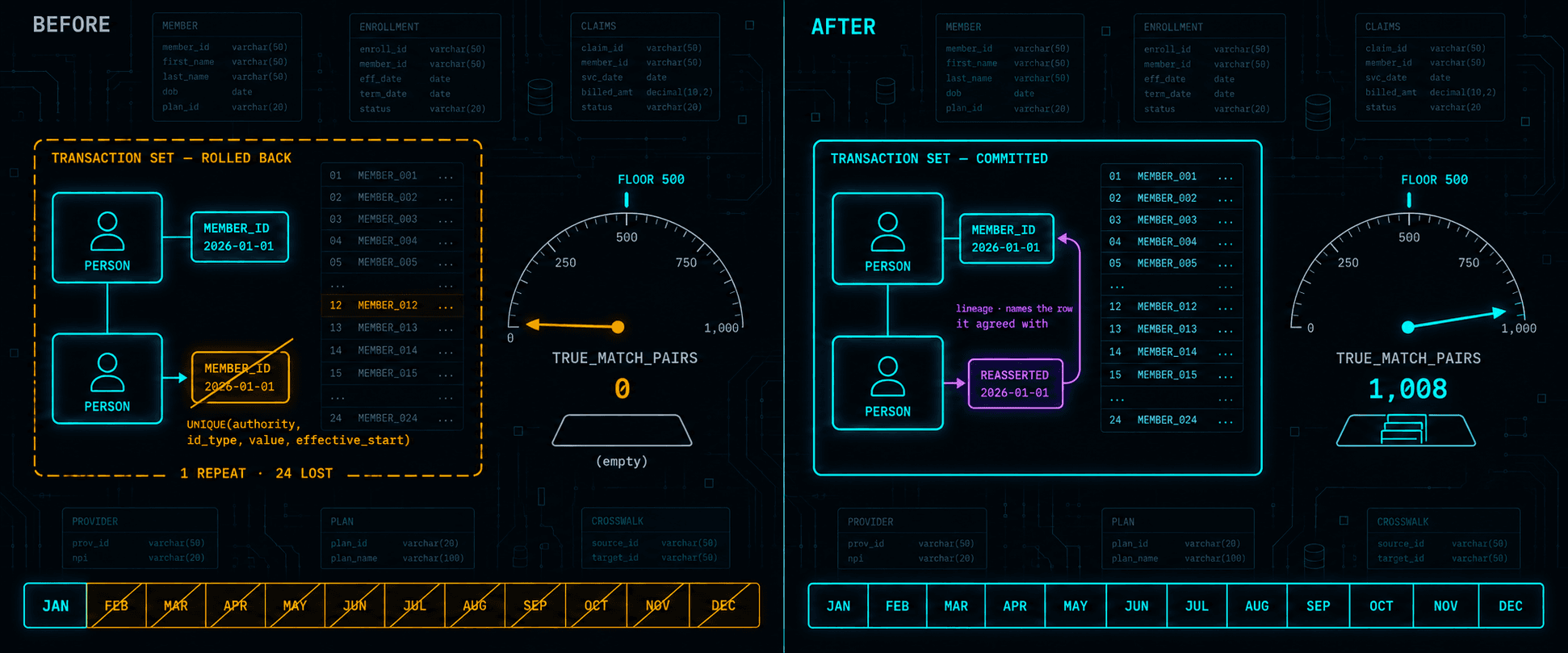
- Until Part 11 that refusal rolled back the entire transaction set, which cost four thousand two hundred and sixty-six enrollments in one corpus run. Since Part 11 the write path catches it, skips the insert, and records a re-assertion against the original row.
- So the second person row exists, holds no identifier of its own, and is the same woman only because the matching tier afterwards draws a link between the two from that re-assertion record.
What it costs today, in the corpus: 7,064 person rows for 5,217 people. Eighteen hundred and forty-seven of those rows are someone who already had one, reachable only through the link graph — which is why answering "is she covered" walks a recursive query rather than reading a row. A re-issued card number does the same thing with a later start date, and the exact-match tier declines to link it on purpose, because payers recycle numbers. Forty-three members' coverage therefore appears to begin at their re-issue rather than their enrollment.
Every reader of that table has to know that a person row is an arrival, and nothing in the schema says so.
Fixing it is a migration, a change to the write path and a full corpus re-run. That is a part, and this is not it. Stating it precisely and handing it over is worth more than a clean sweep arranged for the occasion.
What the Next Format Would Test
Of the five structural claims this architecture rests on, four now have a verdict. One does not.
The gate's independence from file format has never been tested, because the second format asserts nothing — an inquiry has no entity for a rule to judge, so the gate correctly never ran. The format that would settle it is a hospital admission message: it asserts a person from a demographic segment, and the same demographic and identifier rules that judge an enrollment member would have to judge it knowing nothing about where it came from.
If they run unchanged, the claim holds and the word platform was doing real work for fourteen parts. If they do not, that is the first finding of whatever comes next.
The series stops here. The question it leaves is specific, the tool that counts the vocabulary now runs on every build, and the check fails on the tenth word the day somebody declares it.
Which is all a retrospective can really do: leave behind something that notices faster than a person reading carefully, because a person reading carefully got this repository to eight and the number was nine.
This is Part 14, the last, of Building the Platform, a build-in-public series on a healthcare enrollment data platform. The corpus, the people in it and the payers are synthetic; the generator is seeded and reproducible, and the ground-truth manifest is the only reason any of the numbers above can be checked. Every figure quoted is extracted from the repository by a script rather than transcribed, which is the one thing this part is actually about.