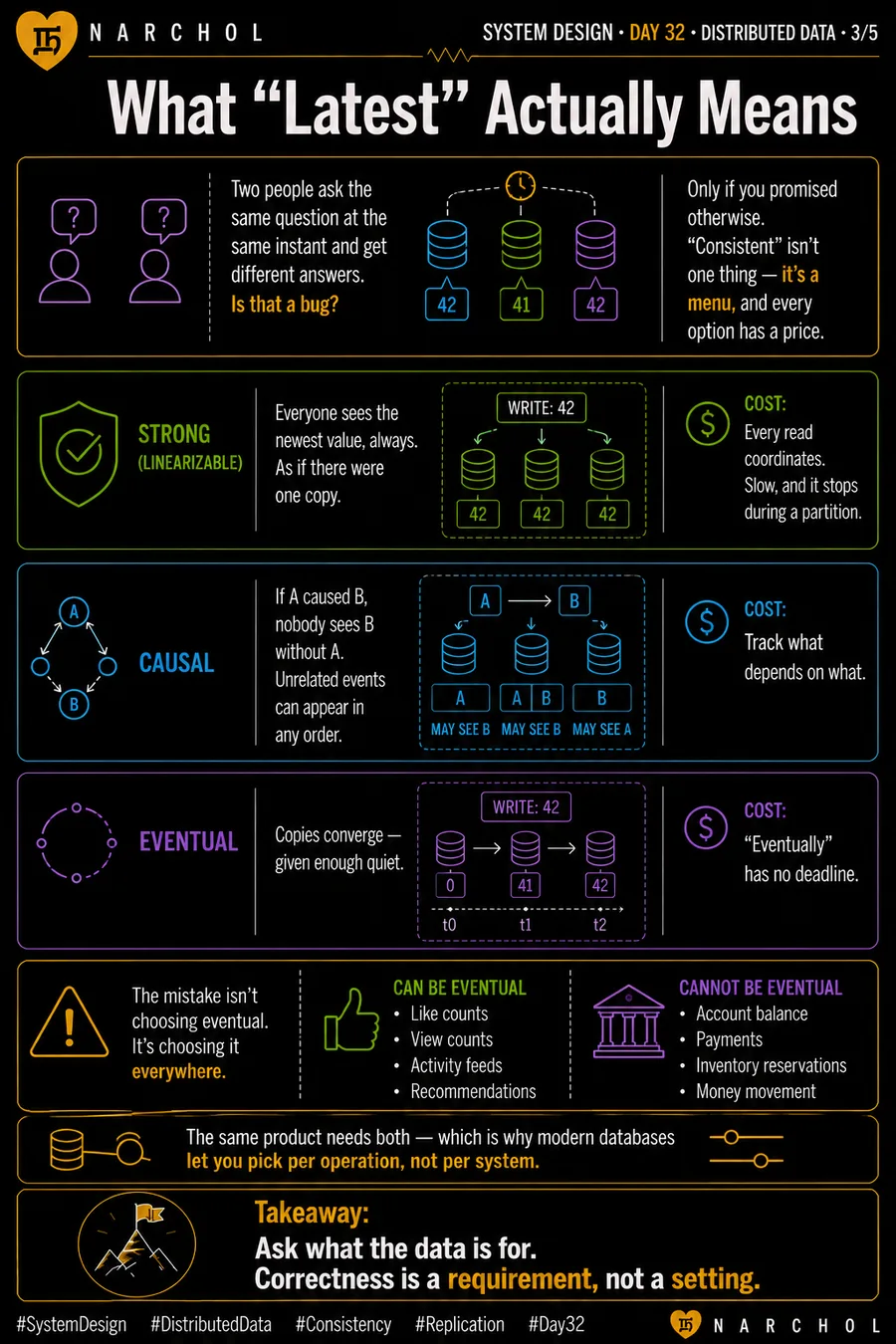
Two people ask the same question at the same instant and get different answers. Whether that counts as a bug depends entirely on what you promised.
Strong consistency — linearizable — means everyone sees the newest value, always, as if there were only one copy. Every read has to coordinate. It is slow, and during a partition it stops.
Causal consistency is weaker and often enough. If A caused B, nobody sees B without A; unrelated events can appear in any order. The cost is bookkeeping — tracking what depends on what.
Eventual consistency promises only that the copies converge, given enough quiet. It is fast and cheap, and "eventually" carries no deadline.
The mistake is rarely choosing eventual. It is choosing it everywhere. Like counts, view counts, activity feeds and recommendations can all sit a few seconds behind and nobody is harmed. Account balances, payments, inventory reservations and money movement cannot.
The same product needs both, which is why modern databases let you pick per operation rather than per system.
Ask what the data is for. Correctness is a requirement, not a setting.