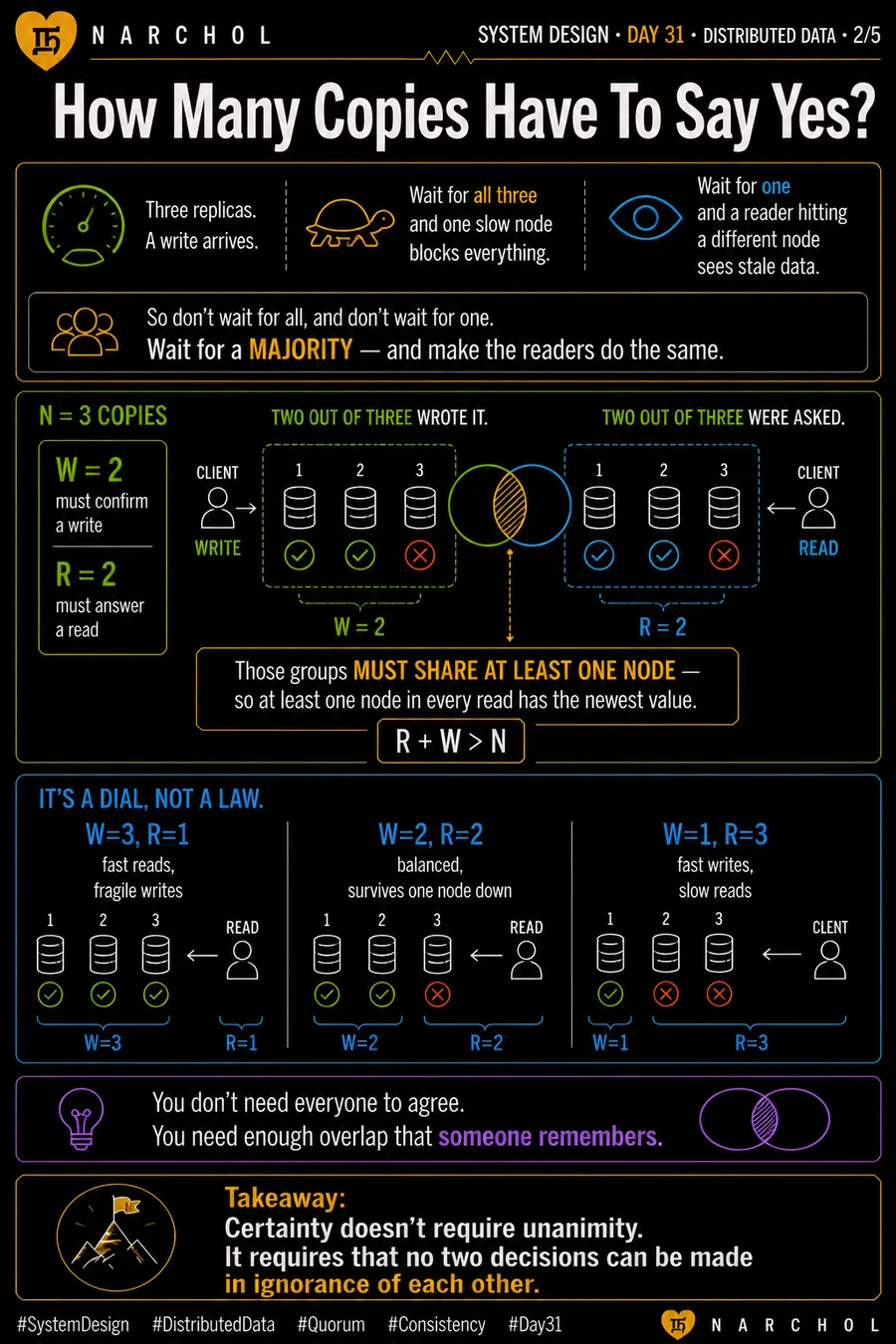
Three replicas, a write arrives, and the only real question is how many of them have to acknowledge it before you tell the client yes.
Wait for all three and one slow node blocks everything. Wait for one and a reader who lands on a different node sees stale data. So the answer sits in the middle — wait for a majority, and make the readers do the same.
Call the replica count N, the writes that must confirm W, the reads that must answer R. Set W=2 and R=2 against N=3 and the two groups cannot avoid each other: any two nodes out of three share at least one member, and that shared node is holding the newest value.
R + W > N is the whole rule. It buys nothing about speed and everything about overlap.
It is also a dial. W=3, R=1 gives fast reads and fragile writes. W=1, R=3 flips it. W=2, R=2 sits in the middle and survives one node going down, which is why most systems land there.
You don't need everyone to agree. You need enough overlap that someone remembers.