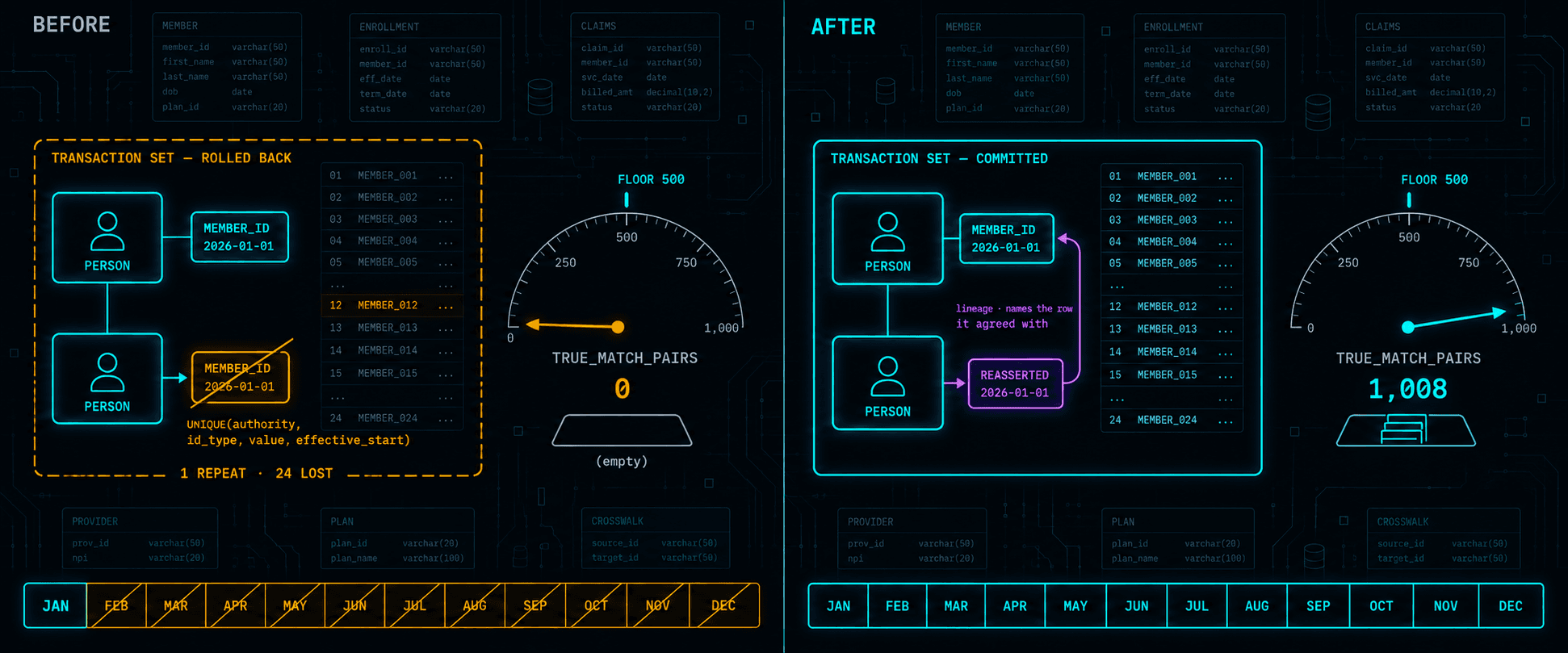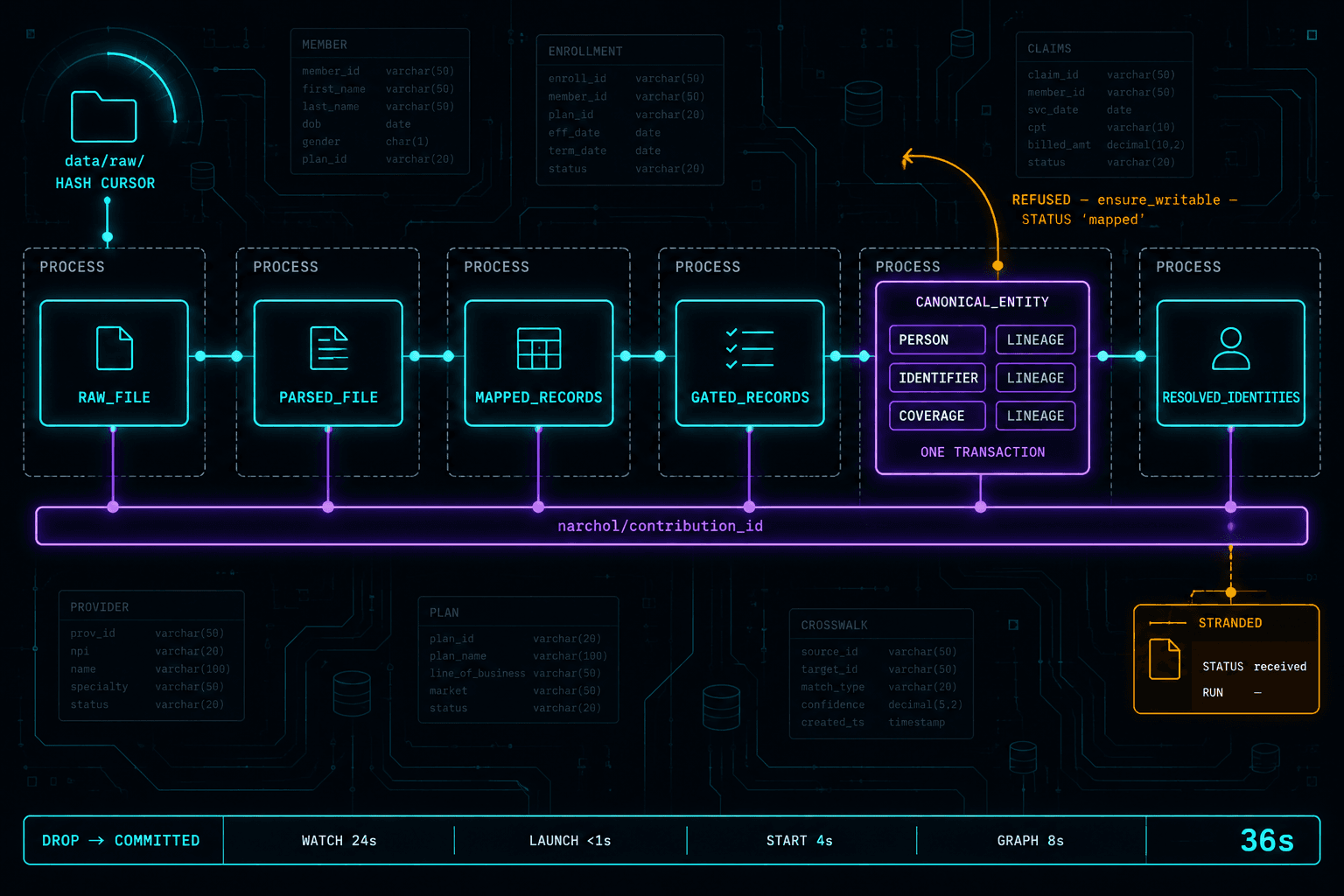
This guide began as an appendix to The Five-Minute Wall. It grew until it was a third of that essay, serving a different reader, and the people it was written for deserved better than an appendix.
Those people are clinicians, operations analysts, care coordinators, enrollment specialists — anyone who works inside healthcare and keeps hearing that AI agents are coming for their workflow, usually from someone who has never seen their workflow. The current on-ramp tells them to learn Python, pick a framework — LangChain, LlamaIndex, CrewAI — and start building. That sequence filters out exactly the people whose judgment matters most. A gastroenterologist who has seen ten thousand colonoscopies knows things about clinical workflow that no engineer can Google. A nurse who has processed a thousand medication reconciliations knows where the system breaks in ways that no demo environment reproduces.
The scarce ingredient in agentic AI for healthcare is the person who knows what actually goes wrong at four o'clock on a Friday — and code has never been it. This guide exists so that person can become a credible partner in the conversation without first becoming a programmer.
This is a path, not a syllabus. There are no deadlines, no prescribed hours, and no expectation that you finish it. Most people who stall do so because they started with a coding framework tutorial and drowned in orchestration jargon in week one. The sequence below exists to prevent that.
Work through it at whatever pace your schedule allows. Stage 0 alone will already put you ahead of most colleagues in conversations about AI. Many of you will stop after Stage 1 and Stage 3, and that is a perfectly good outcome. Nothing here requires you to become a programmer.
| Stage | What it is | Coding needed |
|---|---|---|
| 0 | Concepts and vocabulary | None |
| 1 | Structured beginner courses | Basic Python for some |
| 2 | Vendor documentation | Yes |
| 3 | Healthcare IT foundations | None to minimal |
| 4 | Where agents meet medicine | None |
Stages 3 and 4 can be read at any point. If your interest is clinical and strategic rather than technical, start there.
Stage 0 — Get the Mental Model First
No code, no accounts, no cost.
Anthropic, "Building Effective Agents" — anthropic.com/engineering/building-effective-agents
The best single starting read. It draws the distinction that resolves most confusion: workflows orchestrate models and tools through predefined code paths, while agents let the model direct its own process and tool use. Its central advice is deliberately unglamorous — start with the simplest thing that works and add complexity only when it earns its place. Read this before anything a vendor sends you.
Anthropic Academy — claude.com/resources/courses
Free, official, self-paced, with completion certificates. Several courses require no coding at all. Begin with Claude 101, then AI Fluency: Framework & Foundations — the latter is co-developed with academic partners and focuses on when to delegate to AI and when human judgment cannot be replaced. That framing translates unusually well to clinical practice.
Model Context Protocol (MCP) — modelcontextprotocol.io
How agents connect to real systems — which in healthcare means hospital systems. The standard analogy is a USB-C port for AI applications: one consistent way to connect a model to data sources, tools, and workflows. Now an open-source project hosted by the Linux Foundation rather than any one company's property.
Stage 1 — Structured Courses
Pick one and finish it. Finishing one course beats starting four.
Hugging Face Agents Course — huggingface.co/learn — Free and certified. Five units: introduction, LangGraph, LlamaIndex, smolagents, plus a bonus unit on observability and evaluation. Teaches three competing frameworks side by side rather than promoting one — a good neutral starting point. Assumes basic Python. Realistically 20–30 hours.
Microsoft, AI Agents for Beginners — github.com/microsoft/ai-agents-for-beginners — Free, MIT-licensed, 18 lessons. Each lesson has a README, a short video, and Python samples. Better if you prefer reading to watching.
Google × Kaggle 5-Day AI Agents Intensive — Watch kaggle.com for the next cohort. Over 1.5 million learners in its first run. Covers agents, tools, MCP, context engineering, memory, agent quality, then prototype to production.
DeepLearning.AI — deeplearning.ai/short-courses — Roughly 90 minutes each. Andrew Ng's longer Agentic AI course (~10 hours) is free to audit. Good if you want to dip in rather than commit.
LangChain Academy — academy.langchain.com — Covers LangGraph for stateful multi-agent workflows and LangSmith for monitoring. Useful once you have something running.
Stage 2 — Vendor Documentation (When You Want to Build)
Look at more than one. The abstractions differ, and comparing them teaches you what's essential versus what's marketing.
Anthropic — docs.claude.com — API, tool use, and the Agent SDK.
AWS Bedrock AgentCore — docs.aws.amazon.com/bedrock-agentcore — The "how does it survive production" layer: managed runtime, memory, gateway, code interpreter, observability. Its emphasis on operational concerns is precisely the part healthcare deployments live or die on.
Google, Microsoft, and OpenAI each publish equivalent documentation and SDKs. If your institution already runs on a particular cloud, start there — but read at least one other so you can tell a genuine capability from a proprietary feature.
Stage 3 — Healthcare IT Foundations
This is where you are genuinely scarce. Many people can build an agent. Very few understand clinical workflow, consent, documentation burden, and how care actually gets delivered. If you only have limited time, spend it here rather than on frameworks.
HL7 and FHIR — hl7.org/training — FHIR Fundamentals is a four-week online course pitched partly at architects and project leads. Free supporting material at ecqi.healthit.gov/fhir/education.
Ayushman Bharat Digital Mission (ABDM) — abdm.gov.in — Directly relevant if you work in India. ABHA for patients, HPR for professionals, HFR for facilities, plus a consent manager mediating health information exchange. Records exchanged as FHIR bundles using an India-specific implementation guide.
AMIA — amia.org — The professional home for clinical informatics. Worth knowing that clinical informatics is a formal ACGME-accredited subspecialty — a real career path if this becomes more than curiosity.
Stage 4 — Where AI Agents Meet Medicine
npj Digital Medicine — scoping review of agentic AI in healthcare — nature.com/articles/s41746-026-02517-5 — Seven eligible studies. One with patients. Read this before you read any vendor's case study. It will change how you hear the next pitch.
Stanford, AI in Healthcare (Coursera) — coursera.org/specializations/ai-healthcare — Free to enrol, CME-accredited. Designed for both clinicians and computer science professionals.
Staying current without drowning: NEJM AI and its Grand Rounds podcast. JAMA email alerts. Healthcare IT News and Becker's Health IT. The FDA's AI/ML-enabled medical devices list — over a thousand authorisations by early 2026, mostly 510(k) clearances concentrated in radiology. Four consistent sources will keep you better informed than fifteen inconsistent ones.
Cautions
Never put patient data into a consumer AI tool. Not Claude, not ChatGPT, not Gemini — and not "just the history with the name removed." Re-identification from clinical narrative is easier than most clinicians assume. If you want to work with real data, you need an enterprise or BAA-covered tier, with your IT department and data protection officer involved from the start.
Practise on synthetic or fully de-identified data. Your own de-identified notes are not a safe substitute without formal governance sign-off.
Your institution's policy overrides this guide. Check before using any tool for anything clinical or clinical-adjacent.
Clinical responsibility does not transfer to a tool. Anything that reaches a patient record, a referral, or a prescription is your output and your accountability, however it was generated.
Agents fail fluently. A confident, well-formatted, entirely wrong answer is the characteristic failure mode. Anything you build needs a verification step.
The evidence base is thin. Seven studies, one with patients. Enthusiasm is reasonable; certainty is not.
This guide will go stale. It reflects August 2026. Verify before relying on anything here. The concepts age better than the tooling does.
If You Want to Build Something
Reading about agents doesn't make them stick. Build one small thing:
- An agent that reads a folder of specialty guidelines and answers questions with citations back to the source document
- One that turns unstructured referral letters into a structured summary against a fixed template
- One that drafts a patient-friendly explanation of a procedure at a specified reading level
Synthetic or fully de-identified data only. Keep it off any clinical system. The goal is understanding how these things behave and where they break — not a product.
Why This Is Worth Your Time
Every stage above serves one outcome: when a vendor demos an agent against your workflow, you can ask the question that exposes whether it survives contact with a real Friday afternoon. You know what the demo data conveniently lacked. You know which step of your process exists because of a payer who went bankrupt in 2014, and you can tell when the shiny thing on screen has never heard of it.
None of it asks you to stop being what you already are. The technology is learnable in months; the judgment you bring took a career, and no framework ships with it.
Go at your own pace. There is no race here worth winning.