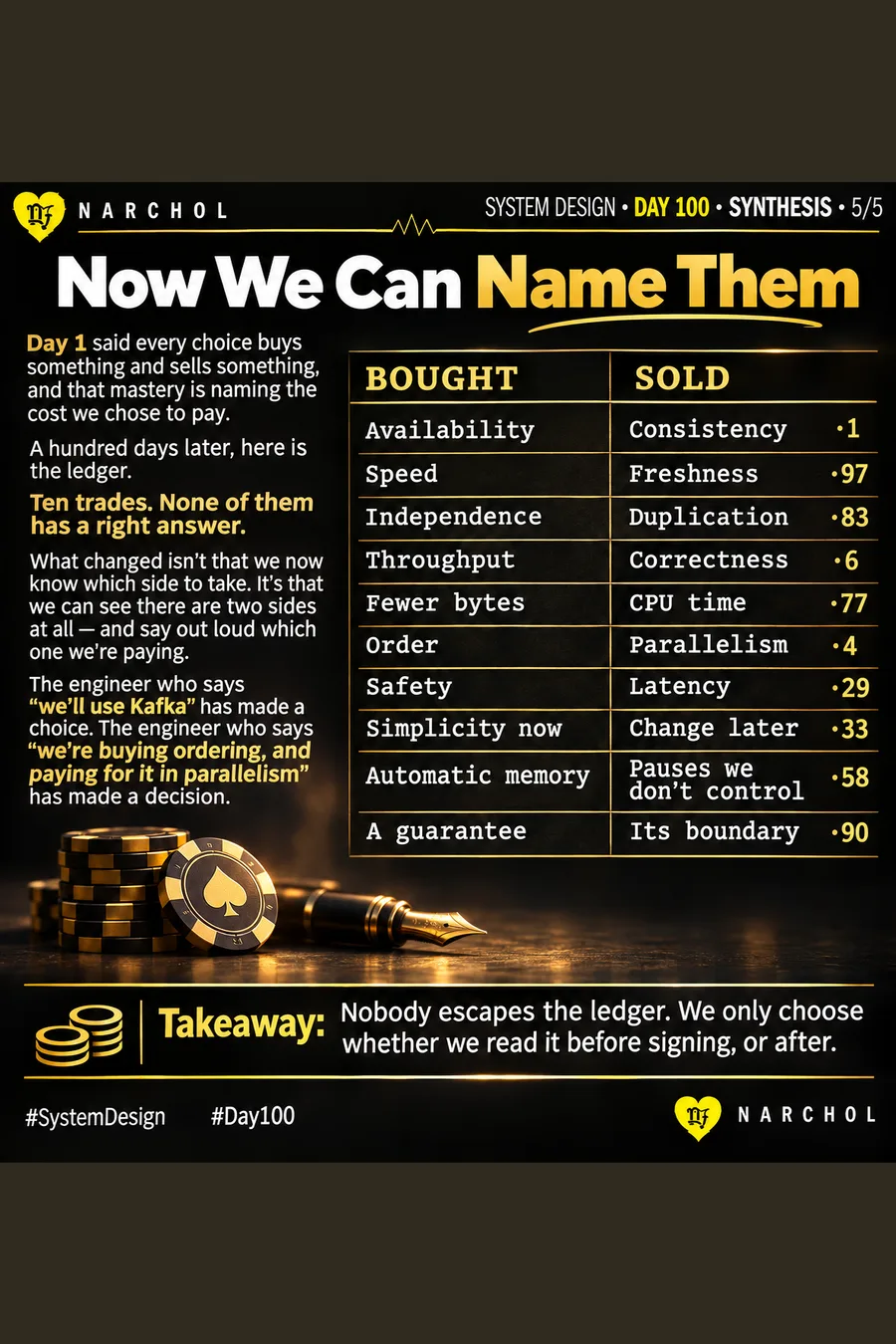
Day 1 said every choice buys something and sells something, and that mastery is naming the cost we chose to pay. A hundred days later, here is the ledger.
Availability bought with consistency. Speed with freshness. Independence with duplication. Throughput with correctness. Fewer bytes with CPU time. Order with parallelism. Safety with latency. Simplicity now with change later. Automatic memory with pauses we don't control. A guarantee with the width of its boundary.
Ten trades, and not one of them has a right answer. What changed over a hundred days isn't that we now know which side to take. It's that we can see there are two sides at all — and say out loud which one we're paying.
The engineer who says "we'll use Kafka" has made a choice. The engineer who says "we're buying ordering, and paying for it in parallelism" has made a decision: something that can be argued with, corrected, or held to a year later when the bill arrives.
That difference is what the hundred days were for.
Nobody escapes the ledger. We only choose whether we read it before signing, or after.