Macular degeneration takes the centre of vision from more than five million people. The photoreceptors die; the nerve cells behind them, the ones that carry signal onward to the brain, mostly survive.
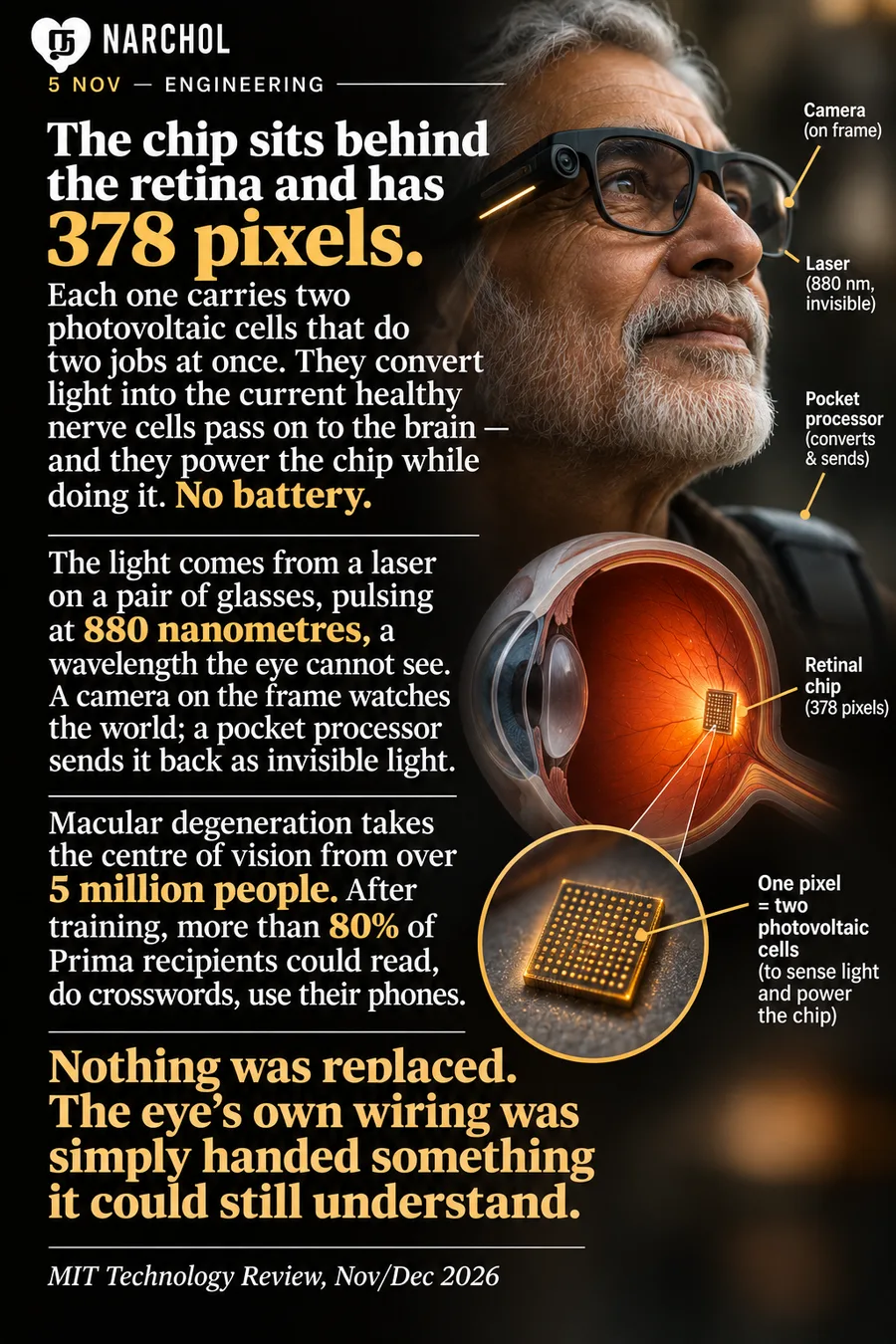
The Prima implant sits behind the retina and has 378 pixels. Each one carries two photovoltaic cells doing two jobs at once — converting light into the current those surviving nerve cells already know how to read, and powering the chip while doing it. No battery, no wire through the wall of the eye.
The light comes from a laser mounted on a pair of glasses, pulsing at 880 nanometres, a wavelength the eye cannot see. A camera on the frame watches the world and a processor in the pocket sends the scene back as invisible light.
After training, more than 80% of recipients could read again. Crosswords, phone screens, letters.
Three hundred and seventy-eight pixels is a tiny number, and it was never asked to be a retina. It only had to speak a language the remaining cells still understood.
Nothing was replaced. The eye's own wiring was simply handed something it could still understand.