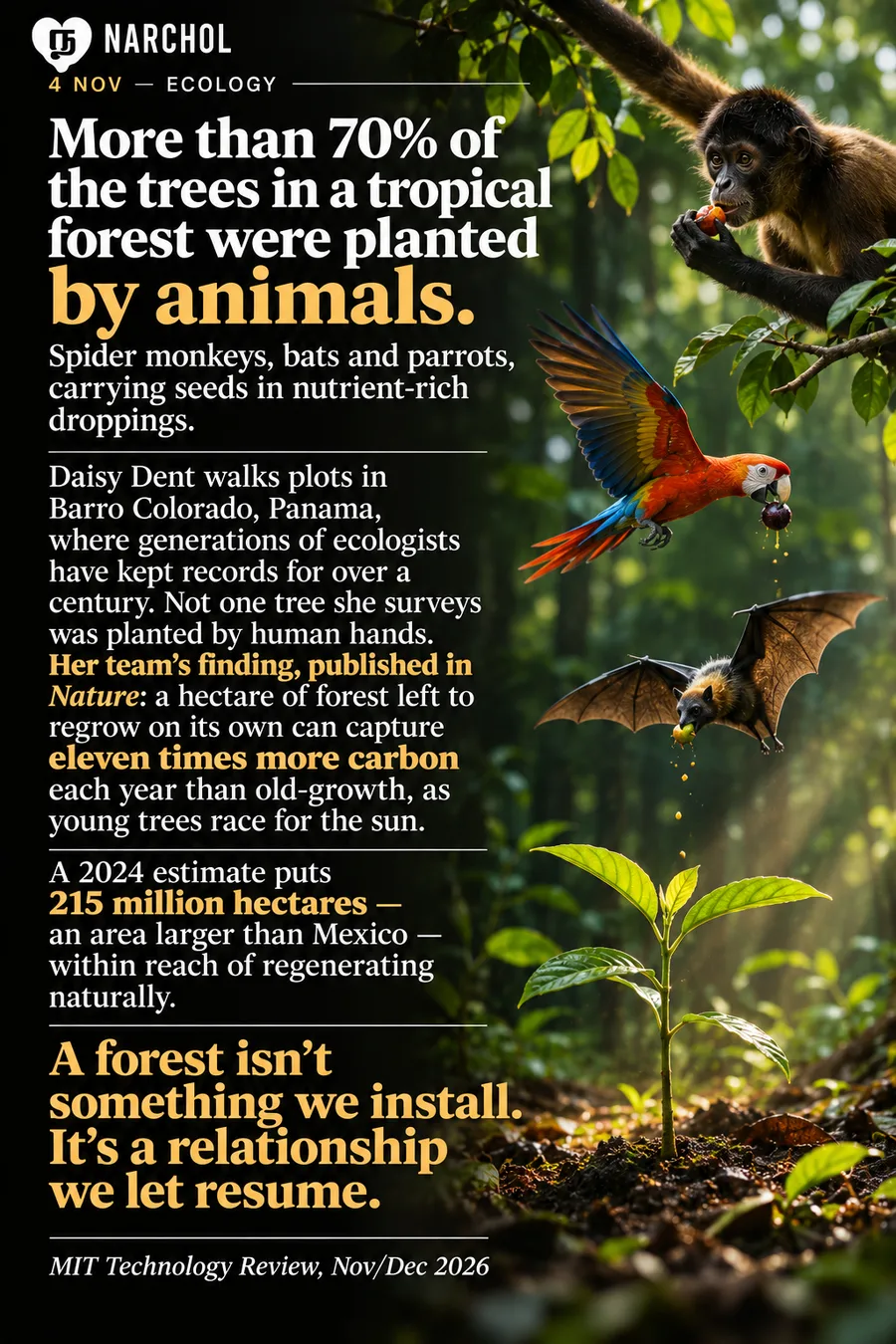
More than 70% of the trees in a tropical forest were planted by animals. Spider monkeys, bats and parrots eat fruit, carry the seed some distance away, and deliver it in a packet of fertiliser.
Daisy Dent walks survey plots on Barro Colorado in Panama, where generations of ecologists have kept records for over a century. Not one tree she surveys was planted by a human hand.
Her team's finding, published in Nature: a hectare of forest left to regrow on its own can capture eleven times more carbon each year than the old-growth beside it. Young trees race for the sun, racing is expensive, and the expense is paid in carbon pulled out of the air.
A 2024 estimate puts 215 million hectares — an area larger than Mexico — within reach of regenerating naturally. No seedlings, no planting crews, no survival rates to report at the end of the quarter.
What it needs is the seed carriers still being there, and the land left alone long enough for them to work. Both are harder to fund than a photograph of someone holding a sapling.
A forest isn't something we install. It's a relationship we let resume.