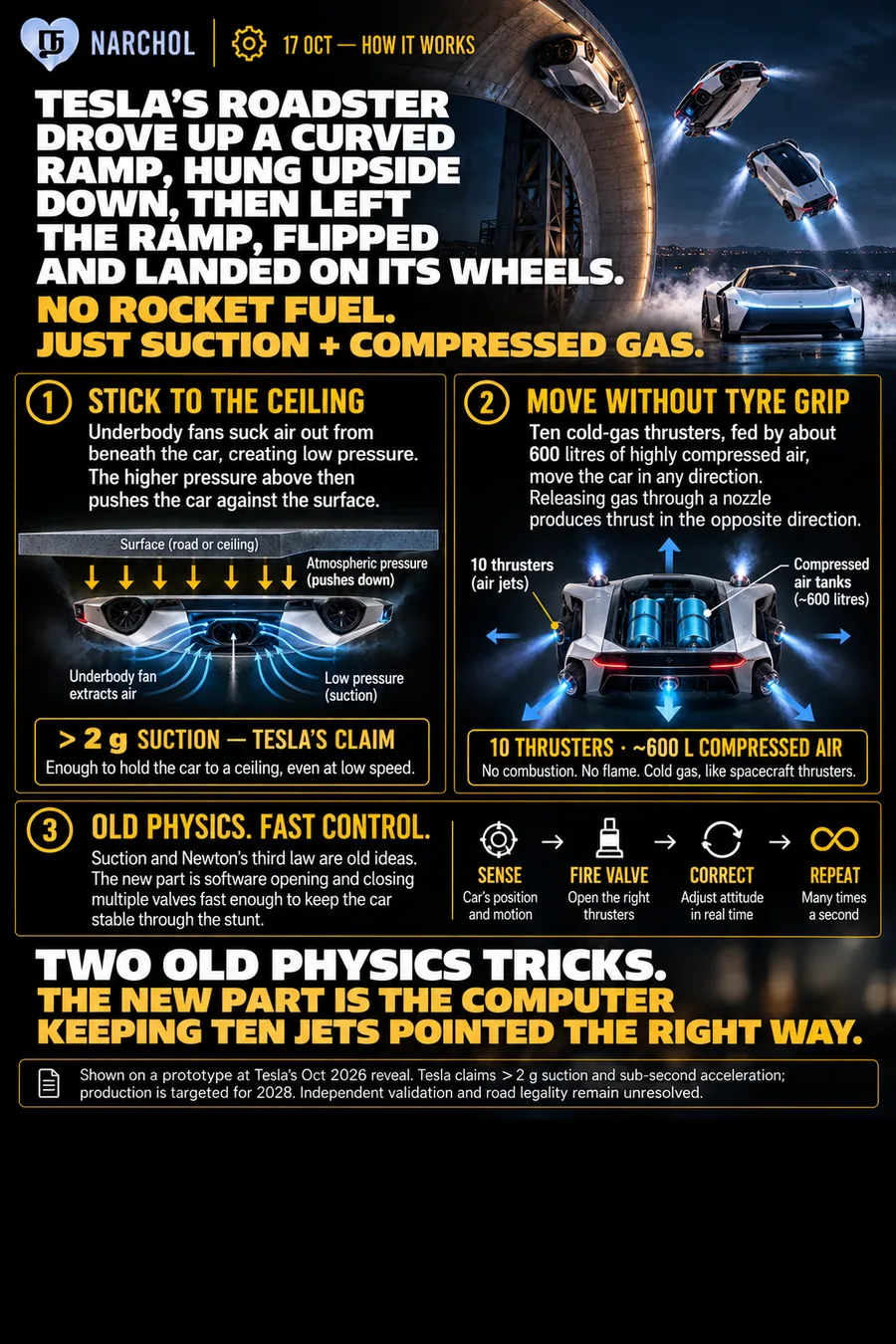
Tesla's Roadster drove up a curved ramp, hung upside down, left the ramp, flipped and landed on its wheels. No rocket fuel. Just suction and compressed gas.
Sticking to the ceiling comes down to pressure. Underbody fans suck air out from beneath the car, and the higher pressure above pushes it against the surface. Tesla claims more than 2g of suction — enough to hold the car to a ceiling even at low speed.
Moving once the tyres have nothing to push against is Newton's third law. Ten cold-gas thrusters, fed by about 600 litres of highly compressed air, release gas through nozzles and produce thrust in the opposite direction. No combustion, no flame — the same idea spacecraft use to hold their attitude.
Both of those ideas are old. The new part is software: sensing the car's position and motion, opening the right valve, correcting attitude, and doing it again many times a second.
Worth keeping the caveats attached. This was a prototype at Tesla's October 2026 reveal. The 2g figure and the sub-second acceleration are Tesla's own claims, production is targeted for 2028, and independent validation and road legality remain unresolved.
Two old physics tricks. The new part is the computer keeping ten jets pointed the right way.