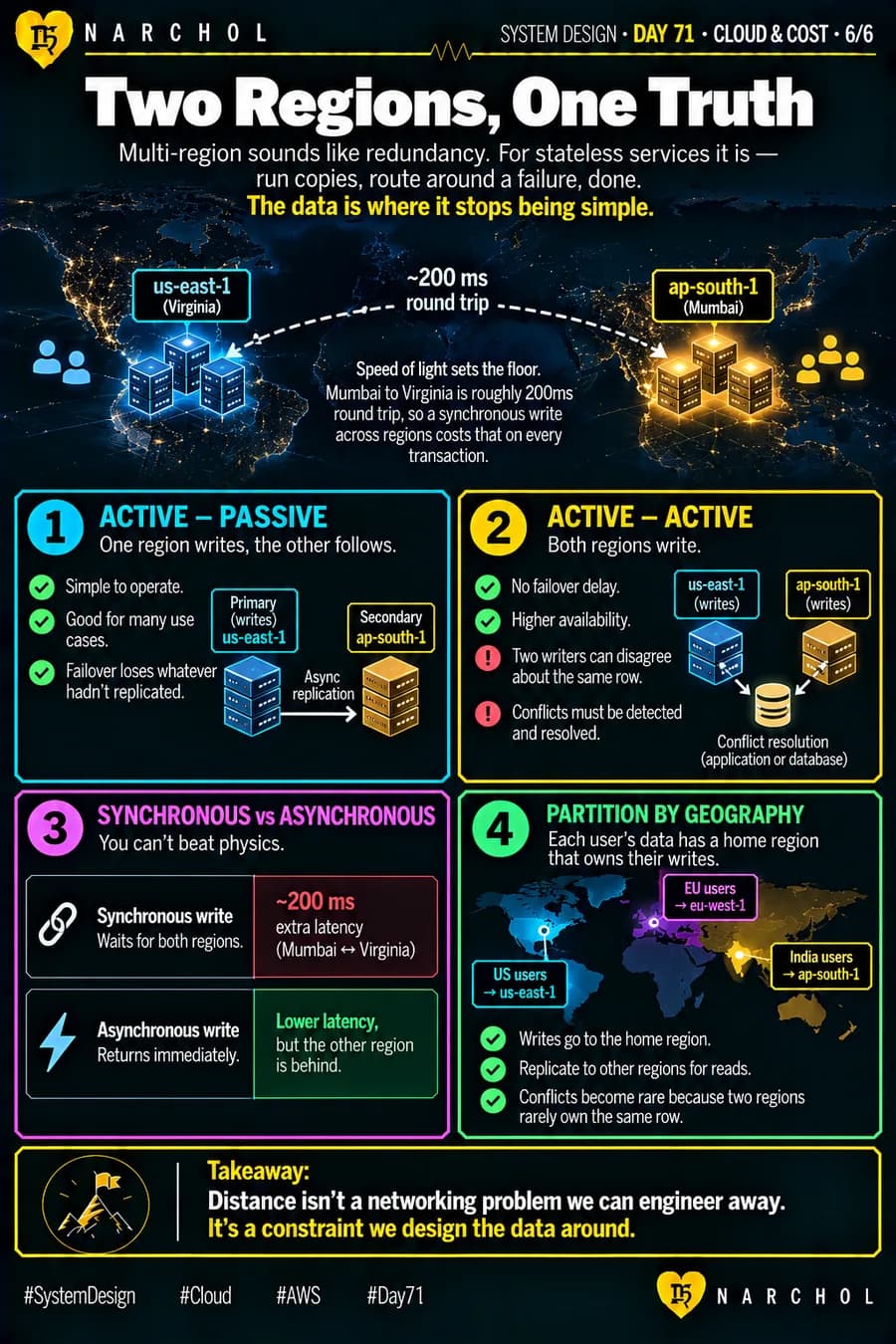
Multi-region sounds like redundancy, and for stateless services it is — run copies, route around a failure, done. The data is where it stops being simple.
Mumbai to Virginia is roughly 200ms round trip, and the speed of light sets that floor. A synchronous write across both regions pays it on every single transaction.
So the real choice is which compromise to live with. Active-passive has one region writing and the other following: simple to operate, good for many use cases, and failover loses whatever hadn't replicated yet. Active-active removes the failover delay and introduces a harder problem — two writers can disagree about the same row, and something has to detect and resolve that, in the application or in the database.
The third option sidesteps most of it. Give every user's data a home region that owns their writes, replicate elsewhere for reads, and conflicts become rare because two regions rarely own the same row.
Distance isn't a networking problem we can engineer away. It's a constraint we design the data around.