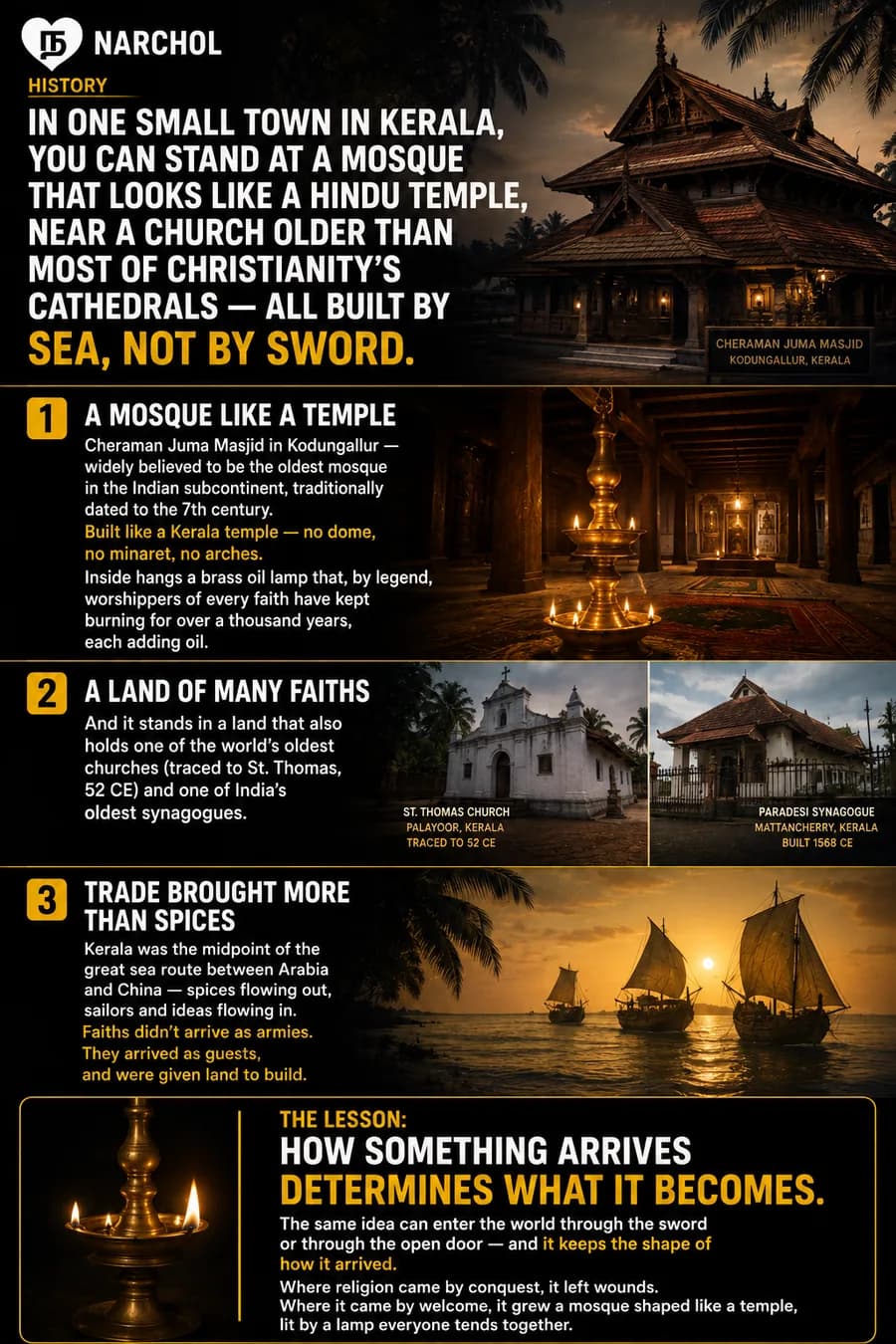
You can stand at a mosque that looks like a Hindu temple, near a church older than most of Christianity's cathedrals.
A mosque like a temple. Cheraman Juma Masjid in Kodungallur — widely believed to be the oldest mosque in the Indian subcontinent, traditionally dated to the 7th century. Built like a Kerala temple: no dome, no minaret, no arches. Inside hangs a brass oil lamp that, by legend, worshippers of every faith have kept burning for over a thousand years, each adding oil.
A land of many faiths. It stands in a land that also holds one of the world's oldest churches — St Thomas Church at Palayoor, traced to 52 CE — and one of India's oldest synagogues, the Paradesi Synagogue at Mattancherry, built in 1568.
Trade brought more than spices. Kerala was the midpoint of the great sea route between Arabia and China — spices flowing out, sailors and ideas flowing in. Faiths didn't arrive as armies. They arrived as guests, and were given land to build.
The same idea can enter the world through the sword or through the open door — and it keeps the shape of how it arrived. Where religion came by conquest, it left wounds. Where it came by welcome, it grew a mosque shaped like a temple, lit by a lamp everyone tends together.