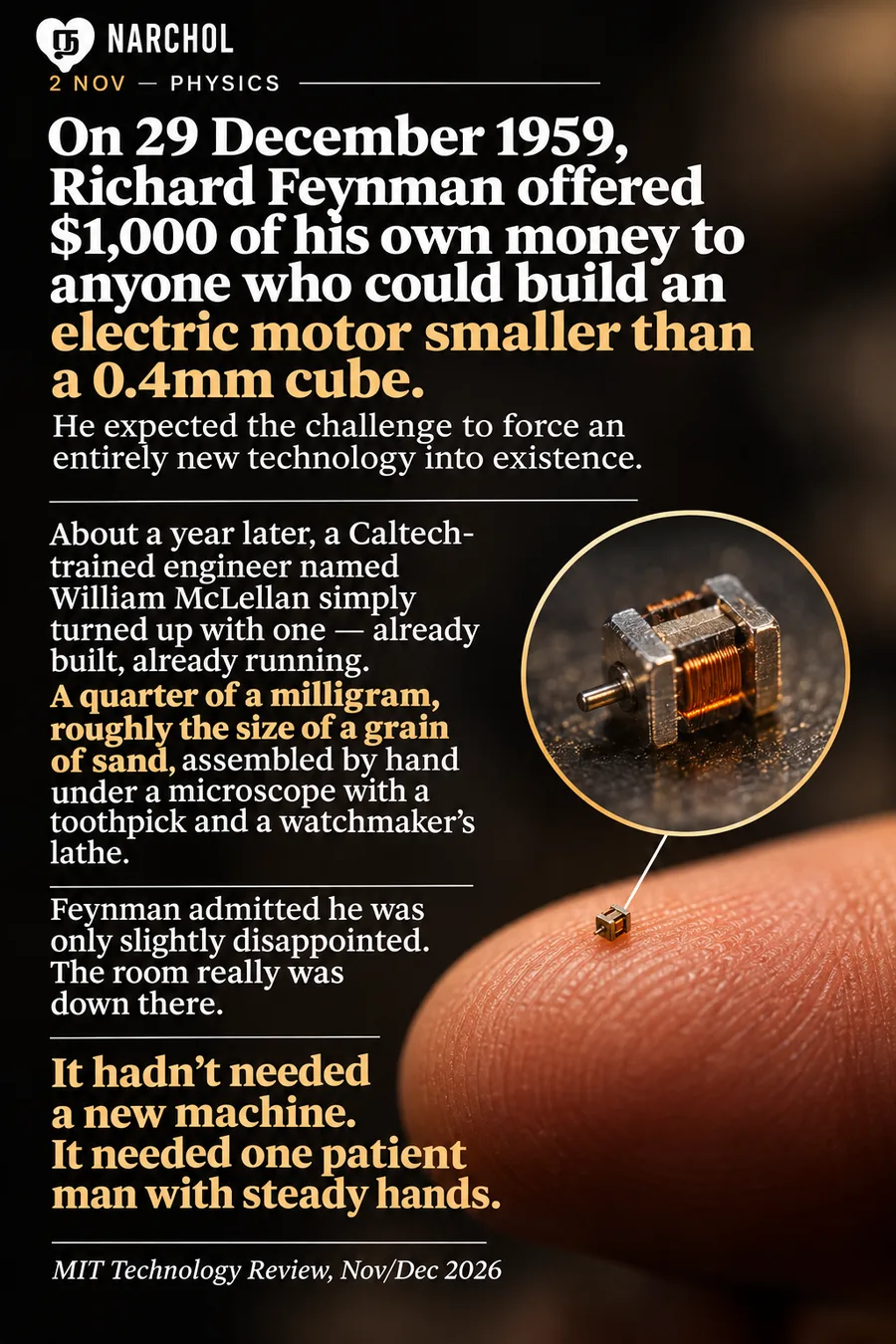
On 29 December 1959, Richard Feynman stood up in front of the American Physical Society and offered a thousand dollars of his own money to anyone who could build a working electric motor smaller than a 0.4mm cube.
He was not trying to fund a product. He expected the prize to sit unclaimed for years while somebody invented an entirely new way of making things — micro-machining, remote manipulators, a whole tier of tooling that did not exist yet.
About a year later a Caltech-trained engineer named William McLellan turned up at his office with a motor in a box. Already built, already running. A quarter of a milligram, roughly the size of a grain of sand, assembled by hand under a microscope with a toothpick and a watchmaker's lathe.
Feynman paid, and admitted he was only slightly disappointed. The room at the bottom really was down there, and reaching it had needed no new physics at all.
What the challenge ended up measuring was patience — steady hands, a magnifier, and the willingness to spend months on an object almost nobody would ever see.
It hadn't needed a new machine. It needed one patient man with steady hands.