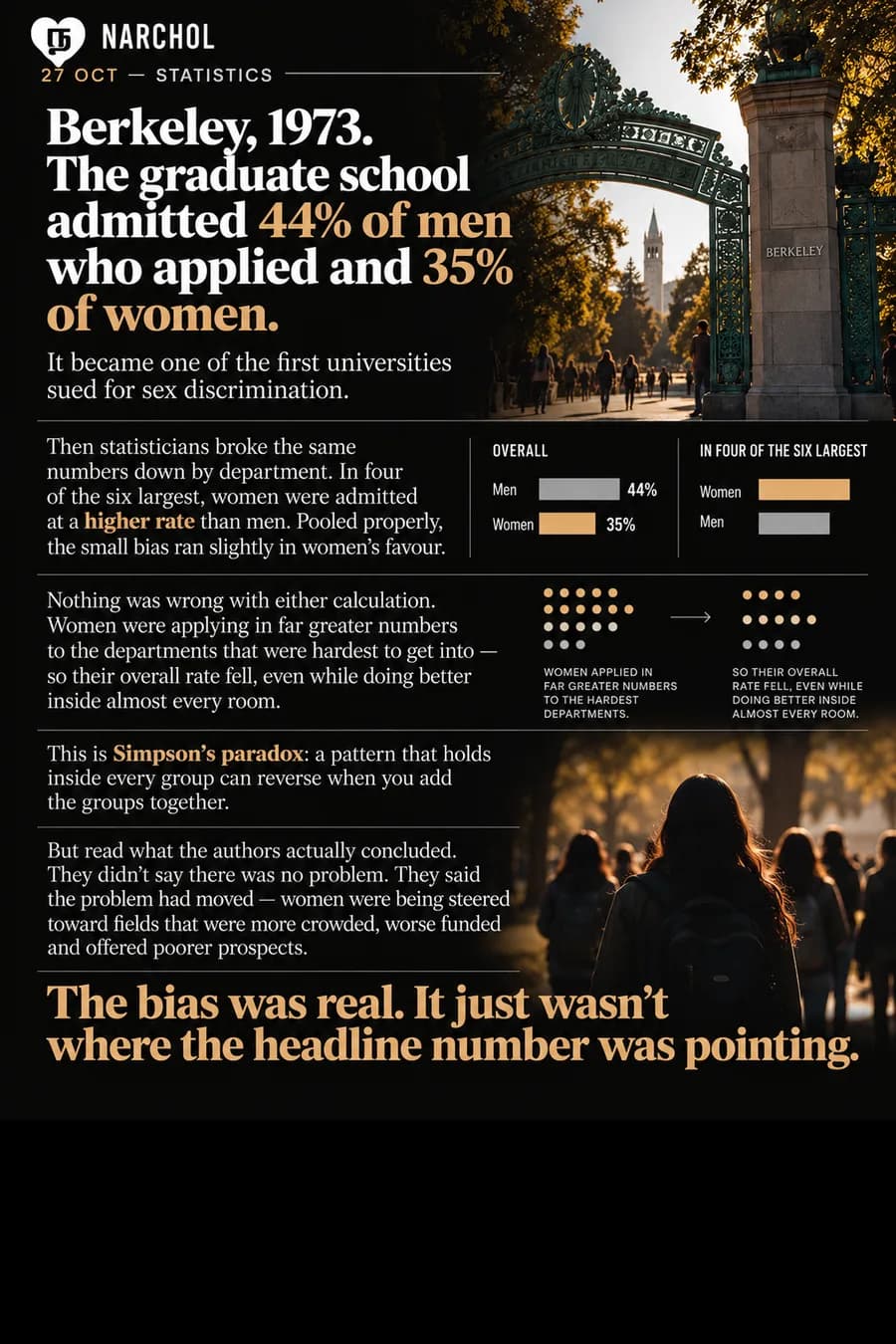
In 1973 Berkeley's graduate school admitted 44 percent of the men who applied and 35 percent of the women. It became one of the first universities sued for sex discrimination.
Then statisticians broke the same numbers down by department. In four of the six largest, women were admitted at a higher rate than men. Pooled properly, the small bias ran slightly in women's favour.
Nothing was wrong with either calculation. Women were applying in far greater numbers to the departments that were hardest to get into, so their overall rate fell even while they did better inside almost every room.
This is Simpson's paradox: a pattern that holds inside every group can reverse when the groups are added together.
The authors' own conclusion is the part that usually gets dropped. They said the problem had moved — women were being steered toward fields that were more crowded, worse funded, and offered poorer prospects.
The bias was real. It was somewhere other than where the headline number pointed.