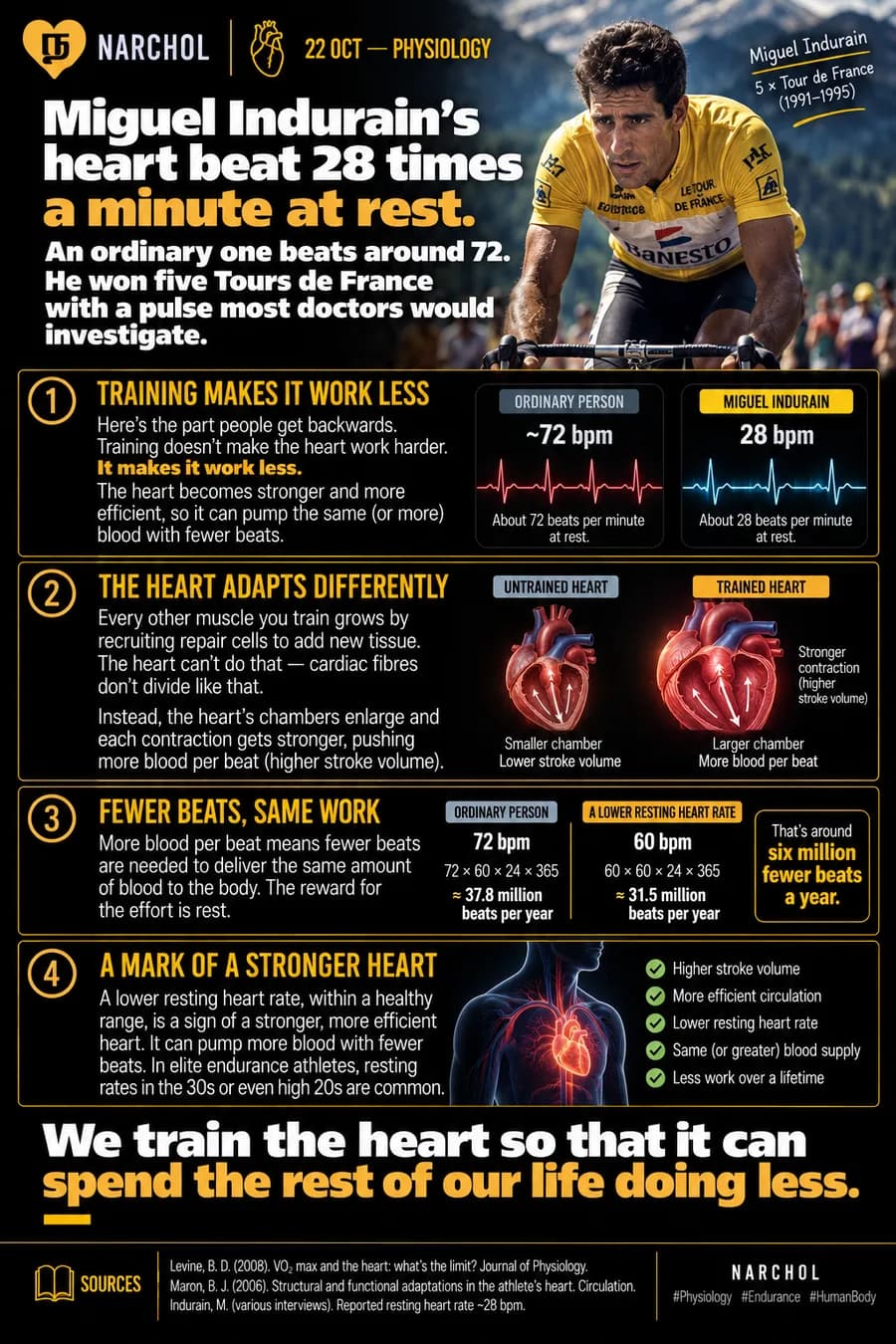
Miguel Indurain's heart beat around 28 times a minute at rest. An ordinary one beats around 72. He won five Tours de France with a pulse most doctors would investigate.
The part people get backwards: training makes the heart work less rather than harder. It becomes stronger and more efficient, moving the same blood — or more — with fewer beats.
It also adapts differently from every other muscle. The others grow by recruiting repair cells to add tissue, which cardiac fibres cannot do. The chambers enlarge instead, and each contraction gets stronger, pushing more blood per beat.
The arithmetic is the reward. At 72 beats a minute a heart beats about 37.8 million times a year. At 60, about 31.5 million. Six million fewer beats, every year, for the same work delivered.
In elite endurance athletes, resting rates in the thirties or even the high twenties are common.
We train the heart so that it can spend the rest of our life doing less.