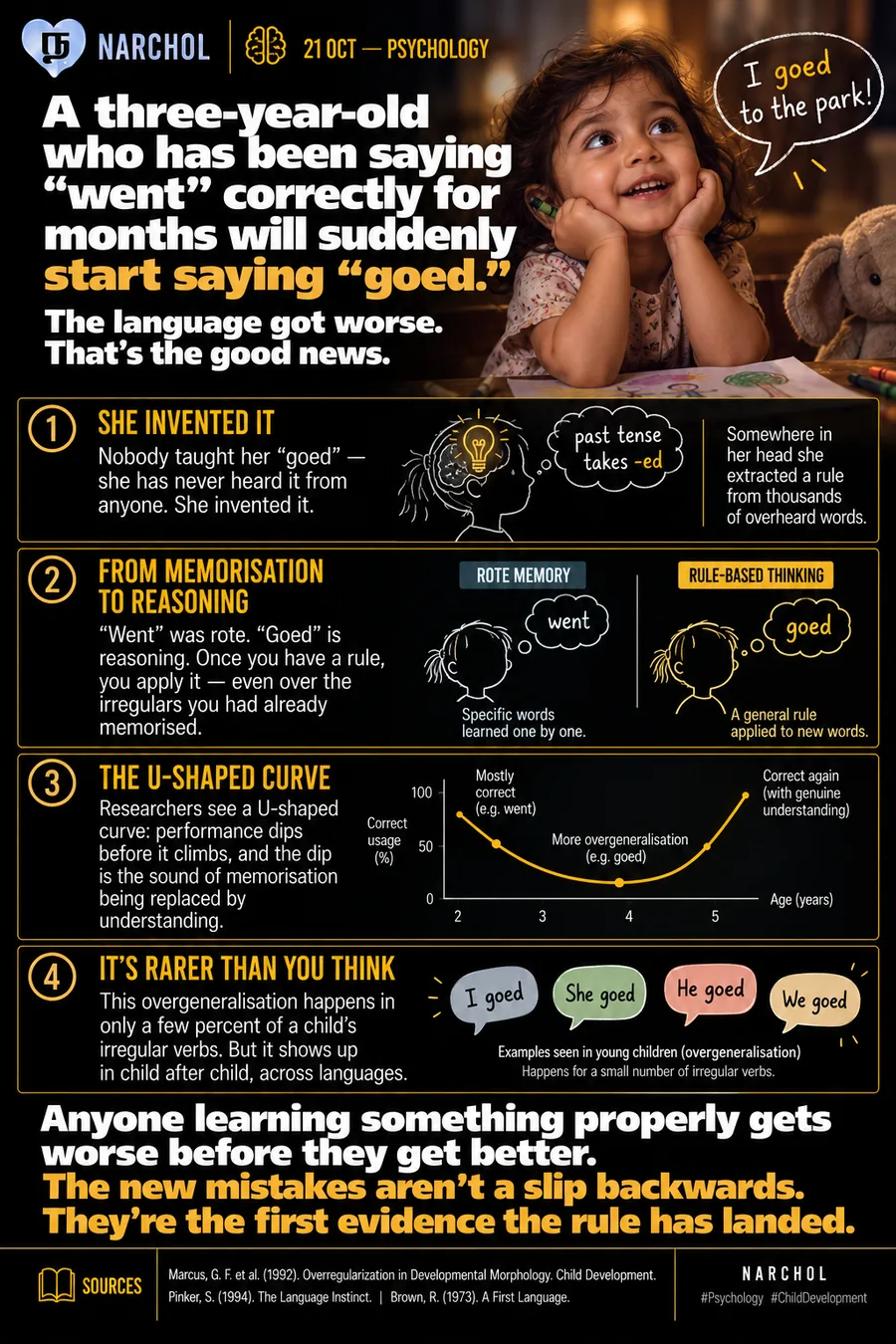
A three-year-old who has been saying "went" correctly for months will suddenly start saying "goed". The language got worse. That is the good news.
Nobody taught her "goed". She has never heard it from anyone. She invented it, by extracting a rule from thousands of overheard words: past tense takes -ed.
"Went" was rote. "Goed" is reasoning. Once you hold a rule you apply it, including over the irregulars you had already memorised one at a time.
Researchers see a U-shaped curve. Correct usage dips before it climbs, and the dip is the sound of memorisation being replaced by understanding. The child comes out the far side correct again, this time with a system underneath it.
It is rarer than the story suggests — only a few percent of a child's irregular verbs — but it shows up in child after child, across languages.
Anyone learning something properly gets worse before they get better. The new mistakes are the first evidence the rule has landed.