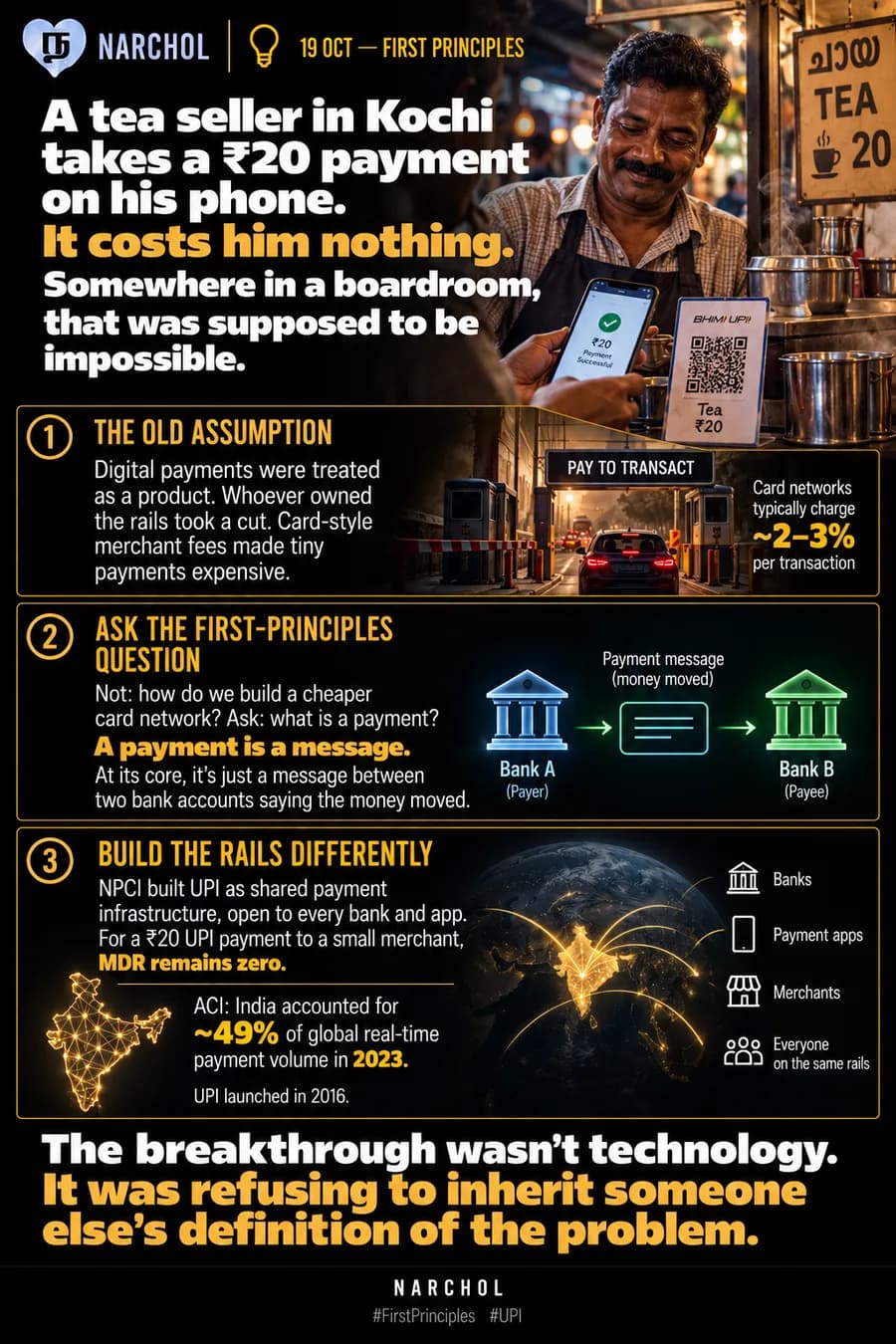
A tea seller in Kochi takes a twenty-rupee payment on his phone. It costs him nothing. Somewhere in a boardroom, that was supposed to be impossible.
The old assumption treated digital payments as a product. Whoever owned the rails took a cut, and card-style merchant fees made tiny payments uneconomic — two to three percent of twenty rupees is not worth collecting, so cash stayed.
The first-principles question skips past how to build a cheaper card network and asks what a payment actually is. At its core it is a message between two bank accounts, saying the money moved.
Build the rails as shared infrastructure rather than a product, open to every bank and every app, and the economics of the whole market change underneath. For a twenty-rupee payment to a small merchant, the merchant discount rate is zero.
India accounted for roughly 49 percent of global real-time payment volume in 2023, from a system launched in 2016.
The breakthrough was refusing to inherit someone else's definition of the problem.