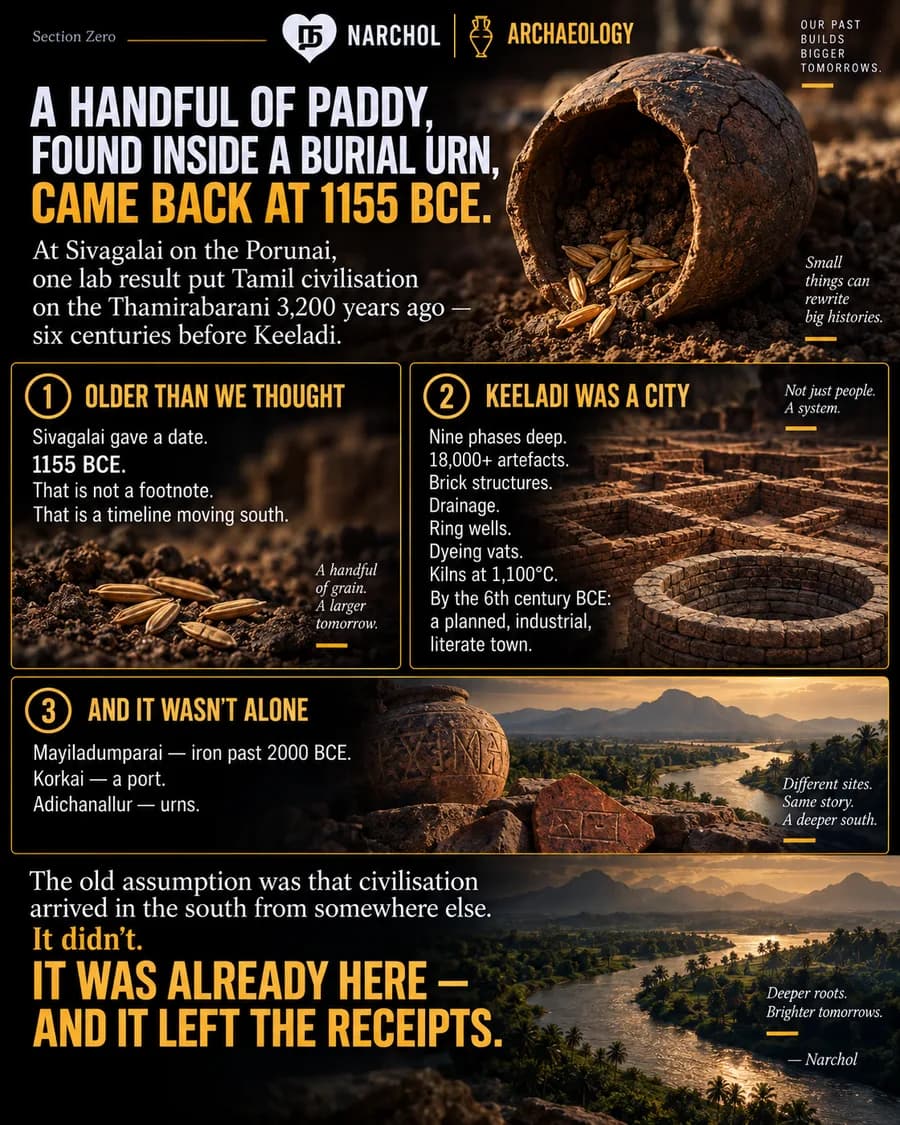
At Sivagalai on the Porunai, archaeologists found a handful of paddy inside a burial urn. The lab put it at 1155 BCE — Tamil civilisation on the Thamirabarani three thousand two hundred years ago, six centuries before Keeladi.
Keeladi itself was never a village. Nine phases deep, more than eighteen thousand artefacts, brick structures, drainage, ring wells, dyeing vats and kilns firing at 1,100°C. By the sixth century BCE it was a planned, industrial, literate town.
It was not alone. Mayiladumparai pushed iron past 2000 BCE. Korkai was a port. Adichanallur gave up its urns. Different sites, the same story, and each one pulls the timeline further south and further back.
The old assumption was that civilisation arrived in the south from somewhere else, carried in by people who already had it.
The old assumption was that civilisation arrived in the south from somewhere else. It was already here, and it left the receipts.