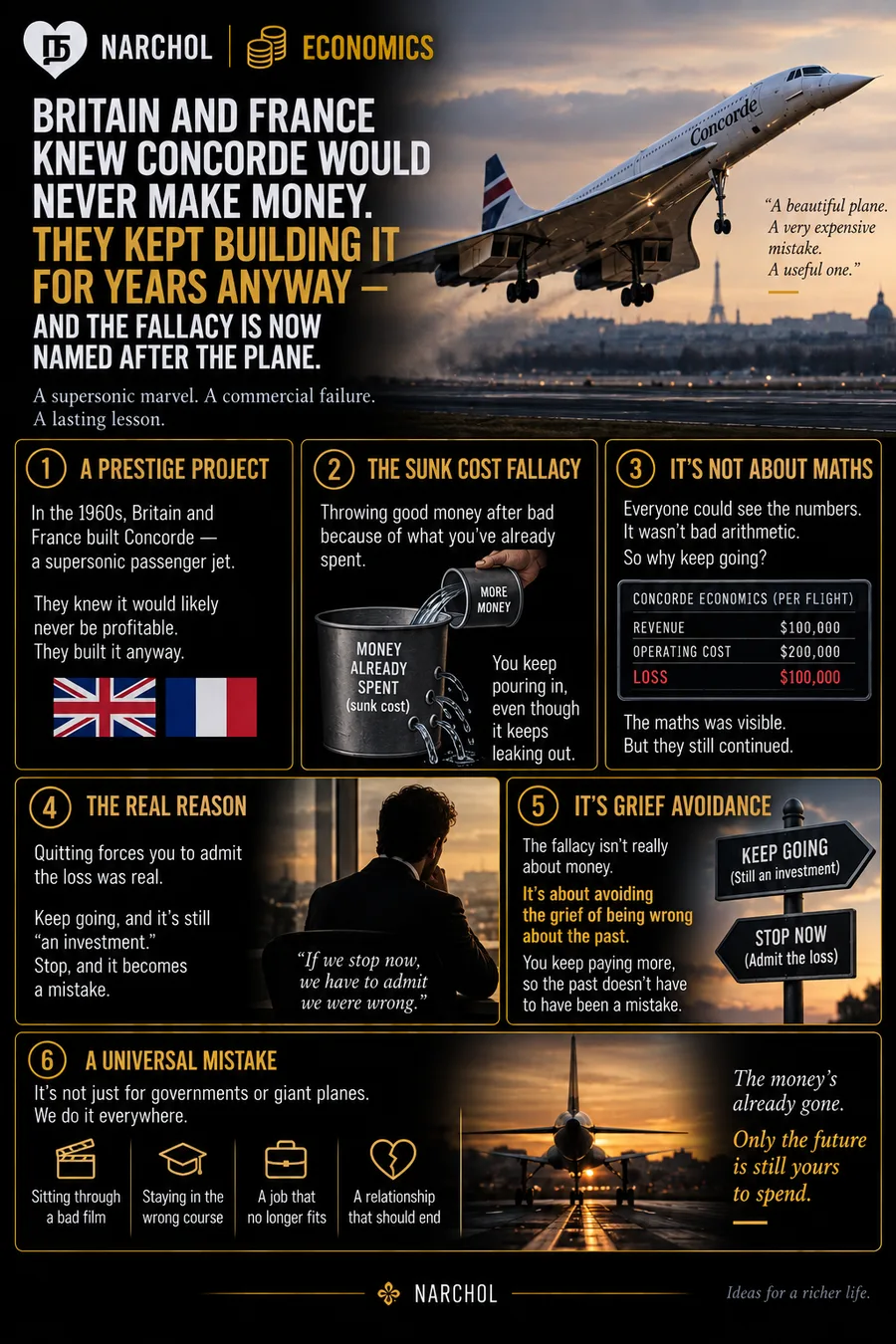
Britain and France knew Concorde would never make money. They kept building it for years anyway, and the fallacy is now named after the plane.
The numbers were never hidden. Around a hundred thousand dollars of revenue per flight against two hundred thousand in operating costs — a loss of a hundred thousand, visible to everyone, every time it flew. Nobody was confused about the arithmetic.
Which is the interesting part, because the sunk cost fallacy gets taught as a reasoning error and it rarely is one. Throwing good money after bad has an emotional job to do. Quitting forces you to admit the loss was real. Keep going and the spending remains an investment; stop and it becomes a mistake. So you pay more, so that the past doesn't have to have been wrong.
Governments and supersonic jets are just the expensive version. Sitting through a bad film. Staying in the wrong course. A job that no longer fits. A relationship that should end.
The money is already gone. Only the future is still yours to spend.