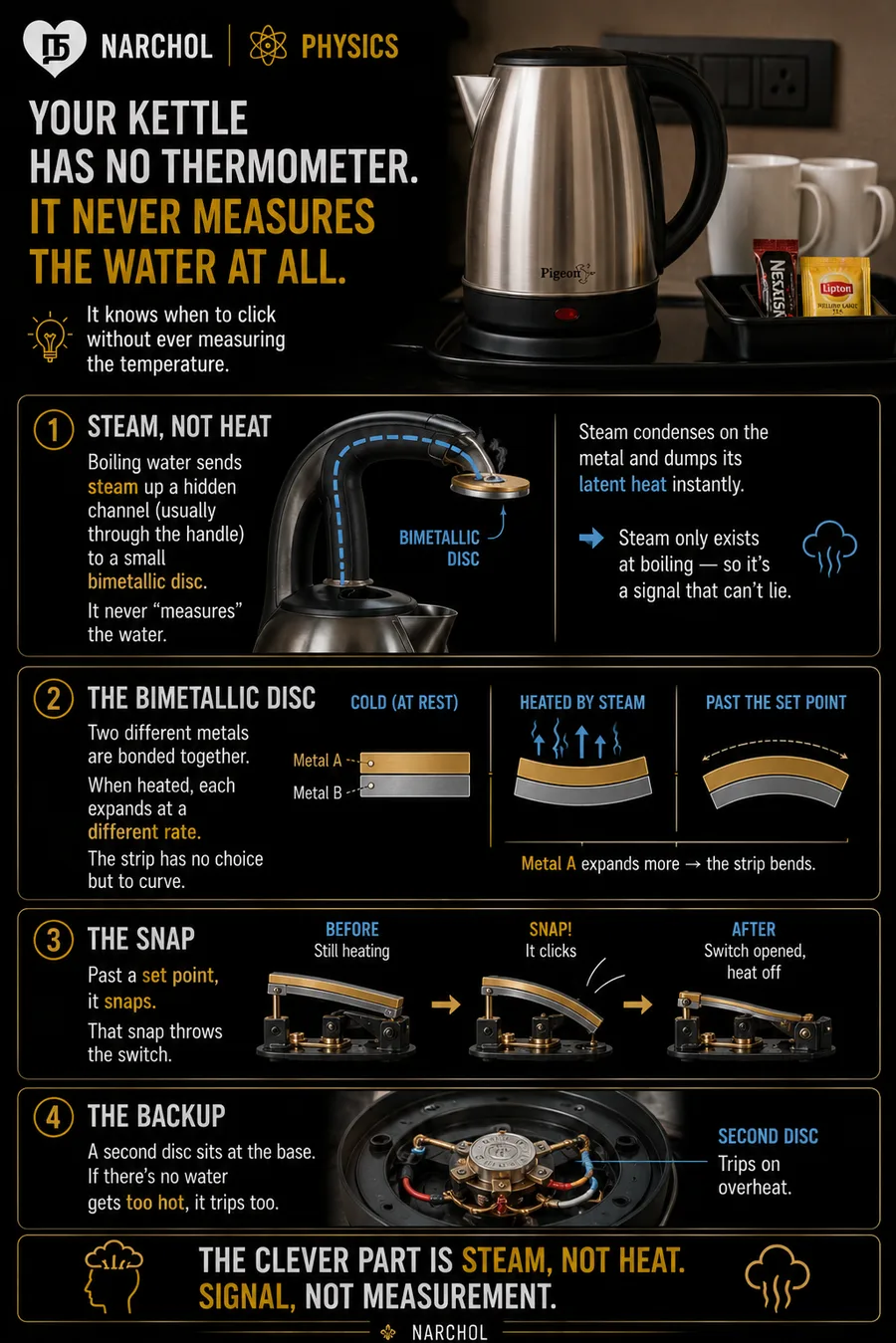
Your kettle has no thermometer. It never measures the water at all, and it still knows exactly when to click.
Boiling water sends steam up a hidden channel — usually through the handle — to a small bimetallic disc near the switch. The steam condenses on the metal and dumps its latent heat instantly. Steam only exists at boiling, which makes it a signal that cannot lie.
The disc is two different metals bonded together. Heated, each expands at a different rate, and a strip bonded along its length has no choice but to curve. Past a set point it snaps, and that snap throws the switch.
A second disc sits at the base for the case nobody plans for — someone switches on an empty kettle, there is no water to cap the temperature, the element runs away. That disc trips on overheat.
The clever part is steam rather than heat: a signal standing in for a measurement.