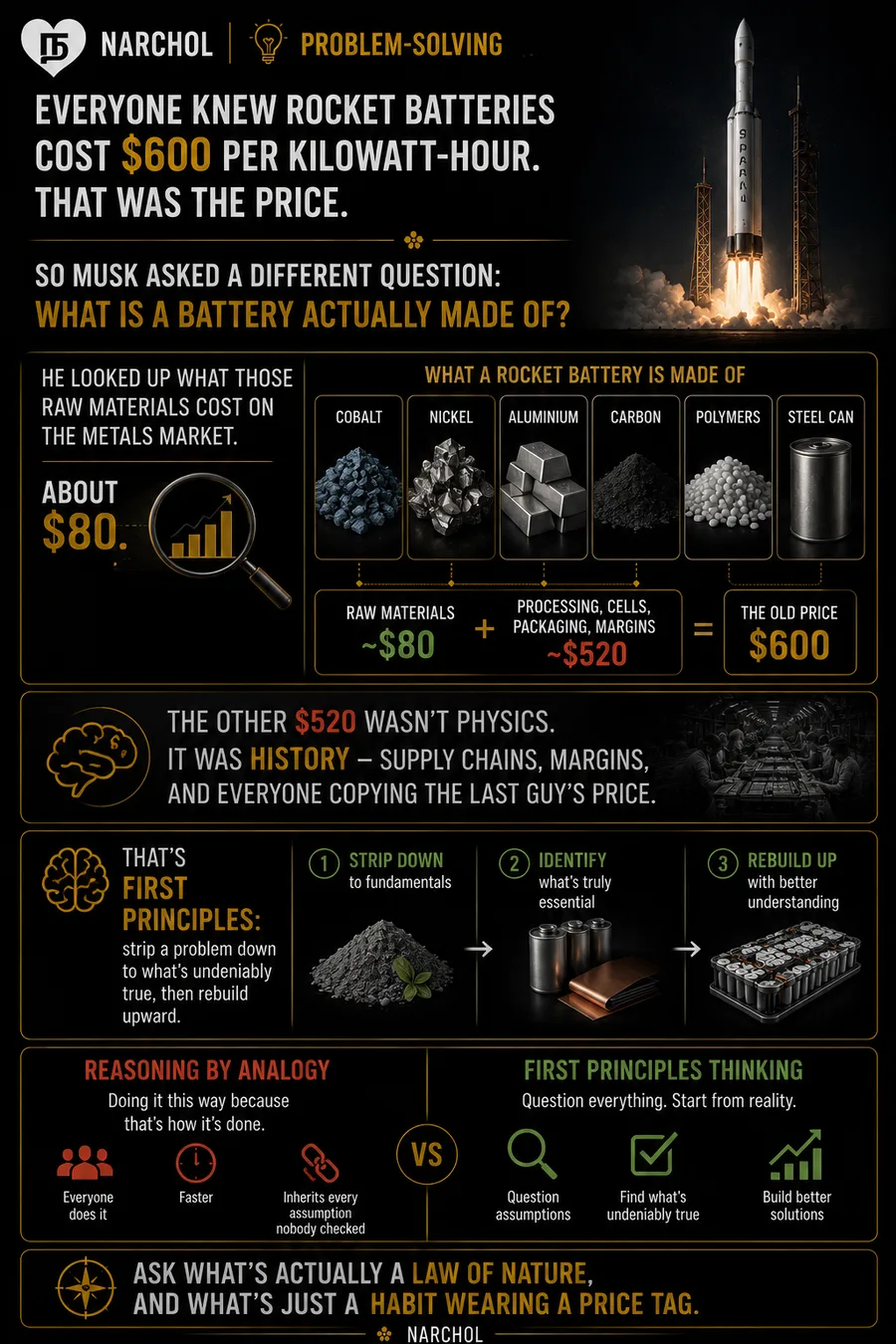
Rocket batteries cost $600 per kilowatt-hour. Everyone in the industry knew it, quoted it, and built their plans around it.
Musk asked a different question: what is a battery actually made of? Cobalt, nickel, aluminium, carbon, polymers, a steel can. He looked up what that basket of metals cost on the metals market and got about $80.
The remaining $520 came from supply chains, processing, packaging, margins, and a long line of people quoting the last guy's number because that was the number. History rather than physics.
First principles means stripping a problem down to what is undeniably true and rebuilding upward from there. Reasoning by analogy — doing it this way because this is how it is done — is faster, and it silently inherits every assumption nobody checked.
Most prices are part physics and part history. The useful question is which part you are paying for, and whether anyone has looked recently.