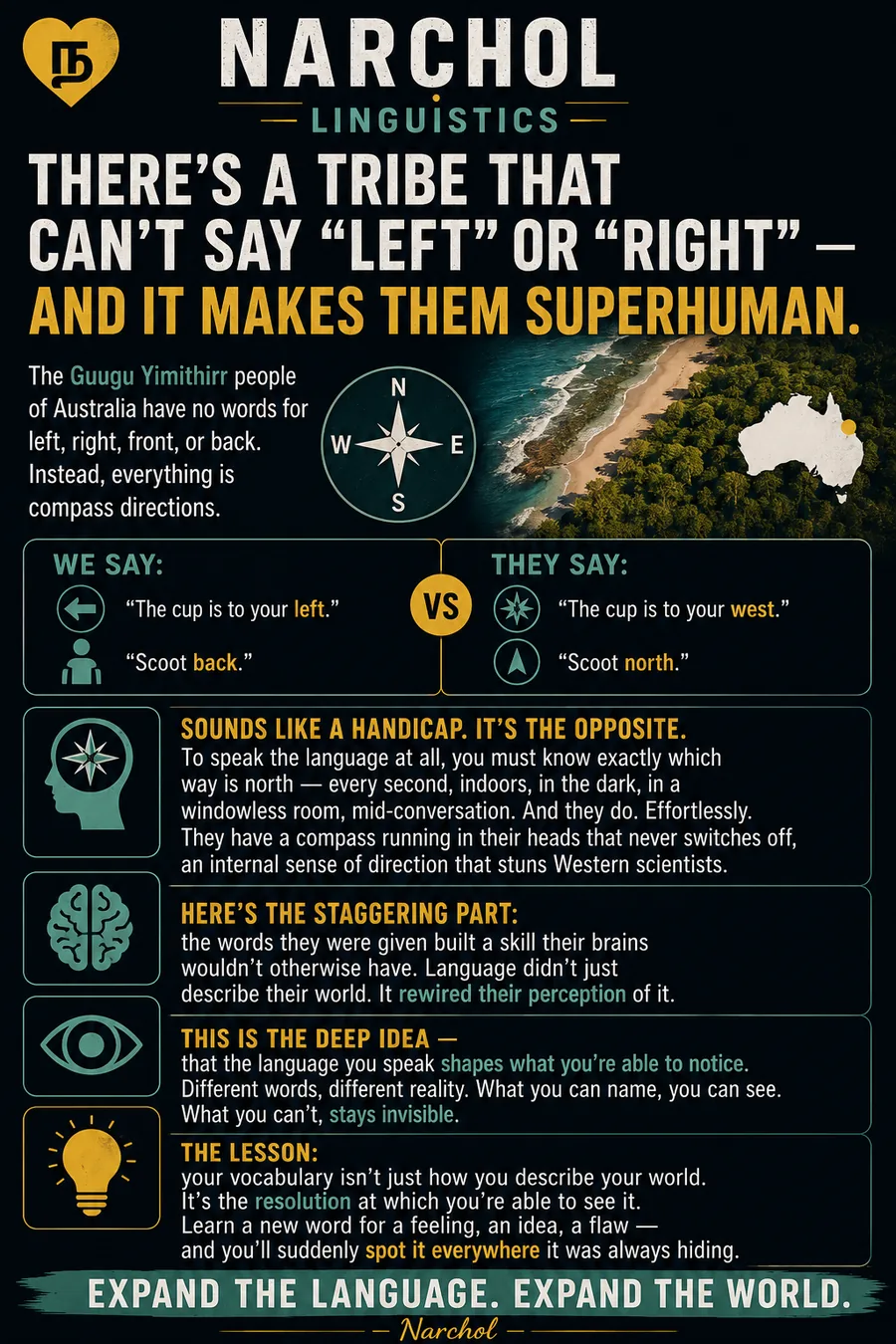
The Guugu Yimithirr people of Australia have no words for left, right, front or back. Instead, everything is compass directions.
We say "the cup is to your left" and "scoot back." They say "the cup is to your west" and "scoot north."
Sounds like a handicap. It's the opposite. To speak the language at all, you must know exactly which way is north — every second, indoors, in the dark, in a windowless room, mid-conversation. And they do. Effortlessly. They have a compass running in their heads that never switches off, an internal sense of direction that stuns Western scientists.
Here's the staggering part: the words they were given built a skill their brains wouldn't otherwise have. Language didn't just describe their world. It rewired their perception of it.
This is the deep idea — that the language you speak shapes what you're able to notice. Different words, different reality. What you can name, you can see. What you can't, stays invisible.
Your vocabulary isn't just how you describe your world. It's the resolution at which you're able to see it. Learn a new word for a feeling, an idea, a flaw — and you'll suddenly spot it everywhere it was always hiding.