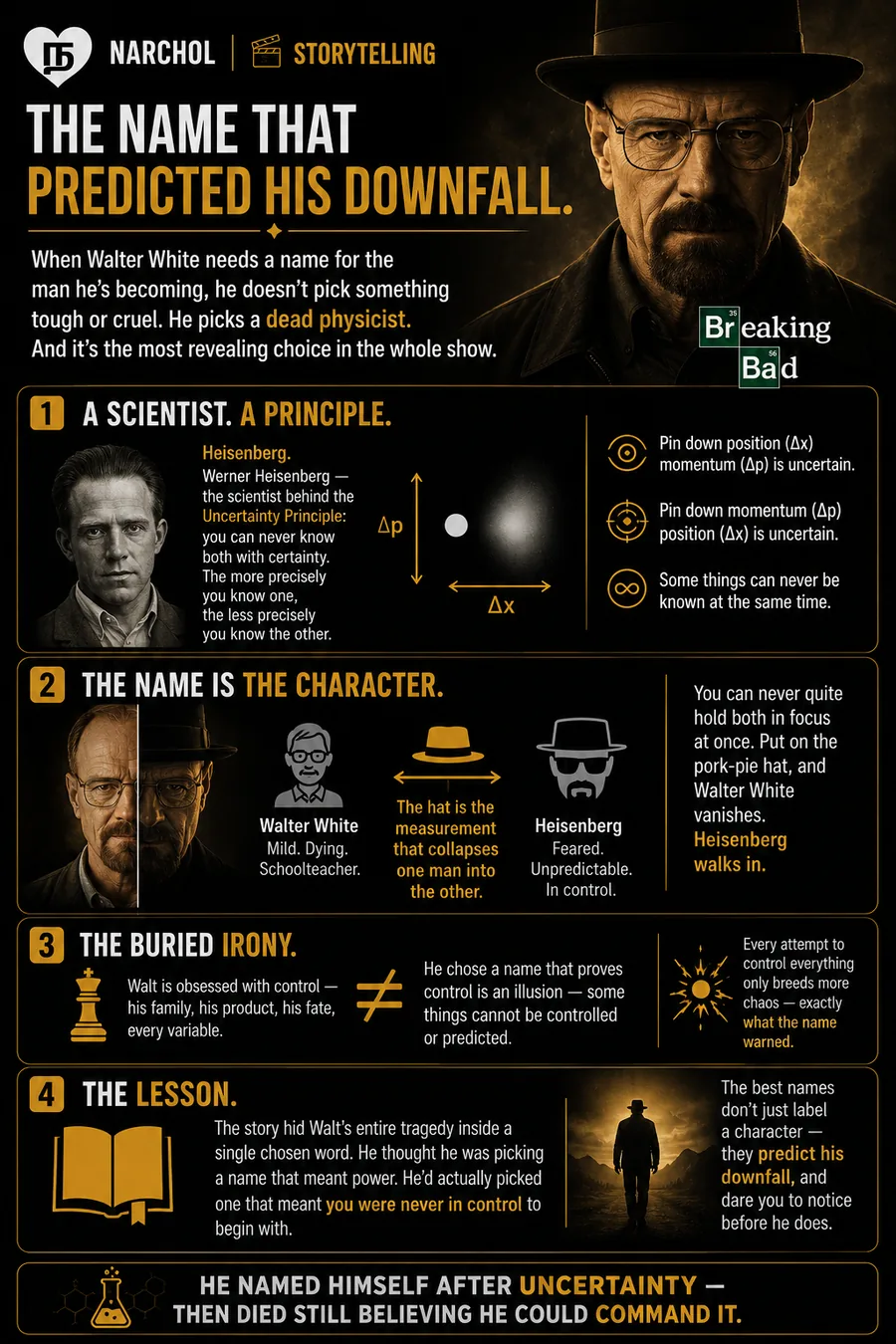
When Walter White needs a name for the man he's becoming, he doesn't pick something tough or cruel. He picks a dead physicist. And it's the most revealing choice in the whole show.
A scientist. A principle. Werner Heisenberg — the scientist behind the Uncertainty Principle: you can never know both position and momentum with certainty. The more precisely you know one, the less precisely you know the other. Some things can never be known at the same time.
The name is the character. Walter White: mild, dying, a schoolteacher. Heisenberg: feared, unpredictable, in control. You can never quite hold both in focus at once. The hat is the measurement that collapses one man into the other — put on the pork-pie hat, and Walter White vanishes. Heisenberg walks in.
The buried irony. Walt is obsessed with control — his family, his product, his fate, every variable. Yet he chose a name that proves control is an illusion, that some things cannot be controlled or predicted. Every attempt to control everything only breeds more chaos — exactly what the name warned.
The story hid Walt's entire tragedy inside a single chosen word. He thought he was picking a name that meant power. He'd actually picked one that meant you were never in control to begin with. The best names don't just label a character — they predict his downfall, and dare you to notice before he does.